

NSW police misconduct: A video went viral this week in NSW showing a police officer pushing a homeless man. Since then, it has spread rapidly across social media, drawing widespread condemnation from the public and advocacy groups.
The footage shows an NSW officer physically pushing a man who is experiencing homelessness. The clip has been viewed hundreds of thousands of times and ignited a heated debate about how police interact with society’s most vulnerable people.
O’Brien Criminal and Civil Solicitors has now issued a joint statement on the matter.
The Joint Statement On NSW Police Misconduct
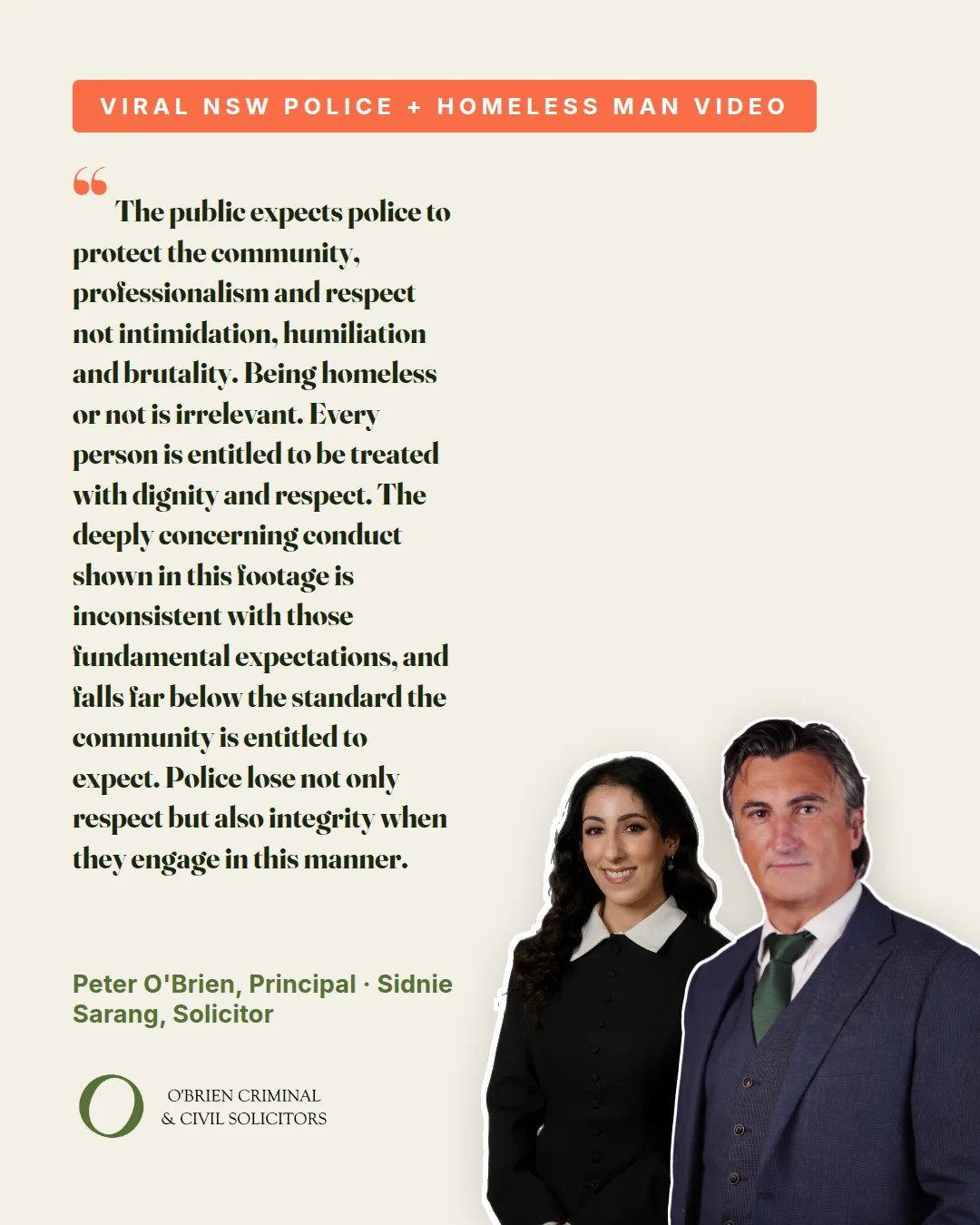
Our Principal, Peter O’Brien, and Criminal Solicitor, Sidnie Sarang, have spoken out together, sharing their opinions on the video:
“The public expects police to protect the community, professionalism and respect not intimidation, humiliation and brutality. Being homeless or not is irrelevant. Every person is entitled to be treated with dignity and respect. The deeply concerning conduct shown in this footage is inconsistent with those fundamental expectations, and falls far below the standard the community is entitled to expect. Police lose not only respect but also integrity when they engage in this manner.”
Peter O’Brien, Principal, and Sidnie Sarang, Solicitor
What Standards Are NSW Police Officers Held To?
NSW Police officers are bound by the Law Enforcement (Powers and Responsibilities) Act 2002 (NSW), commonly known as LEPRA, as well as the NSW Police Force Code of Conduct and the Police Act 1990 (NSW).
These frameworks set clear expectations around the use of force. For instance, officers may only use force that is reasonable and proportionate to the circumstances. The use of force against a person who poses no threat, and who is simply seeking shelter or rest in a public space, raises serious questions about compliance with those standards.
The NSW Police Force is also subject to oversight by the Law Enforcement Conduct Commission (LECC), which investigates serious misconduct and criminal conduct by police officers.
Being Homeless Is Not a Criminal Offence
It is important to be clear: homelessness is not a crime in New South Wales. A person’s housing situation does not alter their legal rights, nor does it justify treatment that falls below the standard owed to any member of the public.
In fact, people experiencing homelessness are often among the most marginalised in our community. They are also among those least likely to know their rights or have access to legal representation. That is precisely why conduct like that shown in this footage demands public scrutiny.
What Can You Do If You Have Experienced NSW Police Misconduct?
If you or someone you know has been subjected to excessive force, unlawful arrest, or mistreatment by police, you have legal options. These may include:
- Making a complaint to the LECC (Law Enforcement Conduct Commission)
- Lodging a complaint directly with NSW Police
- Pursuing a civil claim for assault, battery, false imprisonment, or malicious prosecution
- Seeking compensation through a claim against the State of New South Wales
O’Brien Criminal and Civil Solicitors acts for clients in claims against police across New South Wales. Our team has experience representing individuals whose rights have been violated by law enforcement, and we offer a free, no-obligation consultation to discuss your situation.
Contact O’Brien Solicitors For NSW Police Misconduct Matters
If you have experienced police misconduct or believe your rights have been violated, contact our team today.
Call us on (02) 9261 4281 or email .

Peter O'Brien is the Principal Solicitor of O'Brien Criminal & Civil Solicitors and Australia's leading expert in intentional torts litigation, with over 25 years of experience securing landmark victories in malicious prosecution and unlawful imprisonment cases. Author of Intentional Tort Litigation in Australia and recipient of the Law Council of Australia President's Medal, Peter has achieved record-breaking compensation for clients and is widely recognised for his unwavering commitment to access to justice.