
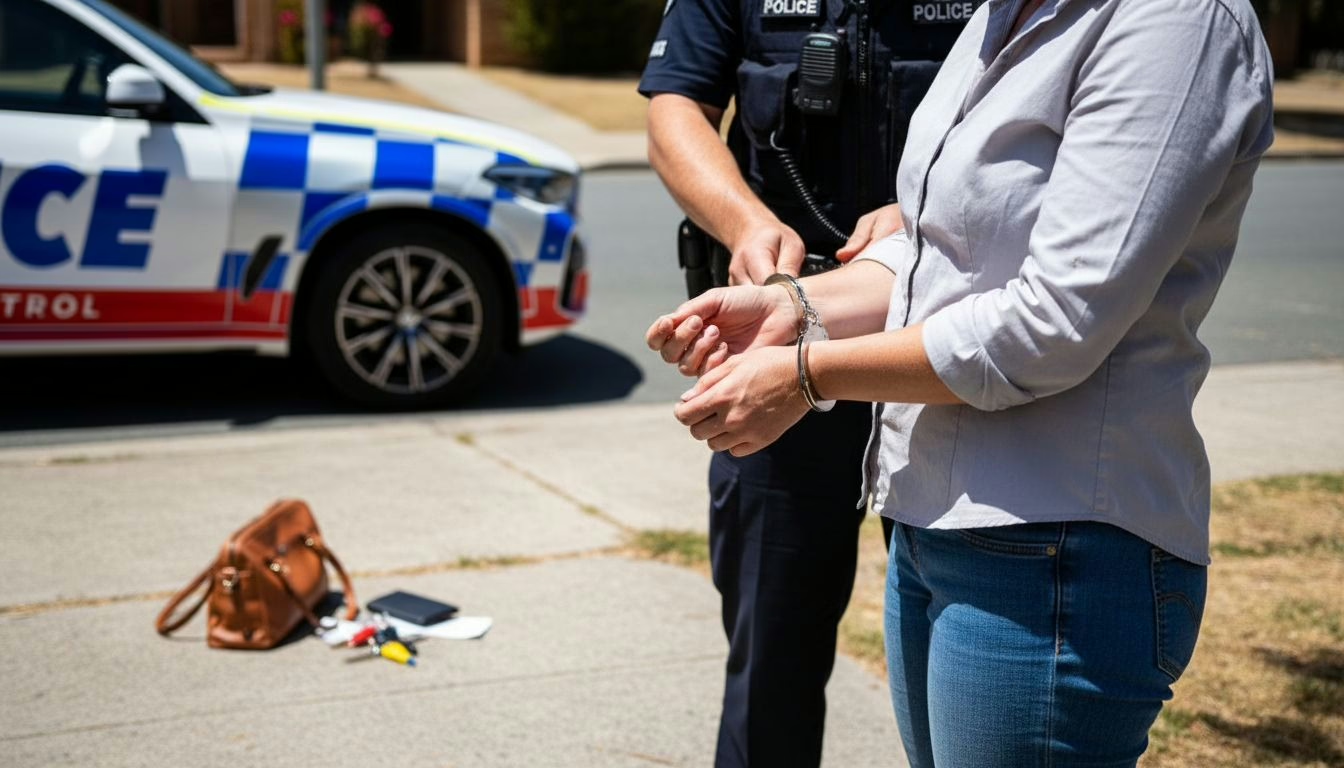
Suing NSW Police: A Four Corners investigation broadcast this week has put NSW police misconduct back under a national spotlight, and the details are deeply troubling. The case of Brad Kellson, a man who spent four days in intensive care after being kneed five times in the ribs by a police officer at Blacktown Police Station, raises serious questions about the use of excessive force, the integrity of police investigations, and the adequacy of oversight mechanisms in NSW.
At O’Brien Criminal & Civil Solicitors, we represent people who have been assaulted, unlawfully arrested, and seriously injured by police. The facts reported by Four Corners mirror situations we see regularly. This case is worth examining closely, both for what it reveals about systemic failures, and because it demonstrates that the civil justice system can, in the right circumstances, hold police to account.
What Happened to Brad Kellson?
On 13 November 2021, Brad Kellson, a 38-year-old man from northern NSW, was arrested by police outside a Blacktown hotel. According to the Four Corners report, the arrest was unlawful from the outset: police had no evidence at that point that Brad had committed an offence, and the arresting officer acknowledged this was an investigation into an alleged domestic violence matter without sufficient grounds to detain him.
What followed escalated quickly. At Blacktown Police Station, Brad was slammed headfirst onto a metal bench, swung across a room with what a judge later described as “enormous force,” and then, while being held down by three officers, kneed five times in the ribs by Leading Senior Constable Mark Davis. The injuries were catastrophic: twelve fractured ribs and a punctured lung. Brad was taken by ambulance to Blacktown Hospital and rushed to Westmead’s intensive care unit, where he remained for four days.
He could not work. He says the experience pushed him into deep depression and suicidal ideation.
An Unlawful Arrest: Why It Matters
Under the Law Enforcement (Powers and Responsibilities) Act 2002 (NSW) (LEPRA), police must have reasonable grounds to arrest a person. If those grounds do not exist, the arrest is unlawful, and every act of force that follows from that unlawful arrest may also be unlawful.
In Brad’s case, the Magistrate found that the initial arrest lacked legal justification. That single finding had significant consequences: it meant the entire chain of events that followed, including the use of force at the station, occurred outside the boundaries of lawful police action.
This is a principle we rely on regularly in civil claims against NSW Police. An unlawful arrest does not merely entitle a person to walk free, it may also ground claims for false imprisonment, assault, and battery under civil law.
The Cover-Up: Collusion And False Evidence
Perhaps more disturbing than the assault itself is what allegedly happened after it. According to the Four Corners report, officers emailed each other their statements before finalising them, a breach of police rules designed to prevent collusion. Two statements, including one from Senior Constable Davis, contained identical paragraphs and even the same spelling mistake: “let go off my leg.”
Magistrate Debra Maher found there had been “clear” and “deliberate” collusion between officers. She found that Davis had not given truthful evidence about his statement, and that his conduct during the arrest served to “inflame and escalate a situation that was relatively under control prior to his interventions.”
On appeal, District Court Judge Stephen Hanley SC went further:
“The police in the matter attempted to ‘patch up’ their case … by resorting to collusion and false evidence. I can only infer this was to avoid an adverse finding against the police who brutally assaulted [Brad Kellson].”
Despite these findings, NSW Police’s internal investigation cleared all officers of dishonesty. The only consequence reported was unspecified “management action”, which can range from a demotion to a counselling session.
Senior Constable Davis remains a serving police officer.
Oversight Failures: The LECC Was Never Told
There is a requirement under NSW Police policy that when a court makes “adverse comments” about police conduct, including findings of collusion or dishonesty, those comments must be reported to the Law Enforcement Conduct Commission (LECC), the independent oversight body for NSW Police.
According to Four Corners, NSW Police failed to report the adverse comments of both Magistrate Maher and Judge Hanley SC to the LECC. The LECC only became aware of the matter independently, at which point a further internal investigation was launched, and again cleared all officers of dishonesty.
This kind of oversight failure is not an anomaly. It reflects a structural problem: the primary accountability mechanism for NSW Police misconduct relies, in significant part, on NSW Police themselves identifying and reporting conduct that reflects poorly on the force.
The Numbers Behind the Pattern
The Brad Kellson case is not an isolated incident. According to NSW Police’s own figures cited in the Four Corners report, public complaints about officers have increased by nearly 70 per cent over the past decade, from 3,130 to 5,248 complaints per year, despite officer numbers falling by around 4 per cent over the same period.
Of the roughly 1,000 misconduct findings recorded annually through internal investigations over the five years to 2024, only 2 per cent resulted in criminal charges being laid against an officer. That is approximately 20 officers per year, across the entire state.
In the last financial year, NSW Police paid out $40 million in settlements and legal costs to people who had sued over alleged officer misconduct. That is 478 civil suits, roughly two every working day. Most were settled confidentially, with no public admission of wrongdoing, and no mechanism for the community to know whether the same officers are repeatedly named.

Suing NSW Police: The Mechanism That Proved Most Effective
Brad Kellson’s criminal charges were either withdrawn or dismissed. The officers who assaulted him were not criminally charged. The internal investigation cleared them.
It was the civil justice system, not the internal complaints process, not the LECC, that ultimately delivered accountability. Brad sued the State of NSW and received a significant financial settlement.
That outcome is consistent with what we see in practice. Civil claims against NSW Police are one of the most effective tools available to people who have been subjected to excessive force or unlawful arrest. They operate independently of criminal proceedings and internal investigations, they are assessed on the civil standard of proof, and they can result in substantial compensation for physical injury, psychological harm, lost income, and breaches of your rights.
If you or someone you know has been subjected to excessive force, an unlawful arrest, or police misconduct in NSW, it is worth understanding what your options are.
What You Can Claim Against NSW Police
A civil claim against the State of NSW may be available where:
- You were arrested without reasonable grounds or without being told the reason
- Force was used against you after you had stopped resisting or were already restrained
- You were physically injured, including rib fractures, soft tissue injuries, or psychological harm, as a result of police conduct
- You were held beyond the legally permitted investigation period
- You were denied access to a lawyer, water, or medical attention while in custody
- Officers gave false evidence or colluded in statements used to prosecute you
Claims can include compensation for pain and suffering, lost income, medical expenses, and psychological injury, as well as aggravated and exemplary damages where conduct was particularly serious or involved deliberate dishonesty.
Act quickly. CCTV footage is routinely overwritten within 30 days. The general limitation period for civil claims is three years from the date of the incident. The sooner you speak to a specialist solicitor, the better your prospects of preserving the evidence you need.
Talk to Our Civil Law Team About Suing NSW Police
At O’Brien Criminal & Civil Solicitors, we regularly act for clients across New South Wales who have been assaulted, falsely arrested, or seriously harmed by police. We are a nationally recognised firm with deep expertise in suing NSW Police for excessive force, false imprisonment, and police misconduct.
📞 Call us on (02) 9261 4281

Peter O'Brien is the Principal Solicitor of O'Brien Criminal & Civil Solicitors and Australia's leading expert in intentional torts litigation, with over 25 years of experience securing landmark victories in malicious prosecution and unlawful imprisonment cases. Author of Intentional Tort Litigation in Australia and recipient of the Law Council of Australia President's Medal, Peter has achieved record-breaking compensation for clients and is widely recognised for his unwavering commitment to access to justice.