
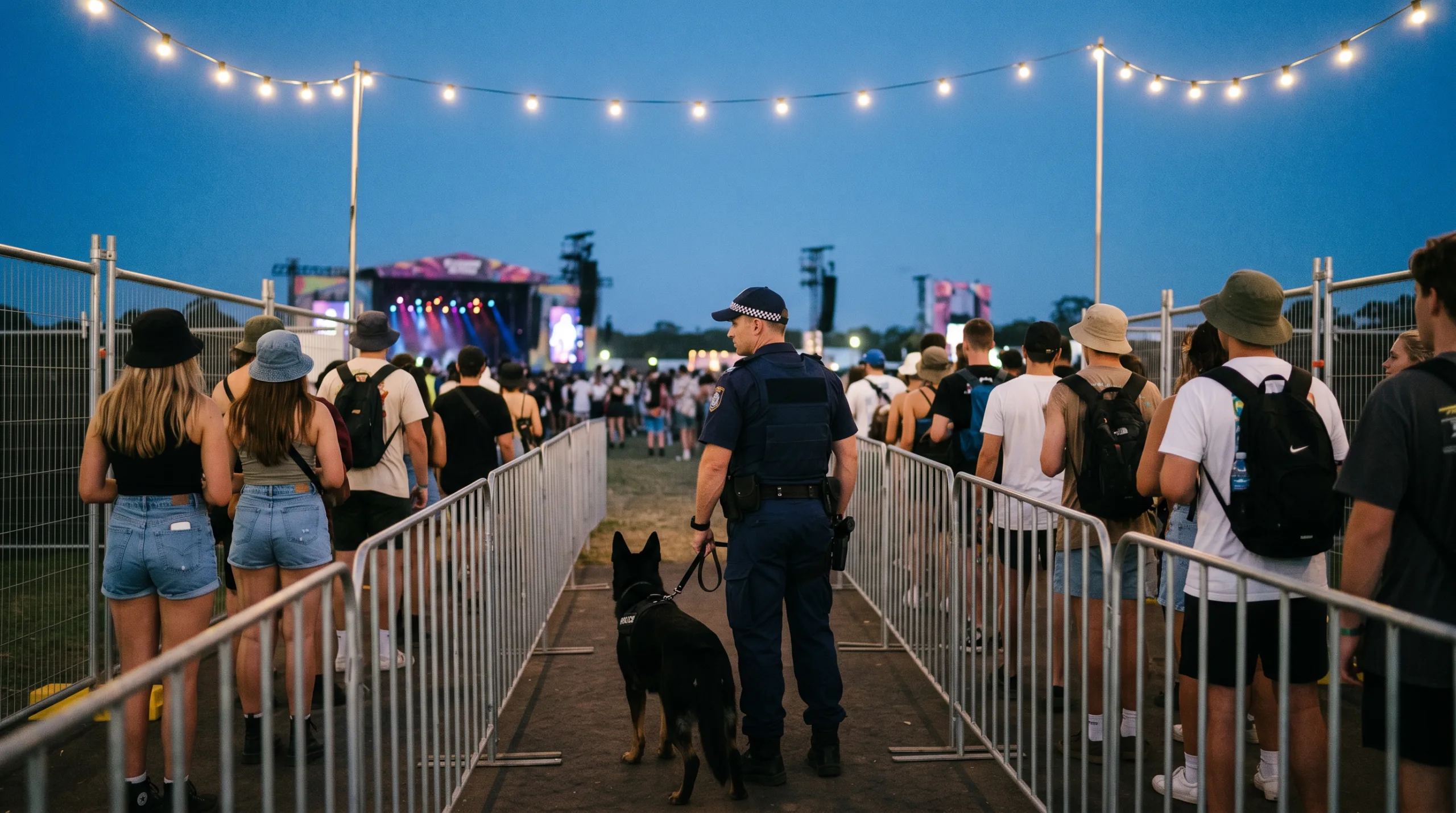
For years, plenty of festivalgoers walked away from a drug dog sit-down assuming they had no choice. Hand over your ID, follow the officer to the tent, take your clothes off if told to. Many believed that once a dog “indicated,” a strip search was simply what happened next.
In September 2025, the NSW Supreme Court said otherwise, and in blunt terms. A drug dog’s interest in you is not, on its own, a lawful basis for a strip search. Justice Dina Yehia found that NSW Police had been running these searches “on an industrial level” at festivals, “with little or no regard to the legislative safeguards” that were supposed to be stopping exactly this.
That finding didn’t just vindicate one festivalgoer. It confirmed what critics have argued for a decade: a lot of what people assumed was “the law” at festivals was actually a myth. Here’s what the case actually decided, and what the law says now that the State is appealing.
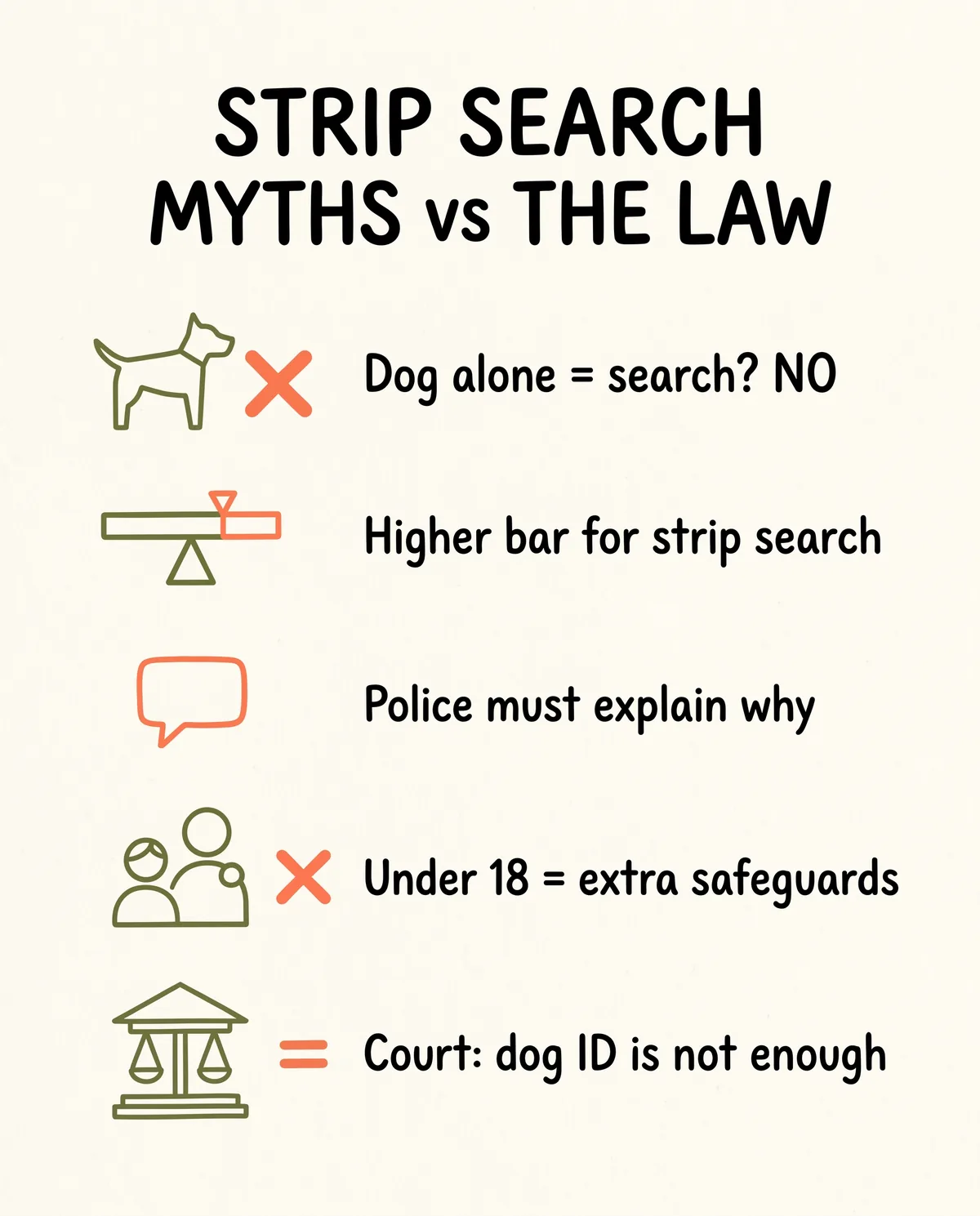
Myth: A Drug Dog Sitting Next To You Is Enough For Police To Strip-search You
The reality: it isn’t, and the Supreme Court has now said so directly.
In Meredith v State of New South Wales (No 5) [2025] NSWSC 1133, the lead plaintiff, Raya Meredith, was strip-searched at a music festival after a drug dog showed interest in her. She was never found with drugs.
Justice Yehia ruled the search unlawful under s 31(b) of LEPRA and awarded her $93,000 in damages, with exemplary damages found owed but not yet quantified. The Court found that indications by drug dogs and a suspicion of drug possession are, on their own, insufficient to justify a strip search.
More than 3,000 other people have registered as group members in the same class action, covering incidents between July 2016 and July 2022. The State of NSW has since lodged an appeal.
A dog’s nose is a tool for suspicion, not a substitute for the law’s actual test.
Myth: Any “Reasonable Suspicion” Is Enough To Justify Taking Someone’s Clothes Off
This is the reality: strip searches sit behind a higher bar than an ordinary search.
The Law Enforcement (Powers and Responsibilities) Act 2002 (NSW) (“LEPRA”) sets different tests for different kinds of searches.
For example, an ordinary search, like a pat-down or a look through your bag, can happen under s 21 where police reasonably suspect you’re carrying drugs, a weapon, or stolen goods.
A strip search is a different power. Under s 31, police need reasonable suspicion the search is necessary, and, critically, away from a police station. Also, they need the “seriousness and urgency of the circumstances” to justify it. That second limb is the one Justice Yehia found NSW Police had been treating as optional.
| Search type | LEPRA section | Threshold |
|---|---|---|
| General search (pat-down, bag check) | s 21 | Reasonable suspicion of drugs, weapons, or stolen goods |
| Search on arrest | s 27–28 | Reasonable suspicion of something linked to the offence or a safety risk |
| Strip search (at a police station) | s 31 | Reasonable suspicion the strip search itself is necessary |
| Strip search (anywhere else, e.g. a festival) | s 31 | Reasonable suspicion plus the seriousness and urgency of the circumstances |
The bar isn’t low even for an ordinary search. In R v Rondo, the NSW Court of Criminal Appeal held that reasonable suspicion needs a factual basis, “more than a possibility.” A drug dog’s reaction alone barely reaches a possibility, and a strip search demands more still: reasonable suspicion plus the seriousness and urgency of the circumstances. Now, a dog’s nose doesn’t get police over either line by itself.
Myth: If Police Tell You To Strip, You Just Have To Do What They Say
The reality: even where a strip search is lawful, LEPRA sets firm rules for how it has to happen. Those rules exist precisely because people assume they have no rights once the search starts.
Under s 32, an officer has to tell you, as far as it’s reasonably practicable, that you’ll be asked to remove clothing and why. Under s 33, the search has to happen somewhere private, out of view of anyone of the opposite sex, and without unnecessary touching. Body cavity searches are never permitted under these powers.
None of this means you can physically resist a search that turns out to be unlawful; that’s a matter for a civil claim or a complaint afterwards, not a fight on the day. But knowing the rules exist is what makes it possible to challenge a search later, which is exactly what happened in Meredith.
Myth: A strip search is a strip search, whether it’s an adult or a teenager
The reality: the law treats searches of minors as a separate, more protected category, not a smaller version of the adult rules.
For a strip search of someone aged 10 to 17, or a person with impaired intellectual functioning, LEPRA requires a parent, guardian, or an independent support person to be present. Police can only skip that requirement under s 34A. This is when officers believe they reasonably suspect any delay would mean evidence is concealed or destroyed, or where an immediate search is necessary for someone’s safety. In this case, the officer has to record why they did it that way.
Below the age of 10, there’s no exception at all. Section 34 prohibits strip-searching a child under 10, regardless of suspicion or urgency.
Myth: If The State Appeals, The Ruling Doesn’t Matter Anymore
The reality: an appeal doesn’t undo a Supreme Court finding on its own, but it does mean this area of law isn’t fully settled yet.
The State has lodged an appeal, and reporting suggests its grounds go beyond the amount of damages to touch on aspects of how strip searches are conducted. Until the Court of Appeal rules, Ms Meredith’s own search, and the finding that it was unlawful, stands. For the roughly 3,000 people registered in the class action, the appeal is a key reason a full resolution is still some way off.
The case arrives against a backdrop of pressure for broader reform. NSW’s own December 2024 Drug Summit recommended scrapping drug-dog use and strip searches for suspected personal drug possession at festivals altogether. The government’s response didn’t adopt that recommendation, which is part of why the courts are currently doing the work of reining the practice in.
What This Means For You
If you’ve been strip-searched at a festival, a protest, or anywhere else in NSW, the Meredith decision matters.
- A dog’s interest, on its own, was never enough, and now there’s a Supreme Court finding that says so in plain terms.
- The safeguards around minors are strict, not procedural. If a young person was searched without a parent, guardian, or support person present, and no genuine emergency justified skipping that step, that’s a serious flag.
- A search doesn’t need to have found something to have been unlawful. Nothing being found is often the strongest sign the search shouldn’t have happened.
- If you’re facing a charge that came out of a search you think was unlawful, that question can affect your defence, separately from any civil claim over the search itself.
How O’Brien Criminal & Civil Solicitors Can Help
If you were strip-searched at a NSW festival, protest, or elsewhere and believe it wasn’t lawful, our civil team acts for people pursuing claims against NSW Police for unlawful searches, false imprisonment, and related misconduct. This is one of the select areas where we can act on a No Win, No Fee basis, assessed case by case.
No Win, No Fee arrangements are available for select practice areas and are subject to assessment. While you won’t have to pay our legal costs if your claim is unsuccessful, you may still be responsible for your opponent’s legal costs in some circumstances.
If you’re facing a charge that arose from a search you believe was unlawful, our criminal team, led by an Accredited Specialist in Criminal Law (a credential held by fewer than 6% of NSW solicitors), can assess whether that search affects your defence.
For the full legal breakdown of what makes a strip search lawful or unlawful in NSW, see our fact sheet on strip search laws in NSW.
Request initial advice (no-obligation) via the form below or call us on (02) 9261 4281.

Peter O'Brien is the Principal Solicitor of O'Brien Criminal & Civil Solicitors and Australia's leading expert in intentional torts litigation, with over 25 years of experience securing landmark victories in malicious prosecution and unlawful imprisonment cases. Author of Intentional Tort Litigation in Australia and recipient of the Law Council of Australia President's Medal, Peter has achieved record-breaking compensation for clients and is widely recognised for his unwavering commitment to access to justice.