
This article refers to Aboriginal and Torres Strait Islander people who have died. It is shared with respect for their families and communities.
A person who is arrested, remanded, or sentenced does not lose the right to come home alive. That principle is being tested in New South Wales right now.
Last October, the NSW State Coroner Teresa Harding confirmed that 12 First Nations people had died in custody across the state so far that year. Harding described it as a “profoundly distressing milestone” and the highest number recorded in a single year.
Nationally, the picture is no better: the Australian Institute of Criminology recorded 33 Aboriginal and Torres Strait Islander deaths in custody in 2024-25, the most since 1979-80.
Behind each of those numbers is a question the criminal law is supposed to answer: was anyone responsible, and if so, what happens to them? A local activist recently asked us to help draw attention to how often that question goes unanswered. This is our attempt to explain the criminal side of deaths in custody in NSW, plainly.
How many people are dying in custody in NSW?
The short answer is more than at almost any point since records began, and the trend is going the wrong way.
Across Australia in 2024-25 there were 113 deaths in custody: 90 in prison, 22 in police custody or custody-related operations, and one in youth detention. Of those, 33 were Aboriginal or Torres Strait Islander people. In NSW, the State Coroner put the 2025 First Nations toll at 12, the worst single year on record.
The toll has not eased in 2026. In late July, Corrections Victoria confirmed the death of an 18-year-old woman at the Dame Phyllis Frost Centre in Melbourne, a death now before the coroner. It is not for us to pre-empt what that investigation will find. However, the frequency alone, death after death across the country, is what keeps families and advocates asking why the system is not changing.
Aboriginal people are grossly over-represented among people in prison in the first place. In 2024-25 they made up around 37% of the national prison population. What the latest data does not show is a higher death rate once a person is inside: Aboriginal people accounted for 29% of prison-custody deaths, below their 37% share of the prison population.
That distinction matters. The crisis is not that prison is more lethal per Aboriginal inmate. It is that far too many Aboriginal people are being locked up at all, which is exactly what the 1991 Royal Commission into Aboriginal Deaths in Custody found more than three decades ago. Over-incarceration is the engine. The deaths follow from it.
How a death in custody can lead to charges
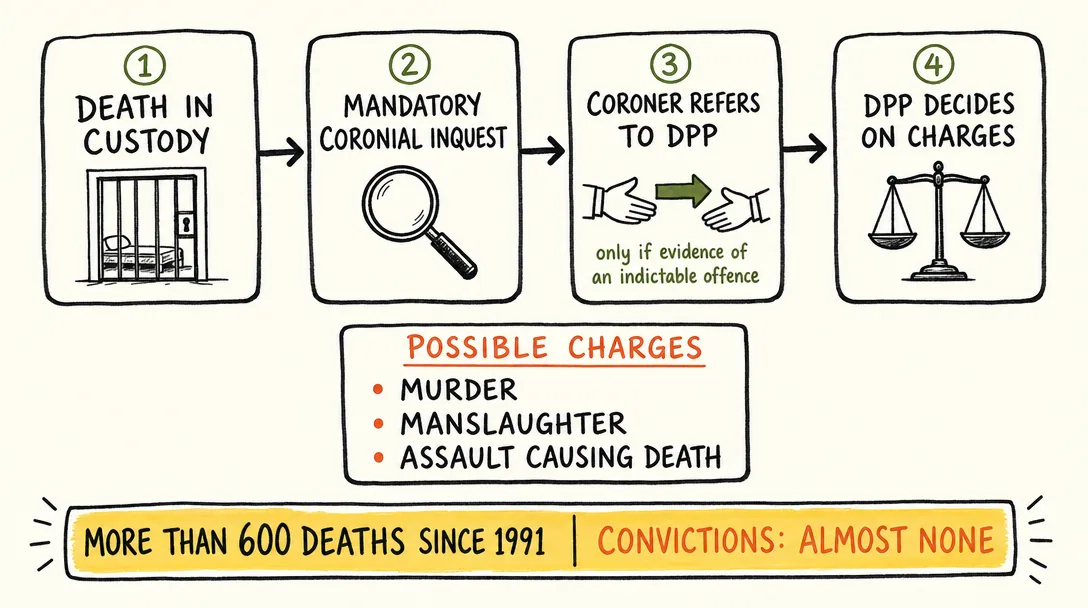
Every death in custody in NSW triggers a mandatory coronial inquest. Under the Coroners Act 2009 (NSW), a coroner must investigate any death that happens in custody or during a police operation. The family does not have to request it, and it cannot be waived.
A coroner cannot convict anyone. Instead, their job is to find out how a person died, not to lay blame. However, the inquest is often the pathway to a charge.
If, during the inquest, the coroner forms the view that a known person may have committed an indictable offence connected to the death, the coroner must suspend the inquest and refer the matter to the Director of Public Prosecutions. From there, it is the DPP that decides whether to lay charges, and a court that decides guilt. The coroner’s referral is the door. It is not the verdict.
This is why coronial representation matters so much for families. The inquest is usually the only forum in which the circumstances of a death in custody are examined in detail, and it is where the evidence that might support a charge either surfaces or does not.
Here is the uncomfortable truth the numbers point to. Deaths in custody are common, but criminal charges against those responsible are vanishingly rare.
Since the Royal Commission handed down its findings in 1991, more than 600 Aboriginal and Torres Strait Islander people have died in custody. The number of officers convicted over any of those deaths is, on the public record, effectively zero.
Deaths in Custody in NSW: The human cost families carry
The criminal-law questions do not exhaust the harm. A few months ago we worked with the same activist to highlight how prison visit cancellations were cutting families off from people who had been charged but not convicted, and were awaiting trial.
Those two issues are connected. A system that struggles to hold anyone accountable when a person dies in custody is the same system that too often forgets the people inside are somebody’s family. You can read our earlier coverage of the prison visit cancellations at Silverwater for more on that.
A note from Peter O’Brien
“People dying in custody should stop the state in its tracks. Every one of these deaths happened to someone the state had taken responsibility for, and yet more than thirty years after the Royal Commission we still see far more inquests than we ever see charges.
Behind each figure is a family who wants a simple thing: an honest account of how their loved one died, and accountability where the evidence supports it. Until governments treat over-incarceration as the root cause, and until deaths in custody are investigated with genuine independence, we will keep having this conversation, and families will keep being the ones forced to demand answers.”
Facing Time In Custody?
If you or a family member is facing time in custody, your safety and your rights while inside are not things you sign away at the prison gate. You do not have to navigate this alone.
For people facing charges or time in custody, our criminal defence lawyers can help you understand the charge against you.
Request initial advice (no-obligation) via the form below or call us on (02) 9261 4281.

Peter O'Brien is the Principal Solicitor of O'Brien Criminal & Civil Solicitors and Australia's leading expert in intentional torts litigation, with over 25 years of experience securing landmark victories in malicious prosecution and unlawful imprisonment cases. Author of Intentional Tort Litigation in Australia and recipient of the Law Council of Australia President's Medal, Peter has achieved record-breaking compensation for clients and is widely recognised for his unwavering commitment to access to justice.