
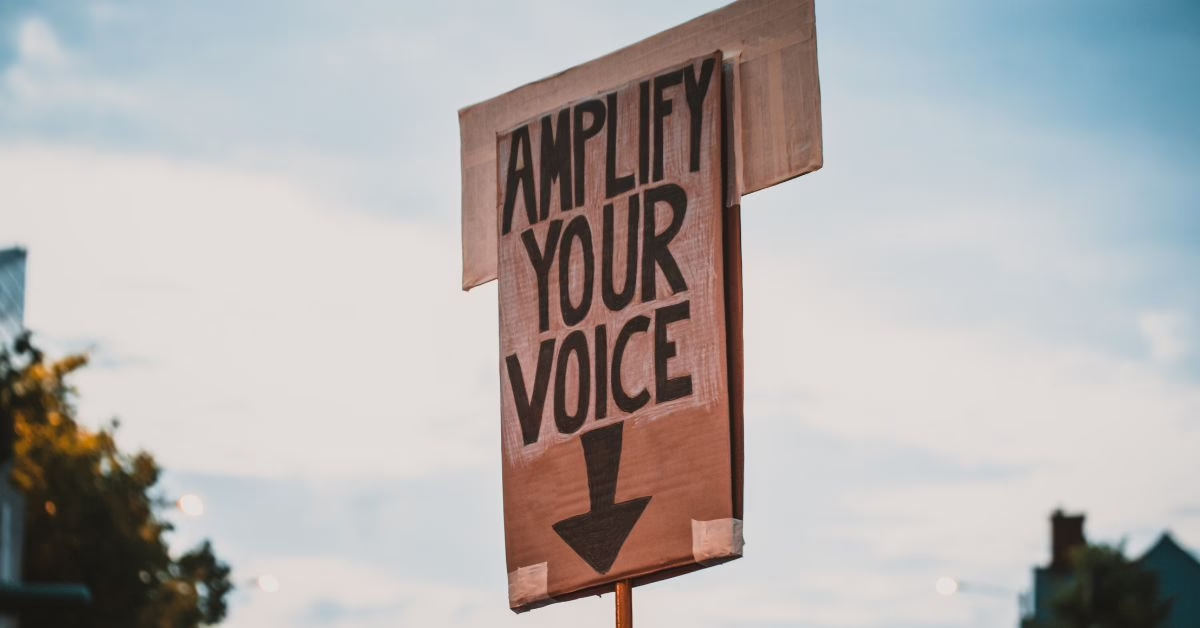
NSW Public Assembly Restriction Declaration: The NSW Court of Appeal has declared invalid a set of amendments associated with the Public Assembly Restriction Declaration (PARD) regime. This particular regime had expanded the NSW Police Commissioner’s power to restrict assemblies in designated areas across the state.
On 16 April 2026, a three-judge bench of the NSW Court of Appeal held that specific amendments made by the PARD-related legislation to the Terrorism (Police Powers) Act 2002 (NSW), the Law Enforcement (Powers and Responsibilities) Act 2002 (NSW) and the Summary Offences Act 1988 (NSW) were invalid. Importantly, the Court’s ruling targets the amended provisions, rather than the broader body of NSW public-order law, which continues to apply.
In this article, we are going to explain what the PARD-related amendments introduced, the constitutional basis on which the Court of Appeal struck them down, and what the ruling means practically for people who have been, or expect to be, involved in assemblies in NSW. We’ll also look at how the decision intersects with ongoing civil claims against NSW Police, including the Hannah Thomas matter.
At O’Brien Criminal & Civil Solicitors, we act for clients on both sides of these matters: as criminal defence lawyers for people facing charges arising from protest activity, and as civil lawyers for people alleging police misconduct. Our view is that the Court’s reasoning is a useful clarification of constitutional limits, rather than a commentary on any particular view of public order.
What Were The PARD-Related Amendments?
The PARD-related amendments were passed in December 2025, in a period of heightened protest activity. At their core, the amendments gave the NSW Police Commissioner authority to issue a Public Assembly Restriction Declaration, a legal instrument that could prohibit assemblies and marches in designated areas for defined periods.
Under the scheme, police were empowered to:
- Designate areas, including parts of central Sydney and surrounds of certain sites, within which assemblies and marches could be restricted
- Disperse gatherings that occurred within a declared area, even if the assembly was otherwise lawful and non-violent
- Arrest participants who remained in, or approached, a declared area in breach of a direction
- Issue move-on directions carrying criminal consequences for non-compliance
The amendments also altered existing offences relating to obstruction and public order, and adjusted search and detention powers under LEPRA in the context of declared areas.
The NSW Government had defended the amendments as a public-safety measure. Legal professional bodies and community groups argued that the scheme went further than was necessary to address legitimate public-order concerns, and that it was incompatible with the implied freedom of political communication in the Australian Constitution.
Who Brought The Challenge?
The challenge was filed with the NSW Court of Appeal on 7 January 2026 by three plaintiffs:
- Elizabeth Jarrett, from the Blak Caucus
- Josh Lees, from the Palestine Action Group
- Paul Silva, also from the Blak Caucus
Their case was that the PARD-related amendments placed an unjustified burden on political communication in a manner that fell outside the legislative power of the NSW Parliament. The plaintiffs also sought costs, which the Court ordered the State of NSW to pay.
Why Did The Court Of Appeal Declare The Amendments Invalid?
The implied freedom of political communication is a well-established constitutional doctrine derived from the text and structure of the Commonwealth Constitution. Stretching back to Lange v Australian Broadcasting Corporation (1997) 189 CLR 520 and refined through decisions including McCloy v New South Wales [2015] HCA 34, the doctrine operates as a restraint on legislative power: Commonwealth and State parliaments cannot enact laws that burden political communication unless they do so for a legitimate purpose and in a reasonably appropriate and adapted way.
In its judgment, the Court of Appeal bench framed the limitation in unambiguous terms:
“When it comes to laws of this kind that restrict communication on governmental or political matters, the legislative power of the state is subject to a fundamental limitation, derived from the Commonwealth Constitution. Such a law is only valid if the burden on freedom of communication is imposed to fulfil a constitutionally legitimate purpose, and the means adopted are reasonably appropriate and adapted to achieve that purpose.”
Applying that test, the Court found that the scheme failed at the proportionality stage. The Commissioner’s power to declare restricted areas was framed in broad terms, the criteria for making a declaration lacked sufficient precision, and the scheme as enacted captured peaceful political assembly alongside conduct that might have justified a narrower measure.
Importantly, the Court did not rule that any public-assembly regulation is unconstitutional. The ruling was directed at the specific amendments as drafted, and does not disturb the legitimate public-safety objectives that such laws may pursue when drawn more narrowly.

What The Ruling Means For People Affected By The PARD-Related Amendments
The practical implications of the decision are significant for anyone who was charged, arrested, or directed to move on under the now-invalid amendments.
Existing Charges May Be Affected
Where a charge was laid in reliance on the specific amended provisions struck down by the Court, there is a serious question about whether that charge can properly proceed. Criminal defence lawyers handling matters arising from declared-area enforcement should be examining whether the prosecuting provision was one of the invalidated amendments, and making any appropriate applications.
Possible Civil Claims Against NSW Police
Where a person was arrested, detained, or subjected to force under powers that have now been declared invalid, there may be a basis for a civil claim against NSW Police. The invalidity of the enabling legislation may remove a key statutory defence, and bring the focus back onto whether the arrest, detention, or use of force was otherwise lawful under the common law and relevant statutory provisions.
Claims of this kind can include false arrest, unlawful imprisonment, assault, battery, and malicious prosecution, but whether any such claim can be made out will depend on the specific facts of each case.
Hannah Thomas Matter
As we have previously reported, our client, Hannah Thomas, is pursuing a civil claim against NSW Police following her arrest at a Sydney protest. While her claim is based on facts that pre-date the PARD-related amendments, the same underlying principles, that police must act within lawful authority and that any use of force must be proportionate, are reinforced by the Court of Appeal’s reasoning.
What Happens Next?
The NSW Government has a number of options open to it. It may choose to:
- Seek special leave to appeal the decision to the High Court of Australia
- Consider drafting more narrowly tailored public-assembly legislation that is more likely to survive constitutional challenge
Premier Chris Minns and Attorney General Michael Daley have indicated that the Government is considering its position. In the meantime, the ruling makes it harder for the State to rely on the invalidated provisions as lawful authority for arrests or directions during assemblies.
The legal framework for assemblies and public order in NSW is now effectively back to the version that existed before the PARD-related amendments, subject to any other temporary restrictions that may apply. The ordinary rules about obstruction, trespass, and the existing, unaffected provisions of LEPRA and the Summary Offences Act continue to operate.
Were You Arrested Or Charged Under The PARD-Related Amendments? Get Expert Legal Advice
The Court of Appeal’s decision may change the legal position for people affected by the invalidated provisions. Whether you are currently facing charges, were previously convicted, or were arrested, detained or moved on in a way that may no longer have lawful basis, the ruling may open up options that did not exist a week ago.
At O’Brien Criminal & Civil Solicitors, we act for clients on both sides of these matters, as criminal defence lawyers for those currently facing charges, and as civil lawyers for those considering action against NSW Police for false arrest, unlawful imprisonment, or assault. We recognise that public-assembly laws serve genuine public-safety purposes; our focus is on ensuring that the legal boundaries of police powers are properly respected in each individual matter.
If you believe you may be affected by the ruling, we encourage you to speak with us as early as possible. Limitation periods apply to civil claims, and evidence, including body-worn camera footage, may deteriorate quickly.

Peter O'Brien is the Principal Solicitor of O'Brien Criminal & Civil Solicitors and Australia's leading expert in intentional torts litigation, with over 25 years of experience securing landmark victories in malicious prosecution and unlawful imprisonment cases. Author of Intentional Tort Litigation in Australia and recipient of the Law Council of Australia President's Medal, Peter has achieved record-breaking compensation for clients and is widely recognised for his unwavering commitment to access to justice.