
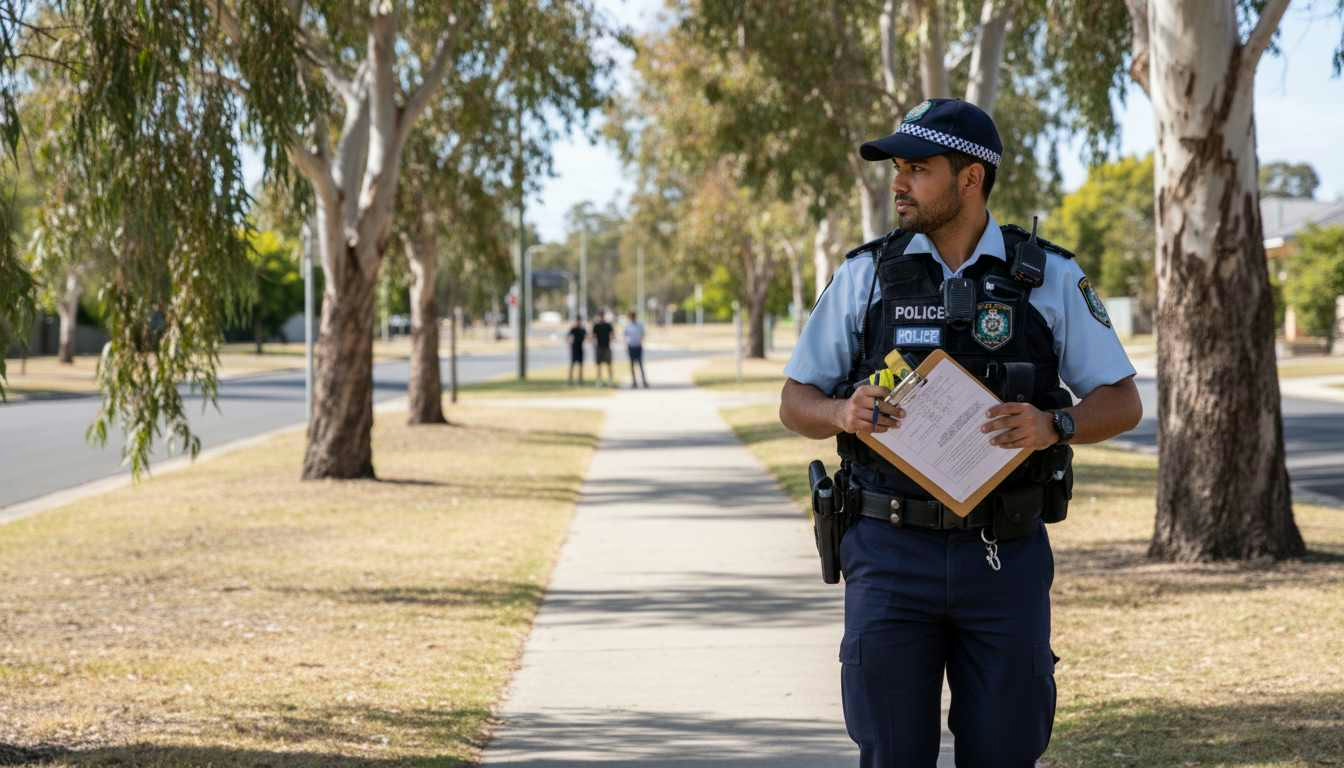
In the five years to July 2023, NSW Police killed 52 people who were experiencing mental health crises. That figure, reported by AAP following the broadcast of ABC Four Corners’ Brutal Force, has reignited a debate that practitioners in police accountability law have been having for years: when a person is in acute mental health distress, is a police response the right one?
Our Principal Solicitor, Peter O’Brien, appeared as an expert voice in Brutal Force, Australia’s landmark investigation into NSW Police misconduct. The program aired on 1 June 2026 and exposed a pattern of excessive force, cover-ups, and inadequate oversight that the 52-death statistic now places in even sharper relief.
The Statistics: What We Know
Fifty-two deaths is not an abstraction. It represents, on average, more than ten people per year, people who called for help, or who were reported as being in distress, and who did not survive the encounter with the officers sent to assist them. The figures cover the five-year period to July 2023 in NSW alone.
That period coincides with what NSW Police describes as an era of increased engagement with mental health co-responder programs, body-worn camera rollouts, and crisis intervention training. The data suggests those measures have not been sufficient.
In the same period, internal NSW Police investigations found approximately 1,000 findings of misconduct per year across the force, yet only around 2% of those cases resulted in charges against an officer. NSW Police is now the national leader in civil law payouts, paying out $40 million in civil claims last financial year alone, with approximately 478 civil suits filed in the same period.
The Case of Jodi Knott: A Symptom of a Wider Pattern
Among the cases highlighted in the weeks following the Four Corners broadcast was that of Jodi Knott, a 48-year-old woman living with schizophrenia, who was allegedly assaulted by NSW Police officers while experiencing a psychotic episode. Body-worn camera footage, broadcast nationally, showed officers kicking, stomping on, and pepper spraying Ms Knott, including, it is alleged, on her genitals.
The RANZCP’s statement renewed calls for a broader rethink of who responds to mental health crises, and under what framework. For O’Brien Criminal & Civil Solicitors, the question is not new. We have represented clients for more than two decades who were alleged victims of police force during mental health welfare checks, including in circumstances that resulted in death.
We previously published a detailed analysis of when police exceed their powers during mental health welfare checks in NSW. The concerns we raised there have only become more urgent.
Who Should Respond to a Mental Health Crisis?
In NSW, police remain the primary after-hours and emergency responders to mental health incidents in the community. Programs such as the Mental Health Intervention Team (MHIT) and the pairing of mental health clinicians with police officers in some districts have improved outcomes in certain setting, but they are not universal, and they do not apply in all emergency scenarios.
Critics, including criminologists, psychiatrists, and civil liberties groups, have long argued that a person in acute psychosis does not primarily need an armed officer. They need a clinician. The 52-death figure reinforces the argument that the current model carries an unacceptable risk for people at their most vulnerable.
Specific transparency measures called for include mandatory activation of body-worn cameras when exercising police powers (NSW remains the only state where this is not compulsory), more detailed public reporting on the outcomes of complaints against officers, and data disclosure on the settlement of civil proceedings. NSW Premier Chris Minns has pointed to existing oversight bodies as adequate, a position critics strongly contest.
Is the LECC Fit for Purpose?
The Law Enforcement Conduct Commission, established under the Law Enforcement Conduct Commission Act 2016 (NSW), is the independent body charged with oversight of NSW Police conduct. Its jurisdiction is confined to serious misconduct, leaving the vast majority of use-of-force complaints processed internally by the force itself.
Ms Higginson has called for the LECC to be granted expanded powers and more investigators to probe complaints, a position our firm has encountered repeatedly in practice. On Four Corners, Peter O’Brien described the broader failure of the current oversight system.
Public Confidence in NSW Police Is at a Decade Low
The 52-death figure and the Four Corners broadcast have coincided with a measurable decline in public trust. A recent survey by the NSW Bureau of Crime Statistics and Research (BOCSAR) found that public confidence in NSW Police has dropped to its lowest level in more than a decade. That finding matters not only politically but legally: civil claims against police have been rising steadily, and the volume of litigation reflects a community that is increasingly willing to seek accountability through the courts when internal processes fail.
Our Work: Representing Victims of Police Misconduct in Mental Health Contexts
O’Brien Criminal & Civil Solicitors has been at the forefront of civil claims against NSW Police for more than twenty years. Many of our clients are among the most vulnerable members of the community, people living with mental illness, First Nations Australians, and young people who were already in crisis when police arrived.
We are currently representing Samantha Testalamuta, a proud Wiradjuri woman living with bipolar disorder, whose alleged assault by NSW Police officers was featured in the Four Corners investigation. We are also representing Hannah Thomas, whose civil claim against NSW Police, arising from her unlawful arrest at a Sydney protest, has been the subject of significant national media coverage, including in the Sydney Morning Herald. NSW Police have conceded in court documents that Ms Thomas was a victim of battery and unlawful imprisonment.
Across our caseload, the same patterns recur: excessive force, inadequate documentation, internal investigations that exonerate the officers involved, and victims left without answers. The 52-death figure is not a statistical anomaly. It is consistent with what we have seen in practice over two decades.
Our work in this area is guided by a simple principle: the law applies equally to everyone, including those who enforce it. When police abuse their power, whether against a person in mental health distress, a protester, or anyone else, they must be held accountable through the civil courts, where evidence is tested and outcomes are public.
We offer no win, no fee arrangements in eligible police misconduct matters. If you or someone you know has experienced alleged police assault, unlawful arrest, or excessive force, including in the context of a mental health episode, we encourage you to seek legal advice as early as possible.
Contact O’Brien Criminal & Civil Solicitors
For a free, confidential initial consultation about a police misconduct matter, contact our experienced civil law team.
Call us on 02 9261 4281 or fill in the form below.

Peter O'Brien is the Principal Solicitor of O'Brien Criminal & Civil Solicitors and Australia's leading expert in intentional torts litigation, with over 25 years of experience securing landmark victories in malicious prosecution and unlawful imprisonment cases. Author of Intentional Tort Litigation in Australia and recipient of the Law Council of Australia President's Medal, Peter has achieved record-breaking compensation for clients and is widely recognised for his unwavering commitment to access to justice.