
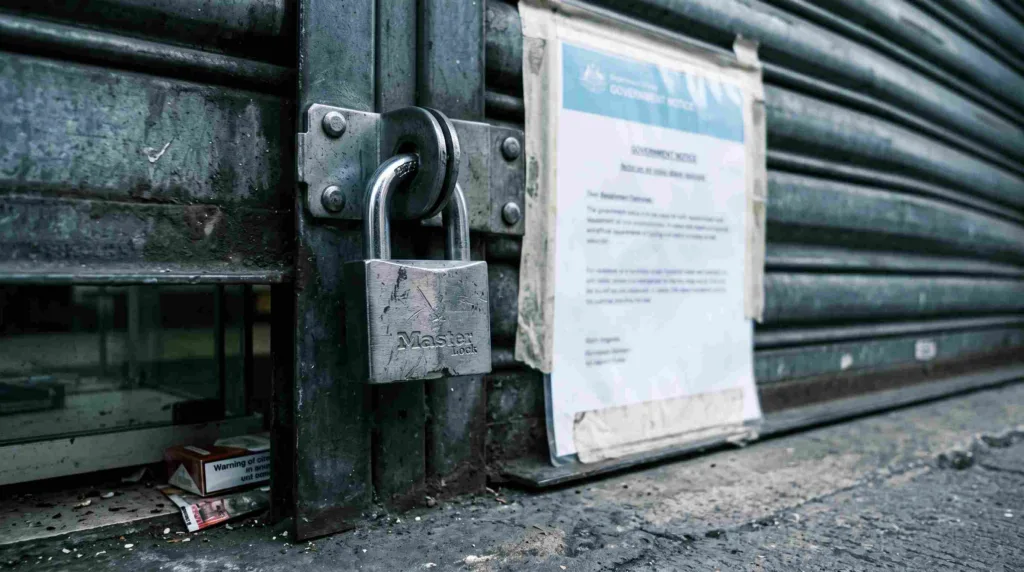
On 1 July 2026, it became a criminal offence in NSW to be a commercial landlord who knowingly lets a tenant sell illicit tobacco or illegal vapes from your building. The maximum penalty? A year in prison, a fine of $165,000, or both.
This is a big change. Before that, the legal risk in the illicit tobacco trade sat with whoever was behind the counter. Now, it reaches the person who owns the lease. This offence also sits alongside a closure order regime, which has already shut hundreds of NSW shopfronts.
Lately, the public conversation about illicit tobacco has been dominated by firebombings and organised crime. However, the enforcement that is actually happening looks quite different.
What changed and when with illicit tobacco charges in NSW
Three separate reforms have landed in NSW within twelve months, and they interact.
| Area | Before | Now |
|---|---|---|
| Selling tobacco | Retailers notified NSW Health they were selling | A licence is required for every physical and online store (scheme commenced 1 July 2025, licences required by 1 October 2025) |
| A shop caught selling illicit stock | Fines, product seizure, prosecution | Fines and prosecution, plus short-term closure orders of up to 90 days and long-term orders of up to 12 months (from 3 November 2025) |
| The landlord’s position | No direct criminal exposure | “Criminal offence to knowingly permit the premises to be used for illicit sales (from 1 July 2026), plus power to terminate a lease where the tenant has no valid licence / where a closure order is in place.” |
| Maximum penalty for selling illicit tobacco | Substantially lower | Up to 7 years imprisonment and a fine of $1.54 million |
The closure order powers came in under the Tobacco Legislation (Closure Orders) Amendment Act 2025 (No 51). However, landlord offence came in under a 2025 amendment to the Public Health (Tobacco) Act 2008 (NSW).
What does a closure order actually do?
A closure order shuts the premise, but not the business owner’s ability to trade elsewhere. Now, NSW Health can issue a short-term order of up to 90 days, and apply for a long-term order of up to 12 months.
As at 26 June 2026, NSW Health had issued 321 short-term closure orders since the power commenced on 3 November 2025. Within those, 162 are still in force.
That’s basically one shopfront closed every two and a half days over eight months.
Breaching a closure order is an offence, and this is where ordinary people get caught. Simply entering closed premises might land you with a maximum fine of $82,500 for a first offence, and $137,500 for a subsequent one.
The penalties for selling from a closed premises carry up to $137,500 or six months imprisonment for an individual on a first offence. They rise to $275,000 or a year for a second offence. Corporations face up to $1.375 million.
Therefore, a shop assistant who opens up a padlocked store because they were told to, is committing an offence. That is because the instruction does not transfer the liability.
Who is actually being prosecuted?
This is where the firebombing narrative and the enforcement reality split.
Between 1 January and 27 October 2025, NSW Health conducted approximately 1,260 retailer inspections, seized 11.8 million cigarettes and related products worth roughly $18.9 million. They also finalised 17 prosecutions which resulted in $597,200 in fines.
Seventeen finalised prosecutions against 1,260 inspections with the majority of enforcement activity being regulatory: inspection, seizure, fines and closure. The criminal prosecutions are a small subset, and they tend to involve quantity.
That matters because the offence structure is tiered by volume. A commercial quantity is defined as 2,500 cigarettes or 2.5 kilograms of tobacco, and the exposure escalates sharply from there.
| Quantity held | Maximum penalty |
|---|---|
| At least a commercial quantity, less than 10 times | 2 years imprisonment, $308,000 |
| 10 to 50 times a commercial quantity | 5 years imprisonment, $924,000 |
| 50 times a commercial quantity or more | 7 years imprisonment, $1.54 million |
Selling illicit tobacco carries the top tier penalties regardless of quantity: 7 years and $1.54 million. Illegal vaping goods attract the same maximum, whether or not the product contains nicotine.
Trading without a licence is a fine-only offence, but the fines are not small. Fines range from $660,000 for an individual and $880,000 for a corporation, with on-the-spot penalties from $5,500 to $22,000.
Importantly, the penalties above are statutory maximums. They describe the worst case the legislation permits, not the ordinary outcome, and sentences vary widely with quantity, role, criminal history and plea.
Where the violence fits in
The reason NSW moved this hard is that the illicit tobacco trade has produced arson.
NSW has seen tobacconist firebombings, bigger than those in Victoria. In February 2026, emergency services attended a fire at a business on Imlay Street in Eden on the state’s far south coast.
Two people, aged 16 and 24, were arrested in Victoria in March and the older of the two was listed to appear at Eden Local Court in April.
The NSW Government’s response has run on two tracks:
- The regulatory track is the licensing and closure order regime described above, enforced by NSW Health authorised inspectors through a newly established Centre for Regulation and Enforcement. This reaches shopkeepers, employees and now landlords.
- The criminal track sits in the Crimes Legislation Amendment (Organised and Gang-related Crime Reforms) Act 2026. This lifted penalties for firebombings and for recruiting children into criminal activity. This track reaches the crime networks.
It is easier to close a shop and fine a lessor than to prosecute a syndicate, which is reflected in the enforcement statistics.
How The Closure Orders Affect You
If you own, lease, manage or work in a retail premises that sells illicit tobacco or vaping products in NSW, your exposure has changed.
- Landlords. The offence requires that you knowingly permit the use. Awareness is the element that does the work. If you become aware of illicit sales from your premises and take no step to report it or end the tenancy, you are in the territory the offence was written for. Keeping records of what you knew and when, and of the steps you took, is now directly relevant to your criminal exposure.
- Retailers and business owners. A licence is required for every store, physical and online. Trading without one is not a technicality, and quantity is what moves an offence from a fine into imprisonment territory.
- Employees. The closure order breach offences apply to individuals. If you are told to open or trade from premises subject to an order, you carry your own liability.
- Anyone charged. The elements are more contestable than the penalty headlines suggest. Knowledge, possession, quantity and whether the product meets the statutory definition of illicit are all things the prosecution has to establish.
How O’Brien Criminal & Civil Solicitors Can Help
An illicit tobacco charge is often the first time an otherwise law-abiding business operator has faced a criminal court. The gap between a regulatory fine and a prison-range offence can turn on a single element such as quantity or knowledge.
Our criminal defence team is led by an Accredited Specialist in Criminal Law, a credential held by fewer than 6% of NSW solicitors. We act for people facing charges under NSW health and criminal legislation, including vaping and importation matters, and we can advise on where a matter genuinely sits on the offence scale before decisions are made that are hard to undo.
Request initial advice (no-obligation) via the form below or call us on (02) 9261 4281.

Peter O'Brien is the Principal Solicitor of O'Brien Criminal & Civil Solicitors and Australia's leading expert in intentional torts litigation, with over 25 years of experience securing landmark victories in malicious prosecution and unlawful imprisonment cases. Author of Intentional Tort Litigation in Australia and recipient of the Law Council of Australia President's Medal, Peter has achieved record-breaking compensation for clients and is widely recognised for his unwavering commitment to access to justice.