
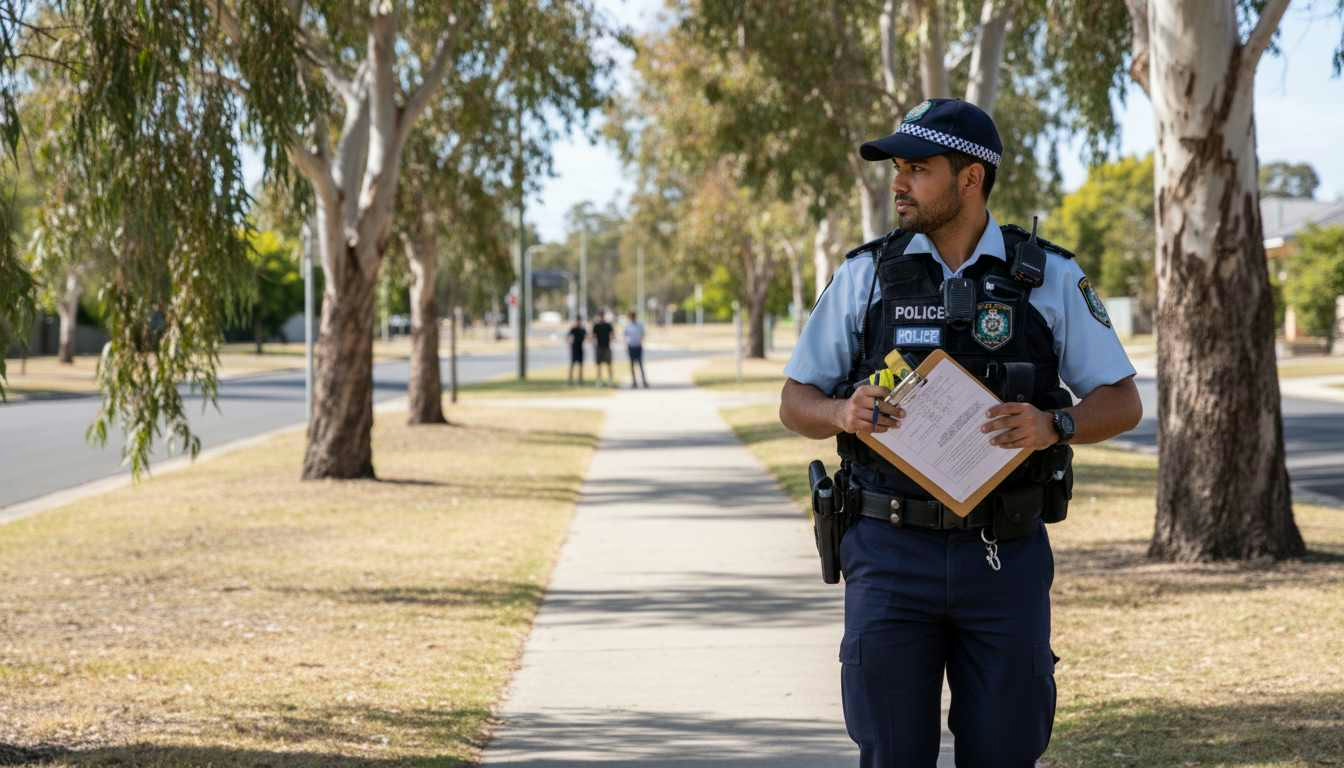
Police wanding powers commenced on 9 December 2024. Under powers modelled on Queensland’s Jack’s Law, police can use handheld scanners, electronic metal-detecting wands, to stop and scan individuals without a warrant at designated areas. The powers are contained in Part 4A of the Law Enforcement (Powers and Responsibilities) Act 2002 (NSW).
Who Can Authorise A Wanding Operation?
A senior police officer of the rank of Assistant Commissioner or above can turn on wanding powers in a designated area. This is not something a frontline constable can do unilaterally.
Read our successful Criminal Law Case Studies.
Where Can They Wand You?
Designated areas include:
- Public transport stations (including bus, train and tram stations) and their surrounds
- Public transport vehicles within two scheduled stops of a designated station
- Shopping precincts, sporting venues, pubs and clubs, and places that are part of the night-time economy
Active declarations have been made at locations including Parramatta Westfield, Blacktown Railway Station and surrounds, Sydney CBD shopping precincts, and Westfield Bondi Junction.

How Long Can A Declaration Last?
A declaration can only be in place for 12 hours, though it can be extended if the relevant criteria continue to be met. NSW Police are required to publish active declarations on the NSW Police Force website as soon as practicable after making one.
What criteria must be met before wanding can be switched on?
Wanding powers can only be activated for areas where at least one of the following has occurred in the last 12 months:
- At least one offence committed by a person armed with a knife or weapon
- At least one serious indictable offence involving violence
- More than one offence of knife possession or possession of a prohibited weapon
What must police do when wanding you?
Under section 45K of the Law Enforcement (Powers and Responsibilities) Act 2002, police conducting a scan must identify themselves and their station, activate their body-worn camera, and use the scanner in the least invasive way practicable. They must also explain why you are being stopped.
What happens if wanding detects something?
If the wand detects a metal object, you may be required to produce it. A personal search may follow under existing LEPRA powers if reasonable suspicion arises from that point.
What happens if you refuse wanding?
Failure to comply may result in a maximum penalty of a $5,500 fine. Refusal can also give police grounds to consider escalating to a full personal search under LEPRA if reasonable suspicion arises from your behaviour or the circumstances.
Results so far:
Under Operation Ares, NSW Police have conducted high-visibility wanding operations across metro and regional NSW including Sydney CBD, Liverpool, Campbelltown, Blacktown, Mt Druitt, Parramatta, Newcastle, Coffs Harbour, Dubbo, Wollongong, Wagga Wagga, Nowra, Albury and Lavington.
What You Cannot Carry In Public
The core offence, custody of a knife: Under section 93IB of the Crimes Act 1900 (NSW), it is a criminal offence to have a knife in your custody in a public place or school. The maximum penalty is 40 penalty units or imprisonment for 4 years, or both. A knife is defined under section 93IA as a knife blade or a razor blade.
Visible carrying causing fear:
Under section 93IC of the Crimes Act 1900 (NSW), a person must not use a knife, or carry a knife that is visible, in the presence of another person in a public place or school in a way that is likely to cause a reasonable person to fear for their safety. The maximum penalty is 100 penalty units or imprisonment for 4 years, or both.
Self-defence is explicitly not a defence. This is one of the most commonly misunderstood points. Section 93IB(4) makes clear that it is not a reasonable excuse for a person to have a knife in their custody for self-defence, or for the defence of another person.
Prohibited weapons, machetes and swords:
Recent reforms have moved machetes and many types of swords into the prohibited weapon category under the Weapons Prohibition Act 1998 (NSW), meaning you generally cannot possess them without a permit or specific authorisation. Possession of a prohibited weapon without the right authority is a separate and more serious category of offence under that Act.
Other prohibited knives under the Weapons Prohibition Act 1998 (NSW) include flick knives, ballistic knives, butterfly knives, push daggers, star knives, sheath knives, and knives with a double-edged blade. These cannot be purchased, possessed or carried without specific authorisation.
Selling knives to under-18s:
The Law Enforcement (Powers and Responsibilities) and Other Legislation Amendment (Knife Crime) Act 2024 made it an offence to sell a knife to anyone under the age of 18, with exemptions for retailers selling to young people who need a knife for their work or study. The maximum penalty for selling a knife to a child under 16 is an $11,000 fine and/or 12 months imprisonment.
What You Can Legitimately Carry: The “Reasonable Excuse” Defences
Carrying a knife in public is not automatically criminal if you have a lawful reason. The burden falls on you to prove that reason on the balance of probabilities. Recognised excuses under section 93IB(2)-(3) of the Crimes Act 1900 (NSW) include:
- Occupation or trade: Tradespeople, chefs, and others who require a knife as part of their work may carry one for that specific purpose.
- Recreational activities: Camping, fishing, and other activities that genuinely require a knife are recognised excuses, provided the knife is appropriate for the activity.
- Cultural or religious practice: Genuine religious observance, including the carrying of a ceremonial knife as required by Sikh practice, is a recognised reasonable excuse.
- Transit: Carrying a knife while travelling directly to or from an activity that lawfully involves it, such as driving a chef’s knife to work, can constitute a reasonable excuse.
- Retail or exhibition: Carrying a knife for purposes of retail display, organised trade exhibitions, or sanctioned knife collector events.
- Official uniform: Wearing a knife as part of an authorised official uniform.
What is not a reasonable excuse: section 93IB(4) explicitly provides that self-defence, or the defence of another person, is not a lawful excuse for carrying a knife in a public place or school.
Penalties At A Glance
| Offence | Legislation | Maximum penalty |
| Custody of knife in public/school | s 93IB Crimes Act 1900 | 4 years imprisonment and/or $4,400 fine |
| Visible carrying causing fear | s 93IC Crimes Act 1900 | 4 years imprisonment and/or $11,000 fine |
| Refusing to comply with wanding | Part 4A LEPRA | $5,500 fine |
| Selling knife to child under 16 | 2024 knife crime amendments to the Summary Offences Act 1988 (NSW) | $11,000 fine and/or 12 months imprisonment |
| Possessing a prohibited weapon (e.g. machete, flick knife) | Weapons Prohibition Act 1998 | Varies — up to 14 years for the most serious category |
Police retain discretion to issue a Penalty Infringement Notice for some lower-level knife offences under the Summary Offences Act 1988, or to lay charges under either that Act or the more serious Crimes Act provisions depending on the circumstances. The NSW Police Knife Crime factsheet provides further guidance on how these powers are applied in practice.
This article contains general information about NSW knife laws as at March 2026. It is not legal advice. Anyone charged with a knife or weapons offence in New South Wales should seek advice specific to their circumstances.
Charged With A Knife Offence In NSW? Get Legal Advice Now
O’Brien Criminal and Civil Solicitors have extensive experience defending weapons charges across NSW. If you have been stopped, searched, or charged in connection with a knife or prohibited weapon, contact us today.
📞 Call 02 9261 4281 for a free, confidential consultation
💻 Submit your enquiry online at any time

Wilson Tighe is a Senior Associate at O'Brien Criminal & Civil Solicitors, where he practises primarily in criminal defence across multiple Australian jurisdictions. He holds an LLB, a Bachelor of Arts in History, and a Graduate Diploma in Legal Practice, having completed his degrees at Charles Darwin University in 2013.