
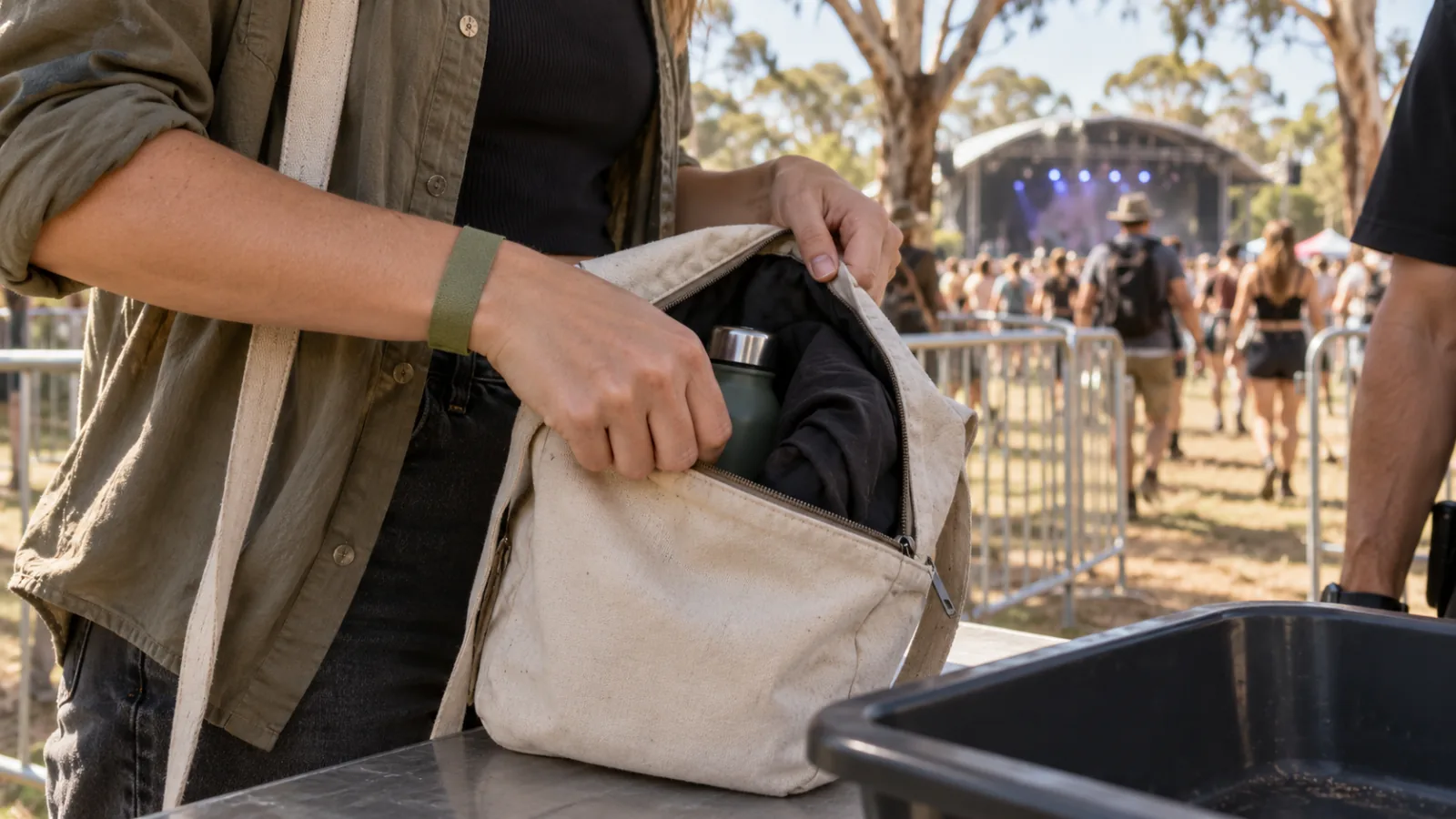
When you go to a music festival, you still have rights. Police searches, security bag checks and drug-detection dogs involve different powers. And just attending a festival does not give police unrestricted authority to search you.
If an encounter leaves you worried about a charge or how you were treated, write down what happened and get advice. In this guide, we’re going to explain the main rules for NSW events and the practical steps you can take.
At a glance: Ask who is requesting the search and why. If you do not agree to a police search, say so calmly without physically resisting. Request legal advice before answering questions about an allegation, and get medical help immediately if someone is unwell.
Can festival security search you?
Remember, security guards are not police and do not have police search powers. Security guards can ask to check your bag when entering the festival. However, you can refuse, but the venue may not let you in.
| Situation | What matters |
|---|---|
| Security entry check | Your consent and the venue’s entry conditions. |
| Police personal search | A statutory search power or valid consent, with applicable safeguards. |
| Police strip search | Additional necessity, seriousness and urgency requirements at the festival. |
| Police knife scan | A separate scanning authority and its geographical limits. |
We recommend reading the event’s entry conditions before going to the festival. If you are refused entry or directed to leave, ask who made that decision and record the reason rather than trying to force your way in.
Can police use drug-detection dogs at festivals?
Yes. Police can use drug-detection dogs at certain public places, including festivals and other entertainment events. This applies to people at, entering or leaving the event.
A dog indication does not automatically allow police to strip search you. Police still need a lawful basis for any search.
Police must keep the dog under control and take reasonable steps to stop it touching people. If it touches you, write down what happened and get legal advice.
When can the police search you or your bag?
Under section 21 of LEPRA, police can search you or your bag without a warrant if they reasonably suspect a specified circumstance, like possessing a prohibited drug. Simply attending a festival does not remove that requirement.
Police may also rely on another search power or ask for consent. You should ask for the officer’s reason for this, and if you are being required to submit to a search or asked to agree voluntarily. Those are different.
An ordinary search under section 30 can include patting outer clothing, examining belongings and requiring removal of specified outer items, including a coat, shoes or hat. A more intrusive search requires additional authority and safeguards.
If you do not agree, you can say: “I do not consent, but I will not resist.” Section 29 preserves search safeguards when consent is given. Importantly, general consent to a search is not consent to a strip search.
Police may also use metal-detecting wands under separate powers in authorised areas. Those powers can apply without individual reasonable suspicion; see our NSW knife laws and scanning guide.
What if police want to strip search you?
A strip search at a festival requires more than the grounds for an ordinary search. Under section 31(b) of LEPRA, police must reasonably suspect that it is necessary for the search’s purpose and that the seriousness and urgency of the circumstances make it necessary.
A search can count as a strip search even if you keep some clothing on, for example if clothing is moved to expose intimate areas. Police must assess the need for that level of intrusion.
The safeguards in sections 32–34 include:
- Using the least invasive practicable search and providing reasonable privacy.
- Explaining clothing-removal requirements and seeking your cooperation, as far as reasonably practicable.
- Not removing more clothing than reasonably necessary.
- Not examining body cavities or examining the body by touch during a strip search.
- Additional support-person rules for children aged 10–17 and people with impaired intellectual functioning, subject to limited exceptions.
- No strip searches of children under 10.
Tell police your age and any disability or support needs. Our strip-search fact sheet explains these safeguards, including the same-sex search rules and limits on who may be present.
What should you know about drug allegations?
Possession and supply are different offences, and supply does not necessarily involve selling drugs. The precise allegation, substance, quantity and evidence matter.
Section 10 of the Drug Misuse and Trafficking Act 1985 (NSW) creates the possession offence, subject to its exceptions. Sections 3 and 25 cover supply, which includes conduct such as distributing or offering to supply a prohibited drug.
Under section 29, possession of at least a drug’s specified traffickable quantity can be treated as possession for supply unless a statutory exception is proved. The prosecution must first prove possession of the required amount beyond reasonable doubt. The accused then bears the burden of proving an applicable exception on the balance of probabilities.
Get advice before making admissions or accepting a description of the facts. Our drug possession guide and drug supply guide cover charges, penalties and available options in more detail.
Does festival drug checking change the law?
Some NSW festivals offer an authorised drug-checking service for people aged 18 and over. Using the service does not make drugs legal or safe.
Police and drug-detection dogs may still be at festival entrances and inside the event. They do not usually patrol near the drug-checking service.
Your rights and what you can do now
Stay calm during an encounter and preserve information afterwards. A precise account is more useful than trying to settle the legal question at the festival gate.
- Ask for the officer’s name, station and reason for stopping or searching you.
- Ask whether you are free to leave. Do not walk away from a lawful detention or physically resist a search.
- Give information you are legally required to provide, but ask for legal advice before discussing an alleged offence.
- Record the time, location, witnesses, instructions, clothing removed and any explanation police gave.
- Keep your ticket, event correspondence, paperwork and original recordings.
- If you are charged, note the court date and bail conditions, and arrange legal advice promptly.
If someone becomes unwell, seek event medical staff or call 000 in an emergency. Health needs should be dealt with immediately.
How could a lawyer help your case?
A lawyer can assess a festival-related charge and whether the search that produced the evidence was lawful. They can examine police records, recordings, the drug analysis and the account of what happened before the search.
Unlawfully or improperly obtained evidence may be challenged under section 138 of the Evidence Act 1995 (NSW), but exclusion is not automatic. Depending on the facts, a lawyer may also advise about a complaint or a civil claim arising from police conduct.
For the wider rules beyond festival settings, read our police powers and your rights guide.
Frequently asked questions
Do I have to give police my name at a festival?
In some situations. Police need a legal basis to require identification; attending an event is not a universal identification duty. Ask which power applies, and do not give false details.
Can I film police?
Generally, you can film police activity observable in a public place. Do not obstruct officers or interfere with their work, and take care not to record another person’s private search. Keep the original recording if you need legal advice about the encounter.
Does finding nothing prove a search was illegal?
No. Its lawfulness depends on the grounds and safeguards that applied at the time. You can still seek advice if the grounds were unclear or you are concerned about how police searched you.
How O’Brien Criminal & Civil Solicitors can help
O’Brien Criminal & Civil Solicitors advises people facing festival-related drug charges and concerns about police searches. Our drug defence lawyers can review the allegation and explain the steps available in your circumstances.
Request initial advice (no-obligation) via the form below or call us on (02) 9261 4281.
This content is for general information purposes only and does not constitute legal advice. You should seek independent legal advice relevant to your specific circumstances.