

The ABC recently approached our Special Counsel and Head of our Defamation practice, Stewart O’Connell to get an expert view on the recent Rebel Wilson defamation case.
What happened
Actor Charlotte MacInnes, who appeared in Rebel Wilson’s directorial debut The Deb, sued Ms Wilson over a series of social media posts that Ms. MacInnes said damaged her reputation.
On Wednesday, Justice Elizabeth Raper dismissed the case in the Federal Court, finding that Ms MacInnes had not established the defamatory reputations or that the matter caused, or was likely to cause, serious harm to her reputation.
Justice Raper did find that one post conveyed an “imputation” about Ms MacInnes, but held that it was not defamatory. Lawyers for Ms MacInnes have since announced she intends to appeal. Under the rules, a notice of intention to appeal must be filed within 28 days of the judgement.
Why an appeal is no surprise
Speaking to the ABC, Mr. O’Connell said the decision to appeal was not surprising.
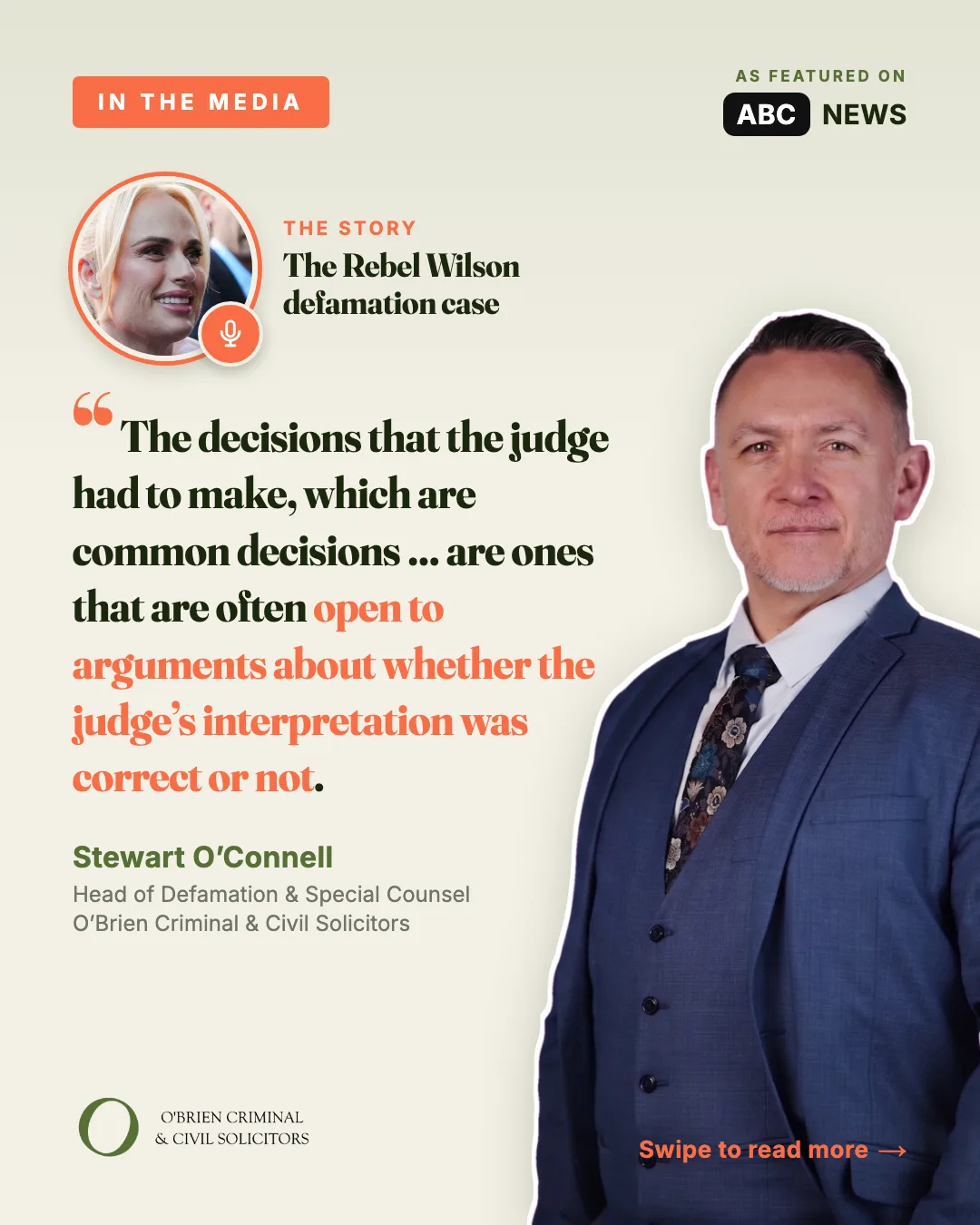
“The decisions that the judge had to make, which are common decisions … are ones that are often open to arguments about whether the judge’s interpretation was correct or not.”
In other words, defamation cases frequently turn on questions of interpretation, and interpretation is one finding an appeal court can be asked to revisit.
The three things a defamation claim must prove
There are three elements that have to be established to determine whether something is defamatory:
- The meaning of the words as they would be understood by an ordinary, reasonable person.
- That the meaning was defamatory, in the sense that it caused people to think less of the person.
- That the publication caused serious harm to reputation, with real consequences.
Mr. O’Connell noted that defamation is “very difficult to establish”, and appeals in this area are not uncommon.
What an appeal would actually involve
Mr. O’Connell explained that a defamation appeal is decided by three judges of the Federal Court, who consider whether the legal arguments are upheld.
“The judges have to decide that by trying to put themselves into the position of the ordinary reader.”
That “ordinary reasonable person” is someone “who has a fair to average intelligence and education … who’s not perverse or morbid or avid for scandal”. On appeal, Ms MacInnes would argue that this ordinary reader would have taken a different meaning from the posts than the one the trial judge found.
There are two distinct battlegrounds:
- Serious harm. It certainly may be open to Ms MacInnes to bring in more evidence on whether her reputation suffered serious harm.
- Meaning. It really comes down to how the appeal judges interpret the words used by Ms Wilson.
If the matter proceeds, Ms Wilson would still have the option of defending herself by proving the content was substantially true.
Why this matters
Defamation is one of the most technical and unpredictable areas of civil litigation. The serious harm threshold, the “ordinary reasonable person” test, and the scope to appeal on interpretation are the exact pressure points that decide these cases. It is an area of law where an experienced and excellent expert in that area is a must.
O’Brien Criminal & Civil Solicitors have the excellence and expertise in acting for people on both sides of defamation disputes. Whether you believe you have been defamed or you are defending a claim please get in touch with us. Early advice matters.
To enquire online or call (02) 9261 4281 for a free, no-obligation consultation.

Stewart O'Connell is a Special Counsel at O'Brien Criminal & Civil Solicitors, bringing over 20 years of experience in criminal defence and defamation law to the firm. He holds an LLB and a Graduate Diploma in Legal Practice. Stewart has appeared as a barrister in ten jury trials, winning nine, and represented the client who received the highest defamation award in Northern Territory Court history.
He has also negotiated significant compensation settlements in defamation matters against major media organisations, including The Sydney Morning Herald, The Daily Telegraph, The Daily Mail, 7News, and The Financial Review. Earlier in his career, Stewart spent thirteen years working with the Aboriginal Legal Services and ran the Northern Territory Legal Aid office in Katherine.
In 2000, he received the National Children's and Youth Law Centre's National Award for Aboriginal Youth Lawyer of the Year. He served as the Senior Project Officer on the Inquiry into Child Sexual Abuse in Aboriginal Communities in the Northern Territory and later represented youth clients in the Royal Commission into the Protection and Detention of Children in the Northern Territory.
Stewart has also taught Criminal Law at the Australian National University. Known for his direct, empathetic communication style, Stewart prioritises achieving the best and most efficient outcome for every client, whether through skilled negotiation or vigorous courtroom advocacy.