
Being charged with drug possession is frightening, especially if it’s the first time you’ve ever been in trouble with police. You’re probably worried about a criminal record, your job, and how one bad decision at a festival, a party, or a random search could follow you for years.
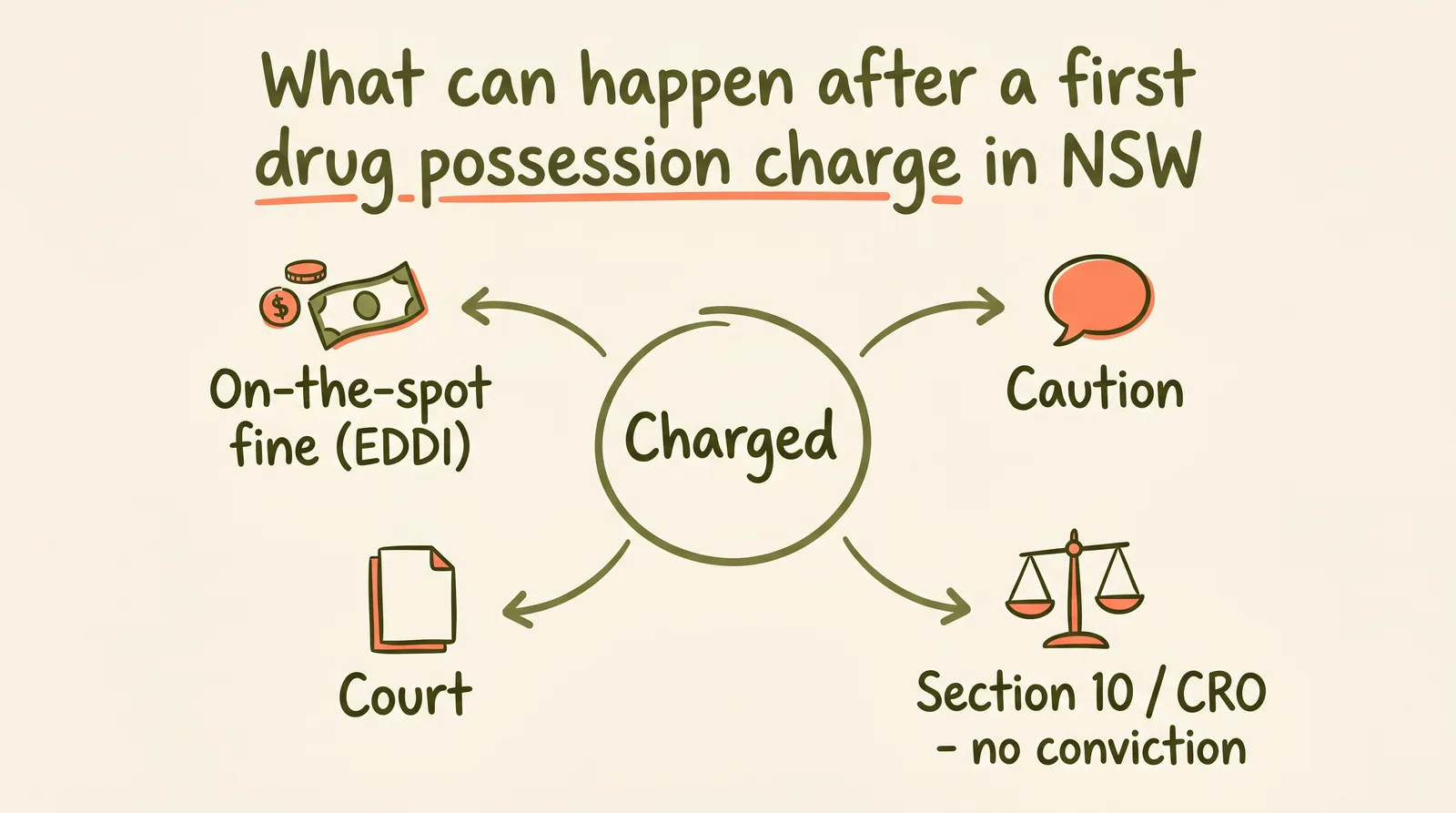
Here’s the reassuring part: for genuine first-time drug possession offences involving a small amount for personal use, the outcome is far from fixed. NSW now has several ways a possession matter can be dealt with, including on-the-spot fines, cautions, treatment programmes, and non-conviction orders, which can mean no criminal record at all.
This guide explains, in plain English, what drug possession means under NSW law, the penalties, how first-time and personal-use matters are usually handled, the diversion and caution schemes that can keep you out of court, and exactly what to do if you’ve been charged.
At a glance
- The offence: possessing a prohibited drug under section 10 of the Drug Misuse and Trafficking Act 1985 (NSW).
- Maximum penalty: 2 years’ imprisonment and/or a $2,200 fine. This is a ceiling reserved for the most serious cases, not the starting point for a first offence.
- Where it’s heard: the Local Court (it’s a summary offence).
- A criminal record is not automatic: police can issue a fine or caution instead of charging you, and courts can deal with a first offence without recording a conviction.
- The one thing to do now: don’t rush to plead guilty or admit anything. Get advice first, because your options are widest before you commit to anything.
This page focuses on possession for personal use and first offences. If your situation involves an allegation of selling or sharing drugs, that’s a much more serious charge. See our guide to drug supply versus drug possession in NSW.
What Does “Drug Possession” Actually Mean In NSW?
Possession means having a prohibited drug in your custody or control, knowing (or being reckless about the fact) that it’s there. Remember, you don’t have to own the drug. Holding it, carrying it, or having it in a bag, pocket, or your car, can all count.
Drug possession offence is set out in section 10 of the Drug Misuse and Trafficking Act 1985 (NSW), which simply states that “a person who has a prohibited drug in his or her possession is guilty of an offence”. A “prohibited drug” is any substance listed in the Act, including cannabis, cocaine, MDMA (ecstasy), methamphetamine (ice), heroin, and many others.
To prove the charge, the prosecution has to establish two things:
- that the drug was in your custody or control (physically on you, or somewhere you had the right to control, such as your bag, your room, or your car); and
- that you knew the drug was there, or were aware it was likely there.
That second element matters. If the drugs weren’t yours and you had no knowledge of them, that goes to the very element the prosecution has to prove, and it’s often where a possession charge falls apart.
What’s The Penalty For Drug Possession In NSW?
The maximum is 2 years’ imprisonment and/or a fine of up to $2,200. However, for a first offence involving a small amount, a maximum penalty is rarely the outcome. Possession is a summary offence, meaning it’s dealt with in the Local Court, not before a jury.
The maximum penalty is a ceiling that tends to be reserved for repeat offenders with a significant history. In practice, a first-time possession matter is far more likely to be resolved further down this list:
| Outcome | What it means | Criminal record? |
| Penalty notice / caution (police) | An on-the-spot $400 fine (EDDI) or a formal caution, with no court | No |
| Section 10(1)(a) dismissal (court) | The charge is found proven but dismissed with no penalty | No |
| Conditional Release Order (CRO) without conviction | Good behaviour for up to 2 years, no conviction recorded | No |
| Fine | A monetary penalty, with a conviction recorded | Yes |
| CRO / Community Correction Order with conviction | Supervision or conditions, conviction recorded | Yes |
| Intensive Correction Order / imprisonment | Reserved for the most serious or repeat matters | Yes |
The single biggest factors are whether it’s a genuine first offence, quantity size, whether it’s clearly for personal use, and how the matter is prepared and presented.
Can I Avoid Court Altogether? Police Fines And Cautions
Yes, in many cases you can avoid court. Since 29 February 2024, NSW Police have had the power under the Early Drug Diversion Initiative (EDDI) to deal with small-quantity personal-use possession without charging you.
The Early Drug Diversion Initiative (EDDI)
Under EDDI, police can issue an adult a $400 Criminal Infringement Notice instead of taking them to court, for possessing a small quantity of certain drugs for personal use. You can receive up to two of these before the police must proceed by charge.
Two important points:
- Complete the health intervention and the fine is waived. Each notice comes with a free, confidential NSW Health drug-and-alcohol session. Complete it and the $400 is treated as paid.
- No criminal record. A resolved EDDI notice does not appear on your criminal record. It works more like a penalty notice than a conviction.
EDDI does not apply to under-18s, drug supply or manufacture, drug driving, larger quantities, or where several different drug types are found. It also remains at police discretion, so an officer can still choose to charge you. (The small-quantity thresholds are set by the NSW Government. If a notice hinges on the exact weight, it’s worth getting advice.)
The Cannabis Cautioning Scheme
Separately, the Cannabis Cautioning Scheme lets police issue a formal caution (not a fine) to an adult caught with up to 15 grams of cannabis for personal use. Or with using equipment like a bong or pipe. You can be cautioned a maximum of twice, and you’re not eligible if you have prior convictions for drug, violence, or sexual offences.
A caution is not a conviction and does not create a criminal record. A second caution, though, comes with a mandatory health-information session.
What If I Do Have To Go To Court?
If you’re charged and it goes to the Local Court, a first offence still has strong non-conviction options. A conviction is not automatic, even on a guilty plea.
The main ways a court can deal with a matter without recording a conviction are:
- A section 10(1)(a) dismissal means the magistrate finds the offence proven but dismisses it outright, with no penalty and no conviction. This is what many people mean when they talk about “getting a section 10”.
- A Conditional Release Order (CRO) without conviction means the offence is proven but dealt with by a good-behaviour order for up to two years, with no conviction recorded. The CRO replaced the old good-behaviour bond on 24 September 2018.
Both fall under the Crimes (Sentencing Procedure) Act 1999. A court weighs things like your character, the seriousness of the offence, whether it was out of character, and your prospects, which is exactly why preparation matters. Our detailed guide to section 10 orders and non-conviction outcomes explains how these work.
Treatment And Diversion Programmes (MERIT, Drug Court)
If drug use is part of a bigger problem, NSW has court-based programmes that focus on treatment rather than punishment. Engaging with them can also help your outcome.
- MERIT (Magistrates Early Referral Into Treatment) is a voluntary Local Court programme for people with a drug problem who are eligible for bail. You can join before entering a plea, and your matter is adjourned while you complete treatment; the magistrate takes your progress into account at sentencing. It’s not available for District Court matters or sexual offences, and only in areas that run the programme.
- The Drug Court of NSW is for people whose offending is driven by drug dependence and who are facing a likely prison sentence. Eligibility is strict and geographically limited, but it offers an intensive, supervised treatment-based alternative to custody.
For possession specifically, engaging voluntarily with treatment, even informally, before your court date can demonstrate genuine insight to a magistrate.
Your Rights & What You Can Do Now
The steps you take between being stopped or charged and going to court can genuinely change your outcome. Focus here:
- You do not have to answer questions. Beyond giving your name and address, you have the right to silence. You can, and generally should, say you want to speak to a lawyer before being interviewed.
- Don’t admit ownership on the spot. Whether you “knew” the drug was there and whether it was in your control are legal questions, not casual ones. What you say at the scene can be used against you.
- Check whether the search was lawful. Police generally need a reasonable suspicion, a warrant, or your consent to search you. If the search was unlawful, it can affect whether the evidence stands.
- Don’t rush to plead guilty or pay a fine. Once you plead or pay without advice, you may give up the chance to argue for a caution, diversion, or a non-conviction order.
- Keep the drug quantity and circumstances in mind. Small quantity, clearly personal use, and a clean record are all in your favour, so note the details for your lawyer.
- Gather character references and evidence of good character. References from an employer or community figure, and evidence of study, work, or treatment, all help show the offence was out of character.
The earlier you get advice, the more of these doors stay open.
How A Criminal Lawyer Can Help Your Case
A criminal solicitor’s job in a drug possession case isn’t just to plead you guilty and hope for leniency. A good criminal defence starts by asking whether the charge stands up at all, and, if it does, how to secure the best realistic result.
Depending on the facts, a solicitor may be able to:
- Test whether the charge is made out. Were the drugs genuinely in your possession, or could they have belonged to someone else in a shared space or vehicle? Did you actually know they were there? Was the police search lawful? Each of these can be a real issue that leads to a charge being withdrawn or dismissed.
- Push for a caution or diversion instead of a conviction. Where you’re eligible, a solicitor can make the case for the matter being dealt with by EDDI, a caution, or MERIT rather than a recorded conviction.
- Argue for no conviction. Even on a guilty plea, a solicitor can put the case for a section 10 dismissal or a CRO without conviction, supported by character references, evidence of treatment, and the context of the offence.
- Raise a mental health diversion where relevant. Under section 14 of the Mental Health and Cognitive Impairment Forensic Provisions Act 2020 (NSW), a magistrate can divert a matter into treatment and dismiss it without a conviction where a mental health condition is relevant.
- Secure the early-plea discount where a plea is the right call. Pleading guilty at the earliest appropriate stage can attract a sentencing discount of up to 25%, though when and how you plead affects your options, which is why advice comes first.
None of these outcomes can be promised. Which arguments are realistically open to you depends heavily on the facts, and that’s exactly what a solicitor can assess.
Frequently Asked Questions
Will I get a criminal record for a first drug possession offence?
Not necessarily. A first offence involving a small amount can often be resolved with an EDDI fine, a caution, a section 10 dismissal, or a CRO without conviction. None of these create a criminal record. A record is only recorded if the court convicts you, which is far from automatic for a genuine first offence.
Will I go to jail for drug possession?
Very unlikely for a first offence involving personal use. Imprisonment is legally possible (the maximum is 2 years), but it is reserved for serious or repeat matters. First-time personal-use possession is usually dealt with at the lighter end: a fine, a non-conviction order, or diversion.
What counts as a “small quantity” for a fine or caution instead of a charge?
The Cannabis Cautioning Scheme covers up to 15 grams of cannabis. The EDDI penalty-notice scheme covers small quantities of certain other drugs, with thresholds set by the NSW Government (for example, around 1 gram for cocaine, methamphetamine or heroin). Because these limits are specific and can change, it’s worth confirming your exact situation with a lawyer.
Can I be charged if the drugs weren’t mine?
Possibly, but ownership isn’t the test. The question is whether the drug was in your custody or control and whether you knew it was there. If drugs were genuinely not in your control, or you had no idea they were present, that can be a defence to the charge.
Do I have to answer police questions if I’m caught with drugs?
No. Beyond providing your name and address, you have the right to silence. You can tell police you wish to speak to a lawyer before answering questions or participating in an interview.
How many times can I get a fine or caution before I’m charged?
You can receive up to two EDDI fines and up to two cannabis cautions. After that, police will generally proceed by charge and the matter goes to court.
Is drug possession a criminal offence in NSW?
Yes. Possessing a prohibited drug remains a criminal offence. EDDI and the cautioning schemes are diversion tools, not decriminalisation. That’s why the option of a fine, caution, or non-conviction order matters so much for keeping your record clean.
How O’Brien Criminal & Civil Solicitors Can Help
A drug possession charge is very often decided by preparation: whether the charge stands up, whether you’re eligible for a caution or diversion, and the case put to the magistrate for a non-conviction outcome.
O’Brien Criminal & Civil Solicitors is a specialist criminal defence firm with more than 20 years’ experience in the NSW Local Court. We’ll explain your realistic options clearly, act early to protect your position, and put the strongest possible case for keeping your record clean where that’s achievable. If you’re looking for dedicated help, see our drug possession lawyers page.
Request initial advice (no-obligation) via the form below or call us on (02) 9261 4281.