
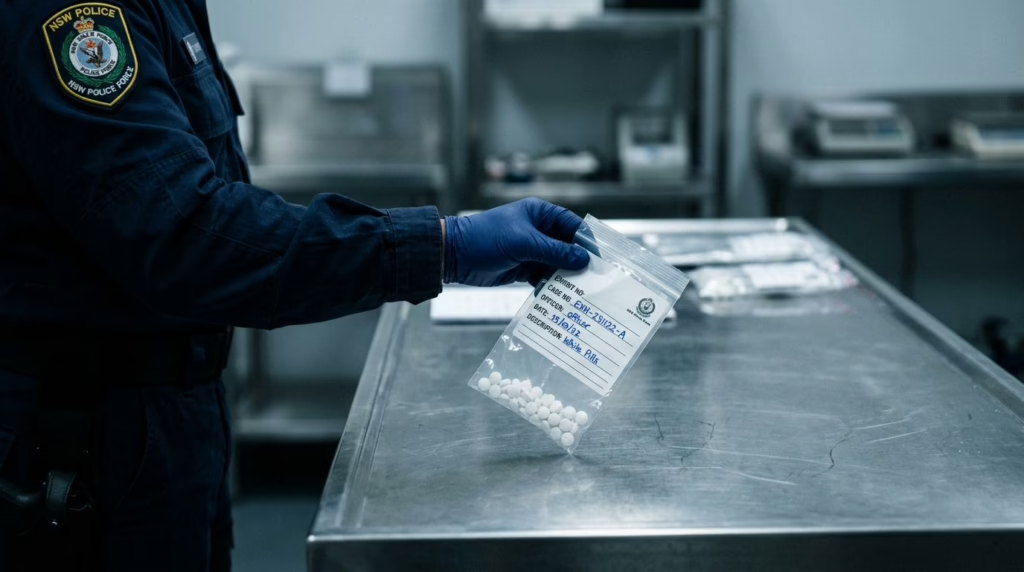
You don’t need to have sold any drugs. You don’t need a dealer’s phone or a bag of cash. In New South Wales, simply being found with a certain quantity of drugs can be enough for police to charge you with drug supply, and enough for a court to presume that was your intention, without any further evidence.
That presumption puts the burden on you. You have to prove the drugs were for personal drug use, on the balance of probabilities, or face a supply charge carrying penalties that bear no resemblance to a simple possession offence.
Possession might lead to a caution, a diversion program, a fine, or in more serious cases, a custodial sentence. Drug supply offences carry maximum penalties of up to 20 years, and higher still for the most serious commercial quantities, with life imprisonment available for the gravest categories under Commonwealth legislation. Understanding where you sit, and what triggered the charge, is where any defence starts. Seeking legal advice early is essential.
Key Takeaways
- Drug possession and drug supply are separate offences under the Drug Misuse and Trafficking Act 1985 (NSW).
- “Supply” is defined broadly — it includes giving drugs to friends without payment, not just commercial drug trafficking or a direct drug sale.
- The Drug Misuse and Trafficking Act contains a deemed supply provision: if you are found with a quantity at or above the trafficable threshold, the law may presume you intended to supply, and the burden can shift to you to prove otherwise.
- Trafficable quantities vary by particular drug type and are set out in the Schedule to the Act; the thresholds for certain drugs are very low.
- Maximum penalties range from 2 years for simple possession up to 20 years and potentially life imprisonment for the most serious drug supply offences.
- NSW has drug diversion and caution pathways for eligible small quantity possession matters, but eligibility depends on the substance possessed, quantity, age, and circumstances.
- O’Brien Criminal & Civil Solicitors have extensive experience defending drug misuse and supply charges across NSW.
What Is Drug Possession?
Under the Drug Misuse and Trafficking Act 1985 (NSW), drug possession occurs when a person knowingly has control of a prohibited drug, without any intent to distribute or supply. Physical possession means the drug is on the person; constructive possession means the person has physical control over a place where the drug is located, with knowledge of its presence.
The prosecution must prove beyond a reasonable doubt that the person had actual or constructive possession of the substance and that it is a prohibited drug. Limited exceptions apply, for example, where a drug is held under a valid doctor’s prescription or for approved scientific research purposes.
This is often treated as a summary offence in the Magistrates Court (Local Court) for small quantities, though the legal process can escalate depending on the amount and circumstances.
What Is Drug Supply?
Drug supply is a more serious offence. “Supply” is defined broadly under the misuse and trafficking Act and includes not only direct sales and drug trafficking but also giving drugs to friends without payment and any transfer of drugs between people. The Crown does not need to prove money changed hands or that an actual sale took place.
The Crown does not always need to establish an actual act of supply. The Act contains a deemed supply provision which, in certain circumstances, creates a presumption of supply intent based on the quantity of drugs possessed, without any evidence of a transaction. These are indictable offences that can be heard in the District or Supreme Court.
Related offences such as cultivating prohibited plants, including cannabis plants, manufacturing prohibited substances, or cannabis resin and cannabis oil production are dealt with separately under the Act and carry their own penalty ranges. Charges related to organised crime or ongoing supply attract additional aggravating factors.
Deemed Supply
The deemed supply provision in the Drug Misuse and Trafficking Act 1985 creates a rebuttable presumption that a person found in possession of a drug at or above the trafficable quantity possessed it for the purpose of supplying prohibited drugs. This can reverse the usual burden of proof.
Once the Crown establishes possession at or above the threshold, the accused may need to prove intent was not to supply, on the balance of probabilities, to rebut the presumption, in other words, the person proves the drug was for personal use rather than supply. Whether and how the reverse onus applies depends on precisely what the facts show and the charge laid.
Trafficable Quantity Thresholds
The trafficable quantities are set out in the Schedule to the Act and vary by drug type. The following are key examples, note how low the threshold is for some substances.
| Drug Type | Trafficable Quantity |
| Cannabis | 300 grams |
| Cocaine | 3 grams |
| Methamphetamine (Ice) | 3 grams |
| Heroin | 3 grams |
| MDMA (Ecstasy) | 0.75 grams |
These figures are illustrative of the key thresholds under the current Schedule. You should obtain legal advice about the specific quantity.
Penalties
Maximum penalties vary depending on whether the matter is heard in the Local Court or District Court, the drug involved, and the quantity. The following is a general guide only.
| Offence | Indicative Maximum Penalty |
| Simple possession | 2 years imprisonment and/or fine |
| Supply (trafficable quantity) | Up to 15 years imprisonment |
| Commercial quantity supply | Up to 20 years imprisonment |
| Large commercial quantity supply | Higher maxima apply, depending on drug |
Actual sentences vary considerably based on specific circumstances, criminal history, and mitigating factors. NSW also has diversion and caution pathways for eligible small quantity possession matters involving personal use, but these do not apply to supply charges, and eligibility depends on the drug, quantity, age, and circumstances.
Defences
Lack of knowledge or control. If you did not know the drug was present or did not have control over it, the prosecution cannot establish possession. Evidence obtained in breach of your rights under the Law Enforcement (Powers and Responsibilities) Act 2002 (NSW) may also be subject to exclusion under section 138 of the Evidence Act 1995 (NSW).
Rebutting deemed supply. For deemed supply charges, the primary approach is proving on the balance of probabilities that the drugs were for personal use, through evidence of consumption patterns, time since acquisition, addiction history, or expert evidence. The stronger and more specific this evidence, the better the prospects.
Non-conviction outcomes. A dismissal under section 10 of the Crimes (Sentencing Procedure) Act 1999 (NSW) can result in no conviction being recorded. Drug Court and other diversion programs may also be available. These depend on the circumstances and are not guaranteed.
Frequently Asked Questions
Can I be charged with supply if I only gave drugs to a friend?
Yes. Supply includes giving drugs to friends without payment. A single, non-commercial transfer can constitute supply.
What happens if I am found with drugs above the trafficable quantity?
The deemed supply provision may apply, shifting the burden to you to prove the drugs were for personal use. This is a serious charge, getting legal advice immediately is essential.
What evidence does the Crown need to prove supply?
For actual supply, the Crown needs evidence of a transaction, though not always a direct witness. For deemed supply, no transaction evidence is required; the quantity triggers the presumption.
Are there alternatives to a criminal conviction for possession?
Depending on the circumstances, diversion or caution pathways may be available outside the court process. A section 10 dismissal can result in no conviction being recorded. Neither is guaranteed, outcomes depend on the specific facts.
How O’Brien Criminal & Civil Solicitors Can Help
O’Brien Criminal & Civil Solicitors have extensive experience defending drug charges across the Local Court, District Court, and Court of Criminal Appeal in NSW, from simple possession through to large commercial supply matters.
Fill out the form below or call (02) 9261 4281 for a free, no-obligation consultation.