
Being investigated or charged with drug importation? This is a very frightening experience as the stakes are high.
Drug importation is a federal offence that can carry life imprisonment. Normally, they are prosecuted by a specialist Commonwealth agency, and the process moves quickly once the Australian Federal Police (AFP) or Australian Border Force (ABF) are involved.
If this is happening to you or someone you care about, the most important thing to understand right now is that a charge is not a conviction. Your knowledge of what you were carrying, your role, and the strength of the prosecution’s evidence all matter, and all can be challenged.
This guide explains how Australian law defines and penalises drug importation, how quantity and purity are actually calculated, and what the AFP investigation process looks like. We also go through what defences may be available, and what you can do right now to protect your position.
At a glance
- Maximum penalty: drug importation can carry penalties of up to life imprisonment for importing a commercial quantity of a border controlled drug.
- Which court: these are Commonwealth indictable offences, prosecuted by the Commonwealth Director of Public Prosecutions (CDPP) and heard in the NSW District or Supreme Court.
- Your rights: anything you say to AFP or ABF officers before you get legal advice can be used in evidence.
- The one thing to do now: say nothing about the drugs, its contents, or your knowledge of it until you have spoken to a criminal lawyer.
What Is a Drug Importation Charge Under Australian Law?
Drug importation is a federal offence, not a state one. Therefore, all cases in Australia are prosecuted under Commonwealth law.
Charges are governed by Division 307 of the Criminal Code Act 1995 (Cth). The act criminalises importing or exporting a “border controlled drug”, or “border controlled plant”, into or out of the country.
The Customs Act 1901 (Cth) works alongside the Criminal Code to give the ABF its border search, detection, and seizure powers. In practice, the ABF detects and seizes the drugs, usually at an airport or seaport. Then the AFP runs the criminal investigation and, if appropriate, refers the matter to the CDPP for prosecution.
As importation is investigated federally, the same Commonwealth offence and penalty framework applies whether you are arrested in Sydney, Perth, or Darwin.
It sits alongside state offences like drug supply and trafficking in NSW and other border offences like federal firearms trafficking.
How Are Drug Importation Charges and Penalties Determined?
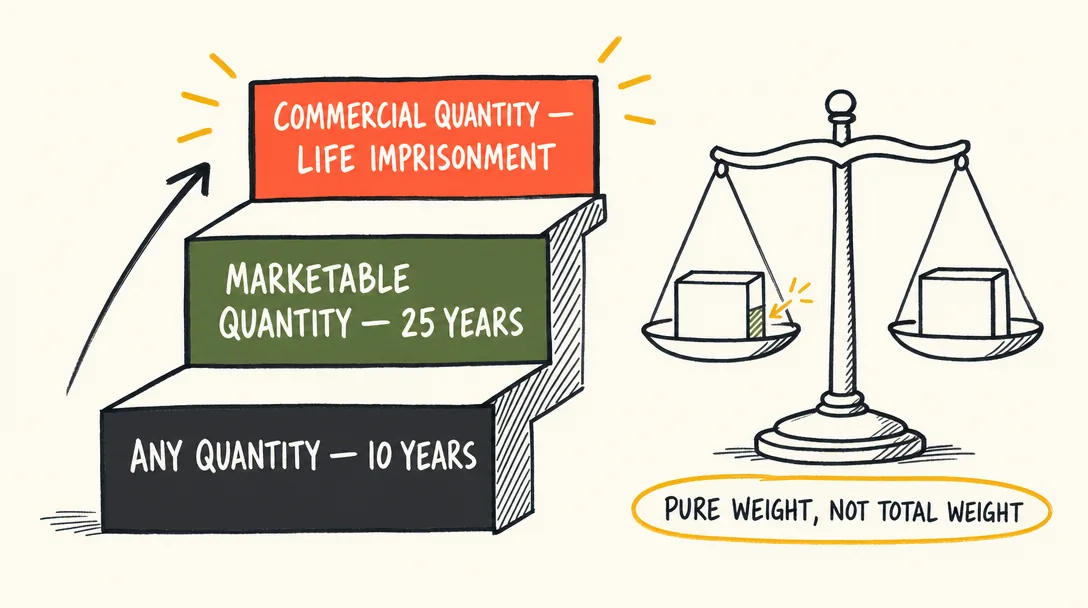
The charge and maximum penalty you face depend on the quantity of the drug involved. Division 307 sets three tiers of offence, each carrying its own maximum penalty.
| Section | Quantity involved | Maximum penalty |
| s 307.1 | Commercial quantity | Life imprisonment |
| s 307.2 | Marketable quantity | 25 years’ imprisonment |
| s 307.3 | Any quantity (no threshold met) | 10 years’ imprisonment |
The specific weights that count as a “marketable quantity” or “commercial quantity” for each drug are set out in Schedule 2 (Border controlled drugs) of the Criminal Code Regulations 2019 (Cth). Here are the drugs most commonly involved in importation matters:
| Drug | Marketable quantity (s 307.2) | Commercial quantity (s 307.1) |
| Heroin | 2g or more | 1.5kg or more |
| Cocaine | 2g or more | 2kg or more |
| Methamphetamine (“ice”) | 2g or more | 750g or more |
| MDMA (“ecstasy”) | 0.5g or more | 500g or more |
| Cannabis (plant material) | 25kg or more | 100kg or more |
A charge related to even a small amount of a drug above the marketable threshold exposes a person to a 25-year maximum imprisonment. The jump to a commercial quantity brings the maximum to life imprisonment.
That said, a maximum penalty is not a typical one. In Wong v The Queen (2001) 207 CLR 584, the High Court explained that drug quantity is only one factor which a court considers. They’ll also look at:
- An offender’s role (courier versus organiser),
- their knowledge of what they were carrying,
- any financial desperation or coercion,
- cooperation with authorities,
- and an early guilty plea can all significantly affect the sentence actually imposed.
Every drug importation case is assessed on its own facts, and outcomes vary widely even within the same quantity band.
How Is Drug Quantity and Purity Calculated?
Quantity is calculated by pure weight, not the total weight of what was seized. Usually, imported drugs are almost never 100% pure. They are typically cut with other substances to bulk out or dilute the product.
The pure weight is worked out by multiplying the total seized weight by the measured purity percentage. For example, 100 grams of a seized substance found to be 70% pure cocaine has a pure weight of 70 grams. Important because this is the figure used to decide which quantity threshold, and therefore which charge, applies to a case.
Forensic analysis of a seizure is generally carried out by the AFP and ABF, including specialist government forensic laboratories like the National Measurement Institute’s forensic drug analysis service. This matters practically because:
- A lower measured purity can, in some cases, bring the pure weight below a higher threshold. This reduces a commercial quantity charge to a marketable one, or a marketable charge to no threshold at all.
- A criminal defence lawyer is entitled to seek independent expert re-analysis of the seized substance. A drug importation solicitor can also challenge the prosecution’s purity and weight findings.
- Chain-of-custody and testing methodology can themselves be contested if there are gaps or inconsistencies in how the sample was handled.
How Do the AFP and Border Force Investigate Importation Cases?
Most importation investigations start with a border detection, not a tip-off about a specific person. The ABF’s screening and detection technology at airports, seaports, and international mail facilities usually identifies the consignment first. From that point, the AFP-led investigation proceeds through evidence gathering, charging, and referral to the DPP.
A typical investigation moves through:
- Detection and seizure of the consignment at the border.
- Forensic analysis of the seized material (weight, purity, composition).
- Identification and surveillance of where it was intended to be going and to who.
- Either a controlled delivery (letting the parcel proceed under surveillance) or a direct arrest operation.
- Police interview the suspected recipient, importer, and any other persons of interest.
Controlled deliveries are common in importation matters as the prosecution needs to prove the accused had knowledge and control of the drugs. This evidence is often the most contestable element of a drug importation case.
What Legal Defences Apply to Drug Importation Charges?
Several defences can apply depending on what you actually knew and did. These details are then assessed on the individual facts of your matter. A lawyer’s early involvement helps identify which defences apply to you.
- Lack of knowledge: this is the most commonly used defence. It applies where a person genuinely did not know that a package or item contained drugs, or did not know they were importing a prohibited substance at all. An example of this might be an unwitting courier used by someone else.
- Duress: where a person was compelled to import drugs because of a genuine, imminent threat of serious harm to themselves or someone else. For this, they must reasonably believe the threat would be carried out if they refused to import the drugs.
- Mistaken belief: where a person held a genuine and reasonable mistaken belief about a material fact. For example, this might be believing the substance was something else like a non-prohibited substance.
Whether any of these defences can succeed depends heavily on the surrounding circumstances: how the package came into your possession, what you were told, any communications, and how you behaved once you became aware (or should have become aware) of what you were carrying.
Can You Get Bail for a Drug Importation Charge?
Bail is possible, but for commercial-quantity importation charges you must actively “show cause” why your detention is not justified. The usual presumption in your favour does not apply.
Under section 16B of the Bail Act 2013 (NSW), importing a commercial quantity of a serious drug is a “show cause” offence.
This reverses the usual approach: instead of the prosecution having to justify refusing bail, the accused must first show why continued detention is not justified. If that first step succeeds, the court then applies the “unacceptable risk” test. This test considers whether release would pose an unacceptable risk of the accused failing to appear for a court date, committing a serious offence, endangering anyone’s safety, or interfering with evidence or witnesses.
Marketable-quantity and lower-level importation charges aren’t automatically show-cause offences. This generally makes a bail application more straightforward, though it still comes down to the individual risk factors.
The general principles that apply to bail applications in NSW still matter here, but the show cause hurdle makes early, well-prepared legal representation important. Courts weigh a range of factors in any importation bail application, including:
- The nature and objective seriousness of the charge
- The strength of the prosecution’s case
- Ties to Australia: family, employment, community, and residence
- History of compliance with bail conditions or court orders in the past
- Risk of flight, particularly for foreign nationals or dual citizens
- Proposed bail conditions (surety, reporting, surrender of passport, residential restrictions)
Your Rights & What You Can Do Now
If you are under investigation, have been questioned or charged, there are steps you can take right now to protect your position, including:
- You have the right to silence. Beyond confirming your name and address, you are not required to answer AFP or ABF questions. Politely decline to discuss the package, its contents, or what you knew, and ask to speak to a lawyer first.
- Get a lawyer before any interview. What you say in an initial interview can be used against you. Ask for an interview to be delayed until you have obtained legal advice.
- Do not make admissions about your knowledge of the package’s contents to police, customs officers, or anyone else. Knowledge is often the central issue in these cases, and an offhand comment can undermine a genuine defence.
- You are entitled to independent purity and quantity testing. Do not simply accept the prosecution’s forensic certificate: ask your lawyer about obtaining independent expert analysis of the seized substance.
- Preserve anything relevant. Messages, receipts, travel records, or communications that show what you were told about the package (or that you had no reason to suspect its contents) can matter later. Keep them, and tell your lawyer about them early.
- Act quickly. Evidence, witness recollection, and bail prospects are all strongest when a lawyer is involved from the earliest possible point, ideally before any interview takes place.
How a Lawyer Could Help Your Case
A solicitor experienced in Commonwealth drug matters can act at every stage of an importation case, not just at trial.
- Assessing and building a defence: examining whether lack of knowledge, duress, or mistaken belief genuinely applies to your facts, and gathering the evidence (communications, travel history, financial records) needed to support it.
- Challenging the prosecution’s quantity and purity findings: arranging independent forensic re-testing and scrutinising the AFP/ABF evidence chain. This may in some cases affect which threshold, and therefore which charge, applies.
- Running your bail application: preparing the material needed to show cause where required, addressing flight-risk and community-tie concerns, and proposing appropriate conditions to the court.
- Negotiating with the CDPP: in some cases, engaging early with the prosecution about the charge itself, or about a plea position, where the evidence supports it.
- Sentencing mitigation: where a plea or finding of guilt occurs, presenting the full picture the court is required to weigh under principles like those in Wong v The Queen. These include role, knowledge, circumstances, cooperation, and personal factors, to support the most favourable outcome available on the facts.
An experienced solicitor’s early involvement, particularly before any police interview, is often the single factor that most affects how an importation matter unfolds.
Frequently Asked Questions
What is the difference between a marketable and a commercial quantity?
A marketable quantity (s 307.2) is the lower threshold, carrying a maximum of 25 years’ imprisonment. A commercial quantity (s 307.1) is a substantially larger amount (for example, 750 grams of methamphetamine compared to 2 grams for marketable) and carries a maximum of life imprisonment. The exact weight for each threshold differs by drug type and is set out in Schedule 2 of the Criminal Code Regulations 2019 (Cth).
How is drug quantity calculated for an importation charge?
By pure weight, not the total weight of what was seized. Laboratories multiply the total weight by the measured purity percentage: for example, 100 grams at 70% purity is treated as 70 grams pure. The defence can seek independent expert analysis to test or challenge the prosecution’s purity findings.
Can you get bail for a drug importation charge?
Yes, but it depends on the charge. For commercial-quantity charges, it is a “show cause” offence under s 16B of the Bail Act 2013 (NSW): you must first show why your detention isn’t justified before the usual risk factors are even considered. Marketable-quantity and lesser charges are not automatically show-cause matters, though bail is never guaranteed and always depends on the individual circumstances.
What if I did not know there were drugs in my package or luggage?
Lack of knowledge is a recognised defence where you can show you genuinely did not know the package contained drugs, or did not know you were importing a prohibited substance at all. Whether it succeeds depends on the surrounding circumstances: how you came to have the item, what you were told, and how you behaved once questioned. Early legal advice is important to properly assess this.
Do I have to answer questions from AFP or Border Force officers?
Beyond confirming your name and address, no. You have the right to silence, and anything you say can be used in evidence. It’s best to ask to speak with a lawyer before answering substantive questions about a package, its contents, or your travel.
Does it matter which state I was arrested in?
No. Drug importation is a Commonwealth offence prosecuted under the same Criminal Code framework regardless of which state or territory you are charged in, although bail procedure follows the bail legislation of the state where you are held (for example, the Bail Act 2013 in NSW).
How O’Brien Criminal & Civil Solicitors Can Help
Federal drug importation charges call for a solicitor who understands Commonwealth prosecution procedure specifically, not just state criminal law, from how the CDPP runs its cases to how AFP forensic evidence and bail applications under the “show cause” test are actually contested.
O’Brien Criminal & Civil Solicitors is led by an Accredited Specialist in Criminal Law and our team has over 20 years’ experience acting for people from the moment of first police contact, including in serious Commonwealth matters.
Getting a lawyer involved before your first interview, and before any admissions are made, is often the single biggest factor in how an importation case unfolds: for your bail prospects, your defence options, and any eventual sentencing outcome.
If you are also facing a related state charge, our specialist drug offence lawyers can advise across both the Commonwealth and NSW elements of your matter.
Request initial advice (no-obligation) via the form below or call us on (02) 9261 4281.
This content is for general information purposes only and does not constitute legal advice. You should seek independent legal advice relevant to your specific circumstances.