

If a worker or another person has been fatally injured in connection with your business, and you are a director, officer, or senior executive, you need to read this. New South Wales now has a specific new offence that did not exist until September 2024.
Industrial manslaughter is prosecuted as a serious indictable crime, not a regulatory fine, and it can be brought against you personally, separately from any charge against your company.
This guide explains what industrial manslaughter actually requires the prosecution to prove, who can be charged, what the due diligence defence involves, and what a lawyer can realistically do if you or your business is under investigation. It is written for directors, officers, and senior managers who want a clear, accurate picture of their exposure, not a scare campaign.
Being contacted by SafeWork NSW or the police after a workplace death is frightening, and the stakes are genuinely high. But the process that follows is well defined, and how you respond in the first days matters enormously to the outcome.
At a glance
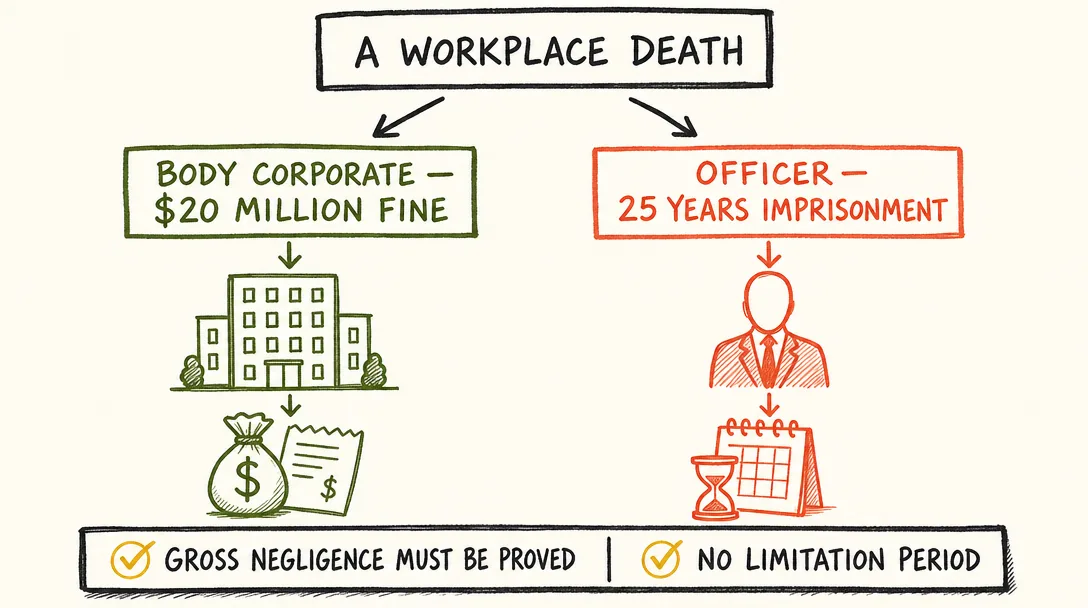
- Maximum penalty: 25 years’ imprisonment for an individual; up to $20 million for a body corporate (PCBU).
- Court: an indictable offence. Charges against an individual are prosecuted on indictment by the Office of the Director of Public Prosecutions (NSW), typically before the District or Supreme Court. Charges against a corporate PCBU are usually dealt with summarily in the Industrial Court of NSW unless the prosecutor elects to proceed on indictment.
- Limitation period: none. Unlike most WHS offences, industrial manslaughter can be prosecuted at any time after the death.
- The one thing to do now: do not give SafeWork NSW, the police, or the coroner’s investigators a statement, formal or informal, before you have spoken to a lawyer. Preserve every document connected to the incident.
What Is Industrial Manslaughter Offence Under NSW Law?
Industrial manslaughter is a criminal offence under section 34C of the Work Health and Safety Act 2011 (NSW). The NSW Government introduced the industrial manslaughter bill, then a proposed offence, into NSW Parliament on 4 June 2024, fulfilling a 2023 election commitment. Once passed as the Work Health and Safety Amendment (Industrial Manslaughter) Act 2024, this amending legislation inserted section 34C directly into the existing framework, and it has been in force since 16 September 2024. It sits in the NSW WHS Act itself, not the Crimes Act 1900 (NSW).
Importantly, this is a workplace safety offence and is prosecuted using the WHS Act’s own duty framework. However, it does still carry the seriousness and penalties of a homicide offence.
To convict a person of industrial manslaughter, the prosecution must prove all of the following key elements:
- The person is a PCBU (a person conducting a business or undertaking) or an officer of a PCBU, and owes a duty to ensure a person’s health and safety.
- The person engaged in conduct (an act, or a failure to act) that breached that duty.
- The breach caused the death of a worker, or another person to whom the duty was owed.
- The conduct was carried out with gross negligence.
Industrial manslaughter requires an actual death. It is the most serious charge in the NSW WHS enforcement ladder, sitting above Category 1, 2, and 3 offences.
Our fact sheet on manslaughter charges in NSW covers the general criminal law offence.
Who Can Be Charged with Industrial Manslaughter: the PCBU or the Officer?
Both the PCBU or an officer can be charged. However, the company being prosecuted does not shield an individual officer from being charged separately, and vice versa.
| Category | Who it covers | Maximum penalty |
| PCBU (body corporate) | The company, incorporated association, or other body corporate carrying on the business | Fine of up to $20 million |
| Officer of a PCBU | Directors, company secretaries, CEOs, CFOs, and others who make, or participate in making, decisions affecting the whole or a substantial part of the business | Up to 25 years’ imprisonment |
| PCBU who is an individual (e.g. a sole trader) | A person running the business in their own right, not through a company | Up to 25 years’ imprisonment |
“Officer” is defined broadly and is not limited to people with “director” in their title.
Someone with genuine influence over decisions that affect the whole or a substantial part of the business, including some senior managers, can be classed as an officer.
What Does “Gross Negligence” Actually Mean?
Gross negligence is a significantly higher bar than ordinary carelessness. The prosecution must show conduct that was a serious and obvious departure from the standard of care a reasonable person would have exercised. It can’t be just a mistake or an oversight. For a body corporate specifically, the legislation sets out its own test: gross negligence can be evidenced by inadequate corporate management, control, or supervision of the conduct of one or more authorised persons, or by a failure to provide adequate systems for conveying relevant information to relevant persons within the organisation. Courts can aggregate the conduct of multiple authorised persons to establish this, even where no single individual’s conduct meets the threshold on its own.
The prosecution does not need to prove that the accused personally knew about the specific risk. That is what distinguishes gross negligence from reckless conduct (the fault element used for Category 1 WHS offences, which does require proof of awareness).
Instead, for industrial manslaughter, an obvious, serious risk that should have been identified and managed can be enough. Even without direct evidence of what was in your head at the time.
This is why documented, ongoing due diligence matters so much: it is the clearest evidence that conduct fell within a reasonable standard of care, not a serious departure from it.
Can the Due Diligence Defence Protect You?
Yes, if it is genuine and ongoing. Section 27 of the WHS Act requires every officer to take a proactive approach to their WHS obligations and exercise due diligence, and evidence that they actually did so is central to defending an industrial manslaughter charge.
Due diligence under section 27 requires an officer to:
- Keep up to date with WHS knowledge relevant to the business and industry.
- Understand the operations of the business and the hazards and risks involved, including which hazards could realistically cause death.
- Ensure the business has, and uses, appropriate resources (funding, staff, and equipment) to manage risks.
- Ensure the business has appropriate processes for receiving, considering, and responding to information about incidents, hazards, and risks.
- Ensure the business has, and implements, processes for complying with its WHS duties, including reporting and investigating incidents.
- Verify that the resources and processes above are actually being used.
Due diligence is not a document you sign once. Instead, it is an ongoing pattern of genuine engagement. Things like: workplace visits, board-level reporting, acting on what safety audits and incident reports tell you. Courts look for a track record, not a policy sitting unused in a drawer.
What are the Insurance Implications?
Most policies will not cover an industrial manslaughter fine or the personal consequences of a conviction, though your legal defence costs may be covered depending on your policy. Standard commercial general liability and professional indemnity policies typically exclude criminal penalties and statutory fines outright. This is a legal restriction, not just a common exclusion, since insuring against a criminal fine as a matter of public policy is generally not permitted.
What is worth checking with your broker:
- Directors and Officers (D&O) insurance: may cover the cost of legal representation for an officer facing WHS-related legal proceedings, including industrial manslaughter. Coverage and limits vary significantly between insurers, and some policies exclude WHS matters entirely.
- Statutory liability insurance: designed specifically to respond to WHS-related defence costs and, in some cases, associated penalties (subject to the same public-policy limits on insuring fines).
- Legal expenses cover: may fund defence costs (barristers, experts, court fees) separately from any liability cover.
Ask your broker directly whether your current policy responds to a section 34C charge and what the sub-limit is. It’s also worth asking whether cover is triggered from the point of a SafeWork NSW investigation or only once charges are laid. The earlier your cover activates, the earlier you can properly resource your defence.
How Are These Charges Investigated and Prosecuted?
Workplace fatalities trigger a multi-agency response. SafeWork NSW (and the police, where a death is involved) will investigate, and the Office of the Director of Public Prosecutions now runs a dedicated specialist unit focused on prosecuting industrial manslaughter offences on indictment.
Charges against the corporate PCBU are more often dealt with summarily in the Industrial Court of NSW, unless the prosecutor elects to proceed by indictment.
Unlike most WHS offences, industrial manslaughter has no time limitation period, so a death that occurred some time ago is not automatically beyond reach. Investigations can take considerable time to conclude before charges are laid.
New Industrial Manslaughter Laws: Your Rights & What You Can Do Now
If your business has experienced a workplace death, or you have been contacted by SafeWork NSW, the police, or the coroner’s office, these rights and steps genuinely affect your position:
- You have the right to obtain legal advice before making any statement. You are not obliged to answer investigators’ questions on the spot, and anything you say informally can be used later. Politely decline to give a statement until you have spoken to a lawyer.
- You have the right to have a lawyer present during any formal interview or record of interview.
- Preserve, do not create, documents. Do not write new explanations, edit records, or “tidy up” documentation after an incident: this can look like, or actually constitute, evidence tampering. Instead, secure and preserve what already exists: WHS policies, training records, maintenance logs, incident reports, board minutes discussing safety.
- Notify your insurer immediately. Many D&O and statutory liability policies require prompt notification of an incident or investigation as a condition of cover. Delaying notification can itself jeopardise your coverage.
- Keep a factual, contemporaneous log of what you are told by SafeWork NSW, the police, or the coroner’s office, and of any documents requested or provided.
- Do not make public statements or admissions of fault, including internally in emails or messages that could later be discoverable, before getting advice.
- Continue (or start) genuine due diligence work. An investigation is not a reason to freeze WHS improvements. Ongoing, documented action can only help your position, and it is the right thing to do for your workforce regardless of the legal exposure.
- Cooperate where you are legally required to, but always on the basis of legal advice about what cooperation actually requires versus what is being asked informally.
How a Lawyer Could Help Your Case
A solicitor experienced in WHS prosecutions can be involved from the moment SafeWork NSW makes contact, well before any charge is laid, and that early involvement is often what shapes the outcome.
- Advising on and managing contact with investigators: attending interviews with you, advising on what must legally be answered versus what can be declined, and preventing an informal conversation from becoming evidence used against you.
- Building the due diligence defence: working with you to gather and organise the evidence of your section 27 due diligence (board minutes, training records, workplace inspection logs, safety audits) into a coherent, well-supported position, rather than a scattered paper trail assembled after the fact.
- Assessing whether the elements are actually made out: scrutinising whether the prosecution can prove gross negligence (as opposed to ordinary negligence, which does not meet the threshold), whether the causal link between the alleged breach and the death is sound, and whether you genuinely meet the definition of “officer” in your role.
- Negotiating with SafeWork NSW and the DPP: engaging on the scope of charges, whether a matter proceeds summarily or on indictment, and, in some cases, whether a lesser WHS charge (such as a Category 1, 2, or 3 offence) is a more appropriate and provable outcome than industrial manslaughter. Note that enforceable undertakings are not available as a resolution to an industrial manslaughter charge itself; SafeWork NSW does not accept them for this offence.
- Mitigation at sentencing: where a charge does proceed and results in a finding of guilt, presenting matters such as your prior safety record, remedial action taken since the incident, cooperation with the investigation, and personal circumstances, which may be relevant to sentence.
- Coordinating with your insurer and broker: helping ensure your defence is properly funded from as early a point as your policy allows, and that notifications are made correctly and on time.
None of this can guarantee a particular result. Every case turns on its own facts, and the seriousness of this offence means outcomes vary widely. What early, specialist legal involvement can do is make sure your actual conduct and your genuine due diligence record are properly put before investigators and, if it comes to it, the court.
Frequently Asked Questions
Can a director really go to prison for a workplace death in NSW?
Yes. Since 16 September 2024, an officer of a PCBU who is grossly negligent in breaching their WHS duty, causing a death, can be personally charged with industrial manslaughter and, if found guilty, faces up to 25 years’ imprisonment, one of the most severe penalties available under NSW law. There is no financial-only outcome for an individual: the penalty is custodial.
Is industrial manslaughter a Commonwealth offence?
No. It is a NSW state offence under section 34C of the Work Health and Safety Act 2011 (NSW), enforced by SafeWork NSW and prosecuted through NSW courts. Every Australian jurisdiction has now introduced its own version, building on the model work health and safety laws framework, but each operates under its own state or territory legislation, with its own penalties and procedure. They are not identical.
What’s the difference between industrial manslaughter and a Category 1 WHS offence?
A Category 1 offence under section 31 of the WHS Act does not require a death. Exposing someone to a risk of death or serious injury, done recklessly or with gross negligence, is enough. Industrial manslaughter under section 34C requires that a death actually occurred, and only gross negligence (not mere recklessness) satisfies the fault element. Our fact sheet on Category 1 WHS offences covers that charge in detail.
Can my company be prosecuted even if I’m not personally charged, or vice versa?
Yes. The PCBU (company) and any individual officer are assessed and prosecuted separately. A company can be convicted while an officer is acquitted, and an officer can be convicted personally even where the company’s case is resolved differently. Corporate structure does not, by itself, protect an individual officer from personal criminal liability.
Does the due diligence defence guarantee I won’t be charged?
No. Due diligence under section 27 is a duty you must actively discharge, not a shield you can claim after the fact. A genuine, documented history of due diligence significantly strengthens your position and may mean the prosecution cannot establish gross negligence at all, but it depends entirely on what you can actually show you did, and every case is assessed on its own facts.
Is there a time limit on when I could still be charged?
No. Industrial manslaughter has no limitation period, which is unusual for WHS offences generally. An investigation into a death from some time ago can still result in a charge being laid later.
How O’Brien Criminal & Civil Solicitors Can Help
O’Brien Criminal & Civil Solicitors is led by an Accredited Specialist in Criminal Law, an accreditation held by fewer than 6% of NSW solicitors, and our lawyers act for clients from the first point of contact with police or regulators. For matters of this seriousness, our solicitor-and-barrister team approach means you have experienced advocacy alongside careful case preparation from day one.
If SafeWork NSW, the police, or the coroner’s office has contacted you or your business about an industrial manslaughter in NSW, do not wait to get advice.
Request initial advice (no-obligation) via the form below or call us on (02) 9261 4281.