

If you or someone you love has been charged with manslaughter, you are facing one of the most serious charges in NSW. The word itself sounds final. It isn’t.
Manslaughter is a grave charge, but it is not murder, and the difference matters enormously for how a court will treat it. There is also no fixed sentence: two manslaughter cases can end very differently depending on what happened and why.
This guide explains what manslaughter actually means in NSW, how it differs from murder, the defences that can apply, what a court considers when sentencing, and the practical steps you can take right now to protect your position.
At a glance
- Maximum penalty: 25 years’ imprisonment (Crimes Act 1900 (NSW), s 24).
- Minimum sentence: none, manslaughter has no standard non-parole period, so the sentence turns entirely on the facts.
- Where it’s heard: the Supreme Court of NSW, before a judge and jury.
- Bail: manslaughter is a “show cause” offence, getting bail is harder and needs a strong, prepared application.
- The one thing to do now: say nothing to police beyond your identifying details, and get a criminal lawyer involved before your first interview.
What is manslaughter, and how is it different from murder?
Manslaughter is the unlawful killing of a person without the intent the law requires for murder. That single word, intent, is the dividing line between the two charges.
Under section 18 of the Crimes Act 1900 (NSW), murder requires the prosecution to prove one of the following:
- that the accused intended to kill,
- intended to cause grievous bodily harm (really serious injury),
- or acted with reckless indifference to human life (knowing their conduct would probably cause death and going ahead anyway).
Manslaughter is what remains when a death is unlawful but that higher mental element is missing.
The practical consequence is important.
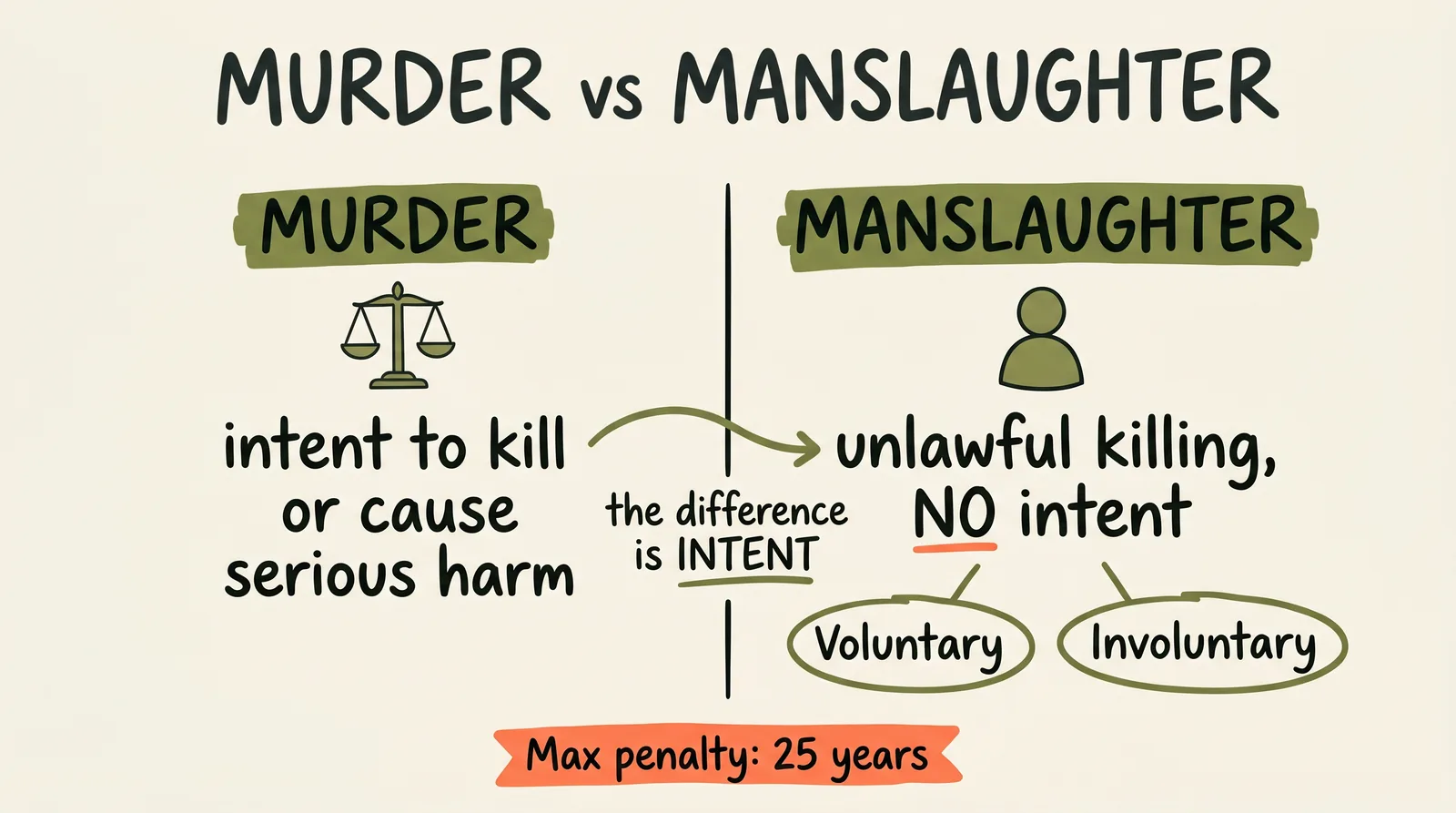
Murder carries a maximum of life imprisonment; manslaughter carries a maximum of 25 years. A result of manslaughter rather than murder is, in many cases, the single most important outcome a defence can achieve.
Voluntary vs involuntary manslaughter: What’s the difference?
There are two broad categories, and they arrive at the same charge from opposite directions.
Voluntary manslaughter is where the conduct would have been murder, the intent was there, but a partial defence reduces it. The killing is still unlawful, but the law recognises circumstances that lower the offender’s culpability (for example, extreme provocation or a substantial mental impairment).
Involuntary manslaughter is where there was no intention to kill or cause serious injury, but the death resulted from conduct the law still treats as criminal, either an unlawful and dangerous act, or criminal negligence.
| Voluntary manslaughter | Involuntary manslaughter | |
| Was there intent to kill/cause GBH? | Yes, but reduced by a partial defence | No |
| Typical route | Murder charge reduced by extreme provocation (s 23) or substantial impairment (s 23A) | Unlawful dangerous act, or criminal negligence |
| Example | A killing in response to serious provocation | A single punch that causes a fatal fall |
Can you be charged with manslaughter over an accident?
Sometimes, yes, but not because the death was intended. Involuntary manslaughter is about how far your conduct fell below what the law expects, not about whether you meant for anyone to die.
It can arise in two ways:
- Unlawful and dangerous act: an intentional act that is both unlawful and dangerous (a reasonable person would see it as carrying an appreciable risk of serious injury) that causes death. A fatal “one-punch” case is the classic example.
- Criminal negligence: conduct that falls so far short of the standard of care a reasonable person would exercise, and involves such a high risk of death or serious injury, that it deserves criminal punishment.
In both, the prosecution must prove a causal link, that your conduct actually caused the death. Causation is often a live battleground in these cases, and it is frequently where a defence is built.
What defences apply to a manslaughter charge?
Some defences result in a complete acquittal; others reduce what would otherwise be murder down to manslaughter. Which apply depends entirely on the facts.
| Defence | Effect | In short |
| Self-defence | Complete defence → acquittal | You believed your conduct was necessary to defend yourself or another, and your response was reasonable in the circumstances as you saw them. |
| Duress | Complete defence → acquittal | You were compelled to act by a threat of death or really serious harm to you or someone else. Duress can apply to a manslaughter charge, but note it is not available as a defence to murder. |
| Extreme provocation (s 23) | Partial → reduces murder to manslaughter | Since the 2014 reforms, only extreme provocation qualifies: the deceased must have committed a serious indictable offence that caused you to lose self-control. Ordinary provocation is no longer enough. |
| Substantial impairment (s 23A) | Partial → reduces murder to manslaughter | An abnormality of mind, arising from an underlying condition, that substantially impaired your capacity to understand events, tell right from wrong, or control yourself. (This replaced the old “diminished responsibility”.) |
| Excessive self-defence | Partial → reduces murder to manslaughter | You genuinely believed force was necessary to defend yourself, but the force used was not reasonable. |
What penalty could a manslaughter conviction carry?
The maximum is 25 years’ imprisonment under s 24 of the Crimes Act, but that number tells you very little about a real case.
Unlike murder, manslaughter has no standard non-parole period. There is no legislated “starting point” and no minimum term. The Judicial Commission of NSW records manslaughter sentences ranging widely, because the circumstances range widely, from a spontaneous single act with strong personal mitigation, to sustained violence.
Section 24 even preserves a rarely used discretion for a court to impose a nominal penalty in an exceptional case.
So what happens in practice? A manslaughter conviction almost always means a full-time prison sentence, historically, around 96% of people convicted are sentenced to gaol.
Published statistics have put the average head sentence in the order of seven years, with a non-parole period of roughly four and a half years. Treat those as a rough guide only: the courts themselves caution that manslaughter cases vary so much that averages are a poor predictor, and real sentences have ranged from the exceptional non-custodial case to well beyond a decade for the most serious.
Broadly, a sentencing judge weighs factors like these:
| Tends to increase the sentence | Tends to reduce the sentence |
| Actual or threatened violence, or use of a weapon | The act was spontaneous, not planned |
| Vulnerability of the victim | Genuine remorse and good prospects of rehabilitation |
| Breach of trust | An early guilty plea (a discount of up to 25% for the earliest plea) |
| A prior record | Strong subjective case, mental health, background, no relevant record |
As there is no template, the quality of the material put before the court, the reports, references, and mitigation gathered on your behalf, often shapes the outcome more than the label of the charge.
Which court hears manslaughter charges, and what does the process look like?
Manslaughter is a strictly indictable offence, which means it is dealt with in the Supreme Court of NSW before a judge and jury, and prosecuted by the Office of the Director of Public Prosecutions. It does not stay in the Local Court.
The prosecution must prove the charge beyond reasonable doubt, the highest standard in law. Along the way, your legal team can test the evidence: challenging how police gathered it, scrutinising forensic and expert material, and probing causation. In a serious homicide matter, a solicitor and barrister will usually work together. The solicitor builds and runs the case, whilst the barrister presents it in court.
For a fuller picture of what a contested hearing involves, see our guide to the criminal trial process in NSW.
Can you get bail on a manslaughter charge?
It is possible, but harder than for most offences. Manslaughter is a “show cause” offence, which means the law presumes you should stay in custody unless your lawyers can show cause why your detention is not justified, before the court even turns to the usual bail considerations.
That makes preparation everything: a well-evidenced bail application, addressing where you would live, what conditions you would accept, and why you are not an unacceptable risk. Our bail applications in NSW guide explains the two-step test in detail.
Your Rights & What You Can Do Now
What you do in the hours and days after being charged can shape the entire case. You have real rights, and some practical steps genuinely strengthen your position.
- You have the right to silence, use it. Beyond giving police your name and address, you are not obliged to answer questions or give an account. Well-intentioned explanations given without advice are one of the most common ways people damage their own case. Politely say you want to speak to a lawyer first.
- Ask for a lawyer before any interview. You are entitled to legal advice before a police interview. Get it. A short call before you speak can change everything that follows.
- Preserve everything. Keep phones, messages, clothing, and anything else relevant exactly as they are. Don’t delete, clean up, or “tidy” anything, it can be vital evidence, and disturbing it can look worse than the truth.
- Write down your memory while it’s fresh, for your lawyer only. A private, dated account of what happened, shared only with your legal team, helps preserve detail. Do not post anything on social media or discuss the incident with anyone else.
- Note potential witnesses. Names, numbers, and anything that identifies who was present or nearby can matter months later.
- Look after your health. If your mental state is relevant (for example, to substantial impairment), early medical and psychological records can become an important part of your defence.
The single most valuable step is getting experienced representation involved early, before the interview, before bail, before decisions are made that are hard to undo.
How a lawyer could help your case
In a homicide matter, experienced representation can shape the outcome at every stage. Depending on the facts, a criminal defence team may be able to:
- Reduce the charge. Argue a partial defence, extreme provocation or substantial impairment, to reduce a murder charge to manslaughter, or run self-defence for a complete acquittal, where the evidence supports it.
- Challenge the prosecution case. Test causation (did the conduct actually cause the death?), scrutinise forensic and expert evidence, and challenge how police gathered evidence, any of which can be decisive.
- Negotiate with the prosecution. Discussions with the DPP can, in some cases, shape what charge ultimately proceeds.
- Build the strongest sentence case. Where a plea is appropriate, assemble the reports, references, and mitigation that genuinely influence a sentence that has no fixed starting point.
None of these outcomes can be promised, but for a charge this serious, the difference the right preparation makes is real.
Frequently Asked Questions
Will I definitely go to jail if convicted of manslaughter?
Most likely, but not automatically. A full-time custodial sentence is the usual outcome given the seriousness of the offence. But because there is no minimum sentence, an exceptional case with strong mitigation can attract a lesser penalty. It always turns on the facts.
Is there a minimum sentence for manslaughter?
No. Manslaughter has no standard non-parole period and no mandatory minimum in NSW. Sentencing is entirely at the court’s discretion, guided by the circumstances and by comparable cases.
Can an early guilty plea reduce my sentence?
Yes, the earliest appropriate guilty plea can attract a sentencing discount of up to 25%. Whether to plead, and when, is a serious strategic decision that should only be made with advice, because it affects both the charge you face and the sentence you receive.
What’s the difference between manslaughter and murder again?
Intent. In short:
- Murder requires an intention to kill, an intention to cause grievous bodily harm, or reckless indifference to human life.
- Manslaughter is an unlawful killing without that mental element.
Can I appeal a manslaughter conviction?
Yes. You can appeal to the Court of Criminal Appeal, for example, where there was a legal error, a procedural unfairness, or where the verdict was unreasonable. See our guide to criminal appeals in NSW.
How O’Brien Criminal & Civil Solicitors Can Help
A manslaughter charge demands genuine specialist experience, the kind that shapes a case from the very first police contact through bail, the Supreme Court, and sentencing.
O’Brien Criminal & Civil Solicitors is a dedicated criminal defence firm with more than 20 years defending serious matters, led by an Accredited Specialist in Criminal Law, a recognition held by fewer than 6% of lawyers in NSW.
For a charge this serious, we build the case properly: the right solicitor and barrister, the right evidence, and the right strategy from day one.
The earlier we’re involved, the more we can do. Speak with us before your next police interview or bail hearing, it’s confidential, there’s no obligation, and it costs you nothing to find out where you stand.
Request initial advice (no-obligation) via the form below or call us on (02) 9261 4281.