
Losing your licence isn’t just an inconvenience. For many, it can cause major disruption to your job, family life, and every day tasks.
Not every suspension can be appealed in NSW, and the routes that exist are narrow. One deadline expires the moment your court case finishes.
This guide covers which decisions you can appeal, how long you have, whether you can keep driving meanwhile, what the Local Court may consider, and why there is no work licence in NSW.
Licence appeals at a glance (NSW)
- The mechanism: an appeal to the Local Court under Part 7.8 of the Road Transport Act 2013 (NSW), ss 266 to 270.
- The deadline: 28 days from the date you are notified (s 267(2)(a)). On a police on-the-spot suspension, also before your charge is finished (s 268(6)).
- Where it is heard: the Local Court. Its decision is final (s 270).
- Key limit: you cannot re-argue whether you committed the offence, or the penalty (s 268(4)).
- Do now: find the notice, count 28 days from the day you were notified, and get advice before that date.
What is a licence appeal, and which decisions can you appeal?
A licence appeal asks the Local Court to set aside or shorten a decision made by Transport for NSW or a police officer. It is not a review of the traffic offence, and it exists only for the decisions listed as appealable decisions in section 266(1) of the Road Transport Act 2013 (NSW).
| Decision | Section | Who can appeal |
|---|---|---|
| A police immediate licence suspension notice (on the spot) | s 266(1)(b), s 224 | Any driver given one |
| Transport for NSW refusing to issue, vary or renew a licence. The right does not extend to a refusal made on the ground that you would be liable to action under s 36(4), the good behaviour breach | s 266(1)(c) | The applicant |
| A suspension or cancellation notice under s 40(1) | s 266(1)(d) | Learner and provisional licence holders |
| A licence ineligibility notice under s 41(1) | s 266(1)(d) | Applicants for a learner or provisional licence |
| A Transport for NSW suspension or cancellation under s 59, where you paid all or part of a penalty notice for speeding or an alcohol or drug driving offence, or let the time to elect a court hearing lapse | s 266(1)(e) | The licence holder |
Two absences from that list cause confusion. A demerit point suspension of an unrestricted licence is not appealable, and a court-ordered disqualification is not appealable this way at all.
A court disqualification is challenged instead by a severity appeal to the District Court, covered in our fact sheet on criminal appeals in NSW.
How long do you have to appeal a licence suspension?
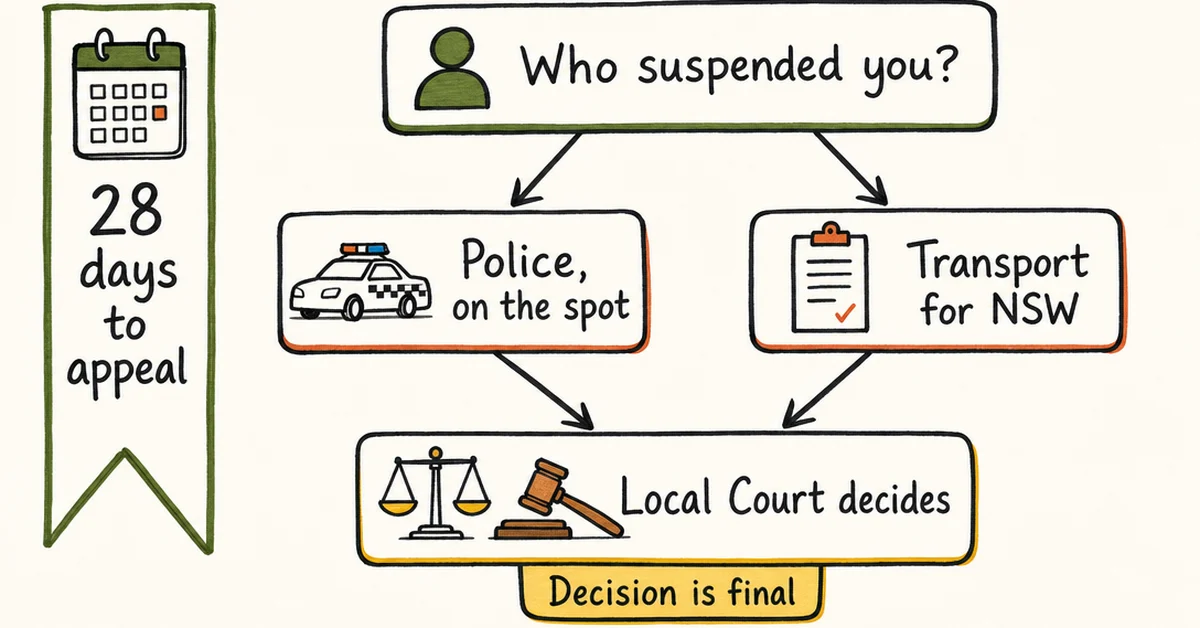
You have 28 days from the date the decision-maker notifies you of the decision, under section 267(2)(a). Transport for NSW treats a posted notice as received 4 days after posting, so the clock is not waiting on the day you open the envelope.
A second deadline catches people out on police suspensions. Under section 268(6), an appeal against an immediate licence suspension notice must be made before the charge that caused it has been heard and determined, or withdrawn. If your matter finalises first, the appeal right is gone even with days left.
We recommend you move fast on a Transport for NSW notice as it must specify a start date not earlier than 28 days after it is given. Therefore, lodging early is what keeps you on the road.
Can you keep driving while you wait for your appeal?
It depends on who suspended you. A Transport for NSW suspension is paused automatically when you appeal. A police on-the-spot suspension is not.
Under clause 147 of the Road Transport (General) Regulation 2021, a decision to suspend, vary or cancel a driver licence on any ground other than medical unfitness or incompetence to drive takes effect only if the Local Court confirms it, or you withdraw.
So appealing suspends the suspension. The carve-out is a heavy vehicle driver licence decision under clause 66 of the Road Transport (Driver Licensing) Regulation 2017: clause 147(2) takes it out of the automatic stay, and clause 148 stays it only in exceptional circumstances.
A police immediate suspension works the other way. Clause 148 lets the Local Court stay it, but only in exceptional circumstances, and until such an order is made you must not drive. Clause 148(4) tells the Court what to weigh: the strength of the prosecution evidence, your need for a licence, the danger to the community, and any other relevant matter.
Appealing an on the spot police suspension
Police can suspend your licence immediately, or within 48 hours of the charge or penalty notice, but only for the offences in section 224(1). If yours is not on that list, the notice should not have been issued. They include:
- Every range of drink driving offence under section 110, from novice, special and low range through to middle and high range, and driving under the influence under section 112(1).
- A short and specific list of Schedule 3 refusal offences: refusing a breath analysis (cl 16(1)(b)), refusing a blood sample under clause 5A (cl 17(1)(a1)), preventing a blood sample being taken (cl 17(2)), and wilfully altering your alcohol concentration (cl 18(1)(a), (b), (e)). Refusing an oral fluid test, or a urine sample, is not on that list.
- Charges involving death or grievous bodily harm caused by a motor vehicle, including murder, manslaughter and offences under ss 33, 35(2), 52A and 54 of the Crimes Act 1900 (NSW).
- Exceeding the speed limit by more than 45 km/h, or more than 30 km/h on a learner, provisional or foreign licence; a learner driving unaccompanied; organised racing, speed record attempts and speed trials held without the Commissioner of Police’s written approval (s 115); and aggravated loss of traction, the offence usually called a burnout (s 116(2)).
The appeal is tightly constrained. Section 268(5) says the Court must not vary or set aside the suspension unless satisfied there are exceptional circumstances, and, unless the statutory rules provide otherwise, must not take the circumstances of the offence into account. No such rule currently exists.
In these cases, you cannot argue that the reading was wrong or the officer mistaken; that belongs to the charge. If the suspension followed a drink driving charge, see our fact sheet on a first drink driving offence.
Demerit point suspensions: who can appeal, and who cannot
Only learner and provisional licence holders can appeal a demerit point suspension in NSW. If you hold an unrestricted licence, you cannot, and no lawyer can change that.
The appealable decision in section 266(1)(d) is a notice under section 40(1), which applies only to “the holder of a learner licence or a provisional licence”. Unrestricted licences are suspended for demerit points under section 33, which is not on the list.
| Licence type | Demerit threshold | Suspension | Appealable? |
|---|---|---|---|
| Learner | 4 points | 3 months | Yes |
| Provisional P1 | 4 points | 3 months | Yes |
| Provisional P2 | 7 points | 3 months | Yes |
| Unrestricted | 13 points in 3 years | 3, 4 or 5 months (s 33(4)) | No |
| Professional driver | 14 points in 3 years | 3, 4 or 5 months | No |
The thresholds come from the section 4(1) definition of “threshold number of demerit points”. The 3 month figure for learner and provisional holders is not set by the Act: section 40(2) leaves the period to the notice, and it is Transport for NSW that states 3 months applies. Only the unrestricted and professional periods are fixed by statute, in the section 33(4) table.
The option Parliament gave unrestricted holders instead is the good behaviour election under section 36: 12 months of good behaviour in place of the suspension. Incur 2 or more demerit points in those 12 months and Transport for NSW must impose twice the original period (s 36(4)), so it is not a soft option.
Is there a work licence or restricted licence in NSW?
No. New South Wales has no work licence, no restricted licence and no hardship licence. If you are suspended or disqualified, you cannot legally drive at all, for any purpose, including getting to work.
This needs saying plainly, because other states do have such schemes and the terminology travels across the border. No equivalent provision exists in the Road Transport Act 2013 or its regulations, and the NSW Government’s guidance on suspension and disqualification describes no such option. What does exist is narrower:
- The appeal itself, for the decisions above. While a Transport for NSW appeal is on foot you usually keep driving.
- The interlock driver licence, for qualifying drink driving offences, which allows you to drive a vehicle fitted with an approved alcohol interlock device after a shorter disqualification. An interlock exemption order under section 212 is possible on narrow grounds, but section 212(5)(b) says one must not be made merely because you will be stopped from driving for work, except on a first offence against section 110(4)(a), (b) or (c) or section 111A(2).
- Removal of old disqualifications under section 221B, once you have been offence free long enough (below).
Old disqualifications: removal, and habitual traffic offender declarations
Section 221B lets the Local Court remove all of your disqualifications once you have been offence free for long enough. Removal is discretionary, not automatic: the Court must also consider it appropriate, weighing public safety, your driving record, whether you drove during the period, your conduct since, the nature of the offences and the effect on family, career, work, education, health and finances.
Two disqualifications are outside the scheme altogether: those imposed under section 211(1)(b) or section 214(2), which are the interlock ones.
| Your convictions | Offence-free period |
|---|---|
| A major offence, exceeding the limit by more than 30 km/h, an offence against s 115(1) or s 116(2), or driving furiously, recklessly or at a speed or in a manner dangerous to the public (s 117(2)), where that offence was committed within the 4 years before the Local Court determines your application | 4 years |
| Disqualifications imposed because you were declared a habitual traffic offender | 2 years |
| Any other case | 2 years |
When the clock starts: The offence‑free period is counted from the date you committed the offence, not the date you were convicted.
Who can never apply: If you have ever been convicted of certain serious driving offences, you cannot apply to remove old disqualifications at all. These include murder or manslaughter by car, any offence that caused death or serious injury by car, predatory driving, police pursuits, negligent driving causing death or serious injury, intentional menacing driving, and failing to stop and assist after a crash.
If your application is refused: You must wait 12 months before you can apply again, and you cannot appeal the refusal. This makes the first application critical.
Old habitual offender declarations: The habitual traffic offender scheme was abolished on 28 October 2017, so no new declarations can be made. However, declarations made before that date still remain in force, which is why some people still have a five‑year disqualification from that old scheme.
How to challenge an old declaration: The Local Court can still hear applications to quash (cancel) these old declarations, even if it was not the court that originally convicted you.
What the Court considers: The Court will cancel the disqualification only if it finds the disqualification is a disproportionate and unjust consequence, looking at your entire driving record and the special circumstances of your case.
What actually persuades a court on a licence appeal?
You need evidence about you and your circumstances, not about the offence. Section 268(4) shuts out arguments about guilt and the penalty, and on an immediate suspension appeal section 268(5)(b) shuts out the circumstances of the offence as well, so everything else does the work.
- A specific, documented need to drive. An employer letter confirming driving is a condition of the job, rosters, the route, or evidence about a dependant who relies on you. A vague statement that you “need” your licence carries little weight; a named consequence with a document behind it carries more.
- Your driving record. A long record with a single lapse reads very differently from a pattern. If yours is poor, address it rather than hope it is not read.
- What you have done since, such as a traffic offender intervention programme, a defensive driving course, or counselling. Character references help where the writer knows the circumstances.
- Alternatives you have genuinely tested, rather than dismissed in a sentence: public transport, rideshare and lifts.
- Anything going to the strength of the prosecution case on a stay application, since clause 148(4)(a) puts it first.
We do not publish success rates. Each appeal is heard on its own facts, and no outcome can be predicted from someone else’s result.
Your rights and what you can do now
You have a right of appeal, a right to written reasons, and a right to be told about both. The most valuable thing you can do this week is protect the deadline.
Your rights: to appeal within 28 days of being notified (s 267(2)(a)); to written reasons from Transport for NSW within 14 days of asking; to be told about your appeal rights when the decision is communicated to you (clause 145); and to keep driving on most Transport for NSW suspensions once an appeal is lodged (clause 147).
Practical steps:
- Diarise the date. Count 28 days from the day you were notified, not from today, and treat it as an absolute cut-off.
- Do not drive if the police suspended you on the spot. The suspension stands until the Local Court orders otherwise, and driving on it creates a fresh charge.
- Order your driving record and start collecting evidence now, especially the employer letter. Both take longer than people expect.
- Get advice before your charge is finalised if the suspension came from police, because section 268(6) closes the appeal at that moment.
How a lawyer could help your licence appeal case
A lawyer’s job here is to work out which route is open to you, then build the narrow case the statute permits, on evidence rather than assertion.
Testing whether the decision was validly made. Immediate suspension notices can only issue for the offences in section 224(1), within 48 hours, in the approved form. A notice outside those limits may be a complete answer.
Choosing the right application. A Part 7.8 appeal, a clause 148 stay, an application to quash an old declaration and a section 221B removal have different tests. Applying under the wrong one wastes the attempt, and a refused section 221B application locks you out for 12 months.
Building the evidence, and advising on timing. A solicitor can identify what carries weight given the limits in section 268, obtain employer and medical material in usable form, and advise when the appeal should run relative to any charge still on foot (s 268(6)).
No lawyer can promise a result, and the tests Parliament has set are demanding. What early advice does is make sure the right application is made, in time, on the material that counts.
Frequently Asked Questions
Can I appeal a demerit point suspension in NSW?
Only if you hold a learner or provisional licence. The appealable decision is a notice under section 40(1), which applies only to learner and provisional holders. An unrestricted or professional licence suspended under section 33 cannot be appealed.
How long do I have to appeal a licence suspension in NSW?
28 days from the date you are notified (s 267(2)(a)). For a police on the spot suspension, there is a second cut-off: the appeal must be made before the charge is heard and determined, or withdrawn (s 268(6)).
Can I still drive while my licence appeal is waiting to be heard?
Usually yes for a Transport for NSW suspension, and no for a police one. Clause 147 of the Road Transport (General) Regulation 2021 stays most Transport for NSW suspensions once you appeal. A police immediate suspension continues unless the Court makes a stay order in exceptional circumstances.
Can I get a work licence in NSW?
No. NSW has no work licence, restricted licence or hardship licence, so if you are suspended or disqualified you cannot drive at all. The nearest real provisions are the appeal itself, the interlock driver licence for qualifying drink driving matters, and a section 221B application after an offence-free period.
Can I appeal the Local Court’s decision if I lose?
Generally no. Subject to the statutory rules, section 270 says the decision is final and binds you and the decision-maker, so the hearing needs proper preparation rather than being treated as a trial run.
I was declared a habitual traffic offender years ago. Does it still affect me?
It can. The scheme was abolished on 28 October 2017, but Schedule 4 clause 65 preserves earlier declarations, so an old five year disqualification can still be run. The former section 220 power to quash continues, and the Local Court can hear the application even if it did not convict you.
If your licence problem arises from a drink driving charge, our drink driving lawyers in Sydney page explains how we approach those matters.
How O’Brien Criminal & Civil Solicitors can help
Licence appeals turn on short deadlines and narrow statutory tests, and the most common way they are lost is choosing the wrong application or lodging it a week late. O’Brien Criminal & Civil Solicitors is a specialist criminal defence firm, led by an Accredited Specialist in Criminal Law (a credential held by fewer than 6% of NSW lawyers), with more than 20 years of practice in the NSW Local Court.
We will tell you plainly which route is open to you, then build the evidence the legislation allows the Court to consider. Where a charge is also on foot, we run both together. If an application should not be made, we will say so.
Request initial advice (no-obligation) via the form below or call us on (02) 9261 4281.
This content is for general information purposes only and does not constitute legal advice. You should seek independent legal advice relevant to your specific circumstances.