

If you were abused as a child, or as an adult in the care of an institution, you may be able to seek compensation, even if the abuse happened decades ago. This guide is for survivors and their families who want to understand their options without pressure and without reliving the detail.
Remember, you do not need to have reported the abuse at the time. In NSW, for child abuse, there is no longer a time limit that can shut the door on your claim.
Below, we explain in plain English what counts as institutional abuse, who can be held responsible, the two main pathways to compensation, and what the process actually looks like. This is at your pace, on your terms.
At a glance
- Who can be held responsible: the institution (church, school, sporting or youth organisation, care home, or government body), not just the individual who caused the harm.
- Time limits: for child abuse in NSW, there is no limitation period, a claim can be brought at any time, no matter how long ago the abuse occurred.
- A criminal conviction is not required to bring a civil claim or apply to the National Redress Scheme.
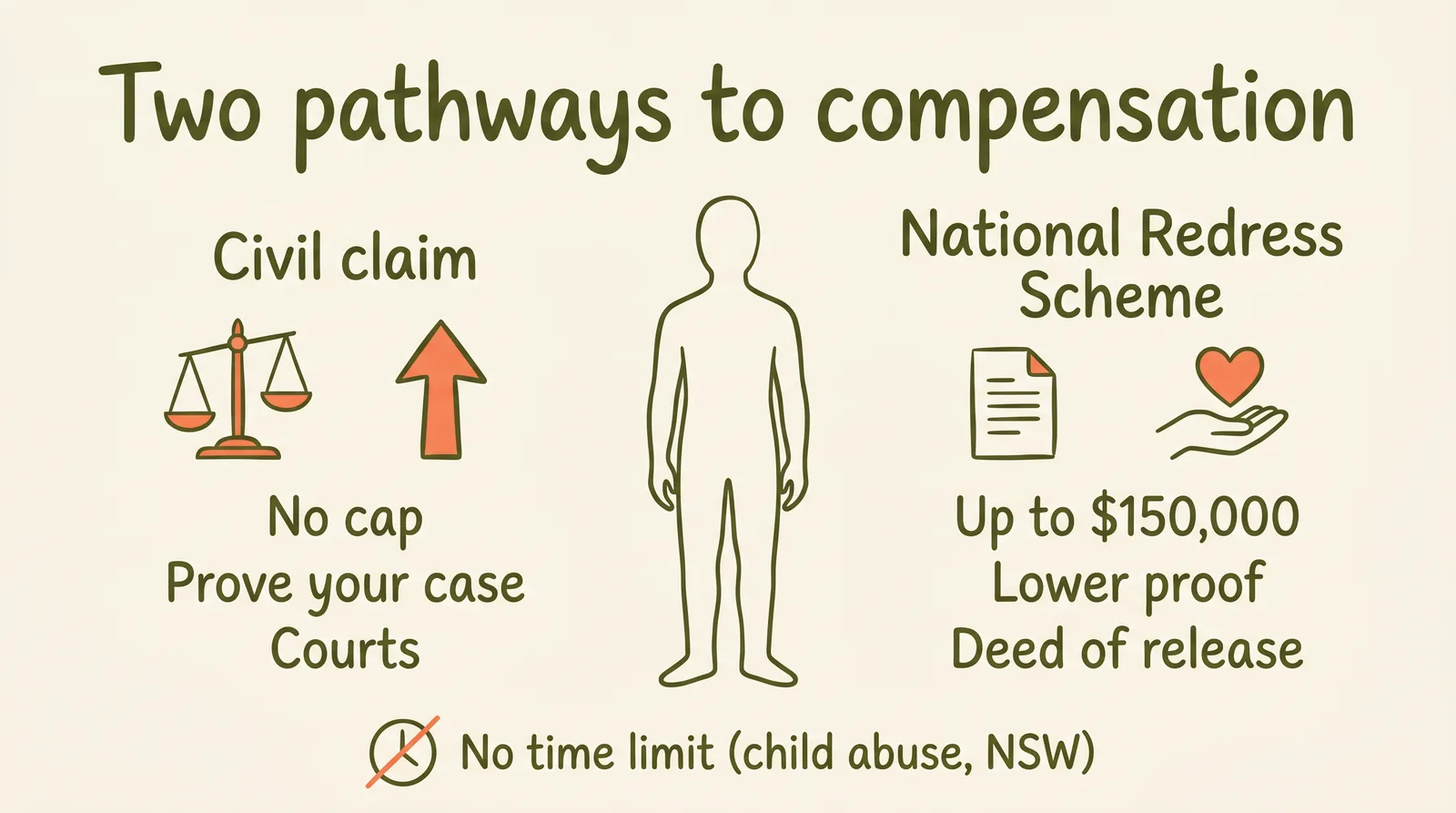
- Two main pathways: a civil compensation claim (no cap, but you must prove your case) or the National Redress Scheme (capped at $150,000, lower proof threshold, but accepting an offer usually ends your right to sue).
- The one thing to do now: get independent legal advice before choosing a pathway or signing anything, the choice can be permanent.
What Counts As Institutional Abuse?
Institutional abuse is abuse that happened while you were in the care, supervision, or control of an organisation. It can be sexual, physical, or psychological, and it usually includes abuse by staff, volunteers, clergy, carers, or others connected to the institution.
The key feature is the connection to an organisation, as the institution had to have responsibility for you, and abuse occurred as a result. Common settings include:
- Churches and religious organisations, such as parishes, dioceses, and religious orders
- Schools and boarding schools, including denominational and state schools
- Sporting and youth organisations, such as clubs, scouts, camps, and youth groups
- Out-of-home care, such as foster care, children’s homes, orphanages, and residential care
- Government institutions, such as juvenile detention, state wards, and defence and training establishments
Abuse in a purely private or family setting is handled differently from institutional abuse, though our lawyers can advise on both. What matters here is that an organisation, not only an individual, may bear legal responsibility.
Who Can Bring A Claim?
A survivor of institutional abuse can bring a claim in their own right. You can act on your own behalf regardless of your age now, and regardless of how long ago the abuse occurred.
In certain situations, others may be able to bring or continue a claim:
- Family members or an estate may, in some cases, continue a claim where a survivor has passed away. The position depends on the circumstances and the type of claim.
- A litigation guardian can act for someone who is unable to conduct proceedings themselves.
If you are supporting a loved one, you cannot generally bring their civil claim for them while they are alive and able to decide for themselves, but you can help them find advice and support. A civil lawyer can explain who is able to act in your specific situation.
Who Is Liable: The Institution, Not Just The Individual
A common and understandable assumption is that the only person who can be sued is the individual who caused the harm. In institutional abuse cases, that is often not where the real responsibility, or the ability to pay compensation, lies.
The institution itself can be held legally responsible. In NSW, there are two main ways this happens under the Civil Liability Act 2002 (NSW), Part 1B:
- Organisational duty of care (breach/negligence). Section 6F imposes a duty on organisations responsible for a child to take reasonable precautions to prevent abuse by someone associated with them. This provision reverses the usual onus of proof: if a survivor shows that an associated individual perpetrated the abuse in connection with the organisation’s responsibility for the child, the organisation is presumed to have breached its duty unless it can prove it took reasonable precautions.
- Vicarious liability. This is the principle that an organisation can be responsible for wrongs committed by its people. In NSW, s 6G extends vicarious liability for child sexual abuse to individuals who are “akin to an employee”, not just formal employees.
There is an important recent development to be aware of. In Bird v DP (a pseudonym) [2024] HCA 41, the High Court held that Australia’s common-law vicarious liability does not extend to relationships that are merely “akin to employment”. Therefore, a true employment relationship is required.
This narrowed one pathway to common law. NSW’s statutory provision (s 6G) was, however, specifically designed to cover the “akin to an employee” situation for child sexual abuse, and the organisational duty in s 6F operates separately. This is exactly the kind of area where the law is technical and evolving, and where advice matters. A lawyer can identify which pathway fits your circumstances.
The Two Pathways: Civil Claim vs National Redress Scheme
There are two main ways to seek compensation for institutional abuse, and they work very differently. Choosing between them is one of the most important decisions in a matter, and it can be permanent.
| Civil compensation claim | National Redress Scheme | |
| What it is | A legal claim through the courts against the institution | A government scheme set up after the Royal Commission |
| Covers | Sexual, physical and psychological institutional abuse | Institutional child sexual abuse (and related non-sexual abuse) that occurred before 1 July 2018 |
| Compensation | No upper limit, reflecting your individual loss and suffering | Payments up to $150,000 (average payments have been around $89,000) |
| Proof | You must prove your case on the balance of probabilities | A lower, “reasonable likelihood” threshold |
| Other elements | Damages award | Payment plus counselling/psychological support and, if wanted, a direct personal response from the institution |
| Effect | You keep the right to pursue full compensation | Accepting an offer means signing a deed of release, so you generally cannot then sue that institution for the same abuse |
| Deadline | No limitation period for child abuse in NSW | Scheme runs to 30 June 2028 |
A civil claim is pursued through the courts and has no cap on compensation. It can better reflect the full impact on your life, including lost income, medical and treatment costs, and pain and suffering. A civil case requires evidence and takes longer, but a lawyer runs the process for you.
The National Redress Scheme is generally faster and has a lower proof threshold, and it includes counselling and a direct personal response. However, it is capped at $150,000 and applies only to institutional child sexual abuse before 1 July 2018. Most importantly, accepting an offer requires signing a deed of release that closes off a civil claim against that institution.
How they interact: because accepting a redress offer usually ends your right to a civil claim, you should get independent legal advice before you apply or accept anything. Applying to the scheme does not, by itself, end your civil rights, but accepting an offer generally does. Which pathway is right depends on your circumstances, the strength of the evidence, and what outcome matters most to you.
Do I need a criminal conviction first?
No. A civil compensation claim and a National Redress Scheme application are entirely separate from the criminal justice system. You do not need the person who abused you to have been charged, prosecuted, or convicted, and you do not need to have made a police report.
Civil claims are decided on the balance of probabilities (more likely than not), which is a lower standard than the criminal “beyond reasonable doubt”. This is one reason many survivors are able to obtain compensation even where a criminal case never proceeded or resulted in an acquittal.
Is There A Time Limit?
For child abuse in NSW, no. Under section 6A of the Limitation Act 1969 (NSW), an action for damages relating to child abuse may be brought at any time and is not subject to any limitation period. This change was made by the Limitation Amendment (Child Abuse) Act 2016 and applies retrospectively, so it covers abuse that happened decades ago.
This was a direct response to the Royal Commission into Institutional Responses to Child Sexual Abuse, which found that time limits were one of the biggest barriers stopping survivors from coming forward. Our Principal Lawyer, Peter O’Brien, acted in this commission, assisting in questioning at a Sydney hearing of the Royal Commission into Institutional Responses to Child Abuse.
A few points to keep in mind:
- The removal of the limitation period is broad and covers child sexual abuse, serious physical abuse, and connected abuse.
- Courts still have some case-management powers (for example, the ability to consider whether a fair trial is possible after a very long delay). This does not reintroduce a deadline, but it is a reason not to wait longer than you need to.
- For the National Redress Scheme, the practical deadline is the scheme’s end date of 30 June 2028.
If your matter does not involve child abuse (for example, abuse as an adult in institutional care), different rules can apply, and a lawyer can confirm where you stand.
Your Rights And What You Can Do Now
Remember, you are in control of this process. Understanding your rights can take some of the fear and uncertainty out of the first step.
You have the right to:
- Come forward at any time. There is no time limit for child abuse claims in NSW, and no requirement to have reported earlier.
- Confidentiality. You can seek advice privately. Court proceedings involving sexual offences carry legal protections for complainants, and settlements are frequently confidential. You will not be named publicly simply for making an inquiry.
- Choose your pathway. No one can force you into the National Redress Scheme or a civil claim. You decide, with advice.
- Free, independent support. knowmore is a free, confidential and independent legal service for people considering the National Redress Scheme (1800 605 762). Redress Support Services and counselling are also available.
Practical steps that can strengthen your position:
- Write down what you remember, in your own time. Names of the institution, approximate dates, locations, and who was in a position of responsibility. You do not need graphic detail. A factual outline is enough to start.
- Gather any documents you already have. School or care records, enrolment details, photographs, letters, or anything that places you at the institution during the relevant period. You do not need everything up front, as a lawyer can help obtain records.
- Note the impact on your life. Effects on your health, relationships, education, and work may all be relevant to compensation.
- Get advice before signing or accepting anything, especially before applying to or accepting a National Redress Scheme offer, because it can permanently close off other options.
- Look after yourself. Support services exist for exactly this. You do not have to go through the process alone.
How A Civil Lawyer Could Help Your Case
Institutional abuse claims are among the more difficult areas of civil law, and having a solicitor act for you can make a significant practical difference. A lawyer does the heavy lifting so you do not have to relive the details repeatedly or deal with institutions and government schemes on your own.
Depending on your circumstances, a solicitor may be able to:
- Assess which pathway is right for you, comparing a civil claim against a National Redress Scheme application, including the trade-off between the redress cap and an uncapped civil claim, before you commit to either.
- Identify who is legally responsible, working out whether the organisation can be pursued through the s 6F organisational duty (with its reverse onus) or vicarious liability under s 6G, and which entity is the correct defendant where structures have changed over time.
- Gather and preserve evidence, obtaining institutional, care, school, and medical records, and taking your account sensitively and once, rather than repeatedly.
- Handle the institution and its insurers, so you are not negotiating directly with the organisation involved.
- Negotiate a settlement or run the matter. Many claims resolve by negotiation, and a lawyer will advise on whether an offer is fair for your circumstances.
- Protect your rights around redress, reviewing any deed of release before you sign, so you understand what you may be giving up.
Outcomes always depend on the individual facts, and no solicitor can promise a particular result. However, experienced representation means your claim is prepared properly and your options are fully explained.
What Can Compensation Cover?
Compensation in a civil claim is intended to recognise the harm caused and its ongoing effects. Depending on your circumstances, it may include:
- Pain, suffering, and loss of enjoyment of life
- Past and future economic loss, including reduced earning capacity where the abuse affected your education or working life
- Treatment and care costs, such as counselling, psychological and medical treatment, both past and future
- Out-of-pocket expenses connected to the abuse and its effects
As a civil claim has no upper limit, it can reflect your individual loss more fully than a capped redress payment. The National Redress Scheme, by contrast, provides a single payment (up to $150,000) plus counselling and, if you want it, a direct personal response from the institution. What is realistically achievable depends on the evidence and the circumstances of each matter.
Confidentiality And Privacy
Privacy is often one of the biggest concerns for survivors, and it is a legitimate one. A few reassurances:
- Your enquiry is confidential. Speaking to a solicitor is private and does not commit you to anything.
- Legal protections apply. In proceedings involving sexual offences, there are legal protections around identifying complainants.
- Settlements are often confidential. Many institutional abuse matters resolve on confidential terms.
- You control what happens next. Nothing proceeds without your instructions.
Frequently Asked Questions
Can I make a claim if the abuse happened decades ago?
Yes. For child abuse in NSW, there is no limitation period. A claim can be brought at any time under s 6A of the Limitation Act 1969 (NSW), and the change applies retrospectively. Many successful claims involve abuse from many years or decades earlier.
Do I need to have reported the abuse to the police?
No. A civil claim and a National Redress Scheme application are separate from the criminal process. You do not need to have made a police report, and you do not need a criminal charge or conviction.
Can I sue the institution, or only the individual?
In most cases, the institution. In NSW, organisations can be held responsible through an organisational duty of care (with a reverse onus of proof) or through vicarious liability. This matters because the institution is usually the party with the responsibility, and the means, to pay compensation.
What’s the difference between the National Redress Scheme and suing?
The National Redress Scheme is a government scheme with a lower proof threshold and a payment cap of $150,000, plus counselling and a direct personal response, but accepting an offer generally ends your right to sue that institution. A civil claim has no cap and can better reflect your individual loss, but requires evidence and takes longer. Independent advice before choosing is strongly recommended.
Will I have to go to court?
Not necessarily. Many institutional abuse claims resolve through negotiation or settlement without a full hearing. If a matter does proceed to court, your lawyer prepares and runs it for you, and legal protections apply to complainants in sexual-offence-related proceedings.
Is it free to get advice or apply for redress?
Getting an initial view of your options need not be costly. knowmore is a free, independent legal service for people considering the National Redress Scheme (1800 605 762). For civil claims, some abuse matters may be handled on a No Win, No Fee basis. This is assessed case by case, and eligibility and cost arrangements are explained up front.
Can I still apply for redress if I’ve already received a payment before?
Possibly. Any prior payment related to the same abuse is generally taken into account and deducted from a redress amount. Because the interaction between prior payments, redress, and civil claims can be complex, this is best checked with a lawyer.
How O’Brien Criminal & Civil Solicitors Can Help
O’Brien Criminal & Civil Solicitors acts for survivors of institutional abuse, pursuing compensation against the churches, schools, care providers, sporting and youth organisations, and government bodies responsible. Our team has extensive experience in institutional and historical abuse claims. Our civil lawyers have acted in some of the most notable institutional abuse cases in the country.
We will explain your options clearly, including the important trade-off between the National Redress Scheme and a civil claim, help you identify the right pathway, and take on the institutions and their insurers so you do not have to.
Request initial advice (no-obligation) via the form below or call us on (02) 9261 4281.