

If someone has said or written something untrue that has damaged your reputation, you may be wondering whether you have a case for “slander”, “libel” or “defamation”, and which one applies to you. It is a natural question, because these three words get used interchangeably online, in the media, and in imported American TV shows.
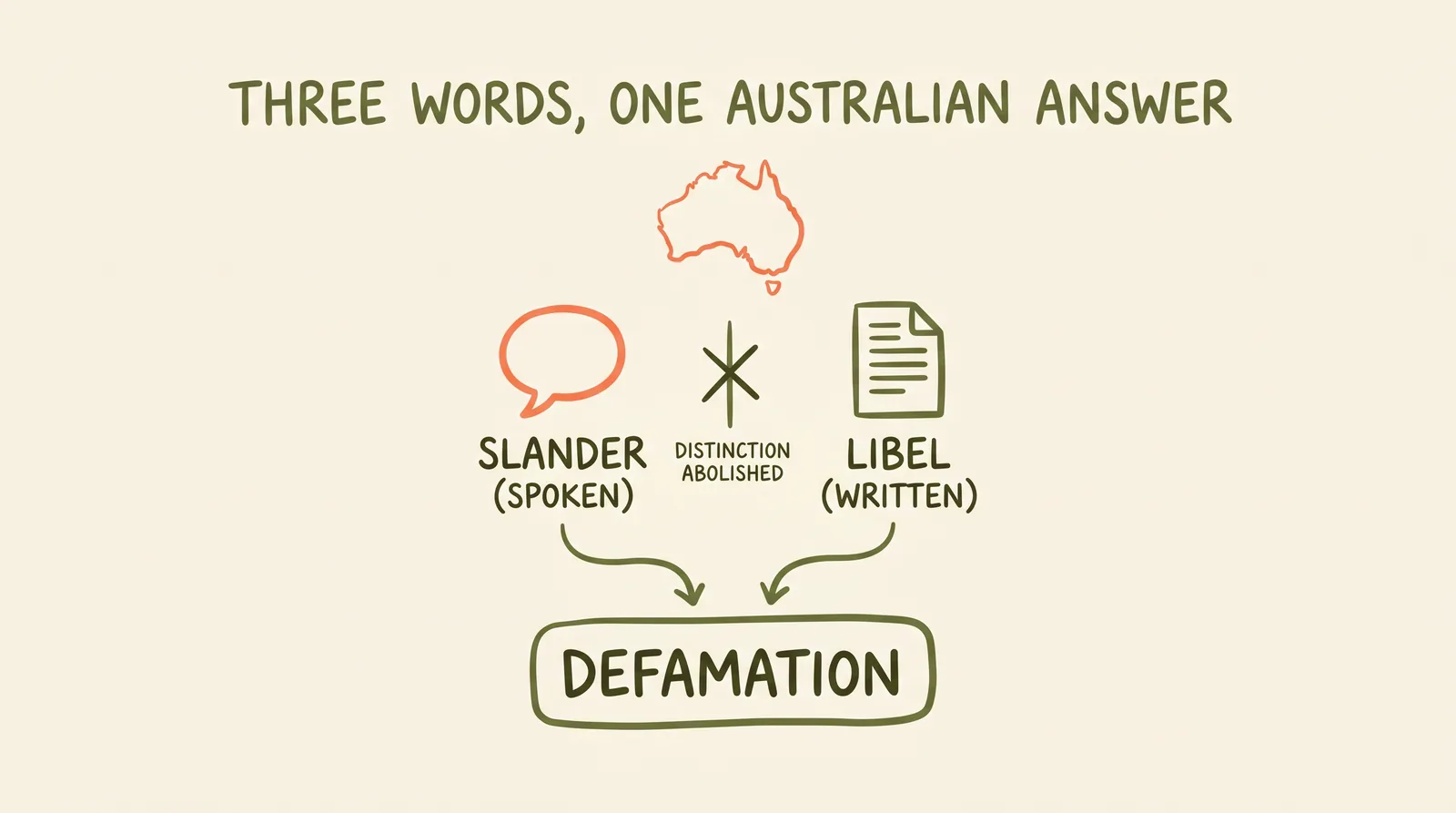
Here is the short version: in Australia, there is no legal difference between slander and libel. Both are simply “defamation”. The old distinction that still matters in the United States was abolished here decades ago.
This guide explains what each term means, why the split still exists overseas, why people keep searching for it. We’ll also run through what you actually have to prove if you want to take action over something that has harmed your good name.
At a glance
- Defamation is the Australian legal term that covers everything: spoken, written, online, or broadcast.
- Slander (spoken) and libel (written) are older labels. Australia abolished the distinction between them.
- You don’t need to work out which one applies. If your reputation has been seriously damaged by an untrue statement, the question is simply whether you have a defamation claim.
- Key deadline: defamation actions generally must be started within one year of publication.
- The one thing to do now: don’t respond publicly or delete anything. Get legal advice quickly, because the time limit is short.
What Is Defamation?
Defamation is the publication of an untrue statement that damages a person’s reputation in the eyes of others. It is the umbrella term Australian law uses for all such harm to reputation, whatever form the statement takes.
It doesn’t matter whether the statement was shouted across a room, printed in a newspaper, posted on Facebook, left in a Google review, or read out on radio. Australian law treats them the same way and calls them all defamation.
The law is set out in the Defamation Act 2005 (NSW) and near-identical Acts in every other state and territory. It is a deliberately uniform national scheme, so the core rules are the same wherever in Australia you live.
For a full explainer of how a defamation claim works, see our What is Defamation fact sheet and the main defamation guide.
What Is Slander?
Slander is the older term for spoken, or “transient”, defamation: words said out loud that were not recorded in any lasting form. A defamatory comment made in a conversation, a speech, or a phone call is what the common law once called slander.
The idea behind the label was that spoken words are fleeting: they are said and gone. Historically, courts treated spoken defamation as less serious than written defamation for that reason. In the past, it often required the person suing to prove they had suffered an actual, measurable loss.
In Australia today, “slander” has no separate legal status. A spoken defamatory statement is just defamation.
What Is Libel?
Libel is the older term for written, or “permanent”, defamation: words fixed in a lasting form. A defamatory statement in a letter, a newspaper article, an email, or a social media post is what the common law once called libel.
As written words last and can be re-read and re-shared, courts historically treated libel as more serious than slander. In general, courts allowed a person to sue without having to prove a specific financial loss.
Like slander, “libel” carries no separate legal meaning in Australia now. Written defamation is, again, simply defamation.
The Key Point: Australia Abolished The Slander/Libel Distinction
This is the single most important thing to understand: in Australian law, the difference between slander and libel no longer exists.
Section 7 of the Defamation Act 2005 (NSW), under the heading “Distinction between slander and libel abolished”, states that the distinction at general law between the two is abolished. Now, the publication of defamatory matter of any kind is actionable without proof of special damage.
In plain English, “actionable without proof of special damage” means you don’t have to prove you lost money or suffered a specific financial hit before you can bring a claim. Whether the statement was spoken or written, it is treated the same way.
| Slander (old term) | Libel (old term) | Australia today | |
| Form | Spoken / transient | Written / permanent | Any form: spoken, written, online, broadcast |
| Legal name | Slander | Libel | Defamation |
| Separate rules? | Once treated as less serious | Once treated as more serious | No, one set of rules for all |
| Where it still matters | US law (and partly UK) | US law (and partly UK) | Not in Australia |
As the Act is a uniform scheme adopted across all states and territories, this is the position throughout Australia, not just in New South Wales.
Why Do People Still Search For “Slander vs Libel”?
Mostly because of American law and media. The slander/libel split is alive and well in the United States, so it appears constantly in US news, courtroom dramas, and online explainers.
There are a few reasons the terms persist here:
- The US still uses them. As mentioned, American law keeps meaningful differences between libel and slander, so US content treats the distinction as important.
- They’re in everyday language. People reach for “slander” for something said and “libel” for something written, out of habit rather than law.
- They sound more specific. When someone feels wronged, “I’ve been slandered” or “that’s libel” can feel like a precise accusation. However, legally, the Australian question is just whether it was defamatory. Or whether you have been defamed.
None of this changes the Australian position. If you are in Australia, the practical question is not “was it slander or libel?” but “do I have a defamation claim?“
What You Have To Prove For A Defamation Claim In Australia
To bring a defamation claim, you generally need to establish three core elements, plus a threshold of serious harm. These apply regardless of whether the statement was spoken or written.
The three core elements are:
- Publication: The statement was communicated to at least one person other than you. It doesn’t need to reach a large audience; one other person can be enough.
- Identification: The statement is about you, or people who saw or heard it could reasonably understand it to be about you (you don’t have to be named).
- Defamatory meaning (imputation): The statement carries a meaning that lowers your reputation, exposes you to ridicule, or causes people to shun or avoid you.
On top of those, the serious harm requirement now applies. Section 10A of the Defamation Act 2005 (NSW), makes it an element of the claim that the publication has caused, or is likely to cause, serious harm to your reputation. The person suing must prove this, and a judge (not a jury) decides whether the threshold is met. For a company, harm is not “serious” unless it has caused, or is likely to cause, serious financial loss.
The reforms were designed to filter out trivial or spiteful claims. It means the label, slander or libel, was never the real question.
To bring a defamation claim, the real questions are:
- Was the statement published?
- Was it about you?
- Was it defamatory?
- And did the statement do serious damage?
Your Rights And What You Can Do Now
If you believe you have been defamed, a few early steps protect your position, and the clock is already running.
- Act quickly. In NSW, the limitation period is generally one year from the date of first publication (a court can extend this by up to three years, but only where it is just and reasonable, so don’t rely on it). As it’s so short, delay is one of the biggest risks to a defamation claim.
- Preserve the evidence. Take dated screenshots of posts, reviews, messages, or articles. Save URLs. Note who saw or heard the statement. If it was spoken, write down what was said, when, where, and who else was present, while it’s fresh.
- Don’t retaliate. Publicly hitting back, or making your own false statements about the other person, can create a defamation claim against you. Resist the urge to fire off a response.
- Don’t tip them off to delete. Confronting the publisher before evidence is preserved can prompt them to take material down. Capture it first.
- Understand the first formal step. Under the current law, sending a concerns notice (a formal document setting out what was published and why it is defamatory) is generally required before court proceedings can begin. It gives the other side a chance to make amends and can resolve matters without litigation. Getting this document right matters, so it’s worth legal input.
- Weigh whether it’s worth it. Not every hurtful comment clears the serious-harm threshold. Part of getting advice early is an honest assessment of whether a claim is likely to succeed and be worth pursuing.
How A Defamation Lawyer Could Help Your Case
A defamation solicitor’s first job is to tell you honestly whether you have a viable claim and, if you do, to move fast before the time limit closes. As the one-year period is short and the serious-harm test now sets a real bar, early advice can be the difference between a claim that proceeds and one that’s lost on a technicality.
Depending on the circumstances, a defamation solicitor can:
- Assess the merits. Review the statement against the elements (publication, identification, defamatory imputation) and the serious-harm threshold, so you know where you stand before spending money.
- Draft the concerns notice. Prepare the formal notice correctly, setting out the imputations precisely, which is both a legal precondition and often the fastest route to a resolution.
- Negotiate an outcome. Pursue an apology, a correction, removal of the material, and/or compensation without the cost and stress of a full trial.
- Preserve and gather evidence. Secure the publication, identify who it reached, and build the record needed to prove harm.
- Run the claim. If it can’t be resolved, prepare and conduct the proceedings, and respond to any defences the other side raises.
For the defences that can be raised, and the compensation a court may award, see our fact sheets on defences to defamation and defamation damages in Australia.
Every matter turns on its own facts, and no solicitor can promise a particular result. What early advice does is give you a clear-eyed view of your options.
Frequently Asked Questions
Is there a difference between slander and libel in Australia?
No. Australian law abolished the distinction. Both spoken (“slander”) and written (“libel”) statements are simply treated as defamation. Australia has a uniform Defamation Act that applies across every state and territory.
Is slander the same as defamation?
Effectively, yes, in Australia. “Slander” is an old word for spoken defamation. As the slander/libel distinction was abolished, spoken defamation is just defamation here. The term still has a separate meaning in the United States, which is why it’s so widely used online.
Which is worse, slander or libel?
Historically, libel (written, permanent) was treated as more serious than slander (spoken, fleeting), and written defamation could be sued without proving financial loss. In Australia that hierarchy no longer exists. All defamation is treated the same, and none of it requires proof of special damage.
Can I sue for something someone said about me verbally?
Potentially, yes. Spoken defamation is actionable in Australia, provided the statement was published to at least one other person, identified you, carried a defamatory meaning, and caused (or is likely to cause) serious harm to your reputation. The practical challenge is proof: it’s harder to evidence spoken words than a written post, so record the details early.
What about something posted online: is that libel or defamation?
In Australia it’s simply defamation. Social media posts, reviews, blog comments, and emails are all written forms that would once have been called “libel”, but the law treats them as defamation like any other statement. Online defamation is one of the most common types of claim today.
How long do I have to take action for defamation?
Generally one year from the date the material was first published. A court can extend this by up to three years, but only where it decides it is just and reasonable to do so. Because the standard period is short, it’s important to get advice promptly.
Do I have to prove I lost money?
No. Under section 7 of the Defamation Act, defamation is “actionable without proof of special damage”, so you don’t have to show a financial loss to bring a claim. You do, however, now have to show the publication caused, or is likely to cause, serious harm to your reputation.
How O’Brien Criminal & Civil Solicitors Can Help
O’Brien Criminal & Civil Solicitors is an established Sydney firm with a dedicated defamation practice, acting for people whose reputations have been damaged online, in the media, and in the workplace. Because defamation’s one-year time limit is unforgiving and the serious-harm test now sets a genuine bar, we focus on giving you a straight assessment early: whether you have a claim, and what the realistic options are.
Our team can prepare a concerns notice, negotiate an apology, correction or compensation, and run the matter if it can’t be resolved. We always tailor our advice to the facts of your specific situation, never with a promised result.
Request initial advice (no-obligation) via the form below or call us on (02) 9261 4281.