
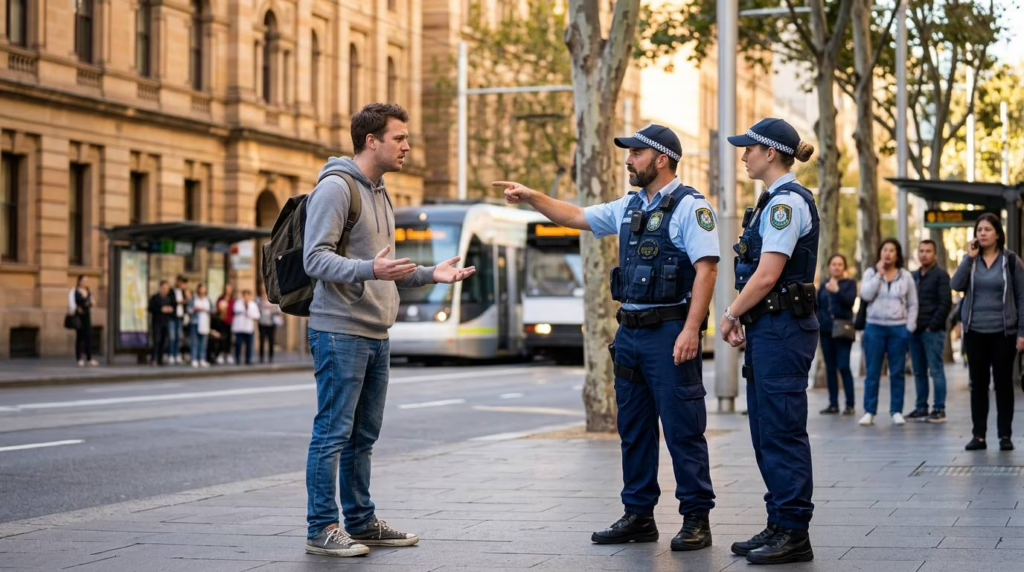
Being charged after an encounter with police is a stressful experience. NSW has several offences involving police, with different penalties, and each depends on the officer acting within their legal powers.
This guide explains the offences, the penalties, move-on directions, what you must tell police, the defences that may be available, and what to do next.
At a glance
- The most common charge: hindering or resisting a police officer in the execution of their duty, under s 60(1AA) of the Crimes Act 1900 (NSW). Maximum 12 months’ imprisonment and/or a fine of 20 penalty units ($2,200).
- Assaulting police: penalties range from 5 to 14 years’ imprisonment depending on the harm caused and whether it occurred during a public disorder. Some of these offences can be dealt with in the Local Court unless an election is made for a higher court.
- Ignoring a move-on direction: a fine of 2 penalty units ($220), and only if police followed the required steps and you kept up the behaviour.
- Where it’s heard: hindering or resisting police under s 60(1AA) is dealt with in the Local Court. Some assault-police offences can also be dealt with in the Local Court unless an election is made for a higher court.
- Do now: say nothing more about the incident, write down what happened, and get legal advice before your first court date.
What are the offences against police in NSW?
NSW law makes it an offence to hinder, resist, assault or threaten a police officer who is carrying out their duty, and the penalty depends on the conduct. The main offences are in s 60 of the Crimes Act.
Others sit in the Law Enforcement (Powers and Responsibilities) Act 2002 (NSW), known as LEPRA.
| Offence | Section | Maximum penalty |
|---|---|---|
| Hinder or resist a police officer, or incite another person to | Crimes Act s 60(1AA) | 12 months and/or 20 penalty units ($2,200) |
| Assault, throw a missile at, stalk, harass or intimidate a police officer (no actual bodily harm) | s 60(1) | 5 years |
| The same, during a public disorder | s 60(1A) | 7 years |
| Assault occasioning actual bodily harm | s 60(2) | 7 years |
| The same, during a public disorder | s 60(2A) | 9 years |
| Wound or cause grievous bodily harm, reckless as to actual bodily harm | s 60(3) | 12 years |
| The same, during a public disorder | s 60(3A) | 14 years |
| Hinder or obstruct a person helping an officer who is being hindered | s 60AC | 12 months and/or 20 penalty units |
| Fail to comply with a move-on direction | LEPRA s 199 | 2 penalty units ($220) |
| Fail to disclose identity, or give a false name or address | LEPRA ss 12 and 13 | 2 penalty units each ($220) |
A separate offence in s 58 covers assaulting someone with intent to commit a serious indictable offence, or with intent to resist or prevent their lawful apprehension. It carries a maximum of 5 years’ imprisonment.
An older provision, s 546C, was repealed in 2022. If you see it quoted on another website, the offence is now s 60(1AA).
What does hindering or resisting police mean?
Hindering or resisting police means doing something that obstructs or opposes an officer who is carrying out their duty. The prosecution must prove the officer was acting in the execution of their duty at the time.
Also, the law does not define “hinder” or “resist”, so the facts of what you did decide whether the charge is made out.
Three points matter:
- An officer off duty can still be covered. Under s 60(4), an action is treated as against an officer in the execution of their duty if it is done in retaliation for what they did on duty, or because they are a police officer.
- Asking questions is not a crime. Asking why police are doing something, whether you are free to leave, or declining to answer questions is not, on its own, hindering or resisting.
- Lawfulness can be central. The officer must have been acting in the execution of their duty. If police acted outside their legal powers, that may affect whether the prosecution can prove this element. A lawyer should examine the basis for any stop, direction or arrest.
When can police give a move-on direction?
Police can give a move-on direction only in limited situations under s 197 of LEPRA, and the direction must be reasonable. It usually tells you to leave a public place and not return for a set time.
Under s 197, an officer needs to believe on reasonable grounds that your behaviour or presence:
- is obstructing another person or traffic
- is harassment or intimidation of someone
- is causing or likely to cause fear to a person of reasonable firmness
- is for the purpose of supplying, or soliciting others to supply, a prohibited drug
- is for the purpose of obtaining or buying a prohibited drug that it would be unlawful for you to possess.
The direction must also be reasonable for the purpose of reducing the obstruction, harassment or fear, or stopping the drug activity. A separate power in s 198 applies to intoxicated people in public places, with a ban on returning for up to 6 hours.
What police must do before you can be charged
You cannot be charged with failing to comply with a direction unless police gave you the information and warning that the law requires. Under s 202, the officer must:
- show evidence they are a police officer (unless in uniform)
- give their name and place of duty
- give the reason for the direction.
Under s 203 they must also warn you that you are required by law to comply. Section 204B says that, without those steps, a failure to comply is not an offence.
Even then, s 199(2) says you are not guilty unless you persisted in the behaviour after the direction was given.
Do move-on powers apply to protests?
Generally no, with exceptions. Section 200 says move-on powers do not authorise a direction about an apparently genuine demonstration, protest, procession or organised assembly, or about an industrial dispute. The exceptions include:
- a serious risk to the safety of a person
- an unauthorised assembly that is obstructing traffic, where the senior officer at the scene has authorised directions, limited to the people obstructing traffic
- specific conduct near a place of worship under s 200AA.
The law in this area has changed recently. The Act’s own note records that the NSW Court of Appeal declared s 200(5) (public assembly restrictions under terrorism laws) invalid on 16 April 2026. If your charge came from a protest, get advice on the version of the law that applied on the day.
What must you tell police?
You only have to give your identity in limited situations. Beyond that, you generally have the right to silence. Under s 11 of LEPRA, police can require you to disclose your identity if it is unknown to them and either:
- they reasonably suspect you may be able to assist in investigating an alleged indictable offence because you were at or near the place before, when, or soon after it happened, or
- they are about to give you a move-on direction.
Refusing, without reasonable excuse, is an offence under s 12. So is giving a false name or address under s 13. Drivers have further duties under other provisions.
You do not have to answer other questions about an allegation. Our guide to police questioning in NSW explains how to say so and what to expect at an interview.
What are the possible defences?
Defences depend on the facts. Most cases turn on whether police acted lawfully and what you actually did.
- The officer was not acting in the execution of their duty. If police went beyond their powers, for example by arresting without a lawful basis, the element may not be made out. Our guide to police arrests sets out the test for arrest in s 99 of LEPRA.
- The direction was not lawful. It may not have met a ground in s 197, may not have been reasonable, may have concerned a protest covered by s 200, or may have skipped the warning required by ss 202, 203 and 204B.
- You did not persist. For a failure to comply charge, you are not guilty unless you kept up the behaviour after the direction (s 199(2)).
- Reasonable excuse. A medical condition, disability or physical limit that stopped you complying may count.
- Self-defence. For assault police charges, s 418 of the Crimes Act applies if you believed your conduct was necessary to defend yourself or another person and it was a reasonable response. Under s 419 the prosecution must disprove it beyond reasonable doubt.
- Excessive force. Police may use only force that is reasonably necessary under ss 230 and 231 of LEPRA. Force beyond that may be relevant to whether the officer was acting lawfully, and to your response.
- The conduct did not reach the threshold, or the wrong person was charged. Not every uncooperative act is hindering. In crowds, identification can be wrong, and footage, CCTV and witnesses can matter.
What are the penalties in practice?
The maximums above are for the worst cases. Courts look at what happened, the harm caused, your history and your circumstances. For hindering or resisting under s 60(1AA), the Local Court can impose a fine, a section 10 dismissal (no conviction recorded), a conditional release order or a community correction order, as well as a prison sentence in serious cases. A conviction can affect work, professional licences and travel.
Assault police offences are treated more seriously because the law protects officers carrying out their duty. The more serious tiers can be dealt with in higher courts.
Your rights and what you can do now
Protect yourself at the scene, then protect your position afterwards.
At the scene:
- Stay calm and do not physically resist. You can challenge the lawfulness of what police did afterwards, in court.
- Ask: “Am I under arrest, or am I free to leave?” and “Which power are you using?”
- Give your name and address if the law requires it, and nothing else about the allegation.
- Say: “I wish to remain silent and I want a lawyer.”
- Note the officers’ names, badge numbers and vehicle, and who saw it.
Afterwards:
- Write down everything you remember while it is fresh: what was said, what direction was given and by whom, and what you did.
- Keep evidence: photos of any injuries, video, messages and the names of witnesses.
- Check your Court Attendance Notice for the date, time and court.
- Do not discuss the incident publicly or online.
- Get advice before you enter a plea. A guilty plea can close off a defence about police conduct.
How a lawyer could help your case
A lawyer will first test whether the police acted within their powers, then whether the prosecution can prove each element. This is often where these cases are won or lost.
A lawyer may:
- review the police brief, including body-worn camera footage that police hold, and test the officers’ accounts
- raise defences such as unlawful direction, no persistence, reasonable excuse or self-defence
- negotiate with the prosecution to withdraw or downgrade a charge where the evidence does not support it
- argue for a non-conviction outcome, such as a section 10 dismissal, where you are sentenced
- advise on a complaint to the Law Enforcement Conduct Commission, or on a civil claim if police acted unlawfully. See our guides on police misconduct complaints and suing NSW Police for unlawful arrest.
Each case turns on its own facts, and no outcome can be promised.
Frequently Asked Questions
Do I have to give police my name and address?
Sometimes. Police can require your identity under s 11 of LEPRA in limited situations, such as when you may be able to help with an indictable offence investigation or before a move-on direction. Refusing without reasonable excuse, or giving false details, can be an offence carrying 2 penalty units each.
Is asking police to explain their powers an offence?
No. Asking why police are acting, or whether you are free to leave, is not hindering or resisting on its own. Stay calm and polite, and do not obstruct them.
Is swearing at police an offence?
It depends on the context. Swearing alone is not hindering or resisting under s 60(1AA), but offensive language in public can be dealt with under other offences. Threats or intimidation can lead to more serious charges.
Can I be charged if police acted unlawfully?
Yes, you can be charged, but unlawful conduct can be a strong defence. If the officer was not acting in the execution of their duty, an element of the offence may not be made out. This is why the police brief needs careful review.
What if police used excessive force?
Get medical attention, photograph any injuries and write down what happened. Police may use only reasonably necessary force. A lawyer can advise on a defence, a complaint and any civil claim.
Will I go to prison if I’m convicted?
Not necessarily. The maximums are reserved for the worst cases. Courts consider the conduct, your history and your circumstances, and options such as a fine or a non-conviction outcome exist for lower-level matters.
Can the charges be withdrawn?
Sometimes. If the evidence does not support an element, or footage contradicts the police account, the prosecution may withdraw or downgrade a charge. This depends on the evidence in your case.
What evidence do police use?
Officer statements, body-worn camera footage if available, CCTV, witness statements and medical records. Your lawyer can request the police brief and review it with you.
How O’Brien Criminal & Civil Solicitors can help
The lawfulness of police conduct is at the centre of most of these charges, and it takes careful work with the police brief to test it. O’Brien Criminal & Civil Solicitors is a specialist criminal defence firm, led by an Accredited Specialist in Criminal Law, with more than 20 years’ experience acting from the first contact with police. We have extensive experience with charges arising from protests and public order incidents.
Request initial advice (no-obligation) via the form below or call us on (02) 9261 4281.
This content is for general information purposes only and does not constitute legal advice. You should seek independent legal advice relevant to your specific circumstances.