
If SafeWork NSW has charged you or your company with a Category 1 workplace health and safety offence this is a very serious offence. You are facing one of the most serious WHS charges in NSW under the Work Health and Safety Act.
You are facing the most serious WHS charge in NSW under the Work Health and Safety Act, short of industrial manslaughter (and separate manslaughter charges under the Crimes Act may also be possible where a death occurs). This is a criminal case in a NSW court, not just a notice or a fine you can pay and move on from.
Many directors, officers, and safety managers charged with a Category 1 offence still think of it purely as a “recklessness” charge. NSW law now also catches gross negligence, which does not require proof the defendant actually knew about the risk. That distinction changes how a Category 1 matter should be approached from the first contact with SafeWork NSW.
This guide explains what a Category 1 offence is, what “reckless or grossly negligent” conduct means, and how it differs from Category 2 and Category 3 breaches. It also covers what defences may be available and what to do if you are under investigation or have already been charged.
At a glance
- Maximum penalty (current, indexed annually): an officer or individual PCBU faces up to 10 years’ imprisonment and/or a fine of about $2.32 million; other individuals (such as some workers) face up to 10 years’ imprisonment and/or a fine of about $1.11 million; a body corporate faces a fine of about $11.15 million. These figures are indexed each 1 July, so always confirm the current amount with SafeWork NSW or your lawyer. These figures rise each year through indexation, so always confirm the current amount with SafeWork NSW or your lawyer.
- Fault element: since a 2020 amendment, Category 1 can be proven by either recklessness or gross negligence. The prosecution no longer has to show you actually knew about the risk.
- Court: prosecuted as a criminal offence in a NSW criminal court; serious Category 1 matters are typically heard in the District Court on indictment
- The one thing to do now: do not give SafeWork NSW investigators a statement, formal or informal, before getting legal advice. Preserve every document connected to the incident.
What Is a Category 1 WHS Offence?
A Category 1 offence is the most serious category of breach under the Work Health and Safety Act 2011 (NSW), created by section 31. NSW’s WHS Act mirrors the national model WHS law but is its own NSW statute, enforced by SafeWork NSW and prosecuted in NSW courts. It is not a Commonwealth offence.
Section 31 applies to a “person conducting a business or undertaking” (PCBU), officers of that business, and workers. The offence happens when a person who has a work health and safety duty does something (or fails to do something) that breaks that duty, puts another person at risk of death or serious injury or illness, and does so in a way that is reckless or grossly negligent.
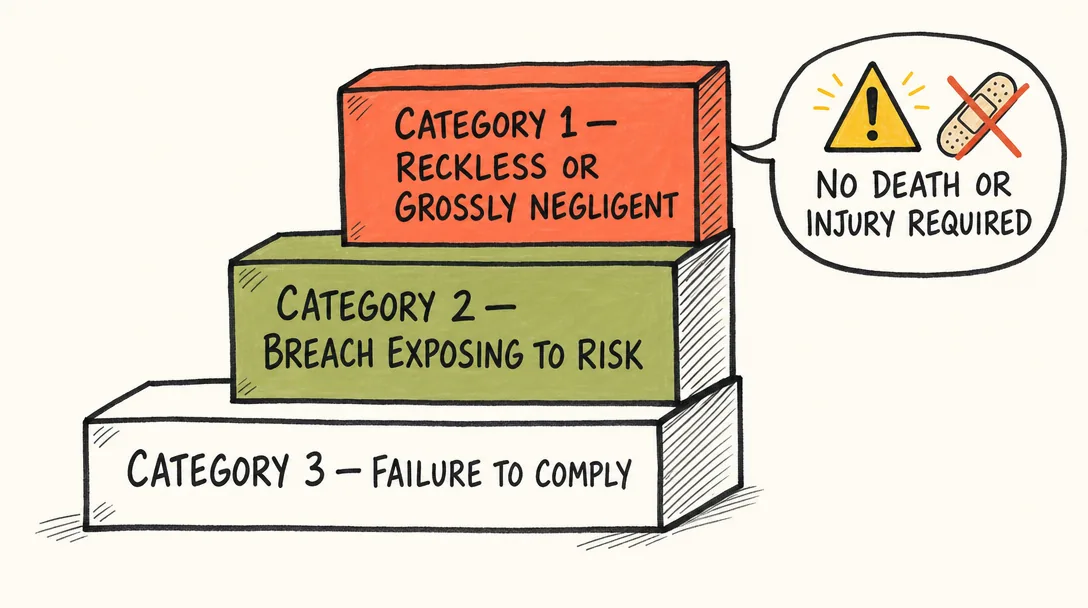
The key point people miss: the offence does not require that anyone actually died or was injured. The law targets the exposure to risk, not the outcome. Someone can be reckless or grossly negligent, expose a worker to a serious risk, and the worker can walk away unhurt. The Category 1 offence is still complete.
Also worth knowing: since 2024, NSW has a separate, even more serious offence of industrial manslaughter (Part 2A of the Act) for cases where a PCBU or officer’s grossly negligent conduct actually causes a worker’s death. A Category 1 charge is not that offence, but SafeWork NSW’s initial investigation into a serious incident often has to consider both.
What Does “Reckless or Grossly Negligent” Conduct Actually Mean?
This is the single most misunderstood part of a Category 1 charge, and the 2020 amendment made it more complicated, not less. The prosecution now has two separate ways to prove the offence.
Path 1: recklessness. The prosecution must prove:
- The person knew there was a real and likely risk of death or serious injury or illness to another person (or did not care whether that risk existed).
- The person failed to take the steps reasonably available to manage that risk.
- Taking the risk was unjustifiable in the circumstances.
Path 2: gross negligence. Added in 2020, this path does not require proof that the defendant actually knew about the risk. The prosecution only has to show that the defendant’s behaviour was so far below what a reasonable person would do in the same situation that it was a clear and serious failure to take proper care. It is a much higher bar than ordinary negligence, but one that does not depend on what was going on in the defendant’s head.
The practical effect of adding gross negligence is that SafeWork NSW no longer has to prove actual awareness to secure a Category 1 conviction. A case built entirely on “the risk was so obvious that failing to see it was itself grossly negligent” can succeed even without evidence the defendant knew.
Who Can Be Charged?
Category 1 charges can be brought against:
- A PCBU: any person conducting a business or undertaking, whether an individual, company, trust, or partnership.
- An officer: a director, secretary, or anyone else who occupies a position that lets them make decisions affecting a substantial part of the business.
- A worker: including employees, contractors, and labour-hire staff.
- A volunteer, in the limited workplace contexts the Act covers.
Most Category 1 prosecutions target the PCBU (the company) and, separately, one or more officers personally. If SafeWork NSW has charged an officer, it is usually because the investigation found evidence that a specific individual either knew about a significant risk and ignored it, or that the failure to identify an obvious risk was itself grossly negligent.
Category 1, 2, and 3 Offences Compared
NSW’s WHS Act sets three tiers of offence. The fault element the prosecution must prove, and the penalties that follow, both escalate up the tiers. Figures below are current at the time of writing and are indexed annually, so treat them as indicative and confirm the exact current amount before relying on them.
| Element | Category 1 | Category 2 | Category 3 |
|---|---|---|---|
| Fault element required | Reckless or grossly negligent | No recklessness needed, just a breach of duty that exposes a person to risk | No fault element, simple failure to comply with a duty |
| Risk level | Death or serious injury/illness | Death or serious injury/illness | Any breach of a WHS duty, regardless of risk level |
| Max penalty, officer/PCBU | Up to 10 years’ imprisonment and a fine of roughly $2.3 million | A substantial fine (no imprisonment) | A smaller fine (no imprisonment) |
| Max penalty, other individual | Up to 10 years’ imprisonment and a fine of over $1 million | A substantial fine (no imprisonment) | A smaller fine (no imprisonment) |
| Max penalty, corporation | Roughly $11 million | A substantial fine, well below Category 1 | A smaller fine again |
The practical effect: Category 2 is often easier for SafeWork NSW to prove than Category 1, because it does not require any fault element beyond the breach itself, no recklessness and no gross negligence.
That is one reason our experienced defence lawyers scrutinise a Category 1 charge closely for whether the reckless-or-grossly-negligent element genuinely stacks up, rather than assuming the more serious label reflects a stronger case. In some matters, the real fight is over whether the facts support Category 1 at all, or only the lesser Category 2 charge.
Penalties and Sentencing in Practice
The maximum penalties above represent the ceiling, not the typical outcome. NSW courts weigh a range of factors in Category 1 sentencing, including:
- The severity and duration of the risk, and how many people were exposed to it.
- What steps the defendant failed to take, compared with what was reasonably able to be done at the time.
- Whether there were prior warnings, near-misses, or earlier WHS notices about the same hazard.
- The defendant’s WHS compliance history and any prior convictions.
- Genuine remorse, cooperation with the investigation, and remedial action taken after the incident.
NSW Parliament increased Category 1 penalties substantially through amendments in 2020 and 2024, on top of annual indexation, reflecting a clear legislative intent to treat these matters more seriously over time.
Actual sentences still vary widely from case to case, and the Judicial Commission of NSW publishes sentencing statistics and case summaries that a lawyer can use to benchmark a likely outcome.
A first Category 1 finding against an officer with a clean record and strong mitigating evidence sits in a very different range to a repeat corporate offender with a documented history of ignored warnings. This is exactly the kind of variation an experienced criminal lawyer factors into advice on plea and sentence.
Possible Defences to a Category 1 Charge
A Category 1 charge can be contested on several grounds, and which one applies depends heavily on the specific facts and on whether SafeWork NSW is relying on the recklessness path or the gross negligence path:
- No recklessness and no gross negligence: the defendant truly did not know about the risk, and their behaviour was not so far below the reasonable standard that it counted as gross negligence.
- Risk not serious or likely enough: the risk was not big or likely enough to meet what the offence requires. This is a technical distinction but can be decisive.
- Justifiable risk: the risk was known but justified in the circumstances, such as an emergency response where waiting to eliminate the risk was not realistic.
- Reasonably practicable steps were taken: the defendant did take the steps available to manage the risk, even if the outcome was still adverse.
- Officer due diligence defence: for an officer specifically, showing that the officer exercised due diligence to ensure the PCBU complied with its WHS duties, per section 27 of the Act.
The strongest defences are almost always built on contemporaneous documentary evidence: risk assessments, toolbox talk records, training logs, incident and near-miss reports, and safety audit findings created before the incident, not after. Evidence showing a known or obvious risk was left unaddressed is the hardest fact pattern to defend against, which is why early legal advice, before any statement is given, matters so much.
Your Rights & What You Can Do Now
If you are under investigation or have been charged, these rights and practical steps genuinely strengthen your position:
- You do not have to give SafeWork NSW investigators a statement without legal advice first. You have the right to remain silent in relation to most questioning, and anything said informally can still be used in the prosecution’s case.
- You have the right to have a lawyer with you at any formal interview, including when you are asked to produce documents or come in for an interview.
- Preserve everything now, before memories fade or records are cycled out: risk assessments, SWMS documents, toolbox talk minutes, maintenance logs, incident and near-miss reports, internal emails discussing the hazard, and any prior SafeWork NSW correspondence or improvement notices.
- Do not alter, destroy, or “tidy up” any document or record connected to the incident once you know an investigation is underway. This can itself expose you to separate offences.
- Keep a written, timestamped account of your own recollection of events and decisions while it is fresh, for your lawyer’s use. This is different from a formal statement to SafeWork NSW.
- Check your insurance position early. Some management liability or statutory liability policies provide cover for legal defence costs in a WHS prosecution. Confirm this promptly, as notification deadlines can be tight.
- If you are a worker rather than an officer or PCBU, get advice on whether the charge against you reflects the level of authority you actually held over the work area or task in question.
How a Lawyer Could Help Your Case
A Category 1 charge is a criminal prosecution, and the defences above are rarely straightforward to run without legal representation. A criminal defence lawyer experienced in WHS prosecutions can help in several concrete ways:
- Testing which fault element SafeWork NSW is actually relying on: recklessness and gross negligence require different evidence, and scrutinising whether either is genuinely made out, or whether the facts only support the lower Category 2 threshold, can support an application to have the charge downgraded or dismissed.
- Assessing the officer due diligence defence: for a charged officer, gathering and presenting evidence of the systems, training, resourcing, and oversight that show due diligence was exercised, which may support a defence or a substantially reduced outcome.
- Reviewing the “reasonably practicable” standard: comparing what the defendant actually did against what was reasonably available at the time, industry-wide, rather than judged with hindsight.
- Identifying mitigating factors that can reduce penalty: a clean WHS compliance history, genuine cooperation with the investigation, early and voluntary remediation of the hazard, and an early guilty plea (which attracts a sentencing discount) can all matter significantly at sentencing, even where liability is not seriously contested.
- Negotiating with the prosecutor: in some matters, engaging with SafeWork NSW’s legal team early can affect whether the matter proceeds as charged, is amended to a lesser category, or resolves on agreed facts that better reflect the defendant’s actual conduct.
- Running the matter through to a defended hearing where a genuine defence exists, including briefing expert evidence on engineering, risk, or industry practice where that is central to the case.
Every one of these depends on the specific facts and evidence in your matter, and none of it is a guarantee of a particular result. What early legal involvement reliably buys you is a properly built case file and a lawyer who is examining the prosecution’s evidence for weaknesses from day one, rather than reacting once a hearing date is already set.
Frequently Asked Questions
What makes conduct “reckless or grossly negligent” under WHS law?
There are two separate ways SafeWork NSW can prove a Category 1 offence. Recklessness requires proof the defendant actually knew about a substantial and probable risk and pressed ahead anyway. Gross negligence, added in 2020, does not require proof of actual awareness. It only requires that the conduct fell so far short of the standard a reasonable person would exercise that it amounted to a serious departure from that standard. Either path is enough to make out Category 1.
What’s the real difference between a Category 1 and Category 2 charge?
Category 1 requires proof of recklessness or gross negligence; Category 2 requires neither. For Category 2, SafeWork NSW only has to show the defendant breached a health and safety duty and that the breach exposed someone to a risk of death or serious injury. Because Category 2’s threshold is lower, it is the most commonly prosecuted category in NSW, even though it carries a less severe maximum penalty than Category 1.
Can a worker or employee be charged with a Category 1 offence, not just the company or a director?
Yes, though it is less common. Workers, contractors, and volunteers can all be charged with Category 1 offences under the Act. In practice, most Category 1 prosecutions target the PCBU and its officers, and a worker is usually only charged where they held real authority or control over the specific work area or conduct that created the risk. If you are a worker who has been charged, get advice quickly on whether the charge reflects the authority you actually held.
Does someone have to be killed or seriously injured for a Category 1 charge to apply?
No. The offence turns on exposure to risk, not on the outcome. A Category 1 charge can be laid even where no one was actually hurt, provided the conduct exposed a person to a substantial and probable risk of death or serious injury and either the recklessness or the gross negligence element is made out.
Is Category 1 the same as industrial manslaughter?
No. Category 1 does not require that anyone die or be injured. It is about exposure to risk. The two offences can overlap on the same facts where a death has occurred, and SafeWork NSW’s initial investigation will usually consider both.
What does “serious risk” mean under WHS law?
It means risk of death or serious injury or illness, not a minor injury. Courts apply an objective test on top of the fault element: would a reasonable person, in the defendant’s position, regard the risk as substantial? This is fact-specific and depends heavily on the industry, the nature of the work, and what was actually known or objectively obvious at the time.
Will I go to prison if I’m convicted of a Category 1 WHS offence?
Imprisonment is a real possibility for individuals convicted of a Category 1 offence. The current maximum includes up to 10 years in custody. In practice, sentencing outcomes vary considerably depending on the severity of the conduct, prior history, and mitigating factors, and not every conviction results in a custodial sentence. This is a matter to discuss directly with a criminal lawyer based on the specific facts of your case, not something a general guide can predict.
How O’Brien Criminal & Civil Solicitors Can Help
A Category 1 WHS charge sits at the sharp end of criminal law, where the outcome can turn on which fault element the prosecution can actually prove beyond reasonable doubt: recklessness or gross negligence. Our criminal defence lawyers are led by an Accredited Specialist in Criminal Law, an accreditation held by fewer than 6% of NSW solicitors, and our team has over 20 years’ experience defending serious criminal charges, including regulatory and WHS prosecutions. We act from the moment SafeWork NSW makes first contact, when preserving evidence and controlling what is said matters most, and we bring in barrister support alongside our solicitors for matters of this seriousness.
Request initial advice (no-obligation) via the form below or call us on (02) 9261 4281.
This content is for general information purposes only and does not constitute legal advice. You should seek independent legal advice relevant to your specific circumstances.