
Being charged with affray is confronting. It often follows a night out that turned into a scuffle or a group confrontation. You may not have thrown a punch at all, yet you can still be charged with affray, a maximum of ten years’ imprisonment.
If you or someone you love has been charged with affray in New South Wales, it is natural to feel overwhelmed and unsure what happens next. The good news is that affray is a criminal charge with real defences, and how it is handled by your lawyer can make a huge significant difference to the outcome.
This guide explains, in plain English, what affray actually is under NSW law, how it differs from common assault and a riot, where your matter will be heard and the penalties you may face. We’ll also go through what typically happens for a first offence, the defences that may be available to, and the practical steps you can take right now.
Affray at a glance (NSW)
- The offence: using or threatening unlawful violence so that a bystander would fear for their safety, under s93C Crimes Act 1900 (NSW).
- Maximum penalty: 10 years’ imprisonment (if dealt with in the District Court).
- Where it’s heard: usually the Local Court (max 2 years there); it can move to the District Court if the prosecution or you elect.
- Key point: a threat made by words alone is not enough. There must be conduct or a gesture.
- Do now: do not speak to police about the incident beyond confirming your identity, and get legal advice before your first court date.
What Is Affray Under NSW Law?
Affray is using or threatening unlawful violence towards another person in a way that would make an ordinary bystander fear for their own safety. It is a public-order offence aimed at frightening, violent conduct, not just a private fight between two people.
The offence is set out in section 93C of the Crimes Act 1900 (NSW). It states that a person “who uses or threatens unlawful violence towards another and whose conduct is such as would cause a person of reasonable firmness present at the scene to fear for his or her personal safety is guilty of affray.”
Two parts of the wording above matter a great deal:
- The “person of reasonable firmness” is hypothetical. No actual bystander needs to have been present, or even likely to be present. The court asks whether an ordinary, reasonably steady person would have feared for their safety if they had been there.
- Words alone are not enough. Section 93C expressly says a threat “cannot be made by the use of words alone.” There must be some conduct or gesture (shaping up to fight, brandishing something, advancing on a person) that carries the threat.
Affray can be committed by one person acting alone, but where two or more people are involved, the law looks at their conduct taken together to decide whether the threshold is met. It can also happen in a private place. For example, a fight at a house party can also be an affray.
Unlawful violence here means violence that is not legally justified. If your conduct was genuinely self-defence, it may not be “unlawful” at all. This is why the circumstances of the incident matter so much.
How Is Affray Different From Common Assault, Riot, And Violent Disorder?
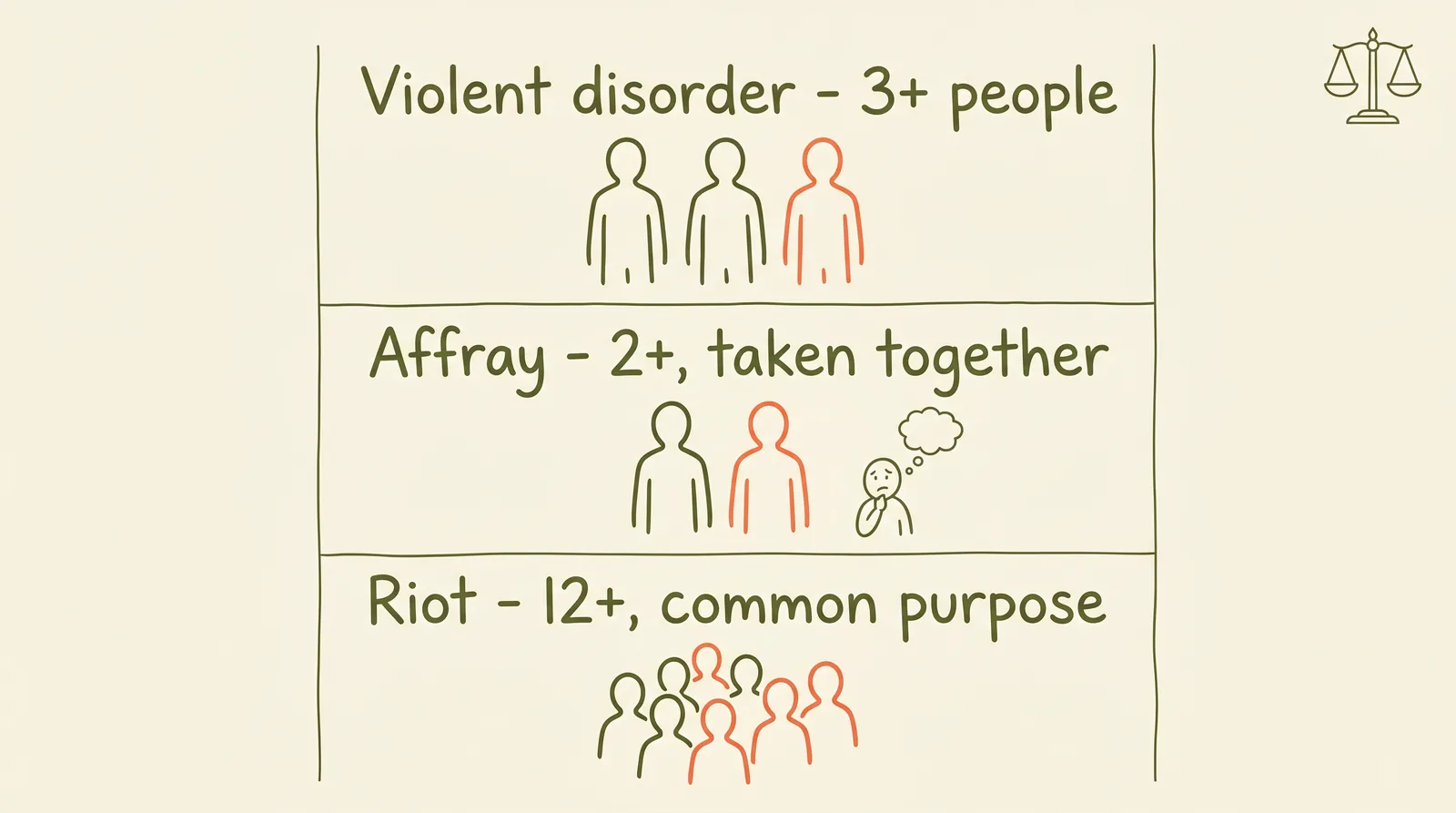
Affray sits between a one-on-one assault and a full-scale riot. The main differences are how many people are involved, whether a specific victim was targeted, and how serious the conduct is.
- Common assault targets a specific person; it is about the effect on that individual.
- Affray is about creating fear in a hypothetical bystander, and there need not be a direct victim at all.
- Riot is far more serious, it needs a crowd.
- Violent disorder is the least serious of the group offences.
The table below sets out the three public-order violence offences in NSW side by side.
| Offence | People required | Governing section | Maximum penalty | How it’s dealt with |
| Violent disorder | 3 or more | s11A Summary Offences Act 1988 (NSW) | 10 penalty units or 6 months’ imprisonment | Summary only (Local Court) |
| Affray | 1 or more (conduct of 2+ considered together) | s93C Crimes Act 1900 (NSW) | 10 years’ imprisonment | Table 1 indictable, usually Local Court |
| Riot | 12 or more, for a common purpose | s93B Crimes Act 1900 (NSW) | 15 years’ imprisonment | Table 1 indictable |
A common point of confusion: it is possible to be charged with both affray and common assault out of the same incident. For example, you may be accused of striking one person (the assault) during a wider brawl (the affray). This is one reason early legal advice matters, as the charges can sometimes be negotiated.
Where Is An Affray Charge Heard, And What Are The Penalties?
Most affray matters are heard in the Local Court, but the charge can be moved to the District Court, where the maximum penalty is much higher. Affray is what the law calls a Table 1 indictable offence under the Criminal Procedure Act 1986 (NSW).
In plain terms, Table 1 means:
- The matter starts and is usually finalised in the Local Court.
- Either the prosecution or you (the accused) can “elect” to have it dealt with in the District Court instead.
That election changes the maximum penalty significantly:
| Court | Maximum penalty for affray | When it applies |
| Local Court | 2 years’ imprisonment | The default, where most affray matters stay |
| District Court | 10 years’ imprisonment | If the prosecution or the accused elects to go there |
The 10-year figure is a maximum, reserved for the most serious cases: sustained, weapon-involved, or gang-related violence causing real fear. It is not the starting point for a typical charge. Courts have a full range of sentencing options available before full-time custody, including good behaviour bonds (conditional release orders), fines, community correction orders, and intensive correction orders.
Whether a charge of affray stays in the Local Court or is elected up is a strategic decision with real consequences, one you should make only with legal advice.
What Usually Happens For A First Affray Offence?
For a genuine first offence at the lower end of seriousness, full-time imprisonment is far from automatic. However, affray is normally treated as a serious offence, so no outcome is certain. The result depends heavily on the facts: the scale of violence, whether anyone was hurt, whether a weapon was involved, and your personal circumstances.
Courts weigh a range of factors, including:
- The seriousness of the conduct. A brief shoving match is treated very differently from a sustained, terrifying brawl.
- Whether injuries were caused and how serious they were.
- Whether a weapon was used or displayed.
- Your record. A clean history is a significant factor in your favour.
- Genuine remorse, an early plea if you accept responsibility, and steps such as counselling or an apology.
Your Rights And What You Can Do Now
You have important rights from the moment police become involved, and the choices you make early can shape your whole case. The single most valuable thing you can do is avoid making your situation worse before you have advice.
Your rights:
- The right to silence. Beyond giving police your name and address, you are not obliged to answer questions or take part in an interview about the incident. What you say can be used against you, and “explaining your side” at the police station often does more harm than good.
- The right to a lawyer. You can ask to speak to a criminal lawyer before deciding whether to participate in a police interview.
- The presumption of innocence. You are presumed innocent, and it is for the prosecution to prove the charge. You do not have to prove anything.
Practical steps that strengthen your position:
- Do not discuss the incident. Not with police (beyond your details), not on social media, and not in messages to others involved. These are frequently obtained by police.
- Write down everything you remember while it is fresh: the sequence of events, who was there, who started what, and whether you were defending yourself or others.
- Preserve any evidence in your favour: your own phone footage, messages, or the contact details of independent witnesses who saw what happened.
- Note any CCTV nearby (venue, street, or transport cameras). Footage is often deleted within weeks, so identifying it early can be critical.
- Get legal advice before your first court date so decisions about pleading and jurisdiction are made properly, not under pressure.
How A Lawyer Can Help Your Affray Case
A criminal lawyer’s role in an affray matter is to test whether the prosecution can actually prove the charge, and, where you accept responsibility, to present your circumstances so the penalty is as light as the law allows. There are several genuine avenues, depending on the facts.
Challenging whether the offence is made out. The prosecution must prove that your conduct would have caused a person of reasonable firmness to fear for their safety. In chaotic incidents, that is not always straightforward. A lawyer may argue:
- You were not the person involved. In group incidents captured on poor-quality CCTV or described by rattled witnesses, identification is often unreliable and can be a complete answer to the charge.
- Your conduct did not meet the threshold. Trying to break up a fight, backing away, or being merely present is not affray. A threat by words alone is expressly not enough under s93C.
- You acted in self-defence. Under sections 418 to 423 of the Crimes Act 1900 (NSW), if you genuinely believed your actions were necessary to protect yourself or someone else, and your response was reasonable in the circumstances as you saw them, the violence may not be “unlawful”, and self-defence can defeat the charge entirely.
- You acted under duress. In some cases, a person compelled to act by a serious and immediate threat may have a defence.
Negotiating with the prosecution. Where the evidence is strong, a lawyer may negotiate to have the affray withdrawn or reduced to a less serious charge. They can also make written representations to the police or the DPP about the facts and the appropriate charge.
Advising on jurisdiction. Whether to keep the matter in the Local Court (with its lower maximum) or accept a District Court hearing is a strategic call. A lawyer weighs the risks either way for your specific case.
Presenting the strongest plea in mitigation. If you choose to plead guilty, a lawyer gathers character references, evidence of remorse and rehabilitation, and puts your circumstances to the court to argue for the most lenient available outcome, including options that avoid a criminal conviction being recorded in appropriate cases.
Every case is different, and no lawyer can promise a particular result. What early representation does is make sure the right defences are identified and the strongest version of your case is put forward from the start.
Frequently Asked Questions
What does an affray charge actually mean?
It means police allege you used or threatened unlawful violence, during a fight, brawl, or confrontation, in a way that would make an ordinary bystander fear for their safety. It is a public-order offence under s93C of the Crimes Act 1900 (NSW), not simply a “public disturbance,” and it carries a maximum of 10 years’ imprisonment.
Can I be charged with affray if I didn’t hit anyone?
Yes. Affray does not require you to actually strike someone or injure anyone. Threatening violence through your conduct (advancing aggressively, squaring up, or being part of a group whose combined behaviour was frightening) can be enough. However, a threat made by words alone is not affray under s93C.
Is affray a serious criminal charge?
Yes. Although many affray matters are dealt with in the Local Court, it is an indictable offence with a maximum penalty of 10 years, and a conviction can appear on your criminal record and affect employment, travel, and visa applications. It should not be treated as a minor charge.
Will I go to jail for a first affray offence?
Not necessarily. For a first offence at the lower end of seriousness, courts have a range of options short of full-time custody, and imprisonment is not automatic. However, the outcome depends on how serious the conduct was and your personal circumstances, so early legal advice is important, and no outcome can be assured.
What’s the difference between affray and assault?
Common assault targets a specific person; affray is about causing fear in a hypothetical bystander. Assault focuses on the effect on an individual victim, while affray focuses on frightening, violent conduct in a wider sense. It is possible to be charged with both offences from the same incident.
Can an affray charge be dropped or withdrawn?
Sometimes. Where the evidence is weak (for example, unreliable identification, or conduct that does not meet the legal threshold) a lawyer may persuade the prosecution to withdraw the charge or reduce it. Whether this is possible depends entirely on the facts and the strength of the evidence.
How can I defend an affray charge?
Common defences include self-defence (under ss418 to 423 Crimes Act 1900), mistaken identity, arguing your conduct did not meet the legal threshold, and in some cases duress. The right defence depends on your circumstances, which is why individual legal advice matters.
If you would like to understand the related offence of common assault, see our fact sheet on common assault and ADVO charges in NSW, and our assault and violent offences page for how we defend these matters.
How O’Brien Criminal & Civil Solicitors Can Help
Affray charges move quickly through the courts, and the decisions made early (whether to speak to police, how to plead, and which court the matter is heard in) shape everything that follows. O’Brien Criminal & Civil Solicitors is a specialist criminal defence firm with more than 20 years defending clients charged with public-order and violence offences across NSW.
Acting from your first contact with police, we test whether the prosecution can prove the charge, pursue withdrawal or a lesser charge where the evidence allows, and, where appropriate, put the strongest possible case for a lenient outcome. We also handle assault and violent-offence matters. Our criminal team will explain your options clearly so you can make good decisions under pressure.
Request initial advice (no-obligation) via the form below or call us on (02) 9261 4281.