
High range drink driving in NSW means driving with a blood alcohol concentration of 0.15% or above. The charge is known as high-range PCA, with PCA standing for “prescribed concentration of alcohol”.
If you’ve been charged, you may be worried about your licence, your court date and whether you could go to jail. Jail is a possible penalty, even for a first offence, but it is not automatic. Your alcohol reading, driving history and the circumstances of the offence can affect the outcome.
This guide explains the penalties for first and repeat offences, what affects the risk of jail and whether you can avoid a conviction. It also covers how alcohol interlocks work and how to prepare for court.
High range PCA at a glance (NSW)
- The offence: a blood alcohol concentration of 0.15 or above, under s110(5) of the Road Transport Act 2013 (NSW).
- Maximum penalty: $3,300 and/or 18 months’ imprisonment for a first offence; $5,500 and/or 2 years for a second or subsequent.
- Where it is heard: summarily, in practice in the Local Court, under s200(1).
- Disqualification: on conviction, the court must make an interlock order (6 to 9 months off the road) or an exemption order (3 years, reducible to no less than 12 months).
- Key deadline: any appeal against a police licence suspension must be lodged within 28 days.
- Do now: do not drive, and get the brief of evidence before you plead.
What counts as a high range PCA in NSW?
High range PCA means a blood alcohol concentration of 0.15 or more. It is the most serious of the five prescribed concentrations of alcohol bands. It is also the only one carrying a potential punishment of imprisonment for a first offence.
The bands are defined in section 108 of the Road Transport Act 2013 (NSW). Which one applies is set by the reading from the breath analysis instrument at the station, not the roadside screening device.
| Band | Blood alcohol concentration | Section | Maximum, first offence |
|---|---|---|---|
| Novice | Above zero, below 0.02 | s110(1) | $2,200, no imprisonment |
| Special | 0.02 to below 0.05 | s110(2) | $2,200, no imprisonment |
| Low | 0.05 to below 0.08 | s110(3) | $2,200, no imprisonment |
| Middle | 0.08 to below 0.15 | s110(4) | $2,200 and/or 9 months |
| High | 0.15 or above | s110(5) | $3,300 and/or 18 months |
One detail catches people out. Section 110(5) is not limited to just driving: it also covers occupying the driving seat and attempting to start the vehicle, and sitting beside a learner driver as their supervisor.
A first low, special or novice range offence can often be dealt with by penalty notice without any court appearance. If yours sits there, our fact sheet on a first time drink driving offence is the better starting point.
What are the penalties for high range PCA?
Three consequences follow a conviction, and people focus on the first while the third actually does the most damage: the sentence, the licence disqualification, and a mandatory interlock order.
| First offence | Second or subsequent offence | |
|---|---|---|
| Maximum fine | $3,300 (30 penalty units) | $5,500 (50 penalty units) |
| Maximum imprisonment | 18 months | 2 years |
| Automatic disqualification | 3 years | 5 years |
| Shortest the court may order | 12 months | 2 years |
| With an interlock order: disqualification | 6 to 9 months | 9 to 12 months |
| With an interlock order: interlock period | 24 months | 48 months |
The automatic period applies unless the court decides otherwise. It cannot go below the minimum, and under section 205 the court can also order a longer period, with no stated ceiling. Time already spent suspended by police counts towards it.
Those automatic figures are the position where the court makes an interlock exemption order. High range PCA is a mandatory interlock offence, so on conviction the court must make an interlock order or an exemption order. Under an interlock order the disqualification is the shorter period in the table above.
A “second offence” is defined by a five year window. The charge is treated as second or subsequent if you were convicted of this or any other “major offence” in the previous five years, or had one dealt with by penalty notice. “Major offence” is the Act’s own term and covers drink driving, drug driving, and the serious driving offences causing death or injury, so it need not have been a high range matter.
Will I go to jail for high range drink driving in NSW?
For an ordinary first offence, imprisonment is possible but not what usually happens. There is no presumption in favour of gaol for high range PCA in New South Wales. The usual penalty in an ordinary case is a fine plus the automatic disqualification.
The most useful published picture of real outcomes is BOCSAR’s sentencing snapshot of NSW drink driving. Of those, 4.3% received a sentence of imprisonment, 41.3% were fined, and only 2.1% avoided a conviction being recorded altogether.
One caveat belongs with those numbers rather than in a footnote: the study covers 2009 and 2010, and several of the sentences it counted no longer exist. Read them as the shape of the risk, not this year’s odds.
The strongest predictor of imprisonment, by a wide margin, was prior record. Across middle and high range convictions taken together, the rate was 0.4 per cent for people with no prior convictions of any kind, 2.7 per cent with earlier drink driving convictions, and 44.6 per cent for those already imprisoned for a similar offence. That last group was tiny, 37 people out of 28,465, so treat the percentage as a direction of travel rather than a reliable rate.
What does the High Range PCA Guideline Judgment say?
In September 2004 a five judge bench of the Court of Criminal Appeal issued a guideline judgment for this offence, and magistrates take it into account when they sentence. It is a check on the sentence a magistrate arrives at, not a binding tariff, and the checklist is public in the Local Court Bench Book.
It first describes an ordinary offence: the person drove to avoid inconvenience or did not believe they were over the limit, was detected on a random breath test, has good character and a nil or minor traffic record, and pleaded guilty. In that case a non conviction order is rarely appropriate, and the guideline adds something that surprises most people: completing a driver education course is not, by itself, a reason for one.
It then lists the factors that increase moral culpability, which are what move a sentence upwards:
- the degree of intoxication above 0.15
- erratic or aggressive driving
- a collision with any other object
- competitive driving or showing off
- the length of the journey over which others were exposed to risk
- the number of people actually put at risk
Where moral culpability is increased, a non conviction order is very rarely appropriate, and where several aggravating factors are present to a significant degree a sentence less than imprisonment is generally inappropriate. The guideline uses 2004 labels; the modern equivalents are conditional release orders, community correction orders and intensive correction orders.
Can I get a section 10 or a conditional release order?
It is possible but uncommon. A section 10 order is usually either a dismissal under s10(1)(a) or a discharge on a conditional release order without conviction under s10(1)(b), and it is the only kind of outcome that avoids the conviction and the licence consequences together.
Because no conviction is recorded, no automatic disqualification follows and, critically, no interlock order can be made, since section 210 is only triggered when the court convicts. That is why the question carries far more weight here than in almost any other traffic charge. Our fact sheet on section 10 orders sets out the general test.
Two hard limits apply. The guideline says such orders must be rare in an ordinary high range case and very rare where moral culpability is increased. Separately, section 203 removes section 10 entirely if you have already had one for another applicable driving offence in the preceding five years.
How does the mandatory alcohol interlock program work?
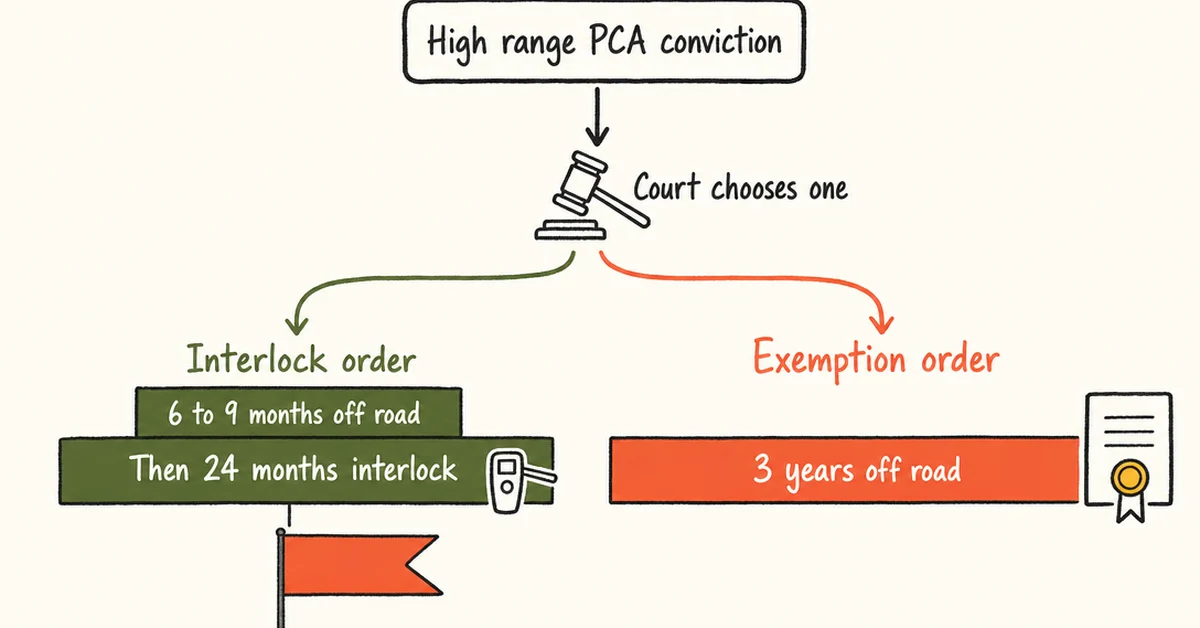
An interlock is a breath testing device wired into your ignition that will not let the car start if it detects alcohol. High range PCA is a mandatory interlock offence, so on conviction the court must make either an interlock order or an exemption order under section 210.
Under an interlock order for a first offence you are disqualified for 6 to 9 months, then hold an interlock driver licence for 24 months. That period starts the day the licence is issued, not the day you are convicted, so delay in applying extends it.
| Interlock order | Exemption order | |
|---|---|---|
| Disqualification | 6 to 9 months | 3 years, reducible to 12 months |
| After that | 24 months on an interlock licence, zero alcohol limit | No interlock, but the Sober Driver Program |
| Cost | Around $2,200 to $2,500 a year plus a $200 fee | $700 for the course where you are not supervised by Corrective Services NSW |
| The risk | Not entering means 5 years disqualified | Much longer completely off the road |
Exemptions are narrow, and narrower for high range than most people expect. Section 212(3) requires you to prove either that you have no access to a vehicle in which to install a device, or that a medical condition diagnosed by a registered medical practitioner prevents you giving a sufficient breath sample and the device cannot reasonably be modified so that you can use it. The third ground, severe hardship, applies only to certain first offences under sections 110(4) and 111A(2), and high range PCA is not one of them.
Section 212(5) rules out the three arguments people most want to run: that you cannot afford the device, that an interlock will stop you driving for work, or that the car’s owner will not consent.
If an exemption is granted, Transport for NSW requires you to complete the Sober Driver Program, a 20 hour therapeutic group course, before applying for your licence.
What happens at court, step by step?
High range PCA is heard summarily in the Local Court. Most of the work that changes the result happens between the court dates rather than on them.
- Charge and immediate suspension. Police may issue an immediate licence suspension notice within 48 hours of charging you, under section 224. You must not drive from that point.
- Suspension appeal, if any. An appeal lies to the Local Court, and section 267(2) requires the notice of appeal to be filed within 28 days of the notice; per Legal Aid NSW it is then usually listed at least 28 days later. Section 268(5) requires exceptional circumstances, and the court cannot consider the circumstances of the offence itself. Section 268(6) also closes the door once the charge has been heard and determined or withdrawn.
- First mention. The prosecution serves the brief of evidence. You can ask for an adjournment rather than pleading on the spot.
- Plea. An early plea attracts a sentencing discount. Our guide to pleading guilty in NSW explains what follows.
- Preparation for sentence. The Traffic Offender Intervention Program, counselling, references and any medical or employment evidence are gathered here, and courts routinely adjourn to allow it.
- Sentence. The magistrate deals with the penalty, the disqualification, and the interlock or exemption order together.
Your rights and what you can do now
You are presumed innocent and the prosecution must prove every element, including that the breath analysis was carried out as the legislation requires. The most valuable things you can do in the first week are practical rather than legal.
Your rights:
- You are not obliged to explain your movements. Beyond identifying yourself and producing your licence when an officer lawfully requires it, and complying with a lawful requirement to provide a breath sample, you do not have to answer questions about where you had been or what you had been doing.
- You can obtain the brief of evidence, including the breath analysis certificate, before deciding how to plead.
- You can ask for time. A magistrate will ordinarily grant an adjournment at a first mention.
Practical steps:
- Do not drive. Driving while suspended or disqualified turns a serious matter into a much worse one.
- Write down the timeline while it is fresh: where you were and when, what you had to eat and drink across the evening, the time you were stopped, and the time of the breath analysis. The gap between those last two can matter.
- Keep the suspension notice. It carries the date the 28 day appeal clock runs from.
- Start the practical work now. Ask about the Traffic Offender Intervention Program and book a session with your GP or an alcohol counsellor. Courts respond to steps already taken, not steps promised.
- Gather character references addressed to the magistrate from people who know what you are charged with.
How a lawyer could help your high range PCA case
A solicitor’s job here is to test whether the charge can be proved and, where it can, to move the outcome down the range the guideline sets out. Both halves are done before the sentencing date.
Testing the prosecution case. The offence depends on a reading obtained through a specific statutory procedure, and that procedure is not always followed. Depending on the facts, a lawyer may examine whether the breath analysis was required within the two hour period allowed by Schedule 3 clause 2, whether it was required at your home, which the same clause prohibits, whether the instrument and certificate requirements were met, and whether you can be proved to have been the driver.
Arguing the band. The boundary at 0.15 separates a 9 month maximum from an 18 month one. Middle range is a mandatory interlock offence too, so the practical gap on a first offence is 3 to 6 months off the road and 12 months on an interlock, against 6 to 9 months and 24 months. A reading close to the line is worth attention.
Reducing the disqualification. The guideline recognises employment, the absence of viable alternative transport, and sickness or infirmity as reasons that may justify moving the automatic period towards the statutory minimum. That has to be evidenced, not asserted, and where the case supports it the same material carries the argument for a non conviction order.
No lawyer can promise a result, and any lawyer who does should be treated with caution. What early representation does is make sure the right points are taken and the right material is in front of the magistrate.
Frequently asked questions
Will I go to jail for a first high range drink driving offence?
Usually not, but it is a real possibility. There is no presumption of imprisonment, and the guideline says the usual penalty in an ordinary first offence is a fine plus the automatic disqualification. Gaol becomes a live risk where moral culpability is increased: a reading well above 0.15, a collision, aggressive driving, or a long journey with passengers.
How long will I lose my licence for high range PCA?
Usually 6 to 9 months for a first offence, because the court must make a mandatory interlock order unless one of the narrow exemption grounds is proved, followed by 24 months on an interlock licence with a zero alcohol limit. If an exemption order is made instead, the automatic period is three years, which the court can reduce to no less than 12 months, or extend.
Can I get a work licence or restricted licence in NSW?
No. New South Wales has no work licence, hardship licence or restricted licence for drink driving, and any page telling you otherwise is describing another state. The interlock driver licence and an application to reduce the disqualification are the only real avenues.
What happens if I refuse to join the interlock program?
You will be disqualified from holding a licence for five years from the date of conviction, unless you first hold an interlock driver licence for the applicable interlock period.
What counts as a second offence?
A conviction for this or any other “major offence” under the Act, or one dealt with by penalty notice, within the previous five years. The maximum then rises to $5,500 and 2 years, the automatic disqualification to 5 years, and the interlock period to 48 months.
Is the Sober Driver Program still running?
Yes. It is a 20 hour therapeutic group course run by Corrective Services NSW or, for interlock exemption order holders who are not under supervision, by Managed Training Services for $700. Transport for NSW requires exemption order holders to complete it before they apply for a licence.
Can a high range PCA charge be defended?
Sometimes. Defences usually turn on the statutory procedure rather than the drinking: whether the breath analysis was required within the two hour window, whether it was required at your home, whether the instrument and certificate requirements were met, and whether you can be proved to have been driving.
How O’Brien Criminal & Civil Solicitors can help
High range PCA is the end of the drink driving range where the decisions genuinely change lives: whether the reading and the procedure can be challenged, whether a conviction can be avoided, and whether you spend nine months or three years without a licence. O’Brien Criminal & Civil Solicitors is a specialist criminal defence firm, led by an Accredited Specialist in Criminal Law (a credential held by fewer than 6% of NSW solicitors), with more than 20 years in Local Courts across New South Wales.
We act on high range, repeat and jail risk matters, including cases where a prior conviction, a very high reading or a collision has put full time custody on the table. We will tell you plainly where your matter sits against the guideline, and what needs to exist before you are sentenced. Our drink driving lawyers in Sydney page sets out how we work.
Request initial advice (no-obligation) via the form below or call us on (02) 9261 4281.
This content is for general information purposes only and does not constitute legal advice. You should seek independent legal advice relevant to your specific circumstances.