
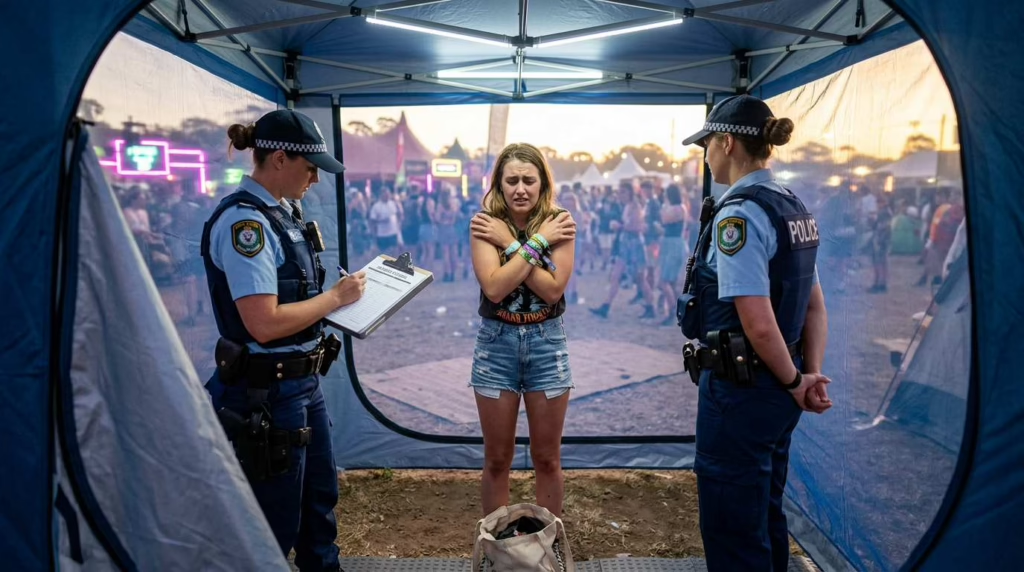
Imagine this: You are at a music festival, or walking down the street, when a police officer tells you that you need to be strip-searched. What are your rights? Is a strip search even legal?
Strip searches are among the most invasive powers available to NSW Police. The law places strict limits on when and how they can be carried out, but those limits are not always followed. Between July 2021 and June 2023, police conducted over 4,500 strip searches in public, a 17% increase in just two years. In more than half of those searches, nothing illegal was found.
This fact sheet explains when a strip search is lawful in NSW, what rules police must follow, what makes a search illegal, and what you can do if your rights are not respected.
Key Takeaways
- Strip search powers in NSW are governed by Sections 31 to 34A of the Law Enforcement (Powers and Responsibilities) Act 2002 (NSW) (LEPRA).
- Police must have reasonable grounds for suspicion before conducting any strip search. For searches conducted in public, there is an additional requirement that the circumstances are serious and urgent.
- A drug detection dog alerting a person is not, on its own, sufficient legal justification for a strip search.
- Strip-searching a child under 10 is illegal in any circumstances.
- Evidence obtained from an unlawful strip search may be excluded by the court under section 138 of the Evidence Act 1995 (NSW).
- You may also have a civil claim for compensation if you were subjected to an unlawful search.
- O’Brien Criminal & Civil Solicitors can advise you on challenging evidence from an unlawful search or pursuing a civil claim.
At a Glance: Key Rights During a Strip Search
Police must:
- Have reasonable grounds for suspicion before conducting any strip search
- Conduct the search in a private area, out of public view
- Use an officer of the same sex as the person being searched
- Explain why the search is happening before it begins
- Consider whether a less invasive search would achieve the same purpose
Police cannot:
- Touch your body or search body cavities
- Ask you to squat, cough, or perform actions designed to expel items
- Strip-search a child under 10 under any circumstances
- Search a child aged 10 to 17 without a parent, guardian, or other appropriate adult present, except where the child objects to that person being there or where delay to obtain an adult would create a safety risk or risk to preservation of evidence
- Remove more clothing than is necessary for the search
What Is A Strip Search?
A strip search in NSW is a search that requires a person to remove all or most of their clothing so that police can conduct a visual examination of their body and clothing. Under LEPRA, it is distinct from a general search. A general search, sometimes called a pat-down or person search, allows police to require a person to remove outer clothing such as a coat, hat, gloves, or shoes. A strip search goes further: it may require a person to remove all or most of their clothing and allows a visual examination of their body, including any clothing removed, but not body cavities.
It is the most invasive search police can carry out on a person short of a medical procedure. Because of this, the law treats strip searches as a measure of last resort. Police should always consider whether a less invasive option would achieve the same purpose before escalating to a strip search.
When Can Police Conduct a Strip Search?
At a Police Station or Detention Centre
Under section 31(a) of LEPRA, police may carry out a strip search at a police station if the officer suspects on reasonable grounds that the search is necessary.
“Reasonable grounds” means the officer must have a factual basis for their suspicion. A gut feeling, a hunch, or the fact that a person looks nervous is not enough. The suspicion must be based on specific, objective facts.
In Public: Streets, Festivals, Train Stations
The legal threshold for strip searches in public is significantly higher. Under section 31(b) of LEPRA, the officer must suspect on reasonable grounds that the search is necessary and that the seriousness and urgency of the circumstances make the strip search necessary. Both requirements must be satisfied. A strip search cannot be treated as justified solely because a drug detection dog has given an indication; police must still establish reasonable suspicion and seriousness and urgency in the circumstances.
A drug detection dog alerting to a person is not, on its own, sufficient legal justification for a strip search. Police need additional, specific grounds before escalating from a general search to a strip search.
What Does a Lawful Strip Search Look Like?
Even where police have the grounds to conduct a strip search, how they carry it out matters. Sections 32 and 33 of LEPRA set out clear requirements around process, privacy, and communication.
Privacy
- The search must be conducted in a private area, out of public view
- Only officers of the same sex as the person being searched may conduct the search
- No one else should be present unless it is reasonably necessary for the purposes of the search
- For children aged 10 to 17, a parent, guardian, or other appropriate adult who is not a police officer should be present, unless specific exceptions apply
No Physical Contact
- Police cannot touch your body during a strip search
- Cavity searches are not permitted
- You must not be asked to squat, cough, or perform any action designed to expel items from your body
Communication
- Police must explain why the search is happening and why you will be required to remove clothing
- You should be asked to cooperate and treated with respect throughout
- If the officer is not in uniform, they must produce evidence that they are a police officer before the search begins
Clothing Removal
- Only the clothing necessary for the search may be removed
- You must be allowed to dress promptly once the search is complete
- If clothing is seized, reasonable replacement clothing must be provided
Rules for Searching Children
Children under 10: Strip searching anyone under 10 years old is illegal in all circumstances (under LEPRA’s child-search provisions, including section 34 and related sections).
Children aged 10 to 17: A parent, guardian, or other appropriate adult who is not a police officer must be present during the search, unless the child objects to that person being there, or unless police determine that the delay required to obtain an appropriate adult would create a risk to personal safety or the preservation of evidence.
When Is A Strip Search Illegal?
A strip search is unlawful if police:
- Do not have reasonable grounds for suspicion under the general search powers, or fail to meet the additional seriousness and urgency requirement for strip searches conducted other than at a police station or place of detention
- Fail to consider whether a less invasive search would be sufficient before proceeding
- Fail to protect the person’s privacy or dignity during the search
- Touch the person’s body, conduct a cavity search, or ask the person to squat and cough
- Strip search a child under 10
- Search a child aged 10 to 17 without a parent, guardian, or appropriate adult present, where required
- Do not explain the reason for the search or ask for the person’s cooperation
- Remove more clothing than necessary, or delay allowing the person to dress afterwards
- Conduct the search using an officer of a different sex to the person being searched
Where any of these requirements are not met, the search may be found to be unlawful. Evidence obtained from an unlawful search may be excluded by the court under section 138 of the Evidence Act 1995 (NSW). Depending on the circumstances, a person may also have a civil claim for compensation.
Are the Rules Being Followed?
Despite these legal requirements, independent oversight has consistently found that police are not meeting the standards the law requires. Key findings from the Law Enforcement Conduct Commission (LECC) 2020 and 2023 reviews include:
- Only 35% of strip search records were clear, complete, and consistent with NSW Police policy
- Only 68% of records showed that officers had adequately considered the reasonable grounds threshold
- Only 27% contained information showing that privacy and dignity requirements had been followed
- 28% of police officers conducting strip searches at music festivals had not completed the required training
- In up to 64% of strip searches, nothing illegal was found on the person
The LECC’s 2020 report made 25 recommendations for reform, including clearer training, better record-keeping, and stronger oversight. Both the LECC and the Redfern Legal Centre have called for urgent reform and greater accountability.
Young People Targeted
From 2016 to 2023, police strip-searched 1,546 children in NSW. The youngest was 10 years old. One year recorded a 30% rise in strip searches of girls, with some as young as 12 subjected to the practice (Redfern Legal Centre, 2024).
Can You Refuse a Strip Search?
This is one of the most common questions people ask, and the answer requires care.
You are not required to consent to a police search, and you can clearly state: “I do not consent to this strip search.” Doing so is important. It creates a record that you objected, which can be directly relevant if the lawfulness of the search is later challenged in court.
However, if police believe they have the legal power to conduct the search, they may proceed regardless of your objection. Physically resisting or hindering police during a search can result in additional criminal charges, such as resisting arrest or hindering police in the execution of their duty. Police may also use reasonable force to carry out a search they believe is lawful.
The practical guidance: state your objection clearly, do not physically resist, and get legal advice as soon as possible afterwards.
Real-World Scenarios
Scenario 1: The Festival Pat-Down That Escalates
A person attending a music festival is approached by police after a sniffer dog passes nearby. The dog does not formally indicate, but an officer says he wants to conduct a strip search based on the person’s “nervous behaviour.” This does not constitute reasonable grounds. The officer has no factual basis beyond a subjective assessment of the person’s demeanour. The strip search, if carried out, would likely be unlawful.
Scenario 2: An Unlawful Search at a Police Station
A person is brought to a police station for questioning. An officer decides to conduct a strip search. During the search, the person is asked to squat and cough. This is expressly prohibited under LEPRA regardless of where the search takes place. Any evidence found as a result may be subject to exclusion under section 138 of the Evidence Act.
Scenario 3: A Child Searched Without a Guardian
A 14-year-old is stopped at a train station and police decide to conduct a strip search. No parent or appropriate adult is present, and no attempt is made to contact one. Unless police can point to a specific exception, the search does not comply with the requirements in section 33(3) of LEPRA and is likely unlawful.
What To Do If You Are Strip Searched
During the search:
- Stay calm and comply with instructions. Physically resisting can lead to additional charges and puts your safety at risk.
- State clearly: “I do not consent to this strip search.” Put your objection on the record.
- Note the officer’s name, badge number, whether they are in uniform, and whether a body camera is operating.
Immediately afterwards:
- Write down everything you can remember: the location, what you were asked to do, who was present, what was said, and how you were treated.
- Note whether a parent or appropriate adult was present if you are under 18, or whether one was sought.
- Seek legal advice as soon as possible.
You can also:
- Make a formal complaint to the Law Enforcement Conduct Commission (LECC) if you believe the search was unlawful or your rights were not respected.
- Speak to a lawyer about whether evidence obtained from the search can be challenged in court, or whether you have grounds for a civil compensation claim.
Frequently Asked Questions
Can I be charged with an offence for refusing a strip search?
Stating that you do not consent is not itself an offence. However, physically resisting or obstructing police during a search they believe is lawful can result in charges such as hindering police in the execution of their duty. The safest approach is to state your objection clearly and comply, then challenge the search through legal channels afterwards.
Does a drug detection dog alert justify a strip search?
No. A drug detection dog indicating in your direction is not, on its own, sufficient legal justification for a strip search. Police need additional, specific grounds before they can escalate from a general search to a strip search.
What happens to evidence found in an unlawful strip search?
Under section 138 of the Evidence Act 1995 (NSW), a court has the discretion to exclude evidence obtained improperly or in breach of the law. Whether evidence is excluded depends on the circumstances, including the seriousness of the breach and the nature of the evidence. A criminal defence lawyer can advise you on whether exclusion is a realistic argument in your case.
Can I make a compensation claim if I was unlawfully strip-searched?
Yes, in appropriate cases. If police conducted a strip search without lawful authority or in a manner that breached your rights, you may have a civil claim for compensation. The O’Brien Civil Law team has experience in civil claims against police, including for unlawful search and detention.
What if I were strip-searched as a child?
Strip-searching a child under 10 is illegal in all circumstances. For children aged 10 to 17, a parent, guardian, or appropriate adult who is not a police officer must generally be present. If those requirements were not met, the search may be unlawful. Contact a lawyer to discuss your options.
How O’Brien Criminal & Civil Solicitors Can Help
Strip searches are meant to be rare, respectful, and strictly necessary. Many people experience them as degrading, distressing, and unjustified, and the oversight data shows that unlawful searches are far from uncommon.
If you or someone you know has been subjected to a strip search that you believe was unlawful, you may have legal options. Our criminal defence lawyers can advise on challenging evidence obtained from an unlawful search, and our civil law team can assess whether you have grounds for a compensation claim against NSW Police.
Call O’Brien Criminal & Civil Solicitors on 02 9261 4281 or enquire online. In some cases, we can arrange an initial phone consultation at no charge.
This fact sheet provides general legal information only and does not constitute legal advice. Every situation is different. If you have been strip-searched or are facing charges arising from a police search, seek independent legal advice about your specific circumstances promptly.