
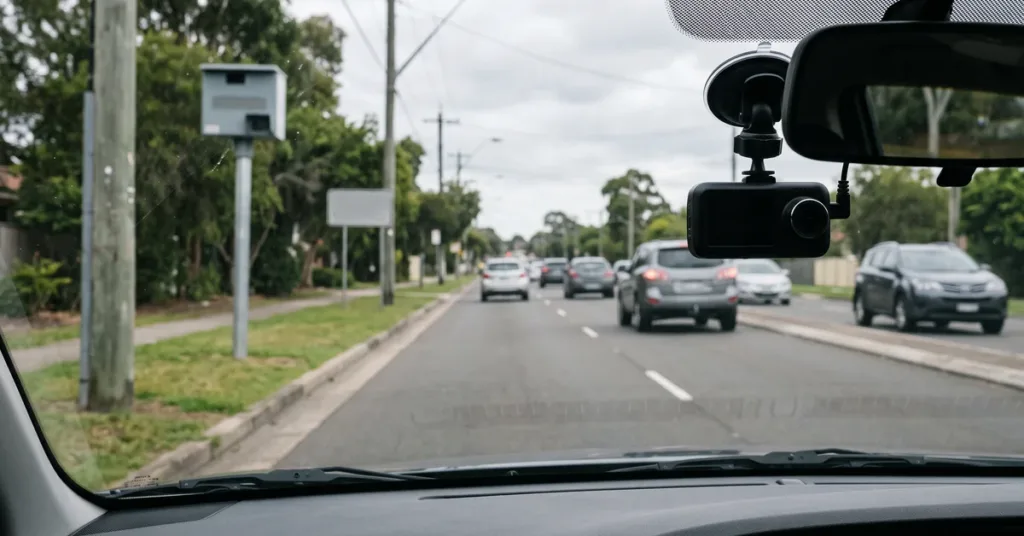
A driver posted to r/AusLegal describing a highway patrol stop: a car of the same make and similar colour had sped past them moments earlier. Shortly after, a highway patrol officer pulled them over, alleging they were doing 30 km/h over the posted limit off a radar reading. Thankfully, the driver had a dashcam. It showed them travelling at the posted limit, with a near-identical car overtaking just before the stop.
The top-voted advice in the Reddit thread was blunt: “It’s just bad luck. Submit the footage and you’ll be fine.” In this case, the driver called the station, submitted the footage, and an officer later confirmed no fine would be issued.
However, another person in the same thread described other situations where that advice didn’t hold. This commentator said they had dashcam footage and still had to go to a Local Court hearing to get the charge withdrawn. This process is consistent with NSW traffic law.
Here’s what’s actually going on.
Who has to prove speeding offence
The prosecution has to prove the speeding allegation beyond reasonable doubt. As the driver, you don’t have to prove anything.
Traffic offences in NSW are prosecuted the same way as any other criminal charge once they reach court. The NSW Judicial Commission’s Criminal Trial Courts Bench Book sets out the principle plainly: the burden of proving guilt sits with the prosecution, and it never shifts to the accused.
A defendant doesn’t need to prove their innocence, prove the radar was wrong, or prove which car was actually speeding. They only need to raise a genuine doubt about an element of the prosecution’s case. A near-simultaneous overtake by a similar make, model, or colour is exactly the kind of fact that can create that doubt.
What police actually rely on to prove a speed reading
A speed reading from a radar or lidar device isn’t automatically accepted: it has to come with proof the device was accurate and correctly used. NSW Police’s Traffic and Highway Patrol Command uses several detection methods, including handheld and vehicle-mounted radar and lidar devices, alongside a following police vehicle’s own speedometer.
Radar and lidar devices used for enforcement must be tested and certified under the Road Transport (General) Regulation 2021 (NSW). This sets testing and accuracy requirements for approved traffic enforcement devices. Where a certificate of accuracy exists, it can be tendered as evidence of the device’s reliability.
That certificate only speaks to whether the device was working, not to whether it was pointed at the right car. A working, correctly calibrated device still relies on the operator correctly identifying which vehicle triggered the reading.
Highway patrol vehicles typically carry their own dash and number-plate recognition footage, which is exactly why one commenter suggested that if the pursuing car’s own camera never captured the actual offending plate, “they would be hard pressed to say it was” the driver they eventually stopped.
That’s the identification gap several people in the thread pointed at without naming it as such. It’s a fact the prosecution has to rule out, not one the driver has to disprove.
Making dashcam footage hold up, if it does go further
Dashcam footage is admissible in NSW proceedings, but only as an unedited, unaltered file with its original timestamp and metadata intact.
Two things protect the footage’s evidential value:
- Keep the original file untouched. Don’t trim, re-export, or re-encode the clip before you have to. Each of those steps can strip or alter the embedded timestamp and file metadata that ties the footage to a specific time and place.
- Hand over a copy, not the only original. A full, unedited copy of the file, transferred in a way that preserves the original metadata, is the standard approach, several commenters made the same point: don’t surrender the only copy, and archive the unedited file somewhere permanent so the dashcam’s own loop-recording doesn’t overwrite it before you need it again.
If the footage timestamp lines up with the alleged offence time and shows a similar vehicle overtaking near the location, it’s directly relevant to whether police correctly identified the speeding car. It isn’t proof on its own, as the two accounts above show, but it’s evidence the prosecution’s case has to survive, whether that happens informally or in front of a magistrate.
Paying the fine vs electing for a court hearing
If a fine is issued and police don’t withdraw it on review, the next decision is whether to pay it or elect to go to court, and once you elect, that election is final. Revenue NSW’s guidance on applying to go to court sets out the process: apply before the fine’s due date, or within a limited window after if the fine has already been paid.
The fine is placed on hold while the application is assessed, a process that can take several weeks. If the election is accepted, Revenue NSW issues a Court Attendance Notice for a mention date at the Local Court nearest the alleged offence.
From there, the matter proceeds like any other Local Court hearing. There’s a plea, and if the plea is not guilty, a defended hearing follows where the prosecution has to make its case and the defence can cross-examine and tender evidence, including dashcam footage properly authenticated, the path both commenters above ended up on.
The trade-off the Local Court of NSW flags is real. A magistrate can impose a fine higher than the infringement notice amount, plus court costs and a victim services levy, and depending on the offence, a conviction can follow where the infringement notice wouldn’t have carried one.
Under the current Road Rules 2014 (NSW) penalty structure, an allegation like the 30 km/h-over reading this driver faced already sits in one of the higher fine and demerit-point brackets, with an automatic licence suspension attached at that tier, which is exactly why it’s worth getting advice on the strength of the identification evidence before deciding, rather than assuming a defended hearing is a formality either way.
What this means for you
If you believe a speed reading has been wrongly attributed to your vehicle, the burden is genuinely on the police, not you. However, whether that gets sorted with a phone call or requires a defended Local Court hearing depends on factors outside your control, including how the individual officer or reviewing officer exercises discretion, and how strong the identifying evidence (yours and theirs) actually is.
Keep the dashcam footage properly preserved either way. It’s what let one driver in this thread resolve things with a single phone call, and it’s what let another win a defended hearing after police initially refused to budge.
How O’Brien Criminal & Civil Solicitors Can Help
Our criminal defence and traffic law team is led by lawyers holding the Law Society of NSW’s Accredited Specialisation in Criminal Law, a credential awarded only after a rigorous assessment process and held by a small proportion of NSW solicitors.
We regularly advise drivers on exactly this decision: whether a disputed speeding allegation is worth taking to a defended Local Court hearing, and how to preserve and present dashcam evidence so it holds up if it gets there.
If you’re facing a speeding infringement you believe was wrongly attributed to your vehicle, especially if police have already declined to withdraw it on review, don’t decide whether to elect for court on your own.
Request initial advice (no-obligation) via the form below or call us on (02) 9261 4281.
This content is for general information purposes only and does not constitute legal advice. You should seek independent legal advice relevant to your specific circumstances.

Peter O'Brien is the Principal Solicitor of O'Brien Criminal & Civil Solicitors and Australia's leading expert in intentional torts litigation, with over 25 years of experience securing landmark victories in malicious prosecution and unlawful imprisonment cases. Author of Intentional Tort Litigation in Australia and recipient of the Law Council of Australia President's Medal, Peter has achieved record-breaking compensation for clients and is widely recognised for his unwavering commitment to access to justice.