
NSW Protest Laws: In the wake of the devastating Bondi Beach attack in December 2025, the NSW Government pushed through some of the most significant restrictions on public assembly in the state’s history. Now, those laws face a constitutional challenge in the NSW Supreme Court that could ultimately have implications for civil liberties across Australia.
What happened?
On 24 December 2025, the NSW Parliament passed the Terrorism and Other Legislation Amendment Bill 2025 after an emergency session that went into the early hours of Christmas Eve. The omnibus legislation cleared the Legislative Council 18 votes to 8.
The laws include tougher gun regulations, expanded hate speech offences, and new police powers to restrict protests following a terrorism declaration. It is this final element that has drawn the most controversy.
How the protest restrictions work
When a terrorist incident is formally declared under the Terrorism (Police Powers) Act 2002, the Police Commissioner or Deputy Police Commissioner, with the agreement of the Police Minister, can declare specific areas where public assemblies are restricted.
These “Public Assembly Restriction Declarations” (PARDs) can be made for an initial period of 14 days and extended in successive 14-day blocks, up to a cumulative maximum of 90 days (three months). Once a declaration is in place, no public assemblies can obtain authorised status (and associated legal protections) in that area under the Summary Offences Act, even by court order.
Within hours of the laws passing, Police Commissioner Mal Lanyon declared restrictions across the South West Metropolitan, North West Metropolitan and Central Metropolitan policing areas, essentially covering most of greater Sydney. On 7 January 2026, he approved a further 14-day extension.
Constitutional challenge launched
A coalition of groups has launched a constitutional challenge against the laws in the NSW Supreme Court, arguing the laws impermissibly burden the implied freedom of political communication. The case could ultimately reach the High Court.
The coalition includes Palestine Action Group Sydney, Jews Against the Occupation 48, and the Blak Caucus.
Their argument centres on the implied constitutional freedom of political communication. The Australian Constitution does not contain an explicit bill of rights, but the High Court has recognised an implied freedom of political communication necessary for the functioning of representative democracy.
Former NSW Supreme Court judge Anthony Whealy, who presided over Australia’s largest terrorism trial, has said the legislation could be liable to challenges on multiple grounds and it might not have the calming influence intended.
Concerns from civil liberties groups
The NSW Council for Civil Liberties has labelled the laws “draconian”. President Timothy Roberts told SBS News that Premier Chris Minns was using a “horrifying situation” to further an agenda against “a legitimate right to assembly”.
“He seems to think that he can get his way to social cohesion by regulating it through laws and using police powers for arrest. That’s not how it happens,” Roberts said. “We get cohesion through talking about issues, hearing from all members of our society.”
Additionally, the Aboriginal Legal Service NSW/ACT has raised particular concern about the potential impact on annual Invasion Day/Survival Day protests on 26 January, as well as rallies marking the 10th anniversary of the death in custody of David Dungay Jr.
“Aboriginal people have resisted and protested colonisation for more than 200 years. Since the 1938 Day of Mourning, 26 January has been marked as a day of protest and solidarity against the unjust dispossession of Aboriginal and Torres Strait Islander peoples,” ALS principal legal officer Nadine Miles said.
What the government says
Premier Chris Minns has defended the legislation, calling concerns about rights to protest “overblown”. He said the powers would only be used sparingly and that the laws would only apply after events that have been designated terrorist attacks.
“We’ve had very few terrorism designations over the last few years. Right now we have one, but it’s the worst terrorism event in the state’s history,” Minns said.
Police Minister Yasmin Catley defended the rushed changes as being necessary: “I have made no apology for being very swift and taking swift action here.”

What are your rights during a restriction period?
It is important to understand that the laws do not make gathering or protesting illegal. There is no offence of “attending an unauthorised protest”. However, assemblies in a PARD area proceed without the usual legal protections that come with Form 1 authorisation.
Without authorised status, police can use move-on directions and other powers that would normally be constrained at an authorised assembly. This means if police exercise those powers, participants are exposed to offences such as obstructing traffic or failing to comply with a direction.
If you are considering participating in a public assembly during a restriction period, you should be aware that you do not have the same legal protections as you would at an authorised assembly, police may issue move-on directions, failure to comply with a move-on direction can result in arrest, and you may be exposed to obstruction and similar offences if police exercise their powers.
Looking ahead
The constitutional challenge will likely take months to resolve, and could ultimately reach the High Court if it proceeds on appeal. In the meantime, the restrictions can be extended in successive 14-day blocks for up to 90 days, and Commissioner Lanyon has not ruled out extending them beyond 26 January.
This case raises fundamental questions about the balance between public safety and civil liberties in a democracy. Whatever the outcome, it will shape the boundaries of the right to protest in NSW for years to come.
If you have been affected by protest-related legal issues, contact a civil lawyer
If you have been arrested, charged, or issued with a move-on direction in connection with a public assembly, you have legal rights. Our experienced criminal and civil lawyers can advise on your options.
Contact O’Brien Criminal & Civil Solicitors for a free consultation.

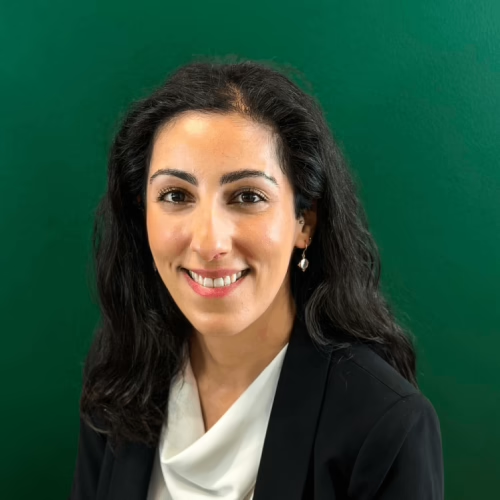
Sidnie Sarang is a multi-faceted lawyer who is passionate about justice. Sidnie practices across criminal defence law, fair trading, and commissions of inquiry including crime commissions and royal commissions.