
If you hold a NSW security licence and you have been charged with an offence, you are facing two problems at once. Importantly, they run on different clocks. The court date is the one you were told about. But the letter from the licensing regulator is the one that stops your income.
For most crowd controllers, guards and cash-in-transit operators, your licence is your job. A suspension on your license has huge, immediate effects as it does not wait for the criminal matter to finish, it does not require a conviction, and you do not get a hearing before it takes effect.
This guide covers who regulates security licences in New South Wales, what triggers a suspension or revocation, what happens the moment you are charged, how show cause and appeals work, and how the outcome of your criminal case feeds into the licensing decision.
Security licence action at a glance (NSW)
- Who decides: the Commissioner of Police, through the Security Licensing & Enforcement Directorate (SLED), under the Security Industry Act 1997 (NSW).
- The test: whether you are a fit and proper person (s 15(1)(f)), and whether your holding a licence is contrary to the public interest.
- Suspension: up to 60 days under s 25, extendable by a further 60. No right to be heard first.
- Key deadline: 28 days to apply in writing for an internal review.
- Do now: answer the show cause request in writing, and get advice before your criminal matter is finalised. The sentence you receive can decide the licence.
Who regulates security licences in NSW?
Security licences are granted, suspended and revoked by the Commissioner of Police, through the Security Licensing & Enforcement Directorate, (SLED). This area sits inside the NSW Police Force.
That structure matters more than it sounds. Your regulator is not a separate industry body that has to be told what happened; it is part of the same organisation that charged you.
Section 9 creates three classes of licence.
| Class | Subclasses |
|---|---|
| Class 1, hands-on security work | 1A unarmed guarding and crowd control, 1B bodyguard, 1C cash-in-transit, 1D dog, 1E monitoring centre, 1F armed |
| Class 2, advisory, technical and sales work | 2A consultant, 2B sales and broking, 2C installation and locksmith, 2D trainer, 2E private investigator |
| Master licence, providing licensed operatives | MA self only, through to ME unlimited operatives per day |
What can get your security licence suspended or revoked?
Criminal history, conduct, and the Commissioner’s view of your character. The Security Industry Act 1997 (NSW) Act sets a suitability test at the application stage, then applies that same test for the life of the licence.
Under section 15(1)(f), the Commissioner must refuse a licence unless satisfied the applicant is a fit and proper person, “having regard to the applicant’s character, honesty and integrity”.
Under section 15(3), a licence may be refused if the grant would be contrary to the public interest. Neither phrase is defined, and both are broad enough to capture conduct that never produced a charge.
Section 16 adds hard disqualifiers.
It is built on a list of prescribed offences in clause 15 of the Security Industry Regulation 2016: firearms and weapons, prohibited drugs, assault, fraud, dishonesty and stealing, robbery, riot, affray, stalking and intimidation, terrorism, reckless conduct causing death at a workplace, and organised criminal group offences. Several entries are narrower than the label suggests, so the clause is worth reading against your own matter.
Two provisions carry all of that across to a licence you already hold. Section 26(1A) requires the Commissioner to revoke if satisfied that, were you applying today, the application would have to be refused. Clause 25 of the Regulation allows revocation whenever the Commissioner considers it contrary to the public interest for you to keep it.
In either case, the Commissioner may rely on criminal intelligence, and need not give reasons that would reveal it.
What happens when you are charged, before any conviction?
SLED does not wait for the court. It publishes “if you are charged with a serious offence” as a stated ground for suspending a licence.
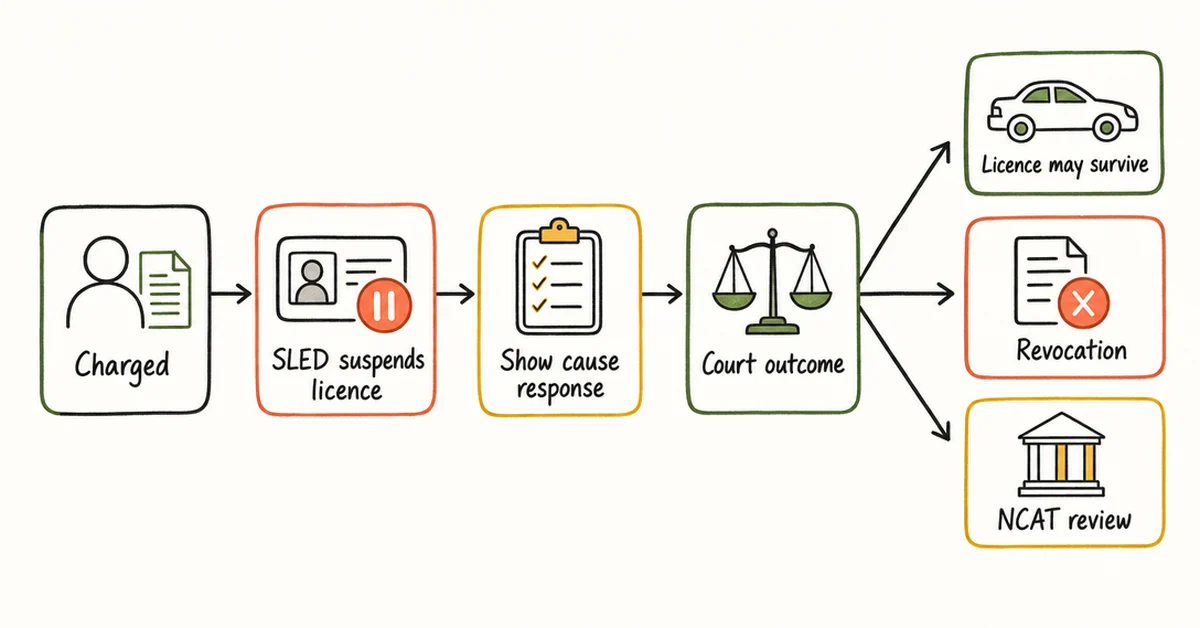
The power is in section 25. If the Commissioner is satisfied there may be grounds for revoking your licence, it can be suspended by notice for up to 60 days from the moment the notice is served. Three features catch people out:
- You get no hearing first. Section 25(1B) says the Commissioner “is not required to give a licensee an opportunity to be heard before suspending the licence under this section”.
- It can be extended. Section 25(1C) allows a further period of up to 60 days by a second notice served while the first is running.
- You cannot work. Section 25(2) is blunt: a suspended licence does not authorise you to carry on any security activity.
You must also surrender the licence immediately under section 31, which for an individual carries a maximum of 100 penalty units, currently $11,000, or 6 months’ imprisonment, or both.
Do you have to tell SLED yourself? Clause 18 of the Regulation makes it a licence condition to notify a change of particulars within 14 days, and SLED’s published class 1 conditions give address, email address and phone number as examples of what that covers. Neither the Regulation nor those published conditions require you to self-report a charge, which is not a reason for comfort: SLED sits inside the NSW Police Force and does not need you to tell it. Check your own licence notice as well, because section 21 lets the Commissioner impose extra conditions on an individual licence.
Being asked is a different question, and the answer there is not simply no. See the limit on the right to silence below.
How does the show cause process work?
“Show cause” is industry shorthand, not a term the Act uses, but the step is built into the suspension notice itself. Section 25(1A) requires the notice to state the reasons and to request that you provide the Commissioner with reasons why the licence should not be revoked.
So the sequence is suspension first, explanation second. Your response is not an appeal. It is your chance, in writing, to stop a temporary suspension becoming a permanent one.
A response that helps you usually does four things:
- Deals with the actual allegation, rather than complaining about the process.
- Corrects factual errors in the notice, with documents attached.
- Explains the context, including anything showing that what is alleged is out of character or that the circumstances are unlikely to recur.
- Addresses fitness and the public interest directly, using references, training records and evidence of steps taken since.
One caution. If you are also facing a criminal charge, what you write to SLED is an account of the same incident, and it has to be prepared with that matter in mind.
How does the criminal case affect the licensing decision?
Directly, and in a way that turns on the sentence, not just the verdict. Because section 26(1A) makes revocation mandatory whenever a fresh application would have to be refused, the penalty a magistrate imposes can decide whether the licence survives.
Assault is the clearest example. Under clause 15(1)(c), an assault only counts as a prescribed offence if the penalty imposed includes imprisonment, an intensive correction order, a community correction order, a conditional release order, a good behaviour bond, a community service order, or a fine of $200 or more.
| Outcome in the criminal matter | Likely effect on the licence |
|---|---|
| Charge withdrawn, or dismissed after a defended hearing | No prescribed offence. Revocation is not mandatory, though SLED can still act on fit and proper or public interest grounds |
| Found guilty, no conviction recorded (a section 10 order) | Falls into the 5 year limb. For assault it is prescribed only if the Commissioner considers it a “serious assault offence” |
| Convicted of assault with a bond, CRO, CCO, ICO, prison, or a penalty of $200 or more | Prescribed offence. Refusal is mandatory for 10 years, so revocation becomes mandatory |
| Convicted of robbery, riot, affray, stalking, intimidation, a drug or terrorism offence, or fraud, dishonesty or stealing carrying a maximum of 3 months or more | Prescribed regardless of the penalty imposed, so revocation is mandatory |
| Convicted of a firearms or weapons offence | Prescribed, but only where the offence would disqualify you from holding a licence under the Firearms Act 1996 |
Read that as general information, not a promise. A non-conviction order changes which limb of section 16 applies, but it does not stop the Commissioner deciding you are not a fit and proper person. What it does mean is that a sentencing submission in the Local Court is also, in effect, a licensing submission.
How do you appeal a security licence suspension or revocation?
There are two stages, and the first normally comes before the second. Internal review, then the NSW Civil and Administrative Tribunal (NCAT).
Stage one: internal review. Under the Administrative Decisions Review Act 1997 (NSW) you have 28 days to apply in writing, running from when you were notified of the decision, or from when you were given written reasons if you requested them under section 49. Section 53(6) requires the administrator to notify you of the outcome within 21 days of the application being lodged, which is also how SLED describes its own process. The reviewer must be someone who was not substantially involved in the original decision, so far as that is practicable.
Stage two: NCAT. Section 29 lets you apply to NCAT to review a refusal, a failure to renew, a licence condition, or the revocation or suspension of your licence. NCAT decides what the correct and preferable decision is, rather than only checking for legal errors. The internal review generally has to be finalised first, though if SLED does not answer within 21 days, it is treated as finalised anyway.
- Applying does not pause the decision. Section 60 says an application does not affect the operation of the decision, but NCAT may order a stay. Where a suspension is stopping you working, asking for one early is often the difference between a survivable process and an unsurvivable one.
- Criminal intelligence is heard in closed session. Under section 29(3) NCAT must not disclose it, and must hear it in the absence of you and your representative unless the Commissioner agrees otherwise.
From NCAT, a party may appeal to an Appeal Panel, then to the Supreme Court on a question of law. If your application was made under the Mutual Recognition Act 1992, SLED directs you to the Commonwealth Administrative Review Tribunal instead of NCAT, again within 28 days.
How long does it take, and is there any income protection?
Realistically, months, and no, the Act contains no compensation scheme.
A suspension can run 60 days and then a further 60. Internal review adds up to 28 days for you to lodge, plus 21 for SLED to answer, and NCAT then takes its own course.
Section 24 sets the licence term at five years from the day it comes into force, or a shorter period if prescribed by the regulations; clause 10 of the Security Industry Regulation 2016 prescribes a one‑year term where the applicant applies for a one‑year licence.
Nothing in that section extends the term to make up for time lost to a suspension. There is no statutory payment and no reimbursement if the charge is later withdrawn, and your employer, who holds the master licence, may stand you down.
Other work is unaffected. But carrying on a security activity while suspended is an offence under section 7(2), with a maximum of 500 penalty units, currently $55,000, or 2 years’ imprisonment, or both. If you are unsure whether a role counts as a security activity, get advice before taking the shift.
Your rights and what you can do now
You have a right to reasons, a right to review, and a right to be represented. The window is short, and the costly mistakes happen in the first fortnight.
Your rights: to be told why the decision was made, except where the reasons would reveal criminal intelligence; to an internal review and then independent review by NCAT on the merits, including a request for a stay while that runs; and, in the criminal matter, the ordinary right to silence when police question you about the alleged offence.
One important limit on that right. Under sections 39O and 39Q, an enforcement officer (a police officer or an authorised member of the NSW Police Force) may require you to produce records or answer questions about compliance with the Security Industry Act. Section 39R(2) removes self-incrimination as an excuse for refusing, and failing to comply without reasonable excuse is an offence under section 39T carrying up to 500 penalty units or 2 years’ imprisonment.
Two protections sit alongside it. You cannot be convicted of failing to comply unless you were warned on that occasion that non-compliance is an offence (section 39R(1)), and your answer is kept out of most criminal proceedings only if you objected at the time that it might incriminate you, or you were never warned on that occasion that you could object (section 39R(3)). Object out loud, on the record, and get advice before answering.
Practical steps:
- Diarise the 28 days. The clock runs from when you were notified of the decision, or from when you were given written reasons if you asked for them first. A phone call is not an application.
- Keep the notice and the envelope. Time runs from service, so how and when it arrived can matter.
- Do not simply surrender and walk away. An uncontested revocation still sits on your licensing history when you apply again.
- Gather evidence now: employment and training records, incident reports, body-worn or venue CCTV, and references from a master licensee who knows your work.
- Do not post about the incident or message colleagues or the complainant about it. Those are routinely obtained.
- Tell your criminal lawyer about the licence on day one. Sentencing options that look interchangeable in court are not interchangeable for your licence.
How a lawyer could help your security licence case
The work splits in two: keeping the criminal matter inside the range of outcomes that leave the licence intact, and running the licensing response properly. Handled together, each supports the other. Handled separately, they often work against each other.
Aligning the sentence with the licensing consequence. Because clause 15 turns on the penalty imposed, a lawyer may put a case for an outcome, such as a non-conviction order or a penalty below the prescribed threshold, that keeps you outside mandatory disqualification. That submission has to be made at sentence, not afterwards.
Testing the charge itself. Where the evidence is weak, a lawyer may seek withdrawal or a reduction to a lesser charge through written representations to police or the prosecution. A withdrawn charge removes the mandatory pathway entirely.
Running the show cause response and the review. A document written against the statutory tests rather than an emotional letter, filed within the 28 days, with a request for reasons and an application for a stay under section 60. Where criminal intelligence is relied on, section 29(4) requires the Tribunal to ask the Commissioner whether the Commissioner wishes to withdraw material the Tribunal considers has not been properly identified as such. A lawyer can also advise on reapplying, since section 16B allows the Commissioner to bar a person from applying again for 2 years after a refusal on fit and proper or public interest grounds.
No lawyer can promise a particular result, and a review can end with the original decision affirmed. In July 2026, SLED reported that NCAT had upheld its refusal of a licence application on public interest grounds. What early representation does is make sure the two processes are run as one, while it still counts.
Frequently asked questions
Can SLED suspend my security licence just because I have been charged?
Yes. Section 25 allows suspension where the Commissioner is satisfied there may be grounds for revoking the licence, and SLED publishes being charged with a serious offence as a reason. No conviction is required, and section 25(1B) removes any obligation to hear from you first.
Do I have to tell SLED I have been charged?
Clause 18 of the Security Industry Regulation 2016 makes it a licence condition to notify a change of particulars within 14 days. Also, SLED’s published class 1 conditions give address, email address and phone number as examples. Neither that clause nor SLED’s published conditions require you to self-report a charge, and SLED sits within the NSW Police Force, so it generally learns of charges without being told. Read your own licence notice, since section 21 allows extra conditions to be imposed on an individual licence. Being asked is different: refusing to answer an enforcement officer’s requirement under section 39Q, without reasonable excuse, is an offence.
Will a section 10 order save my security licence?
Not automatically, but it changes the analysis. A finding of guilt with no conviction recorded falls into the 5 year limb of section 16, and for assault it is prescribed only if the Commissioner considers it a serious assault offence. The Commissioner can still revoke on fit and proper or public interest grounds, so a section 10 is not a safe harbour.
How long can a security licence suspension last?
Up to 60 days initially under section 25(1), and the Commissioner can serve a further notice while it is running to extend it by up to another 60.
Can I work in security while my licence is suspended?
No. Section 25(2) says a suspended licence does not authorise you to carry on any security activity, and section 31 requires you to surrender it immediately. Working anyway risks a charge under section 7(2), carrying up to 500 penalty units or 2 years’ imprisonment.
How do I appeal a security licence decision in NSW?
Apply in writing for an internal review within 28 days, which SLED completes within 21 days. If that fails, apply to NCAT for administrative review under section 29. From NCAT an appeal lies to an Appeal Panel, then to the Supreme Court on a question of law.
Can I reapply for a security licence after it is revoked?
Sometimes, but timing matters. If the revocation followed a conviction for a prescribed offence, a fresh application would have to be refused until the 10 year period passes. A refusal on fit and proper or public interest grounds can also trigger a 2 year prohibition under section 16B.
How O’Brien Criminal & Civil Solicitors can help
A security licence matter is two cases running at once, and the licensing deadlines are shorter than the court ones. O’Brien Criminal & Civil Solicitors is a specialist criminal defence firm, led by an Accredited Specialist in Criminal Law (a credential held by fewer than 6% of NSW lawyers), with more than 20 years defending criminal charges in NSW and acting in NCAT and tribunal matters.
We run the charge and the licensing response as one strategy: testing whether the charge can be defended or withdrawn, putting the sentencing case that keeps you outside the prescribed offence thresholds, drafting the show cause response, and taking the review where it should be challenged. If your licence is already suspended, the time to call is now, not after the notice expires.
Request initial advice (no-obligation) via the form below or call us on (02) 9261 4281.
See also our fact sheet on common assault and ADVO charges in NSW and our assault and violent offences page.