
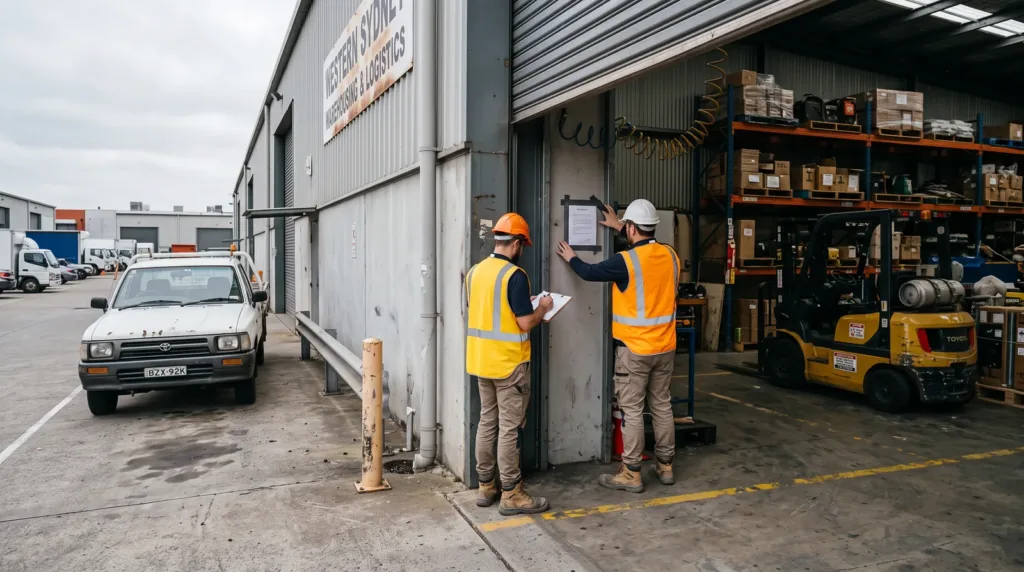
If SafeWork NSW inspectors have arrived at your workplace, issued a notice, or opened an investigation following a workplace incident, what you say and do next is very important. This is not a situation to navigate on instinct.
Many directors feel blindsided when inspectors appear unannounced, especially if they ask you to stop working and interview staff. That reaction is understandable, but SafeWork NSW’s powers, while broad, have real limits, and you have rights that matter from the first conversation.
This guide explains what SafeWork NSW can do, what each type of notice means, and where industrial manslaughter fits into your personal exposure as a director or officer.
At a glance
- The regulator: SafeWork NSW, acting under the Work Health and Safety Act 2011 (NSW).
- Your biggest personal exposure: since 16 September 2024, directors and officers can be personally charged with industrial manslaughter under section 34C of the Work Health and Safety Act 2011 (NSW) if their gross negligence in breaching a health and safety duty causes a death. Maximum penalty for an individual: 25 years’ imprisonment.
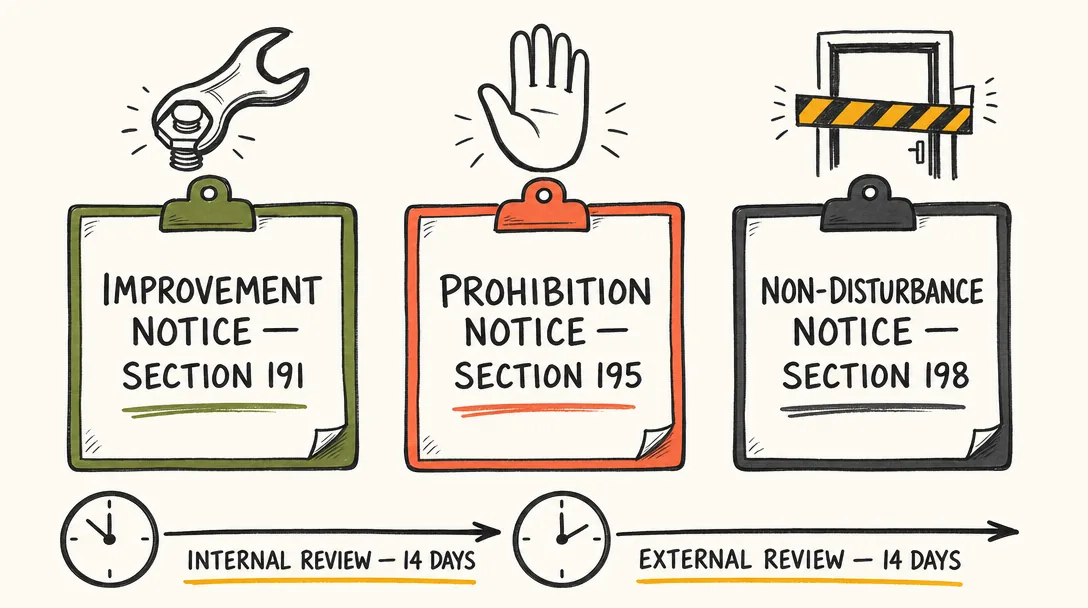
- Notice appeals: internal review of an inspector’s decision within 14 days (or before the compliance date, whichever is earlier); external review to the NSW Industrial Relations Commission within 14 days of the internal review decision (or within 14 days of receiving a statement of reasons, if the Commission orders one).
- The one thing to do now: do not answer SafeWork NSW’s substantive questions or hand over documents without first speaking to a lawyer. Preserve everything relevant, create nothing new.
What Investigative Powers Does SafeWork NSW Have?
SafeWork NSW inspectors can enter, inspect, and gather evidence at your workplace without your consent. However, their powers are defined by the Work Health and Safety Act 2011 (NSW) and stop at its limits.
- Entry to the workplace: an inspector can enter a workplace without notice or a warrant at any time work is being carried out, or when the site is otherwise open, to check compliance or investigate a suspected breach.
- Interview workers: SafeWork inspectors can ask workers questions about work health and safety matters. Workers are not compelled to answer informal interview questions, but inspectors can use formal powers (such as requiring information or documents) to compel a response.
- Inspect, copy, and seize documents: inspectors can examine, photograph, and take copies of records relevant to workplace investigations. These might include safety plans, incident reports, training records, and internal communications, and can require documents to be produced.
- Photograph and record: inspectors can photograph and film the workplace, plant, and conditions. This material can later be used as evidence in enforcement action or a prosecution.
- Issue notices: inspectors can issue improvement, prohibition, and non-disturbance notices on the spot, including immediately stopping work where they believe there is a serious risk.
Types of SafeWork NSW Notices: What They Mean and Your Response
SafeWork NSW uses three main notice types, each with a different trigger, timeframe, and review pathway.
| Notice type | What it means | Compliance | Review rights |
|---|---|---|---|
| Improvement notice (s191) | SafeWork believes the WHS Act has been (or is being) breached, but there is no immediate serious risk. | Fix the specified problem within the period stated on the notice, which the inspector sets to fit the risk rather than a fixed default. | Internal review within 14 days (or before the compliance date, whichever is earlier); lodging an internal review application suspends (stays) the operation of the improvement notice until the internal review decision or an external review application is made. External review to the NSW Industrial Relations Commission within 14 days of the internal review decision (or within 14 days of receiving a statement of reasons, if ordered). |
| Prohibition notice (s195) | SafeWork believes there is (or will be) a serious risk to health or safety. The specified activity must stop. | Immediate. Work cannot resume on the affected activity until the risk is remedied to the inspector’s satisfaction. | Same review pathway as above; an application for review does not automatically suspend the notice. |
| Non-disturbance notice (s198) | Directs you not to disturb an incident site, so evidence is preserved for investigation. | Stays in force until SafeWork withdraws it or for the period the notice specifies. | Same review pathway; get specific written clarity from SafeWork on what you can and cannot touch in the meantime. |
Applying to review a notice is a genuine right, but it is a strategic decision, not an automatic step. Get advice before you decide whether to comply, seek an extension, or apply for review.
The SafeWork Investigation Process: What Happens Next
A SafeWork investigation usually moves through stages, though the pace depends on the seriousness of the incident and the evidence.
- Notification: a death, serious injury, or other notifiable incident must be reported to SafeWork NSW immediately. Dangerous occurrences fall into this category too. Failing to notify is a separate offence.
- Inspector attendance: for serious incidents, inspectors commonly attend within hours or days, photograph the scene, begin interviewing workers, and may issue an immediate prohibition or non-disturbance notice.
- Evidence gathering: SafeWork collects witness statements, documents, and expert reports. This is the stage at which you should be preserving your own evidence and begin instructing your own experts in parallel.
- Prosecution assessment: SafeWork’s legal team reviews the file and decides whether to refer the matter for prosecution. Timing varies and can extend well beyond a year for serious or contested matters.
- Charging decision: if SafeWork proceeds, you will be formally notified of the specific charges. This is the point the matter becomes public and moves toward court.
Industrial Manslaughter: Director Criminal Liability Since September 2024
Since 16 September 2024, a director or officer whose gross negligence caused a workplace death can be personally charged with industrial manslaughter under section 34C of the Work Health and Safety Act 2011 (NSW).
Key points for directors and officers:
- The maximum penalty is 25 years’ imprisonment for an individual (including an officer or an individual PCBU); a body corporate faces a fine of up to $20 million. There is no fines-only outcome for an individual convicted of industrial manslaughter.
- The threshold is gross negligence, meaning a serious, obvious departure from the standard of care a reasonable person would exercise.
- You can be charged personally even where your company is also charged, and a conviction (or acquittal) on one does not determine the other.
- Industrial manslaughter has no limitation period.
If a fatality is involved, assume you may be investigated for industrial manslaughter and get legal advice immediately, before speaking to SafeWork NSW.
Our fact sheet on industrial manslaughter in NSW covers the elements, the due diligence defence, and sentencing in full detail.
Your Rights & What You Can Do Now
- Despite SafeWork’s broad powers, you have real rights during an investigation, and there are practical steps that strengthen your position from the outset.
- Right to legal representation. You can have a lawyer present at any interview. You should ask for the interview to be deferred until your lawyer is available.
- Right to refuse self-incriminating answers. You can decline to answer questions that may incriminate you in relation to a criminal offence. However, failing to cooperate with SafeWork’s compliance functions can have consequences in WHS penalty proceedings. Get advice from a criminal lawyer before any interview about which questions are criminal versus regulatory.
- Right to seek advice before providing documents. SafeWork can require documents to be produced, but you should ask for reasonable time to review sensitive material with a lawyer.
- Right to challenge a notice. Improvement, prohibition, and non-disturbance notices can be reviewed internally within 14 days, then externally by the NSW Industrial Relations Commission within 14 days of that decision. Applying for review does not automatically pause the notice.
- Right to know the case against you. You are entitled to understand what SafeWork alleges and the evidence behind it, and you can seek access to the investigation file through freedom-of-information channels once charges are laid.
- Do not create new documents after the fact. Writing fresh explanations, editing records, or “tidying up” paperwork after an incident can look like, or amount to, evidence tampering. Preserve what already exists instead.
- Preserve physical evidence immediately. Secure the scene and equipment, instruct staff not to clean or repair anything relevant, and take your own photographs and video.
- Notify your insurer without delay. D&O and statutory liability policies commonly require prompt notification as a condition of cover, so delay can itself jeopardise your coverage.
- Keep a factual, contemporaneous log of every contact with SafeWork NSW, including written updates and documented updates on what was said and what documents were requested or provided.
- Continue genuine WHS work. An investigation is not a reason to freeze how you manage risks or maintain safe systems day to day. Ongoing, documented action helps your position and is the right thing to do regardless of the legal exposure.
Call O’Brien Criminal & Civil Solicitors on (02) 9261 4281 before you speak to SafeWork. Getting advice in the first hours after inspectors arrive is the single biggest factor most directors can control.
How a SafeWork NSW Investigation Lawyer Can Help Your Case
A solicitor experienced in WHS prosecutions can be involved from the moment SafeWork NSW makes contact. Before any charge is laid, you should seek legal advice as early involvement is often what shapes the outcome.
Our lawyers can help with:
- Managing all contact with investigators: attending interviews with you and advising in real time on what must legally be answered versus what can be declined, and maintaining ongoing communication with SafeWork on your behalf where appropriate.
- Assessing your exposure to Category 1 and industrial manslaughter charges: reviewing the facts against the elements of each offence, so you understand realistically what SafeWork would need to prove and where the genuine risk sits.
- Building the due diligence defence: organising evidence of your ongoing WHS obligations, as a duty holder, into a coherent position, including board minutes, training records, inspection logs, and safety audits.
- Negotiating on notices and potential charges: engaging with SafeWork NSW on the scope of a notice and whether an application for review is worthwhile. Also, we can determine whether a lesser WHS charge is more appropriate.
- Coordinating with your insurer and broker: helping ensure notifications are made correctly and on time, and that your defence is properly funded from as early a point as your policy allows.
Frequently Asked Questions
Do I have to answer all of SafeWork NSW’s questions?
No. You have the right to decline to answer questions that may incriminate you in relation to a criminal offence. That said, refusing to answer in a purely civil compliance context can carry its own consequences for penalty proceedings, so always get advice on which category a question falls into before your interview.
Can SafeWork NSW enter my workplace without permission or a warrant?
Yes, for a workplace. Under the Work Health and Safety Act 2011 (NSW), an inspector can enter a workplace without a warrant, without notice, at any time work is being carried out or the site is otherwise open, in order to check compliance or investigate a suspected breach. You cannot refuse entry, but you can ask to contact a lawyer straight away.
What exactly is an improvement notice?
An improvement notice under section 191 is issued when SafeWork believes the WHS Act has been breached but there is no immediate serious risk. It sets out what you must fix and the period you have to do it, set by the inspector to match the risk rather than a fixed default. You must comply in a timely manner or risk prosecution, but you can seek internal review within 14 days if you believe the notice is unreasonable or unfounded.
How do I challenge or appeal a SafeWork notice?
You can seek internal review of an improvement, prohibition, or non-disturbance notice within 14 days of it being issued. If you are unhappy with that outcome, you can apply for external review by the NSW Industrial Relations Commission within 14 days of the internal review decision. Applying for review does not automatically suspend the notice, so you may still need to comply while the review is under way. A lawyer can advise on whether review is strategically worthwhile and help prepare the application.
Can I be charged with industrial manslaughter even if SafeWork’s investigation is still civil in nature?
Yes. A single incident can generate both a civil compliance response (notices, and potentially a WHS penalty) and a parallel criminal investigation into industrial manslaughter or a Category 1 offence where a death or serious risk of death is involved. The two run on different tracks, and your obligations and rights differ between them, which is exactly why early advice matters.
Act now if you’ve been contact by SafeWork NSW
O’Brien Criminal & Civil Solicitors is led by an Accredited Specialist in Criminal Law, an accreditation held by fewer than 6% of NSW solicitors. Our lawyers act for clients from the first point of contact with SafeWork NSW and other government agencies, which matters when early decisions shape everything that follows.
If SafeWork NSW inspectors have attended your workplace, issued a notice, or opened workplace investigations, do not wait to get advice.
Request initial advice (no-obligation) via the form below or call us on (02) 9261 4281.
This content is for general information purposes only and does not constitute legal advice. You should seek independent legal advice relevant to your specific circumstances.