
If you have been questioned or charged over possessing precursor chemicals, you’re not being accused of drug possession. Instead, it’s that the police believe you intended to manufacture drugs. A completely different charge.
That distinction means the case turns on intent, which is something a defence lawyer can contest.
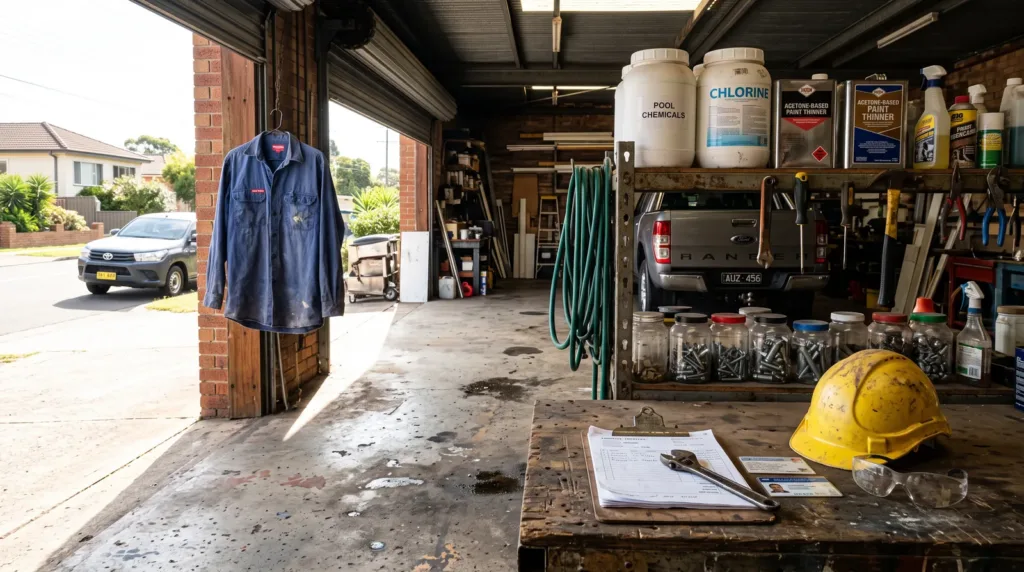
Precursor charges often catch people who actually had a completely legitimate reason to have the chemical in question, like a tradesperson, a hobbyist or a small business owner.
This guide explains what precursor chemicals are, how NSW and Commonwealth law treat them differently, the real difference between a possession charge and a manufacturing charge, how prosecutors try to prove intent, realistic penalties, and what a lawyer can do to challenge the case against you.
At a glance
- NSW precursor possession (with intent to manufacture): s 24A Drug Misuse and Trafficking Act 1985 (NSW): up to 10 years’ imprisonment and/or a $220,000 fine on indictment, or up to 2 years summarily in the Local Court.
- NSW manufacturing: s 24 DMTA: up to 15 years for an indictable quantity, rising to 20 to 25 years for commercial and large commercial quantities.
- Commonwealth precursor offences can apply instead of, or alongside, NSW charges, carrying penalties up to 25 years.
- Court: Local Court for summary NSW matters, District Court for indictable NSW matters. Federal matters run through the Commonwealth Director of Public Prosecutions and can be heard in the District Court exercising federal jurisdiction.
- The one thing to do now: don’t discuss the chemical, its purpose, or your movements with police beyond your name and address. Get legal advice before any further interview, and keep any records that show a legitimate use.
What counts as a precursor chemical under the law?
A precursor is a chemical that has genuine, everyday uses which are legal and can also be used as an ingredient in manufacturing an illicit drug. Therefore, possession of one isn’t automatically illegal. In fact, millions of Australians own products containing these substances for a number of reasons.
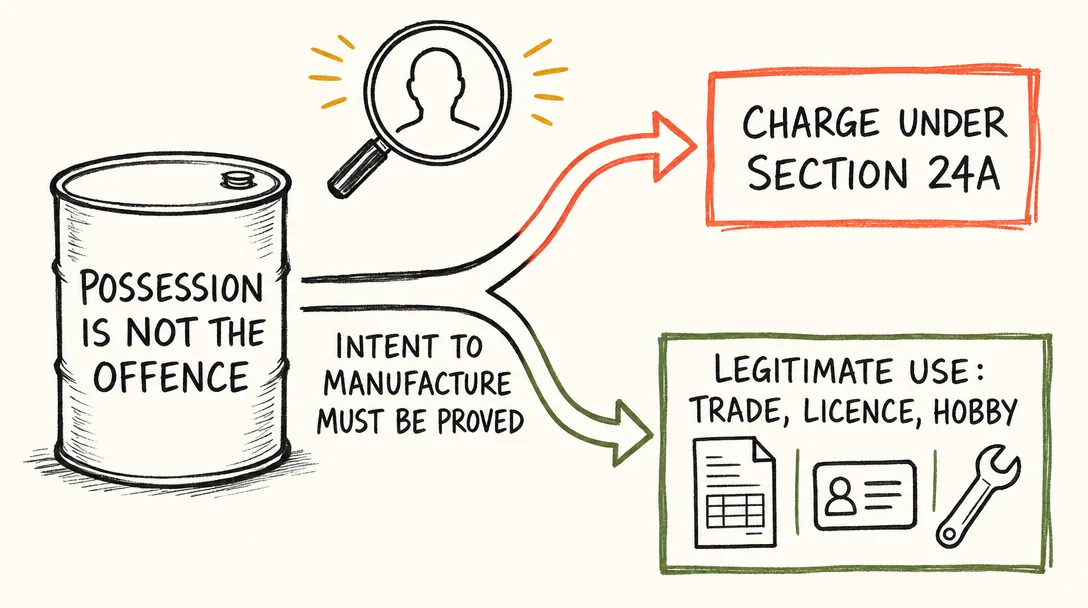
The offence is about intent, not the chemical itself.
NSW precursors are regulated under the Drug Misuse and Trafficking Act 1985 (NSW), with “controlled precursors” and “border-controlled precursors” regulated federally under Part 9.1 of the Criminal Code Act 1995 (Cth).
| Chemical | Common legitimate use | Illicit use police allege |
|---|---|---|
| Pseudoephedrine / ephedrine | Cold and flu medication, decongestants | Methamphetamine manufacture |
| Hydrochloric acid | Pool chemicals, industrial cleaning, metal treatment | Drug conversion and purification |
| Acetone | Paint thinner, nail polish remover, degreasing | Cocaine processing, methamphetamine production |
| Red phosphorus | Matches, fireworks, some fertilisers | Methamphetamine manufacture |
| Iodine | Disinfectant, medical and veterinary use | Methamphetamine manufacture |
| Safrole / anethole | Fragrance and flavouring compounds | MDMA manufacture |
| Acetic anhydride | Industrial solvent, textile and pharmaceutical manufacturing | Heroin processing |
| Sodium or lithium metal | Battery manufacturing, industrial chemistry | Methamphetamine manufacture (“one-pot” methods) |
| Toluene | Paint, adhesives, fuel additive | Drug extraction and purification |
Neither Act publishes a single, static “banned list”. Chemicals are added to the schedules as manufacturing methods change, so what’s scheduled can change.
Is possessing a precursor chemical illegal in NSW?
No, not on its own. Under s 24A of the DMTA, it’s only an offence to possess a precursor or “drug manufacture apparatus” (glassware, heating or filtration equipment associated with drug labs) intended for use in manufacturing a prohibited drug.
Unlike possession or supply charges for drugs, s 24A does not set a set quantity that automatically triggers the offence. The prosecution’s whole case rests on proving what you intended to do with the chemical, which is harder to prove than showing you simply had it.
Excuses for holding precursor chemicals include holding an authority under the Poisons and Therapeutic Goods Act 1966 (NSW), a scientific or industrial licence, employment that requires handling the chemical, or a genuine hobby or research use which is consistent with the amount you had.
What’s the difference between a precursor charge and a manufacturing charge?
A precursor charge alleges preparation. However, a manufacturing charge says the making, or a genuine attempt at it, has already begun. A very important difference.
- Precursor possession (s 24A DMTA): you had the chemical, and police allege you intended to use it, or let someone else use it, to manufacture a prohibited drug. Remember, no drug needs to have actually been produced.
- Manufacturing or production (s 24 DMTA): police allege you manufactured, produced, or knowingly took part in manufacturing a prohibited drug. This requires evidence the process had actually started, not just that you had the chemicals on hand.
The two charges are often laid together where police find both raw precursors and signs that production had progressed. Things like partially synthesised material, a working setup and drug residues. Being charged with both isn’t automatic, and a strong criminal defence on the manufacturing charge might just leave only the lesser precursor allegation.
How do prosecutors try to prove intent to manufacture?
As intent can’t be seen directly, the prosecution builds a circumstantial case from a combination of factors, including:
- Multiple precursors together: several chemicals used in the same manufacturing process, rather than one item with an obvious single use.
- Associated equipment: glassware, heating elements, filtration or extraction gear consistent with a clandestine lab.
- Instructions or research: manufacturing recipes, chemical formulas, or a browsing history of drug-production methods.
- Quantity: amounts well beyond anything a legitimate personal, hobby, or even small-business use would require.
- Storage and concealment: chemicals hidden, disguised, or stored together in a way inconsistent with their stated purpose.
- Prior conduct: any history of drug manufacture or supply, though this alone is never enough to prove the current charge.
Each of these is arguable by a criminal lawyer specialised in drug charges. For example, a tradesperson with acetone and hydrochloric acid in a garage workshop can show invoices, a trade licence, or an employer’s records to the court.
Is this a NSW matter or a federal one?
It can be either, and sometimes both. Which one applies depends on how the matter came to the police’s attention and whether there’s a federal element.
NSW Police and the ODPP typically prosecute domestic precursor and manufacturing matters investigated locally, under the DMTA. The Australian Federal Police and the Commonwealth Director of Public Prosecutions take over cases related to importing or exporting the chemical across Australia’s border, or where the investigation is part of a larger organised-crime operation.
Commonwealth precursor law sits across two parts of the Criminal Code.
Division 306 covers “pre-trafficking”: manufacturing or supplying a controlled precursor domestically, believing it will be used to manufacture a controlled drug.
Division 307 covers importing or exporting a border-controlled precursor, which is the Commonwealth Director of Public Prosecutions’ most commonly prosecuted precursor offence.
If your matter involves a chemical ordered from overseas, intercepted at a border facility, or seized as part of an Australian Federal Police operation, expect it to run as a Commonwealth prosecution, not a state one.
What are the penalties?
The maximum penalty depends on two things: how much of the chemical was involved, and which court hears the case.
| Offence | Legislation | Maximum penalty |
| Precursor possession with intent (summary) | s 24A DMTA (NSW) | 2 years’ imprisonment (Local Court) |
| Precursor possession with intent (indictable) | s 24A DMTA (NSW) | 10 years’ imprisonment and/or $220,000 fine |
| Manufacture, indictable quantity | s 24 DMTA (NSW) | 15 years’ imprisonment (10 years for cannabis) |
| Manufacture, commercial quantity | s 24 DMTA (NSW) | 20 years’ imprisonment |
| Manufacture, large commercial quantity | s 24 DMTA (NSW) | 25 years’ imprisonment |
| Pre-trafficking a precursor, commercial quantity | s 306.2 Crim Code (Cth) | 25 years’ imprisonment |
| Importing/exporting a border-controlled precursor, less than marketable quantity | s 307.13 Criminal Code (Cth) | 7 years’ imprisonment |
| Importing/exporting a border-controlled precursor, marketable quantity | s 307.12 Criminal Code (Cth) | 15 years’ imprisonment |
| Importing/exporting a border-controlled precursor, commercial quantity | s 307.11 Criminal Code (Cth) | 25 years’ imprisonment |
Importantly, the above are the maximum penalties, reserved for the most serious cases, such as a large quantity, a clear commercial operation or an organised syndicate. If you’re a first-time offender, with a genuine legitimate-use argument, you’re unlikely to attract a maximum penalty.
Usually, courts will weigh the role played, the quantity, personal circumstances, and whether you have a prior record. Sentencing statistics published by the NSW Bureau of Crime Statistics and Research consistently show most drug-related matters in the Local Court resolve well below the maximum. However, every case is assessed on its own facts, and this is only general information so expert criminal defence is recommended.
Your Rights & What You Can Do Now
- You don’t have to answer questions beyond confirming your name and address. In NSW you’re generally not obliged to answer further questions or explain why you have a particular chemical. Anything you say can be used against you, and an explanation given under pressure, without legal advice, often does more harm than good.
- You have the right to have a lawyer present before and during any formal police interview or search. Ask for this explicitly and don’t proceed without it.
- Don’t move, dispose of, or alter the chemicals or equipment. Doing so can be treated as evidence of guilt, and can itself expose you to separate charges.
- Gather proof of legitimate use now. Invoices, purchase records, safety data sheets, employment records, trade licences, or evidence of a genuine hobby all help establish the chemical’s real purpose. The earlier this is compiled, the more persuasive it is.
- Don’t discuss the matter on the phone, by text, or on social media. Seized devices and phone records are routinely used as evidence in precursor cases.
- Get legal advice before you do anything else. Whether this becomes a NSW or a Commonwealth matter, an early conversation with a criminal defence lawyer shapes every decision that follows, including whether to participate in a further police interview at all.
How a Lawyer Could Help Your Case
Precursor and manufacturing charges are unusually technical. They turn on chemistry, quantities, and inference, not just on what was physically found. A lawyer experienced in these matters can:
- Challenge the intent evidence directly. As s 24A requires proof of intent, not just possession, a lawyer can test whether the prosecution’s circumstantial case (equipment, quantity, storage) genuinely supports manufacturing intent, or is equally consistent with an innocent explanation.
- Run a legitimate-use defence. Where you had a lawful reason to hold the chemical, work, licensing, hobby, or research, a lawyer can marshal documentary evidence and, where appropriate, expert evidence to support it.
- Contest how the evidence was obtained. Search warrants, seizure procedures, and the chain of custody for chemical exhibits are all open to challenge, and a defect can affect what evidence is admissible.
- Negotiate with the prosecution before committal. In some cases, this can lead to charges being downgraded (for example, from manufacturing to the lesser precursor charge) or withdrawn where the evidence doesn’t hold up. There’s no guarantee of this outcome, but it’s a genuine avenue in appropriate cases.
- Put mitigating factors before the court. No prior record, a demonstrated legitimate business or trade, early cooperation, genuine remorse, and rehabilitation steps already taken can all support a lower sentence within whatever range applies.
- Advise on which jurisdiction is actually in play, making sure you’re not disadvantaged by assuming a matter is a state one when it’s really a Commonwealth prosecution, or vice versa. The procedure, timelines, and sentencing approach differ.
None of this guarantees a particular result, but it does make sure your case is tested properly, rather than accepted at face value.
Frequently Asked Questions
Do I have to answer police questions about why I have these chemicals?
No. Beyond providing your name and address in the circumstances required by law, you’re generally entitled to remain silent and to have a lawyer present before answering anything further. Explaining yourself on the spot, without advice, is one of the most common ways an innocent explanation gets tangled up in a police statement that’s hard to walk back later.
What chemicals are considered drug precursors in NSW?
There’s no single fixed list. Common examples include pseudoephedrine, ephedrine, hydrochloric acid, acetone, red phosphorus, iodine, safrole, acetic anhydride, and various solvents used in extraction or purification. Whether a specific chemical is captured under NSW or Commonwealth precursor provisions is a question worth confirming with a lawyer, since the schedules are updated over time.
Can I be charged even if I never actually made any drugs?
Yes. Precursor possession under s 24A DMTA is a separate offence from manufacturing. It criminalises the intent to manufacture, not the act itself. That manufacturing hasn’t started, wasn’t likely to succeed, or was never actually possible are all things a lawyer can put to the court, but the charge itself doesn’t require any drug to have been produced.
Is my case a NSW matter or a federal one?
It depends on how it arose. If NSW Police investigated a local matter with no import/export or interstate element, it’s typically prosecuted under the DMTA. If the Australian Federal Police or Australian Border Force were involved, for example, the chemical was ordered from overseas or intercepted at the border, expect a Commonwealth prosecution under the Criminal Code instead, which can carry different penalties and procedures.
What if I bought the chemical for a legitimate reason?
A genuine, documented legitimate use is the core defence to a precursor charge. Keep or gather invoices, licences, safety data sheets, and any records showing the quantity you held was consistent with that use. The sooner this is put together, the stronger the position.
Will I be charged just for owning lab equipment like glassware or heating elements?
Owning ordinary equipment is not, by itself, an offence. It becomes relevant evidence when combined with precursor chemicals and other factors police say point to manufacturing intent, but the equipment alone rarely carries a case.
What’s the difference between a summary and an indictable precursor charge?
A summary charge is finalised in the Local Court and carries a lower maximum penalty of 2 years. An indictable charge proceeds in the District Court and exposes you to the full maximum of 10 years and/or a $220,000 fine. Whether a matter proceeds summarily or on indictment depends on the quantity, circumstances, and the election made by the prosecution or the court. This is an area where legal representation can make a real difference to how the matter is dealt with.
How O’Brien Criminal & Civil Solicitors Can Help
Precursor and manufacturing charges hinge on very specific evidence, exactly the kind of case where early, informed legal advice changes what happens next. Led by an Accredited Specialist in Criminal Law (held by fewer than 6% of NSW solicitors) and acting for clients from the moment of first police contact, our criminal team knows how to test intent evidence, engage the right experts, and identify whether a matter should be run as a state or a Commonwealth prosecution.
If you’re facing a precursor or drug manufacturing charge in NSW, or you’ve been contacted by NSW Police or the Australian Federal Police about one, get advice before you say anything further.
Request initial advice (no-obligation) via the form below or call us on (02) 9261 4281.
This content is for general information purposes only and does not constitute legal advice. You should seek independent legal advice relevant to your specific circumstances.