
A penalty notice or court attendance notice for negligent driving can follow an ordinary moment: a nudge in traffic, a misjudged turn, a glance away from the road. The word “negligent” can sound like something a court has already decided.
But it has not. Negligent driving is an allegation. How you respond in the first few weeks can decide whether you end up with a fine and demerit points, a conviction, or no penalty at all.
This guide explains what negligent driving means in NSW, its three tiers, the fine and demerit points, and the risk to your licence. It also compares the offence with dangerous and reckless driving, and covers whether you can avoid a conviction. Our criminal lawyers act for negligent driving matters in NSW.
Negligent driving at a glance (NSW)
- The offence: driving a motor vehicle on a road negligently, under s 117(1) of the Road Transport Act 2013 (NSW).
- Where no one is killed or seriously hurt: maximum $1,100 fine in court, no imprisonment, 3 demerit points. Police may instead issue a $577 penalty notice.
- Where it is heard: dealt with summarily, usually in the Local Court.
- Key deadline: the due date on your penalty notice. Even after paying, you can still ask for a court hearing within 90 days of the notice being issued.
- Do now: do not pay the fine or plead guilty until you know what the demerit points will do to your licence.
What is negligent driving in NSW?
Negligent driving is driving without the care and attention a reasonable driver would take in the same situation. It is judged objectively: the question is not whether you meant any harm, but whether your driving fell below that standard.
The offence sits in section 117(1) of the Road Transport Act 2013 (NSW), which says a person “must not drive a motor vehicle on a road negligently”. The NSW Government describes it as driving “without the due care and attention reasonably expected of a driver”.
Three things about the test matter:
- A crash is not automatically negligence. The prosecution still has to prove your driving fell below the standard.
- The circumstances count. Under s 117(3) the court must consider the road’s condition and use, the traffic actually present or expected, and any hazards such as broken-down vehicles or an accident scene.
- The standard is lower than for serious Crimes Act offences. The Criminal Trial Courts Bench Book notes that the degree of negligence needed for the equivalent earlier offence (s 42 of the former traffic management Act, now s 117) is less than for causing grievous bodily harm by a negligent act under s 54 of the Crimes Act 1900.
What are the three tiers of negligent driving?
Section 117(1) has three penalty tiers, depending on the harm caused. The same driving can be fine-only, or carry imprisonment and automatic disqualification if someone was killed or seriously injured.
| Tier | Section | Maximum penalty, first offence | Licence |
|---|---|---|---|
| Occasioning death | s 117(1)(a) | $3,300 fine or 18 months’ imprisonment, or both | Automatic disqualification |
| Occasioning grievous bodily harm | s 117(1)(b) | $2,200 fine or 9 months’ imprisonment, or both | Automatic disqualification |
| No death or grievous bodily harm | s 117(1)(c) | $1,100 fine, no imprisonment | 3 demerit points; disqualification only if a court orders it |
Penalties for the first two tiers are higher for a second or subsequent offence. We cover them, alongside dangerous driving, in our fact sheets on dangerous driving causing death and dangerous driving occasioning grievous bodily harm.
The rest of this guide is about the third tier, where no one was killed or seriously injured.
What happens if you get a penalty notice for negligent driving?
Police can deal with the non-injury offence by issuing a penalty notice (an on-the-spot fine) of $577 and 3 demerit points, instead of charging you. Only this tier can be dealt with that way, because an offence that carries imprisonment cannot be a penalty notice offence (s 195(6)).
The amount is set by Schedule 5 and section 134 of the Road Transport (General) Regulation 2021. The 3 points come from Schedule 1 of the Road Transport (Driver Licensing) Regulation 2017, and they stay at 3 on long weekends, so double demerits do not apply.
You have three options under the Fines Act 1996 (NSW):
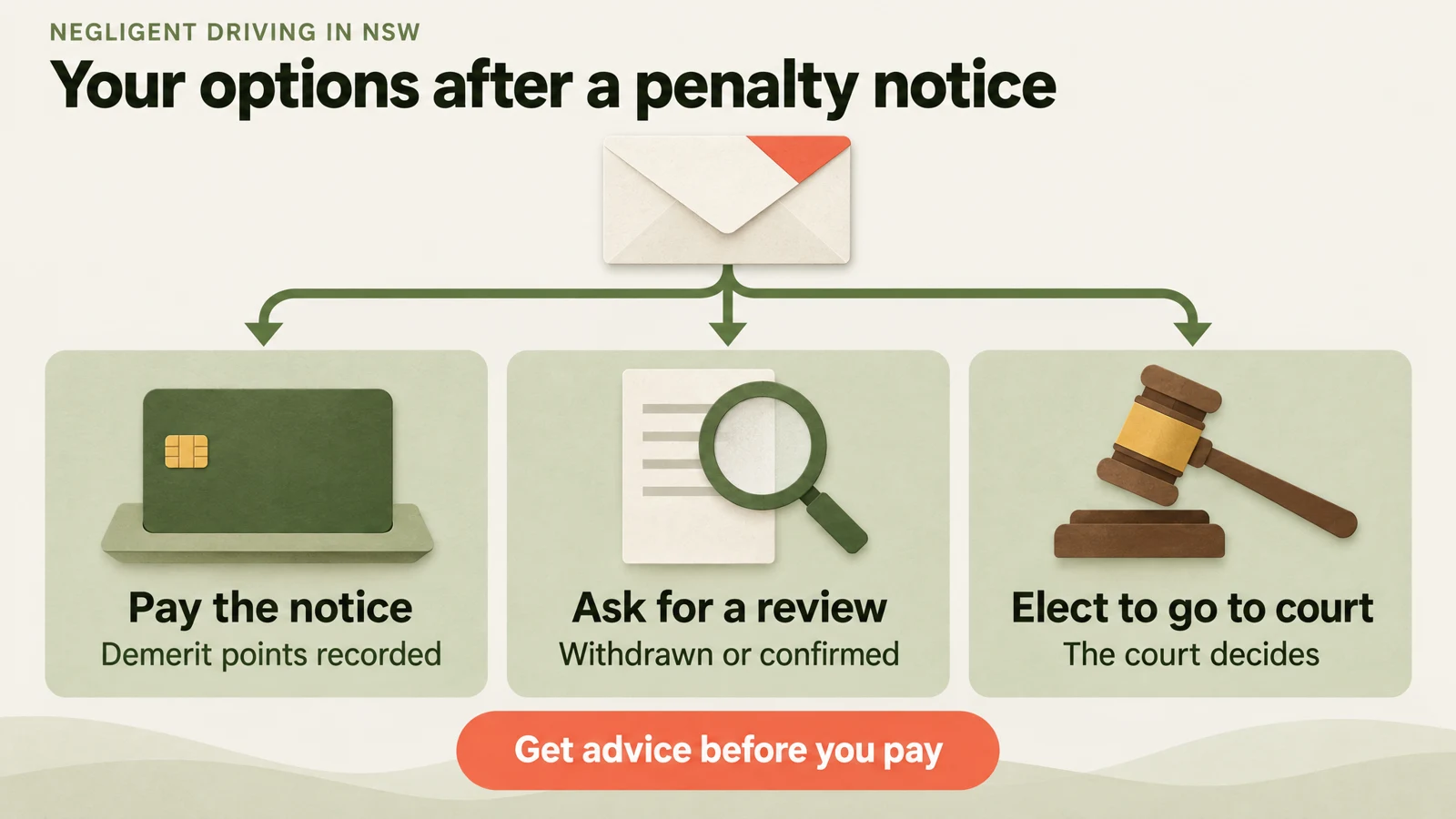
| Option | What it means | What follows |
|---|---|---|
| Pay | The matter ends and no further proceedings can be taken (s 22A(1)) | No conviction, but the 3 demerit points are recorded. You can still court-elect within 90 days of the notice being issued (s 23A(2A)), unless a penalty reminder notice has been served. |
| Ask for a review | You apply using the approved form, with grounds and supporting evidence (s 24A) | The notice is either withdrawn or confirmed (s 24E). If it is confirmed, you can still court-elect within 28 days (s 23A(2C)), unless a penalty reminder notice has been served. |
| Court-elect | You have the matter decided by the Local Court instead (s 23A) | The court can dismiss it, convict you, or deal with you without a conviction |
Paying is not an admission of liability in a civil claim arising from the same incident (s 22A(2) of the Fines Act).
Do not ignore the notice. If it goes unpaid and the time to court-elect lapses, the demerit points are recorded anyway (s 31(2)(c)).
What penalties can a court impose?
If you are charged, or you court-elect, the maximum the court can impose is 10 penalty units, currently $1,100 (a penalty unit is $110 under s 17 of the Crimes (Sentencing Procedure) Act 1999). There is no imprisonment for this tier, whatever your record.
A conviction also brings the 3 demerit points, and costs may be added (a court costs levy, and possibly the prosecutor’s costs, under ss 211A and 215 of the Criminal Procedure Act 1986). The court may also order disqualification for any period it chooses under s 204(1). That power is discretionary: there is no automatic or minimum disqualification for this tier, because it is not a “major offence” under the Act.
At the other end of the range, the court can decline to record a conviction at all (see below). Outcomes depend on the driving, the consequences and your record, which is why court-electing is a decision to make with advice.
Will you lose your licence for negligent driving?
Not automatically. For the non-injury offence, your licence is at risk mainly in two ways: through demerit points, or through a disqualification a court chooses to order.
Check demerit points first. Three points can tip you over your limit:
| Licence | Demerit point limit | Consequence |
|---|---|---|
| Learner or P1 | 4 points | Transport for NSW may suspend the licence or refuse to renew it (3 months, per NSW Government) |
| P2 | 7 points | 3-month suspension or refusal to renew |
| Unrestricted | 13 points in 3 years (14 for a professional driver) | 3 to 5 months, depending on the total (s 33) |
The learner and provisional limits are published by the NSW Government. For a learner or P1 driver with even one prior point, a negligent driving penalty notice takes you to the limit. Transport for NSW can also suspend or cancel a learner or provisional licence after a conviction or a paid penalty notice (clauses 14, 24 and 30 of the Driver Licensing Regulation).
An unrestricted licence holder facing suspension can usually elect a 12-month good behaviour period instead under s 36, but 2 or more points during that period doubles the suspension. Our fact sheet on licence appeals in NSW explains which suspensions can be appealed and the deadlines.
Police cannot suspend your licence on the spot for negligent driving. The immediate suspension power in s 224 covers specified offences, such as Crimes Act driving offences causing death or serious injury, drink and drug driving, street racing and high-range speeding. Section 117 is not one of them.
Negligent driving occasioning death or grievous bodily harm, and s 117(2) driving, are different. They are major offences, so conviction brings automatic disqualification for 3 years, with a 12-month floor (s 205). After another major offence in the previous 5 years, it is 5 years, with a 2-year floor.
Can you avoid a conviction for negligent driving?
Yes, it is possible. A court that finds the offence proved can still decline to convict you under section 10 of the Crimes (Sentencing Procedure) Act 1999, and for this offence that also means no demerit points.
The court can dismiss the charge, or discharge you under a conditional release order or an intervention program, without conviction. In deciding, the court looks at your character, record, age, health and mental condition, how trivial the offence was, and any extenuating circumstances. Our fact sheet on section 10 dismissals in NSW explains how these orders work.
Two features make section 10 especially relevant to negligent driving:
- No demerit points follow a section 10 order. Section 31(4) of the Road Transport Act says Transport for NSW is not to record them. That can matter a great deal for a provisional licence.
- The 5-year bar does not apply to this tier. Section 203 stops a second section 10 within 5 years for negligent driving occasioning death or grievous bodily harm and for s 117(2), but not for s 117(1)(c).
If you plead guilty or are found guilty, the Local Court can also refer you, before sentence, to the traffic offender intervention program: an approved traffic course run under Part 9 of the Criminal Procedure Regulation 2017. Sentencing can be deferred while you complete it (s 11 of the Crimes (Sentencing Procedure) Act), and the court then deals with you. Whether to make a section 10 order is always the court’s decision.
How is negligent driving different from dangerous, furious or reckless driving?
The difference is the degree of fault. Negligent driving is a failure of ordinary care; the more serious offences require driving that was objectively dangerous to others, or reckless.
| Offence | Section | Maximum penalty, first offence |
|---|---|---|
| Negligent driving (no death or GBH) | s 117(1)(c) Road Transport Act 2013 | $1,100 fine |
| Driving furiously, recklessly, or at a speed or in a manner dangerous to the public | s 117(2) Road Transport Act 2013 | $2,200 fine or 9 months, or both; automatic disqualification |
| Menacing driving | s 118 Road Transport Act 2013 | $3,300 fine or 18 months, or both, where intent to menace is proved |
| Dangerous driving occasioning GBH or death | s 52A Crimes Act 1900 | 7 years (GBH) or 10 years (death) |
“Speed or manner dangerous” is not a separate offence in NSW. It is one limb of s 117(2), alongside furious and reckless driving. A person also cannot be convicted of both menacing driving and a s 117 offence for the same incident (s 118(5)).
How long do police have to charge you?
Generally 6 months from the alleged offence. Section 179(1) of the Criminal Procedure Act 1986 (NSW) requires proceedings for a summary offence to start within that time.
The non-injury tier has no special rule, so the 6-month limit applies. Negligent driving occasioning death or grievous bodily harm is different: s 202(1)(e) of the Road Transport Act allows 2 years.
Your rights and what you can do now
What you do before the due date on a penalty notice, or your first court date, shapes every option that follows.
Your rights:
- You must give police your name, address and licence details when they require it (s 175), and comply with lawful directions such as a breath test. You are not obliged to explain how it happened or to take part in an interview.
- The presumption of innocence applies to you. If the matter goes to court, the prosecution must prove your driving fell below the standard of a reasonable driver.
Practical steps that protect your position:
- Check your demerit point balance with Transport for NSW before paying anything. Three more points may cost you your licence.
- Write down what happened now: the road, the weather, the light, the traffic, any hazard, and what the other driver did.
- Keep the evidence: dashcam footage, photos of the scene and road markings, the damage, and the names of independent witnesses. Nearby CCTV can be overwritten quickly.
- Do not admit fault to police, the other driver or on social media. You must still stop and exchange details after a crash (Road Rules 2014 r 287). A short expression of regret is protected in a civil claim (Civil Liability Act 2002 (NSW) s 69), but that protection does not cover the traffic charge, so keep what you say to the facts.
How a lawyer could help your negligent driving case
A lawyer’s job is to test whether the allegation can be proved and, where it can, to protect your licence and your record where the law allows.
- Advising whether to pay, seek a review or court-elect. This is a judgement about risk: court election opens up a dismissal or a section 10, but also exposes you to a higher fine, costs and a discretionary disqualification.
- Testing whether the driving was negligent at all. The prosecution must prove a departure from the reasonable driver standard. Road conditions, hazards, the other driver’s conduct, sightlines and vehicle faults can all be relevant, and s 117(3) requires the court to consider the circumstances.
- Representations to police. In some cases, written representations may persuade police to withdraw a charge or proceed on a more appropriate basis, or support a review of a penalty notice.
- Presenting the case for a section 10. References, your driving record, the need for your licence and completion of a traffic course can all be put to the court in support of a non-conviction outcome, which also means no demerit points.
No lawyer can promise a result. Good advice means your choice is an informed one, and your case is properly put.
Frequently asked questions
How many demerit points is negligent driving in NSW?
Three. Negligent driving where no one is killed or seriously injured carries 3 demerit points, and it stays at 3 during double demerit periods. The points are recorded if you pay the penalty notice or are convicted, but not if a court makes a section 10 order.
What is the fine for negligent driving in NSW?
$577 on a penalty notice, or up to $1,100 if a court deals with it. The penalty notice amount is set by regulation and is indexed, so check the figure on your notice. A court can also order costs, but cannot impose imprisonment for this tier.
Is negligent driving a criminal offence?
Yes. It is an offence under the Road Transport Act 2013, dealt with summarily in the Local Court. Paying a penalty notice ends the matter without a conviction. If a court convicts you, a conviction is recorded. A section 10 order is how a court avoids that.
Can I get a section 10 for negligent driving?
Yes, it is possible. Whether the court makes the order depends on your record, the circumstances and the seriousness of the driving. If it does, no conviction is recorded and no demerit points are added.
Should I pay the fine or take it to court?
It depends on your licence and your record. Paying ends the matter with 3 points and no conviction. Court election can lead to a dismissal or section 10, but carries the risk of a higher fine, costs and a disqualification, so get advice before the due date.
Is it negligent driving if I hit the car in front?
Not necessarily. Police may allege negligent driving after a rear-end collision, but the prosecution must prove your driving fell below the standard of a reasonable driver in the circumstances. Sudden braking, hazards and road conditions can all matter.
How O’Brien Criminal & Civil Solicitors can help
A negligent driving matter often turns on one early choice: pay, seek a review or go to court. O’Brien Criminal & Civil Solicitors is a specialist criminal defence firm, led by an Accredited Specialist in Criminal Law, with more than 20 years in criminal defence across NSW.
We check your demerit point position and the evidence before you commit to anything, then put the strongest case for keeping your licence and your record clear.
Request initial advice (no-obligation) via the form below or call us on (02) 9261 4281.
This content is for general information purposes only and does not constitute legal advice. You should seek independent legal advice relevant to your specific circumstances.