
Someone was badly hurt in a crash, and you were driving.
Two questions need clarification: how serious is this, and does it mean gaol?
The range is wide, and where your case lands depends on things that can still be influenced. This guide covers what the offence requires, what “grievous bodily harm” means, the lesser charges that can be laid instead, the penalties, and what happens to your licence.
If the other person did not survive, this is not your page.
Dangerous driving occasioning death is a separate offence under s 52A(1) with a maximum of 10 years. It is also strictly indictable (must be dealt with on indictment), so unlike the offence covered here it cannot be finalised in the Local Court at all.
Dangerous driving occasioning grievous bodily harm at a glance (NSW)
- The offence: s 52A(3) Crimes Act 1900 (NSW), maximum 7 years’ (11 years’ if aggravated under s 52A(4)); a Table 1 indictable offence dealt with summarily in the Local Court unless the prosecutor or the person charged elects the District Court (Local Court ceiling 2 years).
- Grievous bodily harm means “really serious” injury. It does not have to be permanent or life-threatening.
- Your licence: police can suspend it immediately on charge, before any finding of guilt, until the case is finished.
- Do now: give police your details and comply with lawful testing, but say nothing about how the crash happened until you have legal advice.
What is dangerous driving occasioning grievous bodily harm in NSW?
The offence is committed where a vehicle you were driving was involved in an impact that caused really serious injury to another person, and at the time you were driving under the influence of alcohol or a drug, at a speed dangerous to others, or in a manner dangerous to others. It sits in section 52A(3) of the Crimes Act 1900 (NSW) and carries a maximum of 7 years’ imprisonment.
- The test is objective. The prosecution does not have to prove you knew your driving was dangerous. The Judicial Commission’s Criminal Trial Courts Bench Book asks whether the driving was a serious breach of the proper management or control of the vehicle, creating a real danger beyond the risks ordinarily associated with driving.
- Your driving does not have to be the only cause, only a substantial or significant one. In Omigie v R [2024] NSWCCA 205, a sudden stop on a busy motorway was held to be the substantial cause of the impacts between other vehicles that followed, although the accused’s own car struck nobody.
Under s 52A(8) it is a defence that the harm was not in any way attributable to intoxication, speed, or the manner of driving. It carries a persuasive onus, so the accused must establish it on the balance of probabilities.
What counts as “grievous bodily harm”, and how is it proved?
Grievous bodily harm means really serious injury. There is no list of qualifying injuries in the legislation, no requirement that the injury be permanent, and no requirement that it be life-threatening.
Section 4 of the Crimes Act 1900 (NSW) defines it only partly. Grievous bodily harm includes the destruction of the foetus of a pregnant woman, any permanent or serious disfiguring of the person, and causing a person to contract any grievous bodily disease. That is an inclusive definition, not a complete one.
The rest comes from the ordinary meaning of the words. As the Sentencing Bench Book records, “grievous” simply means “really serious” (DPP v Smith [1961] AC 290), a test NSW courts apply consistently, including in Swan v R [2016] NSWCCA 79.
It is a lower bar than people assume. The Sentencing Bench Book records that grievous bodily harm covers a very broad range of consequences, running from a broken leg at one end of the spectrum to a permanent vegetative state at the other (Conte v R [2018] NSWCCA 209).
It is still a real threshold, and it is a question of fact. Grievous bodily harm sits above “actual bodily harm”, which the bench book describes as harm more than merely transient or trifling. Bruising and minor lacerations are not enough, and the prosecution must prove beyond reasonable doubt that the injury crosses the line. In a driving case that proof is almost entirely medical, and those records can be read closely rather than accepted at face value.
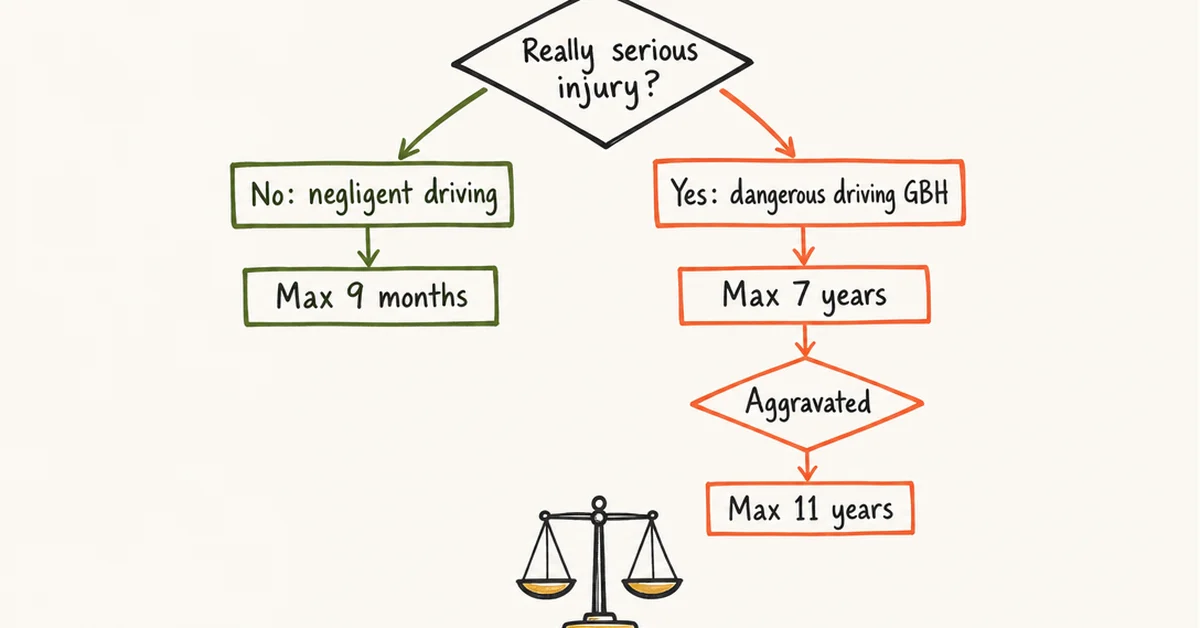
That matters more than any other single issue on the charge sheet. If the injury is not grievous bodily harm, the offence is not made out, and what is likely to remain is a summary charge under s 117 of the Road Transport Act 2013, where the ceiling is a fine or up to 9 months, rather than an indictable offence carrying 7 years.
When does the charge become “aggravated”?
Only if the prosecution proves one of exactly four circumstances set out in s 52A(7). That lifts the maximum from 7 years to 11 under s 52A(4). Nothing else counts, however bad the facts look.
| Circumstances of aggravation (s 52A(7)) | What it means in practice |
|---|---|
| The prescribed concentration of alcohol was present in your breath or blood | A high range reading of 0.15 grams or more of alcohol in 210 litres of breath or 100 millilitres of blood. A low or mid range reading, on its own, is not enough for this aggravation. |
| You were driving more than 45 km/h over the speed limit | A precise figure, and often contested on the speed analysis evidence |
| You were driving to escape pursuit by a police officer | This is what converts a pursuit into the aggravated charge |
| Your ability to drive was very substantially impaired by a drug other than alcohol, or by a combination of drugs | The threshold is deliberately high, and the words “very substantially” do real work. Alcohol on its own is dealt with by the first row, not this one |
If the aggravated form is not charged, the facts that would have made it aggravated cannot be used to push the sentence up as though it had been.
Where will your case be heard?
Usually in the Local Court. Unlike the causing-death offence, this is a Table 1 indictable offence under Schedule 1 of the Criminal Procedure Act 1986 (NSW), so it is dealt with summarily unless the prosecutor or the person charged elects to have it dealt with on indictment.
That is the most practically important fact on this page, because the Local Court cannot impose more than 2 years’ imprisonment for a single Table 1 offence. Our fact sheet on summary and indictable offences in NSW explains the wider system.
| Local Court | District Court | |
|---|---|---|
| How the matter gets there | The default for a s 52A(3) or (4) charge | Only if the prosecutor or the accused elects |
| Maximum imprisonment | 2 years for the single offence | 7 years, or 11 years if aggravated |
| Maximum fine | 100 penalty units (currently $11,000) | The section provides for imprisonment |
| Decided by | A magistrate | A jury, or a judge sitting alone |
An election is not open forever. Under s 263 it cannot be made once the prosecution has begun calling evidence at a summary hearing, or once the prosecution facts have been presented on a plea of guilty. A lower ceiling is also not the same as a lower sentence, so which way to go is a strategic judgement, not a decision to make unadvised on your first court date.
What lesser charges can be laid instead?
Several offences cover injury caused by driving, and they differ enormously in seriousness. Which one you face turns on what the prosecution says you were doing and what it can prove.
| Charge | Section | Maximum penalty (first offence) | Where it is heard |
|---|---|---|---|
| Aggravated dangerous driving occasioning GBH | s 52A(4) Crimes Act 1900 | 11 years | Table 1 indictable |
| Dangerous driving occasioning GBH | s 52A(3) Crimes Act 1900 | 7 years | Table 1 indictable |
| Failing to stop and assist after an impact occasioning GBH | s 52AB(2) Crimes Act 1900 | 7 years | Table 1 indictable |
| Causing GBH by an unlawful or negligent act or omission | s 54 Crimes Act 1900 | 2 years | Table 1 indictable |
| Negligent driving occasioning GBH | s 117(1)(b) Road Transport Act 2013 | $2,200 or 9 months, or both | Local Court or Supreme Court (summary jurisdiction) |
| Furious, reckless or dangerous driving | s 117(2) Road Transport Act 2013 | $2,200 or 9 months, or both | Local Court or Supreme Court (summary jurisdiction) |
The gap between the Crimes Act rows and the Road Transport Act rows is not one of degree. Negligent driving asks whether you fell below the standard of care of a reasonable driver. Dangerous driving asks whether the manner, the speed or your condition created a real danger to others.
The ODPP also explains that negligent driving is usually charged as a “back up” offence alongside a dangerous driving charge, so a conviction for the lesser offence is available if the more serious one fails.
What sentences do NSW courts actually impose?
The 7 and 11 year figures are maximums for the worst cases, and no court starts there. But it would be misleading to soften this: dangerous driving is one of the few offences with a formal sentencing guideline from the Court of Criminal Appeal, and that guideline points towards custody.
The guideline in R v Whyte states that a custodial sentence will usually be appropriate unless the level of culpability is low, as in the case of momentary inattention or misjudgment. For the typical case under s 52A(3) (dangerous driving occasioning grievous bodily harm), where culpability is high, a full-time head sentence of less than two years would not generally be appropriate. The 3‑year figure in Whyte applies to the death offence under s 52A(1), not to GBH. Where the aggravated form under s 52A(4) is charged, the guideline calls for an increment on top of that.
It is a check, not a formula and not a starting point.
The Sentencing Bench Book lists what moves a sentence up: the extent and nature of the injuries, the number of people put at risk, the degree of speed, the degree of intoxication or substance abuse, erratic or aggressive driving, competitive driving or showing off, the length of the journey over which others were exposed to risk, ignoring warnings, escaping police pursuit, sleep deprivation, and failing to stop. Genuine remorse, good prospects of rehabilitation and the timing of any plea count the other way. Youth, good character and a clear record count too, but the bench book records that they are not given the same weight in dangerous driving cases as they are elsewhere.
Where a term of 2 years or less is imposed for a single offence, an intensive correction order is not excluded, so a sentence of imprisonment can sometimes be served in the community. Dangerous driving is not on the list of offences shut out of that order by s 67 of the Crimes (Sentencing Procedure) Act 1999. Whether one is made is a separate question, and community safety is the paramount consideration.
What happens to your licence, and when?
Your licence is dealt with twice, and the first time happens before any court decides anything. Under s 224 of the Road Transport Act 2013 (NSW), police may give you an immediate licence suspension notice within 48 hours of charging you with an offence involving grievous bodily harm caused by the use of a motor vehicle (including a s 52A offence), and it runs until the charge is heard and determined, or withdrawn.
You can appeal that to the Local Court within 28 days of being notified, but it is a narrow appeal. Under s 268 the Court is not to lift or vary the suspension unless satisfied there are exceptional circumstances, and it is expressly not to take into account the circumstances of the offence charged. Ordinary hardship, including losing work, is rarely enough.
There is a second cut-off as well. Under s 268(6) the appeal has to be made before the charge itself is heard and determined or withdrawn, so waiting can close the door even inside the 28 days.
The second point is conviction. A s 52A offence is a major offence under the Road Transport Act, so disqualification is mandatory and additional to any other penalty.
| First major offence | Another major offence in the previous 5 years | |
|---|---|---|
| Automatic disqualification | 3 years | 5 years |
| Shortest period the court can order | 12 months | 2 years |
Two mechanics catch people out. There is no upper limit on how long a court may disqualify you for, only a floor. And under s 206A, where a sentence of imprisonment is imposed, the disqualification is extended by the time actually served in custody, so it is not run down while you are inside; time on parole does not count, and the sentencing court can order otherwise.
One mechanic runs the other way. Under s 206B the court must take any immediate suspension already served into account when it fixes the disqualification, and that period counts towards any minimum the court is required to impose.
What happens between being charged and your court date?
Your first court date is set when you are charged and is written on the court attendance notice. A longer wait usually follows while the prosecution assembles and serves its evidence, and your lawyer can ask the court for time to obtain and read the case against you before any plea is entered.
Where the matter stays in the Local Court, the sequence is a first mention at which bail is dealt with and a timetable set, then your plea. If you plead not guilty the prosecutor must serve the brief of evidence at least 14 days before the prosecution evidence is heard. If the matter is elected to the District Court, it moves through committal instead: a charge certificate confirming which offences will proceed, a case conference, then committal for trial or sentence.
Your rights and what you can do now
You have rights from the first moment police become involved, and the decisions made in the first days often matter more than anything that happens later. The most valuable thing you can do is avoid making your position worse before you have advice.
Your rights:
- The right to silence about how the crash happened. You must give police your name, address and licence details, and comply with lawful directions including breath, blood or urine testing. You are not obliged to give an account of the crash or to be interviewed, and you can speak to a lawyer first. Our fact sheet on police questioning in NSW explains where the line sits.
- The presumption of innocence. The prosecution must prove every element, including that the injuries amount to grievous bodily harm. You need to prove nothing, except the s 52A(8) defence if you raise it.
Practical steps that protect your position:
- Do not explain, apologise or speculate about fault, to police, to insurers, or in messages. People say things out of shock that are later read as admissions. Say nothing on social media either, and do not delete anything.
- Write down what you remember now: the route, the light, the road conditions, when you last slept, and any medication you had taken.
- Preserve your own evidence. Dashcam footage, phone data and servicing records can matter, and nearby CCTV can be overwritten quickly. Diarise the 28 day licence appeal deadline the day any suspension notice is served.
- Get legal advice before your first court date. Decisions about pleading, and about which court hears the matter, cannot be undone.
How a lawyer could help your dangerous driving occasioning grievous bodily harm case
A criminal lawyer’s job here is to test whether the prosecution can prove the offence it has charged, to press for the right charge where it cannot, and, where responsibility is accepted, to put your circumstances so the penalty is as light as the law allows.
- Testing whether the injuries amount to grievous bodily harm. The issue most specific to this charge, and the one most often left unexamined. Where the injury sits near the line, whether a court accepts it as “really serious” decides whether the offence exists at all.
- Testing the manner of driving and causation. Speed estimates, sightlines, road surface and vehicle condition are often contestable, and where another road user, a road defect, a mechanical failure or a medical event contributed, the causal link may not be made out.
- Raising the s 52A(8) defence. Where it applies, it is a complete answer, but it carries a legal onus, so it must be built early rather than raised late.
- Negotiating the charge, by written representations or at the case conference, for a reduction to negligent driving or to the ordinary rather than the aggravated offence, and advising on the election while it is still open.
- Presenting the strongest case on sentence, with character references, evidence of remorse and rehabilitation, medical reports, and submissions on where the offending sits on the scale of seriousness. Our fact sheet on pleading guilty in NSW sets out why the timing of a plea matters.
No lawyer can promise a result. What early representation does is make sure the right issues are identified while the evidence still exists.
Frequently asked questions
What counts as grievous bodily harm in a car accident?
Any injury a court accepts as “really serious”. There is no fixed list. Section 4 of the Crimes Act 1900 says grievous bodily harm includes any permanent or serious disfigurement, the destruction of a foetus, and any grievous bodily disease, but that definition is inclusive, not exhaustive. It need not be permanent or life-threatening.
Will I go to jail for dangerous driving occasioning grievous bodily harm?
Not necessarily, but it is a real risk. The guideline judgment in R v Whyte indicates a custodial sentence will usually be appropriate unless culpability is low, as in cases of momentary inattention or misjudgment. Where a term of 2 years or less is imposed, an intensive correction order is not excluded.
Can the charge be downgraded to negligent driving?
Sometimes. Negligent driving occasioning grievous bodily harm under s 117(1)(b) of the Road Transport Act 2013 is a Local Court offence with a maximum of 9 months for a first offence, and the ODPP describes it as the usual backup charge. Whether a reduction is realistic depends on the evidence about the driving.
Will I lose my licence before I go to court?
Very possibly. Police may issue an immediate licence suspension notice within 48 hours of charging you, and it runs until the charge is heard and determined, or withdrawn. You can appeal to the Local Court within 28 days, but it cannot lift the suspension unless there are exceptional circumstances.
How long will I be disqualified if I am convicted?
Three years automatically, and the court cannot go below 12 months. If you committed or were dealt with for another major driving offence in the previous 5 years, the automatic period is 5 years with a 2 year floor. There is no upper limit, and where a sentence of imprisonment is imposed, the disqualification is extended by the time actually served in custody unless the court orders otherwise.
Can I be charged if the injured person was my passenger?
Yes. Section 52A(5) expressly covers a passenger injured when the vehicle overturns, leaves the road, or throws them from it, so a single-vehicle crash is a common way this charge arises. That the injured person was a friend or relative does not stop the prosecution.
How O’Brien Criminal & Civil Solicitors can help
Cases like this turn on details that are easy to leave unexamined: whether the medical evidence really establishes grievous bodily harm, whether the driving was dangerous by the objective standard the law sets, and which court hears the matter.
O’Brien Criminal & Civil Solicitors is a specialist criminal defence firm, led by an Accredited Specialist in Criminal Law under the Law Society of NSW accreditation scheme, with more than 20 years defending criminal and serious driving matters across NSW.
We act from your first contact with police, examine the medical and reconstruction evidence rather than taking it as given, make representations where the charge is wrong, and build the strongest case on sentence and on your licence.
Request initial advice (no-obligation) via the form below or call us on (02) 9261 4281.
This content is for general information purposes only and does not constitute legal advice. You should seek independent legal advice relevant to your specific circumstances.