
If you take prescribed cannabis medicine and you have been stopped, tested and charged, you are probably feeling a particular kind of unfairness. You did what your doctor told you, right? And you didn’t feel affected, but now you are still facing a fine and the loss of your licence.
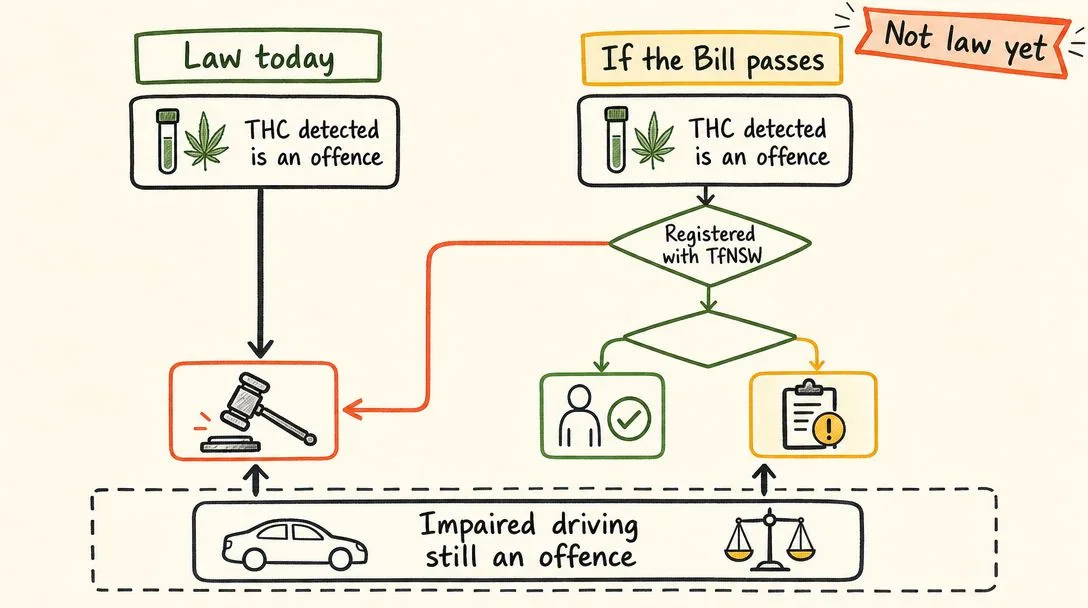
Now the law is set to be changed. A Bill is before the NSW Parliament, and until it passes and commences, the current rule applies to you in full.
This guide covers the law today, what the 2026 Bill proposes and what it does not, and what to do if you have been charged in the meantime.
Medicinal cannabis and driving in NSW at a glance
- The offence today: driving with THC present in your oral fluid, blood or urine, under section 111(1) of the Road Transport Act 2013 (NSW). A prescription is not a defence to it.
- Penalties: a first offence can be dealt with by penalty notice, currently a $722 fine and a 3 month suspension. In court, the maximum fine is $2,200 and disqualification is automatically 6 months, or 3 months at the shortest.
- The reform: the Road Transport Legislation Amendment (Medical Cannabis and Driving Offences) Bill 2026 passed the Legislative Assembly on 5 August 2026 and is still before the Legislative Council. It is not law.
- Key deadline: on a penalty notice, your election to go to court must be made by the due date on the penalty reminder notice (Fines Act 1996 (NSW) s 36).
- Do now: get advice before that date. Paying any part of the fine lets Transport for NSW suspend your licence straight away (Road Transport Act 2013 (NSW) s 59).
Is it legal to drive on prescribed medicinal cannabis in NSW right now?
No. It is an offence to drive with THC present in your system, and it makes no difference that the THC came from a lawfully prescribed medicine taken exactly as directed.
Section 111(1) of the Road Transport Act 2013 (NSW) makes it an offence to drive “while there is present in the person’s oral fluid, blood or urine any prescribed illicit drug”. The section 4(1) definition lists delta-9-tetrahydrocannabinol (THC) first, alongside methylamphetamine, MDMA and cocaine.
Three things matter.
First, the law only cares that THC is present; police do not have to prove you were impaired. Second, there is no safe threshold: any detectable amount is enough. Third, and hardest for patients: it does not matter that the THC came from a prescribed medicine.
Transport for NSW puts the position plainly on its own medical cannabis page: “it remains an offence to drive with THC present in their system, including drivers who are prescribed medical cannabis. Penalties apply.”
Why doesn’t a prescription answer a drug driving charge?
Because the Act only allows a medicinal‑purposes defence for one drug: morphine, not THC.
Section 111(3) creates a separate offence for driving with morphine in your blood or urine. Section 111(5) then provides a defence if the morphine came from a substance taken for medicinal purposes. That defence applies only to the morphine offence, not to the THC offence in section 111(1).
So a driver on prescribed morphine has a statutory defence. A driver on prescribed medicinal cannabis does not.
The second obstacle is more recent and less well known. In R v Narouz NSWCCA 14, decided on 19 February 2024, the NSW Court of Criminal Appeal confirmed that section 111(1) operates as a strict‑liability offence for which the common law defence of honest and reasonable mistake of fact is not available.
That matters because the same argument had sometimes succeeded in the Local Court, most publicly in a 2016 Lismore decision acquitting a driver who waited nine days after using cannabis on police advice. That route is now closed. If you have read that you can defend a charge by showing you honestly believed the THC had cleared, it is no longer available.
What is the difference between the presence offence and driving under the influence?
The presence offence asks only whether THC was in your system. Driving under the influence asks whether you were actually affected by it. The reform Bill touches only the first.
| Drug presence | Driving under the influence | |
|---|---|---|
| Provision | s 111(1) Road Transport Act 2013 | s 112(1) Road Transport Act 2013 |
| What must be proved | THC present in oral fluid, blood or urine | You were under the influence of a drug |
| Is impairment relevant? | No | Yes, it is the offence |
| Maximum court fine (first offence) | $2,200 | $3,300 |
| Prison available? | No | Yes, up to 18 months |
| Automatic disqualification (first offence) | 6 months, court may order not less than 3 months | 3 years, court may order not less than 12 months |
| Would the 2026 Bill change it? | Yes, for registered patients | No |
That last row matters most. Driving while impaired remains a serious offence regardless of any prescription, and regardless of whether the Bill passes. As the Minister put it: “nobody should drive while impaired by cannabis, alcohol or any other drug. That is not changing.”
What does the 2026 Bill actually propose?
A voluntary registration scheme run by Transport for NSW. Registered patients would be exempt from the presence offence where THC is below a set concentration, and would face a new, lower-level offence where it is at or above it.
Much of the reporting has described this loosely. It is not a general defence for anyone holding a prescription, and not a way to reopen charges already on foot. It is a register, and you either get on it or you do not.
Registration. Proposed sections 114A to 114D would let a holder of an unrestricted NSW driver licence apply with proof of a valid prescription and of completing a prescribed education programme on cannabis and driving. Registration would end two months after your prescription expires unless extended.
The exemption. Proposed section 111(1A) would apply only where all of the following are true:
- No other prescribed illicit drug is detected.
- No alcohol at all is detected. A zero requirement, not the usual 0.05 limit.
- You are not on a learner, provisional or interlock licence, not unauthorised to drive, not driving a bus, coach, taxi, rideshare or certain heavy or dangerous goods vehicles, and not working as a driving instructor.
- Your licence is not suspended or expired, and you are not disqualified or subject to a driving prohibition.
The concentration line. The Bill sets a maximum concentration for THC of 50 ng/mL in oral fluid and 3.5 ng/mL in blood. Below it, no offence. At or above it, proposed section 111(1B) creates a new registered medical cannabis user offence, maximum 20 penalty units ($2,200), with automatic disqualification of 6 months under proposed section 204A, or 3 months at the shortest.
Warnings. Proposed section 111AA would prohibit a charge, and require a written warning from Transport for NSW, where a registered user has fewer than two positive detections in the previous two years and has never previously committed the new offence. So the first and second detections at or above the maximum would produce a letter, and the third would be prosecuted. The Government says that third detection would carry a $704 fine and a minimum three month suspension, a figure not in the Bill.
What the Bill does not change
The reform narrows one offence for one registered group. It is not a permission to drive.
- You would still be roadside tested, and you would still test positive. The Government says there would be no change to the roadside detection threshold. The new approach would only apply once the laboratory result is known.
- A positive roadside test still means a 24 hour driving ban. Section 148G(2)(a) lets a police officer prohibit you from driving for 24 hours, and Transport for NSW says registered patients would continue to receive that ban. There is a sting: the exemption would not apply while that prohibition is on foot, so driving inside the window would put you outside the scheme.
- Driving under the influence is untouched, as is post-crash blood and urine testing.
- Nothing would be reopened. The Bill contains no transitional or savings provision, so a conviction, fine or disqualification imposed before commencement would stand. Transport for NSW says the scheme would apply on NSW roads only.
Where is the Bill up to, and when could it start?
As at 26 August 2026 it has passed one House and is still being debated in the other. It is not law, and no start date has been set.
The Bill was introduced on 25 June 2026, passed the Legislative Assembly on 5 August 2026, and sits in the Legislative Council at second reading, debate interrupted.
Two things follow, and both cut against waiting. The detail can still change: amendments have been lodged in the Legislative Council. And passage alone would not switch it on: clause 2 commences the Act “on a day or days to be appointed by proclamation”, and the education programme is still being built.
Your rights and what you can do now
You have real choices in the days after a positive test, and some of them expire.
Your rights
- You do not have to answer questions about your medication. Apart from giving your name and details, you do not have to say what medicines you take, how much, or when. Anything you say at the roadside can be recorded and used as evidence.
- You are entitled to legal advice before deciding how to deal with a charge or a penalty notice.
- A penalty notice is not a conviction, and you do not have to pay it. Under section 36 of the Fines Act 1996 NSW, you can elect to have the matter dealt with by a court by the due date on the penalty reminder notice. Section 36(1A) also lets you elect to go to court even if you have already paid, and the money is then repayable.
Practical steps
- Do not pay the penalty notice before you get advice. Paying the whole or any part of it lets Transport for NSW suspend your licence immediately under section 59, for up to three months. Doing nothing is not a plan either: the same suspension follows once the election time lapses.
- Diarise the election date the day the penalty reminder notice arrives. This is the deadline people miss.
- A penalty notice still counts against you. A drug driving matter dealt with by penalty notice is a prior major offence for five years, which doubles the automatic disqualification on a later conviction from six months to twelve (section 205(3)).
- Gather your prescribing records: the prescription, your prescriber’s letter, the product details including THC content, and the condition treated. These do not create a defence, but they matter to how a court sentences you.
- Write down the sequence while it is fresh: when you last took your medicine, the dose, when you drove, and what you were told at the roadside.
- Do not change your medication to suit a court date without speaking to your prescriber, and do not drive during a 24-hour prohibition.
How a lawyer could help your medicinal cannabis drug driving case
Because the presence offence is absolute liability, the work is usually not about denying the element. It is about the evidence, the process, and persuading a court that a conviction and disqualification are the wrong outcome for a patient taking a lawful medicine as directed.
Testing whether the prosecution case is made out. A lawyer may examine whether the sample was taken and analysed in accordance with Schedule 3 of the Act, whether the certificates are in order, and whether the statutory timing assumptions apply. A charge can fail on a procedural defect.
Asking the court not to record a conviction. This is often the most important option for a patient who needs to keep their licence. Under section 10 of the Crimes SentencingProcedure Act 1999 NSW, a court can dismiss the charge or discharge you on a conditional release order without recording a conviction. Because the automatic disqualification in section 205 only applies if you are convicted, those disqualification periods do not apply if the court makes an order without conviction.
There is a hard limit worth knowing early. Section 203 shuts section 10 off entirely if it has already been applied to you for another listed driving offence in the five years before the court decides your matter. Our guide to section 10 orders and our guide for people facing a first charge explain what courts look for.
Advising whether to elect to court at all. Electing opens the door to a non-conviction outcome, and also exposes you to a higher fine and a longer disqualification than the penalty notice. It is a genuine risk assessment, not a formality.
Building the plea: medical evidence from your prescriber, the treatment history, what losing your licence would mean for your work and your treatment, and character references.
Early legal advice makes sure the deadlines are met, and your circumstances reach the court properly.
Frequently asked questions
Has the NSW medicinal cannabis driving law changed yet?
No. As at 26 August 2026 the Bill has passed the Legislative Assembly and is still before the Legislative Council. Even once passed it commences by proclamation, and registration depends on an education programme still being built.
Is my prescription a defence to a drug driving charge in NSW?
No. The medicinal-purposes defence in section 111(5) applies only to the morphine offence in section 111(3), not to the THC presence offence in section 111(1). Your prescription is highly relevant to sentencing, but it does not answer the charge.
Will I lose my licence for a first drug driving offence?
Usually, yes, on the current law. By penalty notice, the fine is $722 and Transport for NSW may suspend your licence for up to three months, which in practice is three months. On conviction in court, disqualification is automatically six months, or three months at the shortest.
The main way to avoid it is a non-conviction order under section 10. That is discretionary, never assured, and unavailable if you have had a section 10 order for another listed driving offence in the previous five years.
Does the proposed scheme cover P platers, truck drivers and rideshare drivers?
No. It would be open only to holders of an unrestricted NSW driver licence, and not to anyone on a learner, provisional or interlock licence, driving a bus, taxi, rideshare, or certain heavy or dangerous goods vehicles, or working as a driving instructor.
How long does THC stay detectable in a roadside saliva test?
There is no figure you can safely rely on. Detection depends on the product, the dose, how often you take it and your own metabolism, and no published rule reliably predicts when a given patient will test negative. Treating any waiting period as a safe margin is a mistake.
Does prescribed CBD oil show up on a roadside drug test?
Roadside testing looks for THC, not CBD. Roadside tests target THC; CBD itself is not an offence. However, some products marketed as CBD contain THC, so check the exact THC content with your prescriber.
Should I wait for the new law before dealing with my charge?
No, and waiting can cost you. The Bill contains nothing that would reopen a matter finalised before it commences, and the election deadline keeps running. Registration would also require an unrestricted NSW licence, so a disqualification imposed now would keep you out of the scheme while it runs.
How O’Brien Criminal & Civil Solicitors can help
A drug presence charge arising from prescribed cannabis medicine is a sentencing problem more than an argument about the facts, and it turns on preparation: the medical evidence, the prescribing history, and what a disqualification would do to your treatment and your work.
O’Brien Criminal & Civil Solicitors is a specialist criminal defence firm led by an Accredited Specialist in Criminal Law, a credential held by fewer than 6% of NSW solicitors, with more than 20 years in Local Courts across NSW. We act on drug-related charges regularly, and we will tell you plainly whether electing to court is worth the risk.
Request initial advice (no-obligation) via the form below or call us on (02) 9261 4281.
This content is for general information purposes only and does not constitute legal advice. You should seek independent legal advice relevant to your specific circumstances.