
Being charged with driving while disqualified or suspended can feel disproportionate, especially if the drive was short or you did not realise your licence was affected.
It is still a criminal offence that goes to court, can carry imprisonment and usually adds time off the road.
This guide explains the offences under New South Wales law and how disqualified, suspended, cancelled and refused differ. It then covers the penalties, how long you may lose your licence, when police can take your car or plates, and whether a non-conviction outcome is possible.
Driving while disqualified or suspended at a glance (NSW)
- The offence: driving while disqualified, suspended, cancelled or refused, under section 54 of the Road Transport Act 2013 (NSW).
- Maximum penalty: $3,300, 6 months’ imprisonment, or both for a first offence; $5,500, 12 months, or both for a second or subsequent offence. The unpaid-fines offence carries less.
- Licence loss: an automatic disqualification of 6 months (first) or 12 months (repeat), or 3 months for a first unpaid-fines offence, unless the court orders otherwise (s 205A).
- Where it is heard: the Local Court. There is no on-the-spot fine option.
- Do now: stop driving, find out exactly what your licence status is and why, and get advice before your first court date.
What is the offence of driving while disqualified or suspended?
It means driving on a road when you do not have a legal right to drive. Section 54 creates four offences, depending on why your right to drive was removed.
- Section 54(1): driving while disqualified.
- Section 54(3): driving while suspended, other than for unpaid fines.
- Section 54(4): driving after your licence was cancelled or your application refused, without having since obtained a licence.
- Section 54(5): driving after a suspension or cancellation for unpaid fines under the Fines Act 1996.
Each subsection also covers applying for a licence during that period under a false name, or without mentioning the disqualification, suspension, cancellation or refusal. Sections 54(1), (3) and (4) also apply where the disqualification, suspension or cancellation was imposed by a court anywhere in Australia, or under the law of another state or territory (s 54(11)).
What is the difference between disqualified, suspended, cancelled and refused?
They are four different ways of losing the right to drive, each imposed by a different decision-maker. Which one applies decides the offence you face and how you get back on the road.
| Status | Who imposes it | What it means | Getting back on the road |
|---|---|---|---|
| Disqualified | A court, usually automatically on conviction | Any licence you held is permanently cancelled, and you cannot get a new one during the period (s 207) | Apply for a new licence when it ends |
| Suspended | Transport for NSW (for example, demerit points), police, or a fine default | Your licence exists but is not in force | Usually resumes when the suspension ends. A fine-default suspension lasts until it is lifted |
| Cancelled | Usually Transport for NSW, including for long-unpaid fines | Your licence has ended | Apply for a new licence |
| Refused | Transport for NSW | Your application was turned down | No driving that class of vehicle until a licence is issued |
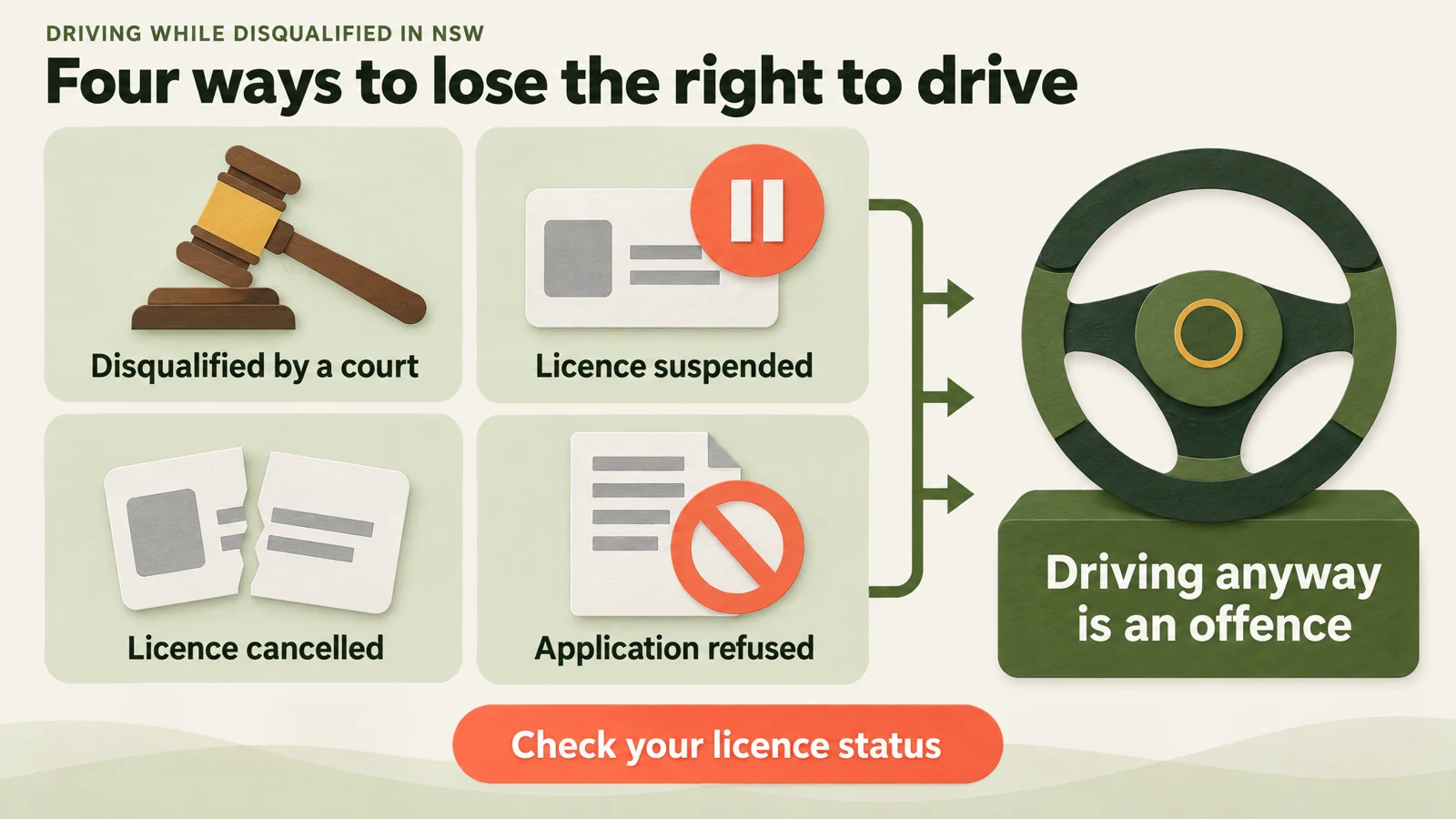
Do not assume a disqualification simply ends by itself. Because it cancels your licence, you must apply for a new one before you drive again.
What are the penalties for driving while disqualified or suspended?
For a first offence under s 54(1), (3) or (4), the maximum is a $3,300 fine, 6 months’ imprisonment, or both. A second or subsequent offence carries up to $5,500, 12 months, or both. The unpaid-fines offence carries less.
A NSW penalty unit is currently $110 under section 17 of the Crimes (Sentencing Procedure) Act 1999, so 30 penalty units is $3,300 and 50 is $5,500.
| Offence | First offence maximum | Automatic disqualification (minimum) | Repeat offence maximum | Automatic disqualification (minimum) |
|---|---|---|---|---|
| Disqualified, s 54(1) | $3,300 and/or 6 months | 6 months (3) | $5,500 and/or 12 months | 12 months (6) |
| Suspended, s 54(3) | $3,300 and/or 6 months | 6 months (3) | $5,500 and/or 12 months | 12 months (6) |
| Cancelled or refused, s 54(4) | $3,300 and/or 6 months | 6 months (3) | $5,500 and/or 12 months | 12 months (6) |
| Unpaid fines, s 54(5) | $3,300, no prison | 3 months (1) | $5,500 and/or 6 months | 12 months (3) |
These are maximums for the most serious cases, and courts have many options well short of them. For the unpaid-fines offence, s 54(6) requires the court to consider the effect on your employment and your ability to pay the fine.
What counts as a second or subsequent offence?
Generally, a conviction for a relevant offence in the previous five years makes a new offence “second or subsequent”, under section 9 of the Road Transport Act. The earlier offence need not be identical.
For s 54(1), (3) and (4), the earlier offence can be any of those three or never-licensed driving (s 53(3)). It can also be a “major offence”, a defined list that includes drink driving, drug driving, driving under the influence and dangerous driving (s 9(5) and the definition in s 4). For the unpaid-fines offence, it is generally only an earlier offence of the same kind.
How long will I be disqualified?
The usual automatic disqualification is 6 months for a first offence or 12 months for a repeat offence. For a first unpaid-fines offence, it is 3 months. The court can impose a different period, but not below the statutory minimum.
- It starts on the day you are convicted, unless the court sets a later date (s 207A).
- It runs at the same time as other disqualifications unless the court orders otherwise, according to the Judicial Commission’s Local Court Bench Book. Whether a new period should run on from an existing one can be a live issue at sentence.
- Time already spent suspended over the same drive counts. If your licence was suspended for an offence arising from the same driving (for example, high-range speeding), the court must take that time into account. It also counts towards the minimum (s 206B).
These periods replaced an older scheme of generally longer automatic periods on 28 October 2017, when the habitual traffic offender scheme was also abolished. Material written before then may describe rules that no longer apply.
Will I go to jail for driving while disqualified or suspended?
Not necessarily. Imprisonment is available for most versions of the offence, but it is the maximum, not the starting point. Factors that tend to matter include:
- Why you were off the road. A court disqualification after a serious driving offence is viewed differently from a demerit-point or unpaid-fines suspension.
- Why and how you drove. A genuine emergency differs from convenience, and clean driving differs from speeding while disqualified.
- Your record, especially earlier unlicensed driving.
- What you have done since, such as an early plea and dealing with unpaid fines.
We do not quote outcome percentages, because no reliable published figure fits every case.
Can I get a section 10 or avoid a conviction?
Yes, it is possible. A court can find the offence proven but dismiss the charge, or impose a conditional release order, without recording a conviction, under section 10 of the Crimes (Sentencing Procedure) Act 1999.
Unlike drink driving, this offence is not on the s 203 list that bars a second section 10 within five years. And because the automatic disqualification applies to a person who is convicted, an order without conviction should mean it does not follow. Our fact sheet on section 10 dismissals in NSW explains what the court weighs.
Can police impound my car or take my number plates?
In some situations. Police may impound a vehicle or confiscate its plates where the driver is a registered operator, or the vehicle is company-registered, and either:
- the driver is disqualified and was speeding more than 30 km/h over the limit; or
- the driver is disqualified or never licensed and has two or more prior convictions for driving while disqualified or never licensed within five years.
A first offence of driving while suspended, cancelled or disqualified does not, on its own, trigger these powers. Where used, the vehicle or plates are generally held for 3 months (s 248).
You can apply to the Local Court for early release after five working days. The Court looks at public safety and extreme hardship to someone other than the registered operator, and fees must be paid first (s 249).
What if I did not know my licence was suspended?
It is not an automatic defence, but it can matter. Section 54 does not require proof that you knew, and an unpaid-fines suspension takes effect “without further notice” (Fines Act s 66(1), (4)).
Two narrow avenues exist:
- Altered dates. If a disqualification’s dates were moved under s 206, driving during the new dates is not an offence unless Transport for NSW first gave you written notice of them (s 54(2)).
- Honest and reasonable mistake. A genuine belief, on reasonable grounds, that you were licensed may be a defence, but whether it is available depends heavily on the facts.
Even without a defence, not knowing can be relevant to the penalty.
What about unlicensed or never-licensed driving?
Driving with an expired licence, or never having been licensed, is a separate and less serious offence under s 53.
- Unlicensed (s 53(1)), such as an expired licence: up to $2,200, no prison, and it can be dealt with by penalty notice.
- Never licensed (s 53(3)), meaning no Australian licence in the five years before: $2,200 for a first offence; $3,300 and/or 6 months for a repeat, with a 12-month automatic disqualification (minimum 3 months).
Can I appeal the suspension, or get my licence back sooner?
Some suspensions can be appealed to the Local Court within strict deadlines, but NSW has no work licence. Old disqualifications can sometimes be removed after an offence-free period, and pre-2017 habitual traffic offender declarations can still be quashed. Our fact sheet on licence appeals in NSW sets out each route, and our guide to drink driving in NSW covers suspensions after a drink driving charge.
Your rights and what you can do now
The presumption of innocence applies to you. You also have the right to silence beyond giving your name and address, and the right to legal advice. The most important step is to stop driving until you know where you stand.
Your rights:
- The right to silence. You do not have to answer police questions about why you drove or what you knew.
- The right to a lawyer before deciding whether to be interviewed.
- The presumption of innocence. The prosecution must prove you were disqualified, suspended or cancelled at the time.
Practical steps:
Stop driving until your licence status is clear. Find out why you were disqualified or suspended, keep all notices, and get legal advice before court. If unpaid fines are involved, contact Revenue NSW. Gather evidence of your need to drive and consider a traffic offender program.
How a lawyer could help your driving while disqualified case
A lawyer tests whether the prosecution can prove every part of the charge. If you plead guilty, they put your circumstances to the court and argue for the lightest penalty and disqualification the law allows.
- Checking your status on the day. Records can be wrong and dates miscalculated, and s 54(2) requires written notice of altered dates. An error may be a complete answer to the charge.
- Raising a defence the facts support, such as honest and reasonable mistake, or that you were not the driver.
- Arguing for a non-conviction outcome where realistic, which may avoid the automatic disqualification.
- Arguing the length and timing of disqualification: reduction to the minimum, credit for any suspension over the same drive, and whether it runs alongside an existing period.
- Presenting a strong sentencing case with references, evidence of need and programme certificates. Options after sentence are in our fact sheet on criminal appeals in NSW.
No lawyer can promise a particular result. Early advice gives time for the right arguments to be identified and put properly.
Frequently asked questions
Will I go to jail for driving while suspended in NSW?
Not necessarily. The first-offence maximum is 6 months, and there is no prison for a first offence where the suspension was for unpaid fines. Prison is not automatic, and courts have many options short of custody.
The risk rises with a poor record, repeat offending, or other driving offences on the same occasion.
Is driving while suspended the same as driving while disqualified?
No, but the penalties are the same. A suspension usually comes from Transport for NSW, police or a fine default, and the licence still exists, while a disqualification comes from a court and cancels the licence.
Except for the unpaid-fines offence, both carry the same maximums and automatic disqualification periods.
Can I get a section 10 for driving while disqualified?
It is possible. Section 10 is not barred for this offence, and an order without conviction should mean the automatic disqualification does not apply. Whether it is realistic depends on your circumstances and record.
Will my car be impounded for driving while disqualified?
Usually not for a first offence alone. Impounding or plate confiscation is available only where you are the registered operator (or the car is registered to a company). You must also either be disqualified and speeding more than 30 km/h over, or have two or more earlier convictions for driving while disqualified or never licensed within five years.
My licence was suspended for unpaid fines. Is that treated differently?
Yes. It is a separate offence under s 54(5), with no prison for a first offence and a 3-month automatic disqualification (minimum 1 month). The court must also consider your employment and ability to pay.
Can I drive as soon as my disqualification ends?
No. A disqualification permanently cancels your licence, so you must apply for and be issued a new one first. Driving before then can be a further offence.
How O’Brien Criminal & Civil Solicitors can help
A driving while disqualified or suspended charge can add months to your time off the road, and the key decisions come early. O’Brien Criminal & Civil Solicitors is a specialist criminal defence firm, led by an Accredited Specialist in Criminal Law (fewer than 6% of NSW lawyers hold any Law Society specialist accreditation), with more than 20 years in criminal defence.
We check whether the prosecution can prove your licence status, raise any defence the facts support, and where you plead guilty, argue for the lightest penalty and shortest disqualification the law allows. Our criminal defence lawyers in Sydney will explain your options plainly.
Request initial advice (no-obligation) via the form below or call us on (02) 9261 4281.
This content is for general information purposes only and does not constitute legal advice. You should seek independent legal advice relevant to your specific circumstances.