
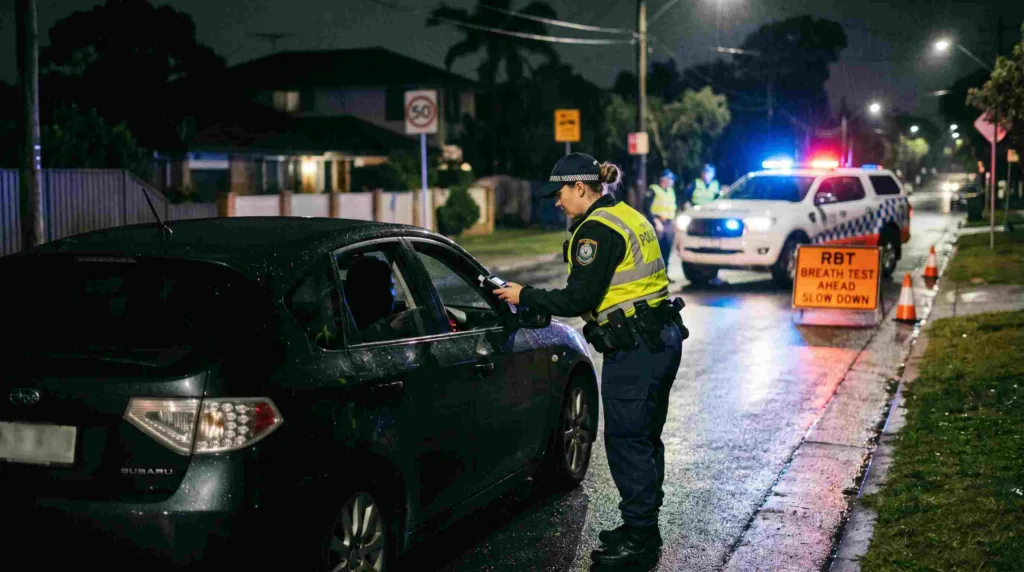
Being charged with drink driving in New South Wales is frightening, and the information you find online is often confusing. Whether it is your first offence or you have been through this before, the two questions on your mind are usually the same: how long will I lose my licence, and could I go to jail?
This guide explains it all: what the offences actually are, the five different alcohol ranges and their penalties, how disqualification works, when a non-conviction is possible, and the mandatory interlock program.
At a glance
- The law: Drink driving (PCA) offences sit in Section 110 of the Road Transport Act 2013 (NSW); the separate offence of driving under the influence (DUI) is in Section 112.
- The ranges: Novice, special, low, mid and high range, set by your blood alcohol concentration (BAC).
- The worst case: High-range PCA carries up to 18 months’ imprisonment, a $3,300 fine, and an automatic 3-year disqualification for a first offence.
- Most cases are dealt with in Local Courts.
- The one thing to do now: Get legal advice from a criminal lawyer before you enter a plea, and check whether you can appeal any immediate licence suspension within 28 days.
What Counts As Drink Driving In NSW?
Drink driving in NSW is not just one offence. It is actually a set of offences that turn on how much alcohol is in your system when you drive.
- The main offences are the prescribed concentration of alcohol (PCA) offences in section 110 of the Road Transport Act 2013.
- Plus the separate offence of driving under the influence (DUI) in section 112.
A PCA offence is proven by your BAC reading, the number from the breath or blood test. Importantly, you do not have to be visibly affected by the alcohol; the reading itself is the offence.
A DUI is different because it does not rely on a specific number. Instead, it applies where police can show your driving was actually affected by alcohol or another drug. For example, if a reading was not obtained but there is other evidence of driving impairment. A DUI carries the same heavy penalties as high-range PCA.
Drug driving is a separate area with its own tests and penalties.
What Are The Five PCA Ranges And The BAC Limits?
There are five PCA ranges, and which one you fall into depends on your BAC and what kind of licence you hold.
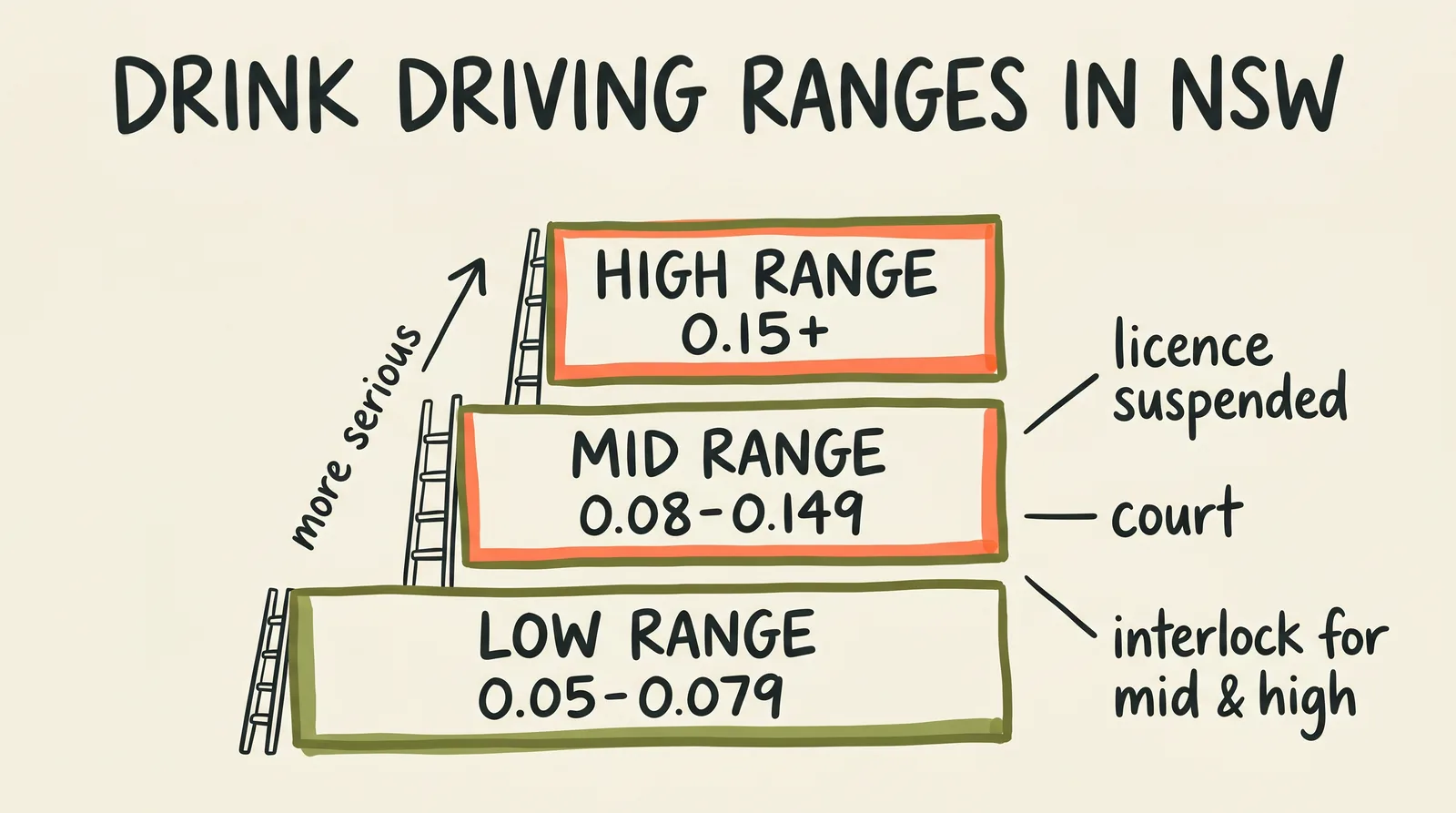
- Novice range: any reading above zero (0.001–0.019) for a learner or P1/P2 (provisional) driver, who must have a zero limit.
- Special range: 0.02 to 0.049 for a “special category” driver, such as a learner or provisional driver, or a driver of a heavy vehicle, taxi, or public passenger vehicle.
- Low range: 0.05 to 0.079 for a full-licence driver.
- Mid range: 0.08 to 0.149.
- High range: 0.15 and above.
The general legal limit for a full, unrestricted licence is under 0.05. For learners and provisional drivers the limit is zero.
What Are The Penalties For Each Range?
Penalties climb sharply with each range. The table below sets out the maximum court penalties, the fine you may receive if police issue an on-the-spot penalty notice, and how long you lose your licence.
Remember: a maximum is the ceiling, not the likely outcome. Most first-time low, special and novice range matters are resolved without a prison sentence, and the penalty notice pathway avoids court altogether for many first offenders.
| Offence (first offence) | BAC | On-the-spot fine | Max court fine | Max prison | Automatic disqualification | Minimum court disqualification | Interlock |
|---|---|---|---|---|---|---|---|
| Novice range | >0.00–0.019 | $704 (3-mth suspension) | $2,200 | — | 6 months | 3 months | Subsequent offences |
| Special range | 0.02–0.049 | $704 (3-mth suspension) | $2,200 | — | 6 months | 3 months | Subsequent offences |
| Low range | 0.05–0.079 | $704 (3-mth suspension) | $2,200 | — | 6 months | 3 months | Subsequent offences |
| Mid range | 0.08–0.149 | Not available | $2,200 | 9 months | 12 months | 6 months | Required |
| High range | 0.15+ | Not available | $3,300 | 18 months | 3 years | 12 months | Required |
| DUI (s112) | Impairment-based | Not available | $3,300 | 18 months | 3 years | 12 months | Required (alcohol) |
For a second or subsequent offence within five years, the numbers rise:
- mid-range prison rises to 12 months and automatic disqualification to 3 years;
- high-range prison rises to 2 years, the maximum fine to $5,500,
- and automatic disqualification to 5 years.
- Second-offence penalty notices are not available.
High-range PCA: Will I Go To Jail?
Not necessarily, but prison is a real possibility and the courts treat high-range PCA very seriously. For a first offence the maximum is 18 months’ imprisonment. However, a custodial sentence is not the automatic result for a first-time offender with otherwise good character.
What makes high-range different is the guideline judgment that governs how magistrates sentence it which is the Application by the Attorney General under Section 37 of the Crimes (Sentencing Procedure) Act 1999 for a Guideline Judgment Concerning the Offence of High Range PCA. This was decided by the NSW Court of Criminal Appeal in 2004.
The guideline describes what an “ordinary” high-range case looks like: a driver of prior good character, detected by random breath test, who pleaded guilty and is at low risk of reoffending. In such a case, the guideline says a non-conviction order (section 10 or a conditional release order without conviction) will rarely be appropriate, and the automatic disqualification should apply unless there is a good reason to reduce it (such as employment needs, the absence of viable alternative transport, or illness).
In short: for high-range PCA, expect the court to record a conviction and disqualify you in most cases. The real work of a defence is usually about reducing the length of disqualification and avoiding a prison sentence, not avoiding a conviction altogether.
How Long Will I Lose My Licence?
Your disqualification depends on the range, whether it is a first or repeat offence, and whether the court makes an interlock order. Two numbers matter:
- Automatic disqualification is the default period that applies if the court says nothing else. For example, 6 months for a first low-range offence, or 3 years for a first high-range offence.
- Minimum disqualification is the shortest the court can go. For example, 3 months for a first low-range offence, or 12 months for a first high-range offence.
A magistrate can order any period between the minimum and the automatic default, and for high-range can extend beyond the automatic period without limit. So the actual disqualification you receive sits somewhere in that band, and good preparation genuinely affects where you land within it.
Note that NSW does not have a “work licence” or restricted licence that lets you keep driving for your job during a disqualification. The two real mechanisms are the interlock licence (below) and, in the short term, appealing an immediate suspension within 28 days.
What Is The Mandatory Alcohol Interlock Program?
An interlock is a breath-testing device fitted to your car that stops the engine starting if it detects alcohol.
- For mid-range, high range, DUI, refusal, and repeat drink driving offences, the court must generally make a mandatory interlock order.
- An interlock order has two parts: a shorter disqualification period, followed by a minimum period on an interlock licence during which the device stays in your car.
- For a first high-range offence the interlock participation period is a minimum of around 24 months; for a first mid-range offence it is a minimum of around 12 months.
- Serious or repeat offences can attract up to 48 months.
Remember: You pay the installation and monthly monitoring costs yourself.
If you cannot participate, perhaps because you genuinely have no access to a vehicle, you can ask the court for an interlock exemption order.
However, the trade-off is significant: an exemption means a much longer straight disqualification instead of the shorter interlock pathway, so it is rarely the better option.
The interlock rules and participation periods are technical and change over time, so it is important to confirm the current figures with the NSW Government interlock program information or a solicitor before making a decision.
Can I Get A Section 10 or Conditional Release Order (No Conviction)?
For lower-range first offences, it may be possible to get a section 10(1)(a) dismissal and a conditional release order (CRO) without conviction. There are two ways a NSW court can find the offence proven but decline to record a criminal conviction, meaning no fine and no automatic disqualification.
A CRO is a good-behaviour order the court can impose with or without a conviction; the “without conviction” version is the modern equivalent of the old section 10 bond. To be persuaded, a court typically looks at the seriousness of the offence (your BAC), your character and traffic record, your reasons, genuine remorse, and steps such as completing a traffic offender program.
These orders are realistically achievable for many first-time low, special and novice range matters, harder for mid range, and, under the guideline judgment above, rarely appropriate for high range.
First Offence: What Actually Happens?
For a first low, special or novice range offence, many people are dealt with by a penalty notice and never go to court. Police can issue an on-the-spot fine of $704 with an automatic 3-month suspension, and if you accept it, no conviction is recorded. You can choose to have the matter dealt with in court instead, which is what you would do if you want to seek a section 10 or CRO.
For a first mid-range offence you will be required to attend the Local Court. A first mid-range matter is serious but a prison sentence is uncommon for an otherwise good driver; the usual outcome is a fine and disqualification, sometimes with an interlock order, and occasionally a CRO.
A first high-range offence always goes to court and usually results in a conviction, disqualification, and an interlock order. Prison is a genuine risk depending on the reading and circumstances.
If you hold a professional licence or accreditation (in fields such as law, health, finance, security, teaching or transport), a conviction, and sometimes even a non-conviction, may trigger reporting obligations to your regulator. Check your obligations early; this is one of the strongest reasons some first offenders push for a non-conviction outcome.
Second And Repeat Offences
A second or subsequent drink driving offence within five years attracts materially higher penalties and a much greater risk of prison. The maximum fines and prison terms roughly double, automatic disqualification periods lengthen (high-range rises to a 5-year automatic disqualification), interlock orders become mandatory across more ranges, and penalty notices are not available.
Courts also treat a repeat offence as showing a pattern, which reduces the chance of a non-conviction and increases the weight given to deterrence and community safety. If you are facing a second or later offence, early legal advice matters more, not less.
Can I Appeal An Immediate Licence Suspension?
Yes, in most cases, if you act within 28 days. For mid and high-range offences, police can suspend your licence on the spot, before your matter is even heard. You can appeal that suspension to the Local Court under section 267 of the Road Transport Act 2013.
Two things to know.
First, lodging the appeal does not automatically let you drive in the meantime; the suspension stays in force unless and until the court lifts it.
Second, the court can only vary or set aside the suspension if it is satisfied there are exceptional circumstances, and it is not permitted to consider the circumstances of the alleged offence itself. It is a demanding test, but a real avenue where losing your licence immediately would cause exceptional hardship.
What Is The Court Process?
Most drink driving matters run in the Local Court and follow a broadly similar path.
- First mention: the first date, where you indicate whether you are pleading guilty or not guilty. You do not have to enter a plea immediately if you need advice.
- Sentence hearing (guilty plea): where you present your case for the lightest appropriate outcome, including character references, a traffic offender program certificate, evidence of hardship, and submissions on penalty and disqualification.
- Defended hearing (not guilty plea): where the prosecution must prove the offence and any defences are tested.
- Determination: the magistrate decides the outcome.
Straightforward guilty pleas often resolve within a couple of months. What happens between the charge and the sentence date, such as the references you gather and the program you complete, frequently makes the difference to the result.
Your Rights And What You Can Do Now
You have real rights and there are concrete steps that can strengthen your position before you ever reach court:
- You are not required to enter a plea on the first date. Ask for time to get advice if you need it.
- Check the 28-day suspension appeal window immediately if your licence has been suspended on the spot.
- Do not assume the penalty notice is your only option. If you want to pursue a section 10 or CRO, you can elect to go to court instead.
- Complete a Traffic Offender Intervention Program before your sentence date. Courts view this favourably and it can influence both conviction and disqualification.
- Gather character references from employers, community members or others who can speak to your character and your need for a licence.
- Document your need to drive for work, carer responsibilities, medical needs or lack of public transport, as this is directly relevant to disqualification and to any suspension appeal.
- Keep the paperwork: your charge sheet, the certificate of analysis (the BAC reading), and any suspension notice.
- Be careful about employment and licensing disclosures, and avoid discussing the matter on social media.
How A Lawyer Could Help Your Drink Driving Case
A drink driving lawyer can help in the following ways:
- Scrutinise the evidence. The prosecution must prove the elements of the offence, including a valid BAC reading. A lawyer can check whether the breath analysis was conducted correctly and within the legal time limits, whether the reading is reliable, and whether the stop and testing were lawful. These are issues that can occasionally lead to a charge being withdrawn or dismissed.
- Present the strongest sentencing case. For a guilty plea, much of the outcome turns on preparation. A lawyer assembles character references, program certificates, and submissions aimed at a non-conviction (where realistic) or the shortest disqualification available within the range.
- Argue for a section 10 or CRO where the facts support it, most realistically in lower-range first offences.
- Run a section 267 suspension appeal on the exceptional-circumstances test.
- Advise on the interlock decision: whether to accept the interlock pathway or seek an exemption, given the very different disqualification consequences.
These are matters of “may” and “in some cases”, depending on your circumstances. However, the difference between a well-prepared matter and an unprepared one is often measured in months of licence loss, and sometimes in whether a conviction is recorded at all.
If you are ready to speak to a criminal lawyer about your matter, our drink driving lawyers in Sydney can advise on your specific charge.
Frequently Asked Questions
What is the legal blood alcohol limit in NSW?
For a full, unrestricted licence, the alcohol limit is under 0.05. For learner and provisional (P1 and P2) drivers, and other special category drivers such as heavy vehicle and public passenger vehicle drivers, the limit is zero.
Will I definitely lose my licence for a first drink driving offence?
In some cases, but not always. A first low, special or novice range offence usually carries at least a short disqualification or a 3-month suspension under a penalty notice, though a section 10 or CRO can avoid disqualification where the court is persuaded. Mid and high-range first offences almost always involve disqualification.
Can I get a work licence to keep driving for my job?
No, NSW does not have a work or restricted licence for drink driving. The two real options are the interlock licence (which lets you drive a fitted vehicle after a shorter disqualification) and, in the short term, appealing an immediate suspension within 28 days.
How long does a drink driving conviction stay on my record?
A conviction for drink driving may appear on your criminal and traffic history for 10 years. Under NSW spent convictions rules, many convictions become “spent” after a 10-year crime-free period, but this is subject to conditions and exceptions. We recommend checking your specific situation, as some disclosure obligations continue.
Is high-range PCA an automatic jail sentence?
No. Prison is the maximum sentence for drink driving, not the default. For a first offence with good character and an early guilty plea, imprisonment is a real risk but not automatic; a conviction and disqualification are the more common outcome, and the focus of a defence is usually reducing the disqualification and avoiding jail.
What happens if I refuse a breath test?
Refusing or failing to provide a breath analysis is a separate offence carrying penalties. These may be similar to high-range PCA, including a mandatory interlock order. Refusing does not avoid consequences; it generally makes them worse.
Do I have to go to court for a first low-range offence?
Not necessarily. Police can issue a penalty notice with a $704 fine and a 3-month suspension, which avoids court and a conviction. You can choose to go to court instead if you want to seek a non-conviction order.
Charged with drink driving in NSW? What happens next depends on the details.
The outcome of a drink driving charge often comes down to specifics most people never think about, which is how accurate the breath or blood reading actually was, how well your case is put to the magistrate, and whether the right options (like an interlock licence or a licence appeal) are used to keep you on the road.
O’Brien Criminal & Civil Solicitors is a specialist criminal defence firm led by an Accredited Specialist in Criminal Law — a Law Society of NSW credential held by fewer than 6% of the state’s solicitors along with over 20 years defending traffic and criminal charges.
The earlier you get advice, ideally before you enter a plea, the more we can do to protect your licence, your record and your livelihood.
Get no-obligation advice today. Fill in the form below or call us on (02) 9261 4281.