
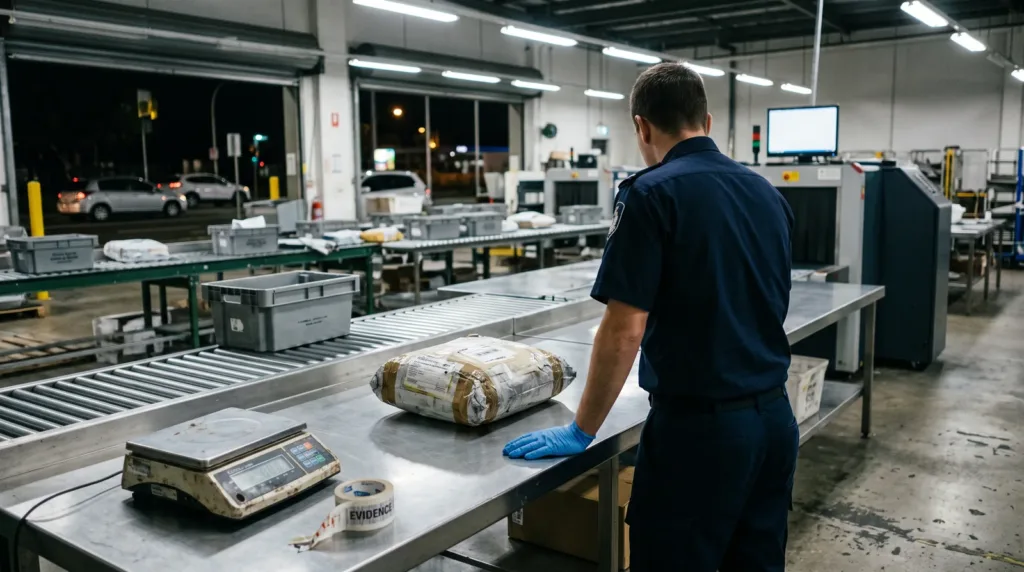
If the Australian Border Force has intercepted a package of steroids addressed to you, or you’ve received correspondence, or a visit from investigators, you need to read this.
Steroid importation is treated very seriously. However, a seizure or an initial contact from authorities is not the same as a conviction. The way you respond is important.
This guide explains how anabolic and androgenic substances are regulated in Australia, what offence you may actually be facing, how the law treats personal use differently from commercial importation, and what a lawyer can do to help at each stage.
As this area of law involves several overlapping Commonwealth provisions that are easy to get wrong, including in generic content online, everything below has been checked against the current Customs Act 1901 (Cth) and its regulations.
At a glance
- What it is: Importing anabolic or androgenic steroids, sometimes referred to as image-enhancing drugs or performance and image-enhancing drugs, without a valid Therapeutic Goods Administration (TGA) approval is an offence under the Customs Act 1901 (Cth), not the general Commonwealth drug-importation regime some sources assume applies.
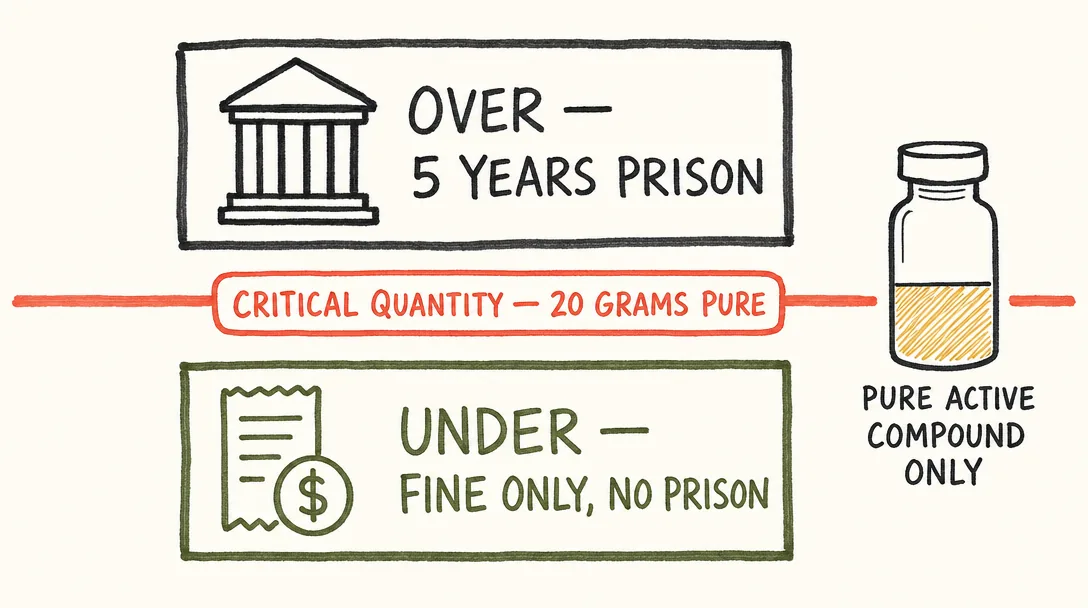
- Maximum penalty: Up to 5 years’ imprisonment and/or a fine of 1,000 penalty units where the quantity exceeds the “critical quantity” (20 grams of pure/active steroid). Below that, the offence still carries up to 1,000 penalty units (and potentially other penalties): imprisonment is uncommon for small, personal-use quantities but is not legally excluded.
- Which “court”: Prosecuted by the Commonwealth Director of Public Prosecutions (CDPP): heard in the Local Court (summarily) or, for the more serious tier, potentially the District Court.
- Key early step: How you respond to Australian Border Force (ABF) at the point of interception or during any subsequent interview can shape the rest of the process. Get legal advice before you say or sign anything.
Are steroids actually illegal to import into Australia?
Yes, illegal steroids cannot be brought into the country unless the importation is properly authorised.
Anabolic and androgenic substances (testosterone, nandrolone, trenbolone, boldenone, and their many synthetic derivatives) are classified as Schedule 4 (“Prescription Only Medicine”) substances. These sit under the Poisons Standard made in the Therapeutic Goods Act 1989 (Cth). That means steroids can only be possessed or used when prescribed by an Australian medical practitioner and dispensed through a registered pharmacy. It does not allow you to personally import them.
Being a Schedule 4 medicine, rather than an illicit “border controlled drug” under the Commonwealth Criminal Code, matters because it changes which offence applies.
Steroids are not prosecuted under the general serious-drug-importation regime that covers substances like cocaine or MDMA. Importing steroids without authority is instead a distinct offence under the Customs Act 1901 (Cth).
What offence am I facing, and what’s the maximum penalty for importing steroids?
Penalties depend on quantity which is measured by the pure or active steroid content, not the total weight. The Customs Act splits prohibited imports into tiers:
| Quantity | Offence | Maximum penalty |
| Over the “critical quantity” (anabolic/androgenic steroids: 20 grams of pure active substance, set by Schedule 7, Part 1 of the Customs Regulations 2015 (Cth)) | “Tier 1 goods” offence: s233BAA, Customs Act 1901 (Cth) | 5 years’ imprisonment and/or 1,000 penalty units |
| Under the critical quantity | Prohibited imports offence: s233, Customs Act 1901 (Cth) | Up to the greater of 5× the duty (if known) or 1,000 penalty units; imprisonment is possible in law but uncommon for small, personal‑use importations. |
A “penalty unit” is a Commonwealth measure which currently sits at $364. This puts the maximum fine for a tier 1 offence at roughly $364,000, in addition to the potential for up to 5 years’ imprisonment.
As this figure is adjusted every few years, it’s worth having your lawyer confirm the exact rate that applies to your matter. This tiered structure is similar in concept to how other Commonwealth import offences work, such as federal firearms trafficking charges, where the offence and penalty also scale with what’s actually involved.
The 20-gram threshold catches a lot of people. It’s measured on pure active compound, not the total weight of tablets, vials, or powder. Therefore, a large volume of low-purity tablets can fall under the threshold, while a small number of high-concentration injectable vials can easily exceed it, sometimes representing a vast quantity of active substance in a comparatively small parcel.
Does it matter whether it was for personal use or to sell on?
Yes. Intended use affects the outcome, even though it is not a stand-alone defence to the importation charge itself. Courts look at whether the quantity and evidence point to personal use or supply to others.
- Personal use quantities. Genuine personal-use amounts, sometimes a few months’ supply, can support an argument for a less serious charge (the sub-critical-quantity, fine-only offence). Where the charge is more serious, a more lenient sentencing outcome may be possible. This is a matter of evidence and argument, not an automatic entitlement.
- Commercial-style evidence. Financial records suggesting sale, communications with buyers, multiple package addresses, or bulk packaging materials all push a matter towards being treated as importation for supply. That increases both the seriousness of the charge and the likely penalty, and it’s exactly this kind of evidence that enforcement agencies rely on to distinguish personal users from commercial operators feeding unregulated supply chains.
Courts assess each case on its own facts. Quantity, purity, prior history, and circumstances all matter, and no single factor guarantees an outcome either way. If you’re also trying to understand how a supply-style charge differs from a possession-only one, our drug supply and drug trafficking guide covers that distinction in more detail.
Is there a legal way to import steroids?
Only through an authorised medical and pharmacy pathway, one of the properly regulated supply chains that keeps these substances subject to medical oversight. You cannot lawfully arrange your own import, even with a prescription. A legitimate importation typically requires:
- A valid prescription from an Australian-registered medical practitioner.
- The prescription being filled and imported through a TGA-authorised pharmacy or hospital, not by the patient directly.
- Where relevant, specific TGA approval for goods brought in under a research or special access pathway.
Ordering steroids from an overseas supplier, even while genuinely believing a prescription makes it legal, does not meet this standard and is still an offence. If you have a legitimate medical need, the lawful route is through your doctor and an authorised pharmacy, not a direct personal order.
What happens when the Australian Border Force intercepts a package?
Steroids are usually detected through X-rays, detector dogs, or routine parcel and cargo inspection at mail centres and ports. If ABF intercepts a package addressed to you, a few things commonly follow:
- A seizure notice may be sent, sometimes with no further contact if the quantity is very small and it’s a first occurrence. This is not guaranteed and shouldn’t be assumed.
- You may be contacted for a voluntary interview. You are not obliged to attend or answer questions without a lawyer present.
- For larger or repeat importations, the matter may be referred for formal investigation and prosecution by the CDPP, particularly where the case forms part of a broader effort to disrupt unlawful activity early, before goods reach consumers.
Your Rights & What You Can Do Now
If you’re facing an investigation, a seizure notice, or a police/ABF interview about steroid importation, there are things you can do to protect your position before you speak to a lawyer, including:
- You have the right to remain silent. You do not have to answer questions from Australian Border Force, the Australian Federal Police, or ABF investigators beyond confirming your name and address. Anything you say can be used in evidence. It’s reasonable, and expected, to say you want to speak with a solicitor first.
- Do not sign anything you don’t understand. This includes formal cautions, records of interview, or any document ABF or police present at a seizure or interview, including any search warrant paperwork.
- Preserve evidence that supports your account. If the importation was for genuine personal medical use, keep any medical records, prescriptions, doctor’s letters, or correspondence that support that. These can matter significantly at charge and sentencing stages.
- Don’t ignore correspondence. A seizure notice or letter that goes unanswered can escalate. Get advice promptly so you understand your options and any deadlines that apply.
- Don’t attempt to “explain it away” informally. Contacting ABF yourself to argue your case before getting advice can inadvertently create evidence that’s harder to walk back later.
- Get advice before any interview. Whether you’re asked to attend voluntarily or are formally interviewed, understanding your position beforehand changes what you should, and shouldn’t, say.
How a Lawyer Could Help Your Case
A criminal solicitor experienced in Commonwealth prosecutions can act at several points, well before a court appearance and well beyond it too:
- Assessing which offence actually applies. Early assessment of whether the matter sits above or below the critical quantity can affect your defence strategy from the outset.
- Raising available defences, depending on the evidence, which may include:
- Lack of knowledge: that you did not know the goods were steroids, or did not know importing them without authority was unlawful, which can go to intent and culpability.
- Genuine personal use: supported by medical evidence, which may support a reduced charge or a more favourable sentencing outcome.
- Procedural issues with the search or seizure: for example, defects in how a package was intercepted, opened, or how evidence was subsequently gathered under search and seizure warrants, which may affect what evidence is admissible.
- Lawful authority: where a prescription and a mistaken but genuine attempt at authorised importation exists, this may be relevant to how the matter is resolved.
- Negotiating with the CDPP. In some cases, a lawyer may be able to negotiate the charge itself, for example, resolving a matter as a lower-tier, fine-only offence rather than proceeding on a more serious charge, depending on the evidence and quantity involved.
- Mitigating penalty. Factors such as no prior record, early engagement with authorities, genuine medical need, cooperation, and personal circumstances can all be put forward at sentencing to argue for a more lenient outcome.
- Guiding you through the process so you understand each step, from an initial ABF letter through to any court appearance, reducing the uncertainty that comes with a Commonwealth investigation.
However, none of the above guarantees a particular result. Every matter turns on its own facts and evidence, but early, informed legal input measurably improves the position from which your case is argued. Our criminal defence lawyers in Sydney regularly act in Commonwealth prosecutions of this kind, alongside NSW state matters.
Frequently Asked Questions
What is the maximum penalty for importing steroids into Australia?
It depends. Below that threshold, the offence under s233 carries up to the greater of 5× the duty (if known) or 1,000 penalty units; imprisonment is uncommon for small, personal‑use importations but is not legally excluded.
Can I import steroids if I have a prescription?
No, not by yourself. A prescription authorises you to possess and use the medicine once it has been lawfully supplied. It does not authorise you to personally arrange an import. Lawful importation has to go through an authorised Australian pharmacy or hospital acting on your prescription. If you need steroid medication for a genuine medical condition, speak to your doctor about the correct authorised pathway.
Is “it was for personal use” a defence to an importation charge?
Not a complete one. Importing without authority is unlawful regardless of intended use. Evidence that the quantity was genuinely for personal use can support a lower-tier charge, if the quantity is under the critical threshold, or more lenient sentencing where it isn’t. It is a mitigating factor, not an automatic exemption.
What if I didn’t know it was illegal to import steroids?
Ignorance of the law is not, on its own, a full defence. However, a genuine lack of knowledge about what was in the package can be relevant. If you truly didn’t know the goods were steroids, or didn’t realise a prescription doesn’t cover personal importation, that context matters to how the case is argued and should be raised with a solicitor as early as possible.
I received a seizure letter from Australian Border Force. Do I need a lawyer straight away?
It’s worth getting advice before you respond, even for a first, small seizure. Not every seizure leads to prosecution, but how you handle any follow-up contact, including whether to attend a voluntary interview, can affect whether the matter proceeds further. A short conversation with a solicitor early on costs you nothing to arrange and can prevent avoidable missteps.
Will a steroid importation charge show up as a criminal record?
Potentially, yes, particularly for a tier 1 (over-threshold) offence or where the matter proceeds to a formal charge. What appears on a record, and for how long, depends on how the matter is resolved, including whether a conviction is recorded at all. That’s another reason early legal representation matters.
How O’Brien Criminal & Civil Solicitors Can Help
Commonwealth prosecutions like this move differently to state matters, and getting the quantity and offence classification right from day one shapes everything that follows. O’Brien Criminal & Civil Solicitors is led by an Accredited Specialist in Criminal Law, a distinction held by fewer than 6% of solicitors in NSW, with over 20 years’ experience defending clients against Commonwealth Director of Public Prosecutions matters, including Customs Act offences.
We act from the moment you’re first contacted by Australian Border Force or investigators, not just once charges are laid, whatever stage the alleged importation is at. For more serious tier 1 matters, we bring in barristers where needed to build the strongest possible defence team around your case, always working closely with you to protect your interests and, where relevant, the wider community’s confidence in a fair process.
If you’ve received a seizure notice, been asked to attend an interview, or have been charged in connection with importing steroids, request initial advice (no-obligation) via the form below or call us on (02) 9261 4281.