

Separations produce apprehended violence orders, and BOCSAR records 52,757 ADVOs commenced in NSW in 2025. Sometimes police attend one bad night and take out an order before you have spoken to a lawyer. Sometimes one is filed the same week a parenting dispute starts.
Either way, you are in two courts with different jobs. The NSW Local Court is deciding whether you should be restrained; the Federal Circuit and Family Court of Australia is deciding what is best for your children and how your property is divided. Choices made in one can quietly determine the outcome in the other.
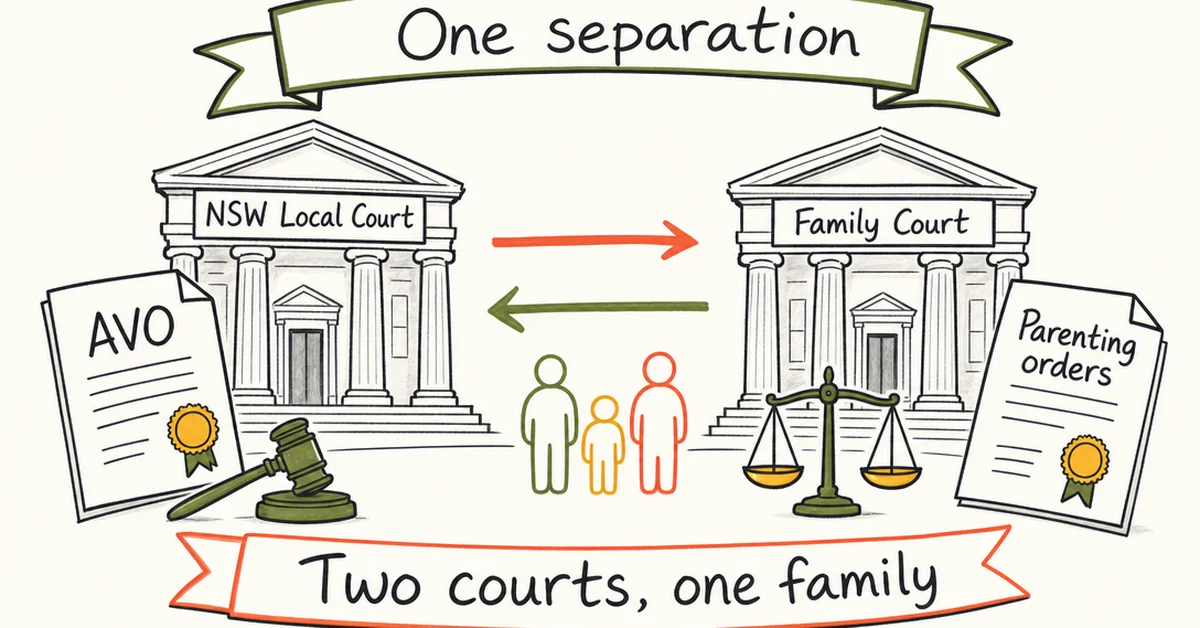
This guide covers that overlap and nothing else. For what an AVO is and what breaching one means, see our fact sheet on apprehended violence orders in NSW, and if the same incident has produced a charge, being charged with assault in a domestic setting.
AVOs and family law at a glance (NSW)
- Two laws, two courts: the AVO sits under the Crimes (Domestic and Personal Violence) Act 2007 (NSW) in the Local Court. Parenting and property sit under the Family Law Act 1975 (Cth) in the Federal Circuit and Family Court.
- Which one wins: where they conflict about a child spending time with you, the family law order prevails (s 68Q). The Local Court can change a parenting order in limited circumstances (s 68R); the family court cannot change or cancel your AVO.
- The cost of a quick fix: consenting without admissions ends the Local Court matter, but the order becomes a mandatory consideration in the parenting case (s 60CC(2A)(b)).
- Do now: tell each court about the other proceeding, and agree to no AVO condition until it has been read against your parenting arrangements.
- Never breach it: knowingly contravening carries up to 2 years’ imprisonment; contravening an ADVO intending to cause harm or fear carries up to 3 years; and a persistent breach carries up to 5 years (s 14).
How does an AVO affect parenting orders and time with your children?
An AVO does not automatically stop you seeing your children, and it is not an order about parenting. But it is a mandatory consideration in the family court’s decision, and its conditions can make ordinary arrangements unworkable.
Since 6 May 2024, the family court decides parenting cases under a rewritten test. The presumption of equal shared parental responsibility was repealed, so nothing now pushes towards shared arrangements as a starting point. The court works through the best interests factors in s 60CC of the Family Law Act, and the first is what arrangements would promote the safety of the child and of each person caring for the child.
Section 60CC(2A) makes the order itself relevant in terms. On safety, the court must consider any history of family violence, and any family violence order that applies or has applied to the child or a member of the child’s family.
A NSW ADVO qualifies, so it goes into the file whether or not you accepted the allegations behind it, and whether or not it has expired. A party who is aware of the order must tell the family court (s 60CF).
Two things surprise people. “Family violence” in s 4AB is broad, covering stalking, repeated derogatory taunts, damaging property, harming an animal, and economic or financial abuse. And if your children are named as protected persons on the AVO, the starting position is far more restrictive, and loosening it means work in the Local Court, not the family court.
Which order wins when an AVO and a parenting order conflict?
Where a family law order says a child is to spend time with you and the AVO says you cannot be where that requires you to be, the family law order prevails, and the AVO is invalid to the extent of the conflict (s 68Q).
That is narrower than it sounds. The invalidity operates only so far as the family law order provides for a child to spend time with a person, or requires or authorises someone to spend time with a child. An order letting you collect the children at 5 pm Friday licences nothing else at that address or at any other time.
NSW builds the same result into the AVO itself. The optional Order 6 in Form 2 of the Crimes (Domestic and Personal Violence) Regulation 2025 (NSW) permits contact with the protected person where it is “ordered by this court or another court about contact with the child/children”, or agreed in writing about the children, or through a lawyer.
If Order 6 was not ticked, none of those exceptions exists on your order. That tick box is one of the most consequential things in an AVO for a separating parent, and it is routinely overlooked.
| Question | The answer |
|---|---|
| Can the Local Court change a parenting order? | Yes, within limits. When making or varying an AVO it may revive, vary, discharge or suspend a parenting order, but only so far as that order provides for a child to spend time with someone (s 68R). Parental responsibility orders sit outside the power |
| On what conditions? | It must make or vary the AVO in the same proceedings, and must have material that was not before the court that made the parenting order (s 68R(3)). On an interim AVO it cannot discharge an order, and the change is time-limited (ss 68R(4), 68T) |
| Can the family court vary, suspend or cancel your AVO? | No. No such power exists in the Family Law Act. It can render the AVO partly invalid under s 68Q and grant its own injunctions (ss 68B, 114), but only a NSW court can vary or revoke the AVO (s 73) |
That last row is what people get wrong, and it wastes money. Asking a family court to “lift the AVO” is asking for something it cannot give.
What does consenting to an AVO “without admissions” really mean?
It means the order is made without you accepting any allegation and without the court deciding whether anything is true. Section 78 allows a final AVO by consent “whether or not the defendant admits to any or all of the particulars of the application”.
Consenting is often sensible: it ends the matter quickly and avoids a contested hearing. But four consequences reach into the family law case, and are rarely explained at the courthouse door.
- The order still counts. Section 60CC(2A)(b) requires the family court to consider any family violence order that applies or has applied. A consent order is not a finding that anything happened, and a judge can be told that, but it is still on the file.
- You may lose the right to cross-examine in person. Under s 102NA, where family violence is alleged and a final family violence order applies to both parties, you cannot cross-examine personally and it must be done by a legal practitioner. That can make running your parenting case without a lawyer impossible.
- The police material can follow you. The family court can order a police force to produce documents about family violence (s 67ZBE).
- The duration is not a formality. Where no period is specified, an ADVO runs for 2 years for an adult defendant (s 79A), outlasting many parenting disputes. A court can also make an ADVO of indefinite duration where it is satisfied of a significant and ongoing risk of death or serious harm (s 79B).
The answer is not to refuse to consent on principle, but to negotiate the conditions and the duration before anything is signed.
What happens to the family home and your property?
An AVO can exclude you from a home you own or rent, and in a rental it can end your tenancy outright. It does not decide the property settlement, but family violence is now expressly relevant to that settlement.
Section 35(2)(b) lets the court prohibit access to premises occupied by the protected person “whether or not the defendant has a legal or equitable interest in the premises or place”. Ownership is not an answer to an exclusion condition.
If you rent, s 79 of the Residential Tenancies Act 2010 (NSW) goes further. If a final AVO prohibits a tenant or co-tenant from having access to the premises, that person’s tenancy terminates; the other co-tenant’s tenancy is unaffected. For belongings left behind, the Local Court can make a property recovery order (s 37).
Since 10 June 2025, the family court must take into account the effect of any family violence on a party’s ability to make contributions (s 79(4)(ca)) and on their current and future circumstances (s 79(5)(a)). Pets now have their own regime under s 79(6) and (7).
Can an AVO be used tactically, and which proceeding should move first?
Applications are made for many reasons, and it is not useful to speculate about anyone’s motive. What can be said is that cross-orders are now common, and that sequencing is a real strategic decision.
BOCSAR found the proportion of ADVOs granted to both parties in an intimate relationship rose from 5.7% in the 12 months to December 2016 to 13.7% (3,204) in the 12 months to February 2023 (Bureau Brief BB178). Two orders between the same parents make an ordinary handover legally hazardous for both.
Whatever the motive, one response is always wrong. Do not breach the order. A breach is a criminal offence, and it hands the family court the material it is looking for on safety.
Section 14 sets three tiers. Knowingly contravening an AVO carries a maximum of 2 years’ imprisonment (s 14(1)); contravening an ADVO intending to cause harm or fear carries 3 years (s 14(1A)); and a persistent breach, broadly a third contravention within 28 days, carries 5 years (s 14(1C)). Where the act constituting the offence was an act of violence against a person, the court must impose imprisonment unless it orders otherwise and gives reasons.
Sequencing turns on two things. The AVO usually moves first, because the Local Court lists quickly, so its conditions rather than parenting orders tend to govern the first months after separation. And s 68R needs new material, which must be assembled before the AVO is finalised, not afterwards.
The family court can still move quickly on risk. Where a notice alleging family violence or child abuse is filed, s 67ZBB requires it to consider interim and procedural orders as soon as practicable and, where appropriate, within 8 weeks.
Your rights and what you can do now
You are a respondent to a civil application, not a person charged with an offence, and you have real choices about how the order is framed. The most valuable close off once a final order is made.
Your rights:
- You can oppose the order and require the applicant to prove the grounds, or consent without admissions under s 78, accepting nothing alleged.
- You can negotiate the conditions and the duration. Which additional orders are ticked, and how long the order runs, are both open.
- You can apply later to vary or revoke a final AVO under s 73, on notice to the protected person.
Practical steps:
- Read the conditions line by line against your children’s routine, and ask whether Order 6 has been ticked and in which form.
- Tell each court about the other proceeding. You must inform the family court of the AVO (s 60CF), and an AVO applicant must disclose parenting orders (s 42).
- Put all communication about the children in writing through one channel, strictly about logistics, and use a third party for handovers while conditions are unclear.
- Get advice before the next mention date. Once a final AVO is made, changing it means a fresh application.
How a lawyer could help your AVO and family law matter
The value in a crossover case is mostly in the drafting and the sequencing, not in a courtroom fight. A lawyer acting on the AVO with your family law position in view can do three things.
Negotiate the conditions rather than the order, and advise on whether to consent. The work is getting Order 6 into a form that fits your arrangements, resisting exclusion conditions broader than necessary, and arguing for a duration that does not outlast the parenting dispute.
Test whether the order should be made at all. Where the evidence is thin, a lawyer may make representations to police to withdraw or amend the application, or defend it at hearing.
Use s 68R properly, and co-ordinate with your family lawyer. Identifying the new material the section requires, and keeping the two files consistent, is often the highest-value work in the matter.
Frequently asked questions
Can I still see my children if there is an AVO against me?
Usually, yes. An AVO restrains contact with the protected person; it is not an order about parenting. If the children are not named as protected persons, and a parenting order or Order 6 provides for contact about them, time can continue. If they are named, or Order 6 was not ticked, sort it out in court first.
Does an AVO stop me getting equal time with my children?
No, but it changes the question the court is asking. There is no longer a presumption of equal shared parental responsibility, and the first best interests factor is safety (s 60CC(2)(a)). The outcome turns on the evidence about risk, not the order alone.
Can the family court cancel or change my AVO?
No. No power exists in the Family Law Act for the Federal Circuit and Family Court to vary, suspend or revoke a NSW AVO. It can make a parenting order that renders the AVO invalid to the extent of an inconsistency about a child spending time with you (s 68Q). To change the AVO itself, apply to a NSW court under s 73.
If I consent to an AVO without admissions, can it be used against me in the family court?
Yes, though not as proof of the allegations. The order is a mandatory consideration under s 60CC(2A)(b), and a final order applying to both parties triggers the cross-examination ban in s 102NA. It is not a finding that the conduct occurred, and the court can be told how and why it was made.
Can I contact my former partner about the children while an AVO is in place?
Only if a condition allows it. Check whether Order 6 is on your order and which sub-paragraphs are ticked. If none appear, contact about the children is a breach.
How O’Brien Criminal & Civil Solicitors can help
An AVO made during a separation is decided in a busy Local Court list, often in minutes, and it can shape a parenting dispute for the next two years. O’Brien Criminal & Civil Solicitors is a specialist criminal defence firm, led by an Accredited Specialist in Criminal Law (a credential held by fewer than 6% of NSW solicitors), with more than 20 years acting for respondents to apprehended violence orders across Sydney and NSW.
Our Sydney domestic violence lawyers act on the AVO with your family law position in view, alongside your family lawyer: negotiating conditions and duration that fit your parenting arrangements, advising on whether to consent, and making sure nothing done in the Local Court damages your case in the family court.
Request initial advice (no-obligation) via the form below or call us on (02) 9261 4281.
This content is for general information purposes only and does not constitute legal advice. You should seek independent legal advice relevant to your specific circumstances.