

Being investigated for or charged with coercive control can be frightening and confusing. The allegation concerns a pattern of behaviour, not a single moment.
This guide explains the offence, what prosecutors must prove, the available defence, penalties and what to do next.
Coercive control at a glance (NSW)
-
- The offence: a course of abusive behaviour by an adult towards a current or former intimate partner, intended to coerce or control them (s 54D of the Crimes Act 1900 (NSW)).
- Maximum penalty: 7 years’ imprisonment (2 years if the matter stays in the Local Court).
- Where it’s heard: usually the Local Court; it moves to the District Court if the prosecution or you elect.
- Key date: only behaviour on or after 1 July 2024 can form part of the charge.
- Do now: do not contact the other person, do not delete anything, and get legal advice before any police interview.
What is coercive control under NSW law?
Coercive control is a pattern of abusive behaviour towards a current or former intimate partner, carried out with the intention of coercing or controlling them. It became a standalone criminal offence in NSW on 1 July 2024.
The offence sits in Part 3, Division 6A of the Crimes Act 1900, titled “Abusive behaviour towards intimate partners“. To find someone guilty, the prosecution must prove each of the following beyond reasonable doubt:
| Element | What it means in plain English |
|---|---|
| 1. You are an adult | You were 18 or older. A person under 18 cannot be charged with this offence. |
| 2. A course of conduct of abusive behaviour | A pattern of abusive behaviour, engaged in repeatedly or continuously. A one-off act will not usually be enough. |
| 3. Intimate partners | You and the other person are, or were, intimate partners. |
| 4. Intention to coerce or control | You intended the pattern to coerce or control the other person. |
| 5. The reasonable person test | A reasonable person would consider the conduct likely to cause fear of violence, or a serious adverse impact on the other person’s ability to carry on their ordinary day-to-day activities. |
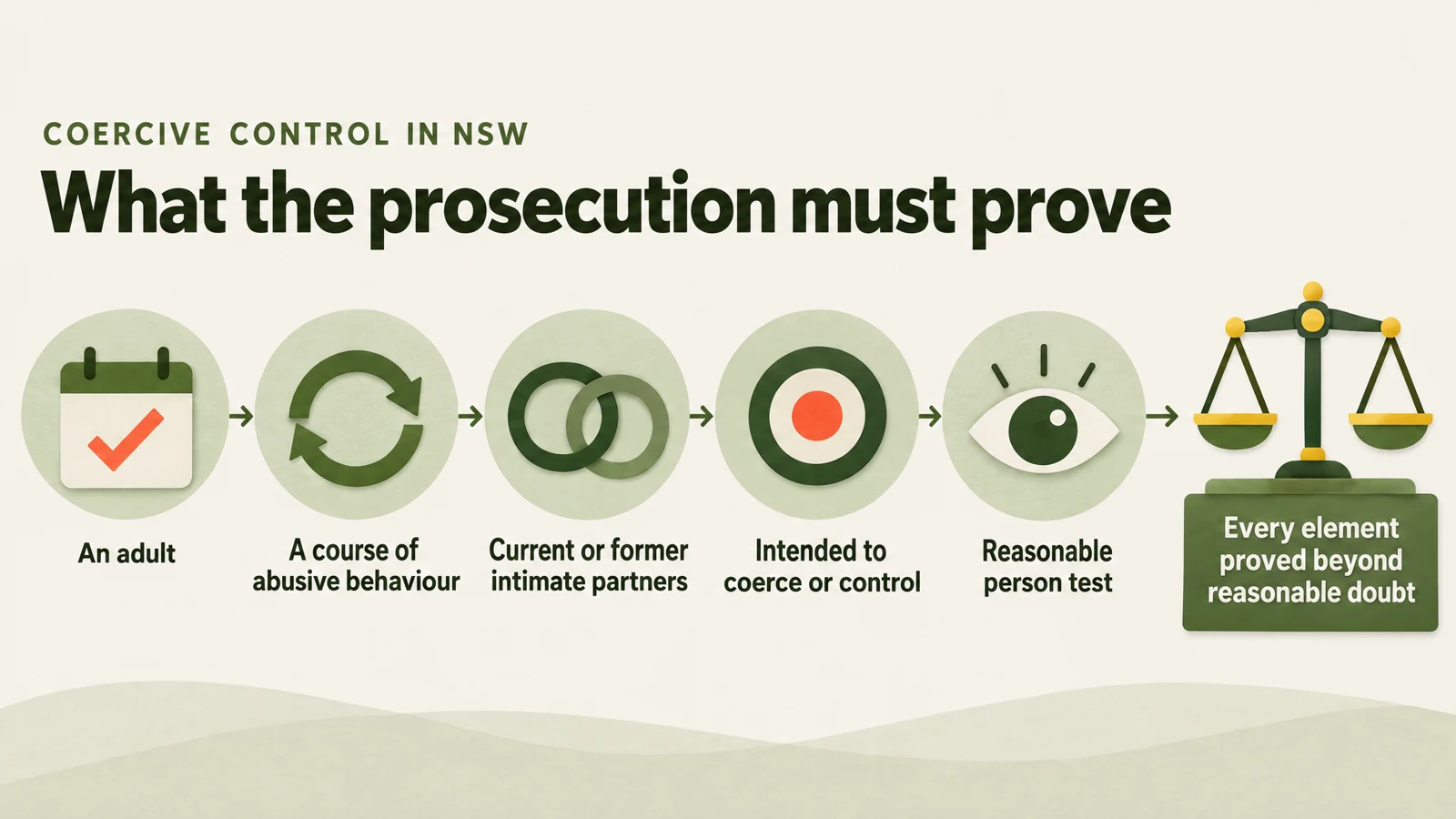
If any one element is not proved, the charge usually fails.
Who counts as an “intimate partner”?
An intimate partner is someone you are or were married to or in a de facto relationship with, or someone you have or had an intimate personal relationship with (s 54C). However, the relationship does not have to be sexual.
As at October 2026, the offence does not extend to other relationships, such as parents, siblings, other relatives or flatmates. A statutory review of the coercive control law is going to consider whether it should. This report is due in July 2027.
Controlling behaviour within a wider family can still lead to an AVO.
What behaviour can amount to “abusive behaviour”?
Abusive behaviour includes violence, threats, intimidation, or coercion or control. The Act’s examples are not exhaustive. Under s 54F, it may include:
- Financial or economic abuse, such as withholding money needed for reasonable living expenses, or unreasonably restricting someone’s job, income or access to shared assets.
- Shaming, degrading or humiliating the other person.
- Harassing, monitoring or tracking their activities, messages or movements, including through phones, apps or location-sharing technology.
- Isolating them from family, friends or culture.
- Damaging property, or harming or using an animal to threaten them.
- Restricting their liberty or unreasonably controlling their daily life.
- Threatening harm to a child or another adult if demands are not met.
Does it have to be a pattern?
Yes. Under s 54G, a “course of conduct” means behaviour engaged in repeatedly, continuously, or both, though not necessarily back-to-back. The court looks at the totality of the behaviour, not each act in isolation.
What does the prosecution have to prove about intention?
The prosecution must prove you intended the course of conduct to coerce or control the other person. Being careless about the effect of your behaviour, or recklessly ignoring it, is not enough under the current law.
Intention is usually inferred from what a person said or did, so messages and context can be used to argue for it and against it. The statutory review must consider whether recklessness should be added.
Does the other person have to have been afraid?
No. The reasonable person test is objective: would a reasonable person consider the conduct likely to cause fear of violence, or a serious adverse impact on daily life? That applies “whether or not the fear or impact is in fact caused”.
The Judicial Commission’s bench book notes that the prosecution does not have to prove what the other person actually felt.
Is there a defence to coercive control?
Yes. Under s 54E, it is a defence if the course of conduct was reasonable in all the circumstances.
You do not have to prove it. Once there is evidence capable of raising the defence, the prosecution must prove beyond reasonable doubt that your conduct was not reasonable. The Act does not define “reasonable”, so it turns on the facts of the relationship and the context of each behaviour.
What is the penalty, and which court hears it?
The maximum penalty is 7 years’ imprisonment. Coercive control is a Table 1 offence under Schedule 1 of the Criminal Procedure Act 1986. That means it stays in the Local Court unless the prosecution or you elect to take it to the District Court.
| Court | Maximum penalty | When it applies |
|---|---|---|
| Local Court | 2 years’ imprisonment (s 267 Criminal Procedure Act) | The default |
| District Court | 7 years’ imprisonment | If the prosecution or the accused elects |
Extra sentencing rules apply to domestic violence offences.
Under s 4A of the Crimes (Sentencing Procedure) Act 1999, a court that finds a person guilty must impose either full-time imprisonment or a supervised order. A different option is only open if the court is satisfied it is more appropriate. In this case, the court must give reasons.
An intensive correction order (ICO) is a jail term served in the community. For a domestic violence offence, the court can only make one if satisfied that the other person, and anyone you are likely to live with, will be adequately protected.
What happens in practice?
There is no reliable “typical” sentence yet. According to BOCSAR’s Coercive Control Monitoring Report June 2026, 42 coercive control charges were laid between July 2024 and June 2026. Of the 10 finalised by 30 June 2026, six were withdrawn by the prosecution and four were proven after a guilty plea.
Those four resulted in two imprisonment orders, one intensive correction order and one supervised community correction order. With numbers this small, past results do not predict your case.
Does the law apply to behaviour before 1 July 2024?
No. The provisions apply only to behaviour that occurred, or is alleged to have occurred, on or after 1 July 2024.
The prosecution must set out the behaviours and the period relied on. If the alleged pattern leans on earlier events, a lawyer will test whether what remains is still a course of conduct.
How does coercive control connect to AVOs, bail and other charges?
A coercive control charge is a domestic violence offence. It can trigger an AVO, attract a stricter bail test and often accompany other charges.
- AVOs. Coercive control is a “domestic violence offence” under s 11 of the Crimes (Domestic and Personal Violence) Act 2007, so the apprehended violence order rules apply. When you are charged, the court must make an interim AVO protecting the other person unless one is not required (s 40). On a plea or finding of guilt it must make a final AVO, again unless one is not required (s 39).
- Bail. Coercive control is a show cause offence under s 16B of the Bail Act 2013. Bail must be refused unless you show why detention is not justified, and the unacceptable risk test then applies. See our guide to bail applications in NSW.
- Other charges. BOCSAR found that 60% of recorded coercive control incidents came with another offence, most often intimidation or stalking (36%) or domestic assault (36%). The Act states that it does not change the common law on double jeopardy, which can matter when the same conduct is relied on for more than one charge.
- Family law. A charge or AVO can affect parenting arrangements. Our AVO and family law crossover guide explains how the systems interact.
What evidence is used in coercive control cases?
The evidence is usually material gathered over time. The prosecution need not prove every detail of each incident, but it must prove a course of abusive conduct beyond reasonable doubt.
Material that may be relevant, for either side, includes:
- Messages, emails and social media, with their full context and timing.
- Bank records showing who controlled money, and why.
- Phone and app data, such as location-sharing settings and who set them up.
- Statements from the other person, friends, family or colleagues.
- Prior police records of domestic incidents. BOCSAR reports that 47% of the people police recorded as victims in these incidents had a prior domestic violence history on police records.
Context changes meaning. Shared financial arrangements, location-sharing both partners agreed to, or heated messages in a difficult relationship do not automatically amount to coercive control.
Your rights and what you can do now
Your rights apply from the first contact with police, and early decisions often shape the whole case.
Your rights:
- The right to silence. Beyond your name and address, you do not have to answer police questions about the allegations. Coercive control is a serious indictable offence, so a “special caution” can apply. Given with your lawyer present, it can in limited cases allow your silence to be used against you (s 89A of the Evidence Act 1995).
- The right to a lawyer before deciding whether to take part in an interview.
- The presumption of innocence. The prosecution must prove every element. You do not have to prove anything.
Practical steps:
- Do not contact the other person, directly or through friends, family or social media. If an AVO or bail conditions are in place, contact may itself be a breach.
- Do not delete messages, photos or accounts. Deleting material can look like concealment and may destroy evidence that helps you.
- Write a timeline of the relationship while your memory is fresh, with the context for key events.
- Gather your own records: bank statements, full message threads, and the names of people who saw how the relationship worked.
- Follow every condition of any AVO or bail order exactly.
- Get legal advice before your first court date, so bail, plea and jurisdiction decisions are made properly.
How a lawyer could help your coercive control case
A criminal lawyer tests whether the prosecution can prove every element and, where you accept responsibility, puts your circumstances to the court. Depending on the facts, avenues may include:
- Testing the elements. Was there an intimate relationship within s 54C, a genuine course of conduct, and an intention to coerce or control? Would a reasonable person consider the conduct likely to cause fear or a serious adverse impact?
- Raising the defence that the conduct was reasonable in all the circumstances, which the prosecution must then disprove.
- Holding the prosecution to its particulars, including challenging any reliance on behaviour before 1 July 2024.
- Seeking withdrawal or a different charge through written representations to police or the Director of Public Prosecutions, depending on the evidence.
- Bail and AVO conditions. A well-prepared show cause bail application, and applications to vary AVO conditions that make work or parenting unworkable.
- Advising on jurisdiction, since whether the matter stays in the Local Court is a strategic decision.
- Presenting mitigation if you plead guilty, such as counselling and behaviour-change programmes, and addressing the s 4A sentencing rule. Reforms passed in 2026, not yet in force at October 2026, will stop courts treating “good character” as a reason to reduce a sentence.
Sometimes the person charged has also experienced abuse in the relationship. The statutory review must consider whether people experiencing abuse are being wrongly identified as the person using it, so if that is your situation, raise it early.
No lawyer can promise a result.
Frequently asked questions
Can a single incident be coercive control?
Generally, no. The offence requires a course of conduct, meaning behaviour engaged in repeatedly or continuously. A one-off act may support a different charge, such as assault or intimidation, but will not usually be coercive control.
Does coercive control apply to family members or flatmates?
No, not under the current law. It applies only between current or former intimate partners. A statutory review is considering extending it, but no change has been made. Controlling behaviour between relatives can still ground an AVO.
Can I be charged for things that happened before July 2024?
No. The offence applies only to behaviour on or after 1 July 2024. Earlier events cannot form part of the course of conduct for a coercive control charge. Whether they can be used for any other purpose depends on the circumstances.
Will I go to jail for coercive control?
Not necessarily. The maximum is 7 years, or 2 years in the Local Court, and courts must impose imprisonment or a supervised order unless another option is more appropriate. Of the four proven charges BOCSAR reported to June 2026, two led to imprisonment orders, one to an intensive correction order and one to a supervised community correction order.
Will an AVO be made against me automatically?
Usually, yes. On a coercive control charge the court must make an interim AVO, and on a plea or finding of guilt a final AVO, unless one is not needed. Conditions can sometimes be varied.
Can a coercive control charge be withdrawn?
Sometimes. BOCSAR reported that six of the 10 charges finalised by June 2026 were withdrawn by the prosecution. The numbers are small, and the outcome depends on the evidence in your case.
How O’Brien Criminal & Civil Solicitors can help
Coercive control charges are new and technical, and they are closely tied to AVOs and bail. O’Brien Criminal & Civil Solicitors brings more than 20 years in criminal defence and is led by an Accredited Specialist in Criminal Law (fewer than 6% of NSW lawyers hold any Law Society specialist accreditation).
We act in domestic violence matters across NSW from your first contact with police. That means advising before any interview, preparing show cause bail applications and testing every element of the prosecution case.
Request initial advice (no-obligation) via the form below or call us on (02) 9261 4281.
This content is for general information purposes only and does not constitute legal advice. You should seek independent legal advice relevant to your specific circumstances.