

A Working with Children Check is the one piece of paper standing between a teacher, a coach, a childcare worker or a youth pastor and the end of their career. Lose it, and the charge in the Local Court stops being the biggest problem you have.
If you have been charged, refused a clearance, or handed an interim bar out of nowhere, you are facing two processes at once, decided by different bodies on different tests. The order in which they resolve can decide whether you work in the sector again.
This guide covers the two categories of offence that cause trouble, what happens when you are charged but not convicted, how the risk assessment works, and how to challenge a decision now that appeals to NCAT are gone.
Working with Children Checks at a glance (NSW)
- The law: the Child Protection (Working with Children) Act 2012 (NSW), administered by the Office of the Children’s Guardian.
- Working while barred: a maximum of 100 penalty units ($11,000), 2 years’ imprisonment, or both, under section 8.
- Who decides: the Children’s Guardian. Since 23 September 2025, NCAT no longer reviews WWCC refusals, cancellations or interim bars; review is by internal review and disqualification reassessment under Part 4 of the Act.
- Do now: diarise 28 days from the date on the decision notice, and get advice on the criminal matter and the Check together.
What is the Working with Children Check, and who needs one?
It is a clearance issued by the Office of the Children’s Guardian authorising a person to do child-related work in NSW. It lasts five years under section 22, and it is recorded on the Working with Children Register, which the Children’s Guardian must keep accurate and up to date and must make available to an employer verifying a worker (section 25).
Section 6 defines child-related work more widely than most people expect. It reaches education, early education and child care, children’s health, disability services, child protection, justice services, residential and transport services for children, clubs and sporting bodies, and religious services, wherever direct contact with children is a usual part of the work and more than incidental to it.
Doing that work without either a clearance or a current application for one, or while subject to an interim bar, is an offence under section 8. The maximum is 100 penalty units (a fine of up to $11,000 at the NSW penalty unit value of $110), two years’ imprisonment, or both. A maximum is a ceiling rather than a starting point, and courts reserve it for the worst examples of an offence.
What are the two categories that catch people out?
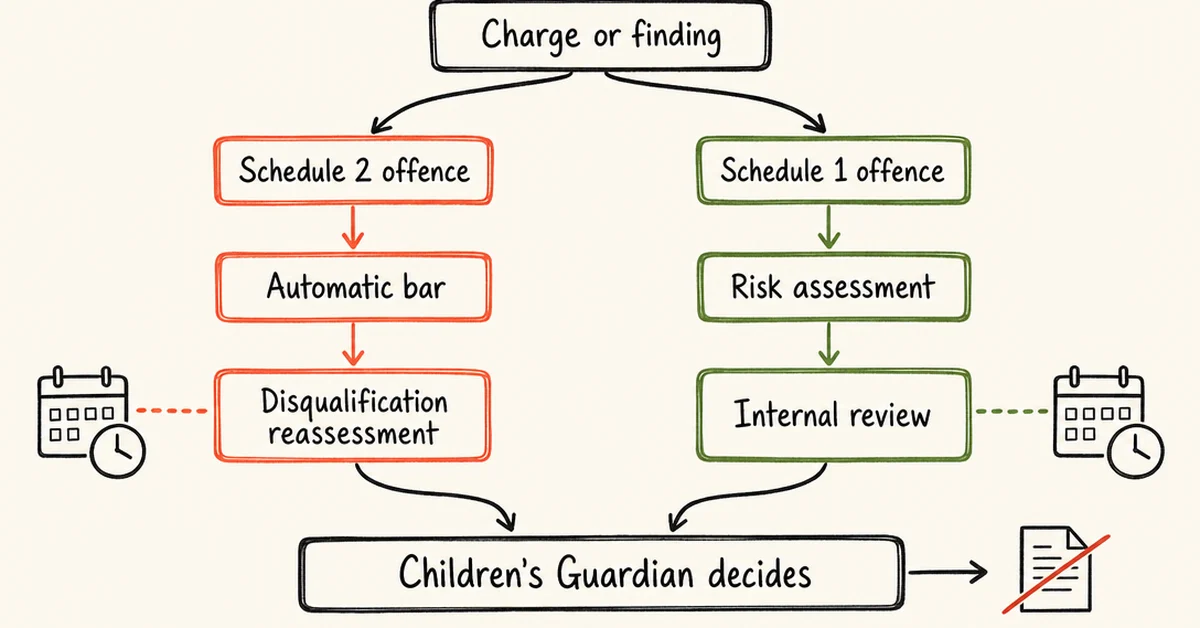
Everything turns on which category your matter falls into. Schedule 2 disqualifies you automatically, with no assessment of your circumstances at that stage. Schedule 1 triggers a risk assessment, where your circumstances are genuinely considered.
People routinely assume they are in the second when they are in the first.
Schedule 2 is a closed statutory list. Because the boundaries matter, here is how it opens, in the Act’s words:
- “murder”
- “manslaughter of a child (other than as a result of a motor vehicle accident)”
- “an offence involving intentional wounding of, or intentional causing of grievous bodily harm to, a child by an adult who is more than 3 years older than the victim”
- a long list of sexual offences under the Crimes Act 1900 (NSW) identified by section number, plus equivalent Commonwealth offences and registrable offences under the Child Protection (Offenders Registration) Act 2000
Schedule 1 is broader and less intuitive. It captures proceedings for offences involving wounding or bodily harm to a child, sexual offences involving a child outside Schedule 2, certain domestic violence offences against a child, some drug supply and animal cruelty offences, and reporting-body findings of sexual misconduct or serious physical assault of a child.
| Schedule 2: automatic disqualification | Schedule 1: risk assessment | |
|---|---|---|
| Effect | You are a disqualified person. A clearance generally must not be granted (s 18(1)), unless a disqualification reassessment later decides you should not continue to be disqualified (s 18(1A)). | The Children’s Guardian must assess whether you pose a risk to children (s 15(1)) |
| Circumstances considered? | Not at this stage. There is no discretion | Yes, on the section 15(4) factors |
| Chance to respond first? | No. Section 19(3) excludes disqualified persons | Yes, notice of a proposed refusal and an invitation to make a submission |
| Challenge route | Disqualification reassessment | Internal review |
One definition matters. Section 5 says “conviction” includes “a finding that the charge for an offence is proven, or that a person is guilty of an offence, even though the court does not proceed to a conviction”. That is broader than the everyday meaning, so if a section 10 order is possible, get advice before assuming it will protect your clearance.
What happens if you are charged but not convicted?
For a Schedule 2 offence, being charged is enough on its own. Under section 18(1)(b) a person “against whom proceedings for any such offence have been commenced, if the offence was committed as an adult” is a disqualified person pending determination of the proceedings. No finding of guilt is required.
For a Schedule 1 matter, a charge triggers a risk assessment, and for the offences listed in clause 1(2) the trigger applies “whatever the outcome of those proceedings”. An acquittal or withdrawal does not erase it there, though it is plainly relevant to the conclusion. A narrower group of matters, in clause 1(3), drops away if you are found not guilty.
The interim bar is separate again. Under section 17 the Children’s Guardian may impose one at any time after an application is received or an assessment begins, if of the opinion that it is likely there is a risk to the safety of children pending the outcome. That is a lower threshold than the final decision, and there is no hearing. Three features do most of the damage:
- It bites immediately, and your employer is told. Section 17(3) requires written notice to you and to each notifiable person, which includes your employer.
- It can run for up to 12 months, ending on revocation, on the grant or refusal of the clearance, or 12 months after it takes effect, whichever is first.
- You cannot seek review until it has run more than six months. The gap between that threshold and the twelve-month ceiling is the hardest stretch for most people in this position.
How does the risk assessment work?
A risk assessment is an investigation by the Children’s Guardian into whether you pose a real and appreciable risk to the safety of children. It is not a hearing, and it is decided on documents.
Section 15(4) lists what may be considered, and it reads as a checklist for your own material: the seriousness of the matters that caused the assessment, the time elapsed and your conduct since, your age then and now, the age and vulnerability of any victim, whether you knew the person was a child, and the likelihood of repetition. The Children’s Guardian also gathers material from the Department of Communities and Justice, NSW Police, the NSW local and district courts and Corrective Services NSW, and section 31 lets it require information from any person. It publishes no standard timeframe and states that assessments “can exceed 12 months”, so answering information requests promptly is one of the few parts of the timeline you control.
The test at the end is strict. Under section 15(4A), the Children’s Guardian can only decide you do not pose a risk to children if satisfied of two things: first, that a reasonable person would allow their own child to have direct, unsupervised contact with you while you were doing child‑related work; and second, that making that decision is in the public interest.
The same two limbs reappear on internal review (section 30(4)) and on reassessment (section 30D(6)). For scale, the Annual Report 2024-25 reports 2,012,813 people holding a clearance and 706 barred.
Can you still appeal to NCAT, and what replaced it?
No. This is the most important thing to know, and much of the material still online is out of date. Since 23 September 2025, when the Child Protection (Working with Children) and Other Legislation Amendment Act 2025 (NSW) commenced, NCAT has had no role in these decisions.
Two mechanisms went at once: external merits review at NCAT of a refusal, a cancellation or a long-running interim bar, and the NCAT “enabling order”, by which a disqualified person could ask the Tribunal to let them work with children despite the disqualification.
Part 4 of the Act is now headed “Internal reviews and reassessments of disqualification”, and the Children’s Guardian is both the decision-maker and the reviewer. The Office of the Children’s Guardian puts it plainly: a disqualified person now applies to it for a disqualification reassessment “instead of to NCAT for an enabling order”.
The two pathways that replaced it
You do not choose. The pathway is fixed by the reason for the decision: a risk-assessment outcome goes to internal review, an automatic disqualification goes to reassessment. Both carry an application fee, currently $224, and both can be lodged late only if the Children’s Guardian agrees to extend the time.
| Internal review (ss 28-30A) | Disqualification reassessment (ss 30B-30E) | |
|---|---|---|
| Who | Refused or cancelled after a risk assessment, or an interim bar running more than 6 months | Refused or cancelled because you are a disqualified person under Schedule 2 |
| Time limit | 28 days from notice, or any time after an interim bar has run 6 months | 28 days from the decision |
| Onus | Reconsidered on the material | You are presumed to pose a risk to children unless you prove the contrary (s 30D(5)) |
| Decided by | Someone who did not make the original decision, of equal or senior office (s 30(5), subject to s 30(6)) | The Children’s Guardian |
| One attempt | No further internal review (s 28(2)) | No internal review of a reassessment (s 30B(3)) |
Applying does not pause anything. Section 29(3) says an application for internal review “does not stay the operation of the reviewable decision”. You remain unable to do child-related work throughout.
Some people cannot apply at all. Section 27 shuts the door where a person was convicted as an adult of one of a narrower list of very serious offences and received full-time custody, or is subject to a home detention, intensive correction, community correction, conditional release or prohibition order still in force. It also shuts the door while proceedings for a Schedule 2 offence remain undetermined.
A separate provision does the same work where another jurisdiction is involved. Since 1 December 2025, section 25A has dealt with a mutual recognition negative notice, meaning a refusal, cancellation or interim-bar equivalent in another jurisdiction. Section 25A(4) says a person in that position cannot apply for an internal review or a disqualification reassessment of the resulting ineligibility, termination or cancellation, so whether any other avenue is open is a question for advice on the individual facts.
Why the order of events matters
The criminal matter and the Check are decided separately, but the first sets the boundaries of the second. Three interactions do the work.
While a Schedule 2 charge is pending, no review is available. You are disqualified because proceedings have commenced, and section 27(1)(c) excludes you from applying on that ground. The realistic step is to finalise the criminal matter first.
How the criminal matter ends can reopen the door early. Section 13A imposes a five-year period during which a further application generally cannot be made after a refusal or cancellation, but allows an earlier application where pending proceedings are withdrawn or dealt with without a finding of guilt, or a finding of guilt is quashed or set aside. A negotiated withdrawal and an acquittal both engage it. A plea does not.
The sentence can decide whether reassessment is ever available. Because section 27(2) turns on full-time custody and on whether a sentencing order is still in force, the order imposed in the criminal court affects whether, and when, you can ask the Children’s Guardian to revisit your disqualification. That belongs in the conversation before entering a plea, not after.
Your rights and what you can do now
You have a right to reasons, a right to put material forward, and a strictly limited window in which to use both. Treat the 28 days as the hard deadline it is, and start gathering material before you settle on an argument.
Your rights:
- Written reasons. A notice refusing or cancelling a clearance must set out the reasons and your right to seek review under Part 4 (sections 20(3) and 23(3)). A decision on an internal review or a reassessment must go further, and give the findings on material questions of fact, the evidence behind them, the decision-maker’s understanding of the law, and the reasons for the conclusion (sections 30A(2) and 30E(2)).
- A chance to respond, in Schedule 1 matters. Section 19 requires notice of a proposed refusal and a chance to make a submission before it is finalised.
- A fresh decision-maker on an internal review, of equal or senior office to the original decision-maker, unless the original decision was made by the Children’s Guardian personally (section 30(6)).
- An extension, if you ask. Ask early and in writing rather than filing late and explaining afterwards.
Practical steps:
- Diarise 28 days from the date on the notice, not the day you opened it.
- Stop child-related work immediately on a bar or interim bar. Continuing is a separate offence, and it will feature in every later decision about you.
- Check which category the notice puts you in. “Disqualified person” or “Schedule 2” means reassessment; a risk assessment outcome means internal review. The wrong application wastes the window.
- Gather material answering the section 15(4) factors: time elapsed, what you have done since, treatment or counselling records, supervision arrangements, and references from people who know the full circumstances and say so.
- Tell your criminal lawyer about the Check on day one, and say nothing about the allegations on social media or to colleagues.
How a lawyer could help your Working with Children Check matter
A lawyer’s role here is to run the two processes as one problem: defending the charge with the Check consequences in view, and putting a properly evidenced case to the Children’s Guardian inside the window.
Defending the charge with the clearance in mind. Whether a charge sits in Schedule 2, whether it was committed as an adult, and how it resolves all change the WWCC position. Where the evidence allows, negotiating for withdrawal, or for a charge outside Schedule 2, may matter more to your career than the sentence would.
Advising on sequencing and plea. Because section 13A treats a withdrawal or acquittal differently from a finding of guilt, and section 27(2) turns on the sentence imposed, decisions about how and when to resolve the criminal matter can be made with the licensing consequences identified rather than guessed at.
Preparing the application. In a reassessment, you carry the onus of displacing a statutory presumption of risk, against a test asking whether a reasonable parent would allow unsupervised contact. That calls for a structured submission addressing each section 15(4) factor, supported by independent expert and character material, not a letter explaining that the allegation was unfair. It also means lodging within 28 days and answering any information request on time, so the application is not terminated.
No lawyer can promise a particular outcome, and these tests are deliberately demanding. What early advice does is make sure the decisions you control are made with the consequences visible.
Frequently asked questions
Can I still appeal a Working with Children Check decision to NCAT?
No. Since 23 September 2025, NCAT no longer reviews these decisions or makes enabling orders. Applications go to the Office of the Children’s Guardian instead, as either an internal review or a disqualification reassessment under Part 4.
Can I get a Working with Children Check if I have been charged but not convicted?
Not while the charge is pending, if it is a Schedule 2 offence. Section 18(1)(b) disqualifies a person from the moment proceedings are commenced, pending determination. For other listed offences a charge triggers a risk assessment instead, and for most of those the trigger applies whatever the outcome.
Does a section 10 or other non-conviction order protect my clearance?
Not necessarily. Section 5 defines “conviction” to include “a finding that the charge for an offence is proven, or that a person is guilty of an offence, even though the court does not proceed to a conviction”. That is wider than the ordinary meaning, so do not assume a non-conviction outcome keeps an offence outside the disqualification provisions.
How long does an interim bar last, and can I challenge it?
It ends on revocation, on the grant or refusal of your clearance, or 12 months after it takes effect, whichever is first. You can only apply for internal review once it has run more than six months. Your employer is notified when it is imposed.
Do I have to tell the Children’s Guardian if I was refused a check in another state?
Yes. The Act requires you to notify the Children’s Guardian as soon as practicable after becoming aware of a refusal, cancellation or interim-bar equivalent in another jurisdiction, and section 25A then operates to terminate or cancel the NSW clearance or application in many cases.
How O’Brien Criminal & Civil Solicitors can help
A Working with Children Check matter is rarely just a regulatory problem. It sits alongside a criminal charge, and how that charge resolves determines what is possible with the clearance and how soon. O’Brien Criminal & Civil Solicitors is a specialist criminal defence firm, led by an Accredited Specialist in Criminal Law, a credential held by fewer than 6% of NSW lawyers, with more than 20 years defending clients whose professional standing turns on the outcome of a criminal matter.
We defend the charge with the licensing consequences in view, advise on sequencing and plea before those doors close, and prepare evidence review and reassessment applications inside the 28-day window. If you have a notice, the clock is already running.
For related material, see our criminal defence services page and our fact sheet on pleading guilty in NSW.
Request initial advice (no-obligation) via the form below or call us on (02) 9261 4281.
This content is for general information purposes only and does not constitute legal advice. You should seek independent legal advice relevant to your specific circumstances.