
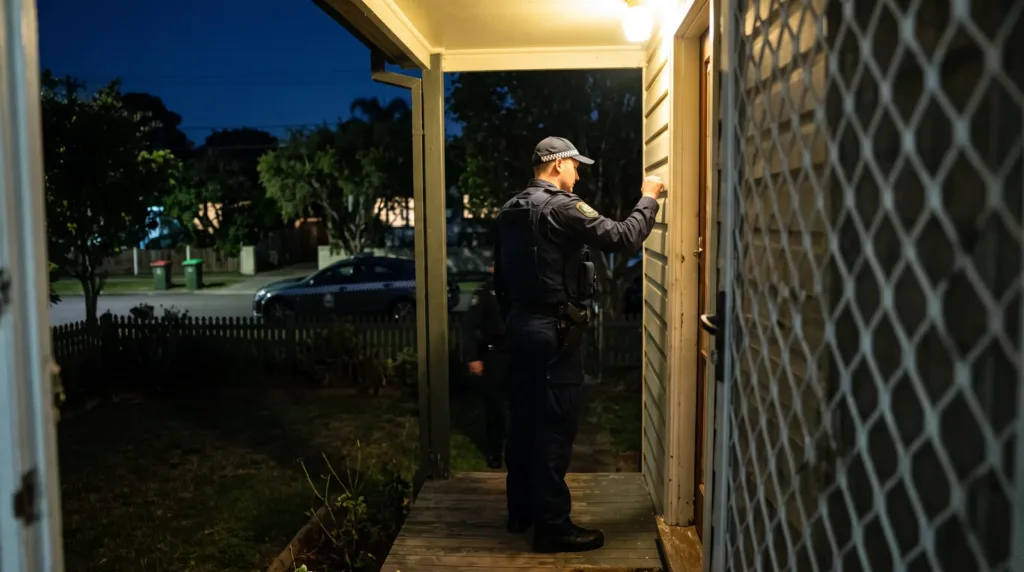
Two mothers have settled a trespass claim against NSW Police after alleging that repeated visits to check on their teenage sons went far beyond anything the law actually allows. The settlement, reported recently by the ABC, was reached on the eve of trial, after one of the families says police visited more than 100 times over 19 months.
The families’ case turned on a single legal idea most people have never heard of: implied licence. It isn’t a warrant. It isn’t a court order.
It’s an unwritten common-law assumption that anyone, including a police officer, can walk up to your front door to knock and ask a question, unless you’ve told them not to.
Police have relied on this doctrine when carrying out bail-compliance checks on residential properties. However, the LECC has criticised the practice, warning it could lead to trespass complaints if a resident withdraws implied licence.
What “implied licence” actually is, and what it was never meant to do
Implied licence is a narrow common-law concept. It’s why a postie, a courier, or a stranger asking for directions isn’t automatically trespassing the moment they step onto your driveway. Basically, society believes that a path to a front door is open for a brief, legitimate approach.
Yet two things make it fragile as a policing tool:
- It only ever authorises a knock-and-ask. It was never designed to authorise a search, a forced entry, or a recurring inspection regime.
- It can be revoked at any time, by the occupier, in words or conduct. A “no trespassing” sign, a verbal warning, or simply telling an officer not to come back is enough to cancel it on the spot.
The NSW Law Enforcement Conduct Commission (LECC) examined this practice in its Bail Compliance Checks in NSW report, published back in 2025. The report found that NSW Police had been relying on what it called “the complex, vague and terminable doctrine of implied licence” to conduct curfew and residential bail checks.
The LECC warned the practice left officers “open to complaints and claims of trespass if a resident revokes an officer’s implied licence to enter the property.”
Furthermore, the LECC recommended police should not rely on implied licence for this purpose. Instead, they should apply to a court for a formal enforcement condition under section 30 of the Bail Act 2013 (NSW) before conducting curfew or residential compliance checks.
A court-issued condition is a specific, reviewable power. Implied licence is neither.
What this looked like in practice for two families
According to the ABC’s reporting, one mother, Joanne*, says her family was checked on by police 109 times between October 2021 and May 2023. At least 59 of those visits, she says, occurred outside any conditions a court had actually imposed.
Joanne says she formally told police in October 2021 that they no longer had permission to come onto her property, but the visits continued.
Four of those visits were conducted under the search powers attached to a firearm prohibition order, with no weapons ever found. Additionally, on the family’s account, no apparent reason was ever given for targeting the property repeatedly.
The second mother, Megan*, says her family experienced more than 150 checks over the same period. Around 40% of them were between 1am and 4am.
She is continuing a separate case in the Federal Court alleging the checks amounted to racial discrimination. This is based on the fact that her sons, then aged 11 and 13, were subjected to disproportionate scrutiny because they are Aboriginal. That claim remains before the court, and this article does not comment on its merits.
Both families’ trespass claims against NSW Police settled confidentially before trial. No findings of fact were made by a court, and NSW Police has not conceded the practice was unlawful.
*Joanne and Megan are pseudonyms used in the ABC’s reporting to protect the families’ identities.
What this means for you
If police have repeatedly attended your home to check on a bail condition, and you’ve never been given a formal court-ordered enforcement condition, they might be relying on implied licence, and you can revoke it.
A few practical points, based on what the LECC found:
- Ask the attending officer whether the visit is authorised by a court-imposed enforcement condition under s 30 of the Bail Act, or whether they’re there under implied licence.
- You are entitled to tell police, clearly and in a way you can later prove (in writing, or in front of a witness), that they no longer have permission to enter your property to conduct these checks.
- Revoking implied licence does not cancel a genuine, court-ordered condition. It only removes the informal basis some checks are relying on instead.
- A pattern of repeated, unannounced visits with no reasonable basis and no court authority can amount to trespass, and in some circumstances false imprisonment or assault, depending on what happened during the visit.
See our guide to suing NSW Police for false imprisonment and making a police misconduct complaint for more detail on how these claims work, including alongside a LECC complaint.
How O’Brien Criminal & Civil Solicitors Can Help
Our team acts for people who’ve had police attend their property beyond what the law actually authorises, including repeated bail-check visits relying on implied licence rather than a genuine court order.
We can assess whether visits you or your family have experienced crossed that line, and what a claim for trespass, false imprisonment, or related conduct might look like. Civil claims against NSW Police are one of the select practice areas where No Win, No Fee arrangements may be available, subject to individual assessment. While you won’t have to pay our legal costs if your claim is unsuccessful, you may still be responsible for your opponent’s legal costs in some circumstances. Similarly, if you need help with your bail conditions, our criminal lawyers can assist you.
Request initial advice (no-obligation) via the form below or call us on (02) 9261 4281.
This content is for general information purposes only and does not constitute legal advice. You should seek independent legal advice relevant to your specific circumstances.

Peter O'Brien is the Principal Solicitor of O'Brien Criminal & Civil Solicitors and Australia's leading expert in intentional torts litigation, with over 25 years of experience securing landmark victories in malicious prosecution and unlawful imprisonment cases. Author of Intentional Tort Litigation in Australia and recipient of the Law Council of Australia President's Medal, Peter has achieved record-breaking compensation for clients and is widely recognised for his unwavering commitment to access to justice.