

NSW Police have uncovered one of the largest fraud syndicates in the country’s history: up to $600 million in fraudulent loans allegedly taken from Australian banks. A 28-year-old Sydney woman is among those charged, facing 17 counts of making false documents to obtain financial advantage, over an alleged $14.5 million in fraudulent loans linked to her matter alone.
This is just a startling figure, the charge itself is one that gets laid far more often, and on a far smaller scale, than a $600 million syndicate.
Anyone who has signed a loan document for someone else, worked at a business now under investigation, or been named as a reference or co-signer for a friend facing scrutiny, is asking a version of the same question. What does this charge actually mean, and what happens next?
What’s actually been alleged
Strike Force Myddleton was set up by NSW Police’s Financial Crimes Squad, with the NSW Crime Commission. Its goal was to look into an alleged syndicate targeting Sydney automotive finance companies using stolen personal information to secure loans for “ghost cars”. Cars that didn’t exist.
According to ABC News, the investigation has since widened beyond car finance into alleged personal, business and home loan fraud. The NSW Crime Commission has recovered $95 million in assets to date.
The 28-year-old woman’s charges are just one part of a much larger operation that has brought the total number of people charged to over 30.
A quick reality check on the headline number. The $600 million is the police’s estimate of the syndicate’s total alleged reach, not what any one person is accused of. The woman’s own alleged conduct, 17 counts totalling $14.5 million, is serious in its own right, but it’s a fraction of the wider figure being reported.
What “making a false document to obtain financial advantage” actually means
The charge reported here sits under section 253 of the Crimes Act 1900 (NSW), headed “Forgery: making false document.” It’s a different, more specific charge than the general “fraud” offence most people have heard of (section 192E, dishonestly obtaining a financial advantage by deception), and it’s worth understanding the distinction.
| Section 253: making a false document | Section 192E: fraud | |
|---|---|---|
| What it targets | Creating the false document itself | Obtaining a benefit by deception generally |
| Maximum penalty | 10 years’ imprisonment | 10 years’ imprisonment |
| Typical evidence | Fabricated payslips, IDs, bank statements, loan applications | Any deceptive conduct, document-based or not |
| Court | Table 1 offence. Usually Local Court, can be elected to the District Court | Can be either, depending on scale |
For a section 253 charge to succeed, the prosecution has to prove, beyond reasonable doubt, that the accused person:
- Made a false document: created or altered it so it purported to be something it wasn’t;
- Intended it to be used to induce someone (typically a bank or lender) to accept it as genuine; and
- Did so because accepting it as genuine would obtain a financial advantage, obtain property, or cause a financial disadvantage to someone else.
In a loan fraud case like this one, that usually means the prosecution has to show a specific fabricated document, a payslip, a bank statement, an ID, or a signed application. They must also then connect it to a specific loan.
That’s why multi-count charges like “17 counts” happen: each count typically corresponds to one alleged false document or one alleged loan, not one broad course of conduct. It also means the defence of any one count often turns on evidence specific to that document, not the syndicate’s conduct as a whole.
Our fact sheet on fraud charges in NSW covers the broader section 192E offence in more depth, including penalties, defences and how a fraud matter typically proceeds through court.
How a loan-fraud syndicate investigation like this actually unfolds
Syndicate-style financial crime investigations rarely announce themselves with one arrest. They tend to move in a pattern worth understanding if you think you might be connected to one:
- A narrow starting point that widens. Myddleton began as a car-finance investigation and expanded into home and business loans over roughly two years. An investigation touching your finance broker, your employer, or a property deal you were involved in can widen to catch people who had no idea the underlying documents were false.
- Forensic financial analysis before charges. Financial Crimes Squad matters typically involve months of document tracing, bank record subpoenas and forensic accounting before any charge is laid, so charges can arrive long after the conduct they relate to.
- Charges laid in waves. More than 30 people have now been charged in this matter, and police have signalled further arrests are expected, including among real estate agents and property developers. Being uninvolved today doesn’t mean the strike force’s interest in a related transaction has necessarily ended.
- Asset recovery runs alongside criminal charges. The NSW Crime Commission’s parallel civil confiscation powers mean property and funds can be restrained even before, or without, a conviction.
If fraud squad detectives come to your door
Take the following steps if a fraud detective comes to your door:
- You don’t have to answer questions on the spot. You’re required to give your name and address if asked, but you are not required to explain a transaction, a document, or your relationship to anyone else under investigation before you’ve spoken to a lawyer.
- Anything you say can be used later, even said casually, even if you think it’s helping your case. A well-meant explanation given without legal advice is one of the most common ways people make their own position worse.
- Ask for time to get legal advice before any interview. Detectives investigating a syndicate of this size are not going to disappear if you ask to call a lawyer first.
- Don’t hand over or destroy documents on your own judgement. If you’re asked to produce records, get advice on what you’re legally required to provide, and never destroy anything once you’re aware of an investigation.
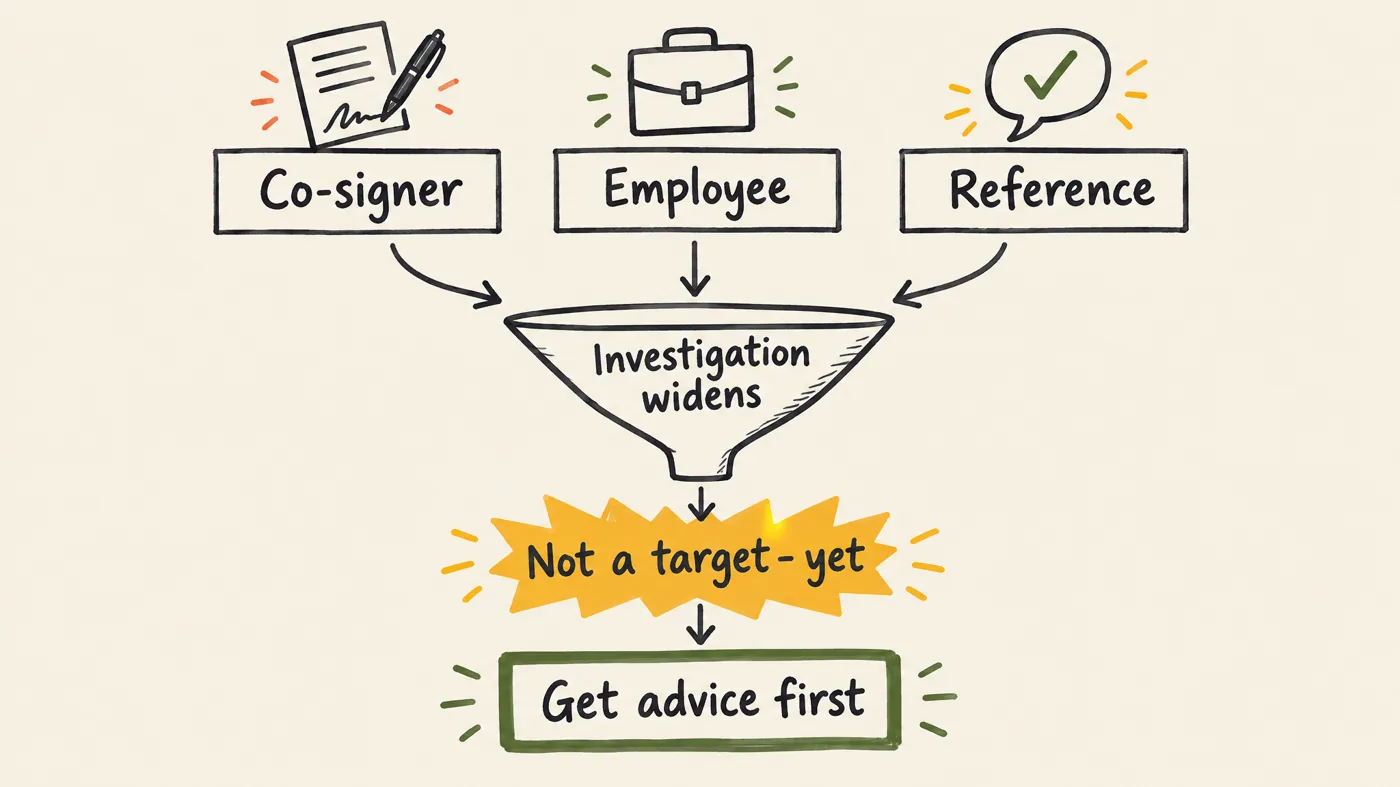
- Being a co-signer, employee, or reference isn’t the same as being a target, but it can be enough to bring you into an investigation’s scope. Early advice is what tells you the difference.
Received a call from Financial Crimes Squad detectives?
If you’ve received a call from Financial Crimes Squad detectives, been named in a search warrant, or simply signed paperwork for a business or a friend now under investigation, get legal advice before you say anything else to police. A section 253 charge turns on the specific document and the specific intent behind it, which means the details of your own situation, not the size of the syndicate in the headlines.
How O’Brien Criminal & Civil Solicitors Can Help
If you’ve been charged with making a false document, fraud, or any offence arising out of a loan or finance investigation, you need advice from lawyers who understand how these document-heavy prosecutions are actually built and defended, not just the news coverage of the syndicate they’re part of.
Our criminal defence team is led by Accredited Specialists in Criminal Law, a credential held by fewer than 6% of NSW solicitors, and we regularly act for people facing fraud and forgery charges connected to loans, finance and business dealings.
If you’ve simply been contacted by police, named in a warrant, or you’re worried a transaction you were part of might come under scrutiny, getting advice early is what protects your position, whether or not you’re ultimately charged with anything at all.
Request initial advice (no-obligation) via the form below or call us on (02) 9261 4281.
This content is for general information purposes only and does not constitute legal advice. You should seek independent legal advice relevant to your specific circumstances.

Peter O'Brien is the Principal Solicitor of O'Brien Criminal & Civil Solicitors and Australia's leading expert in intentional torts litigation, with over 25 years of experience securing landmark victories in malicious prosecution and unlawful imprisonment cases. Author of Intentional Tort Litigation in Australia and recipient of the Law Council of Australia President's Medal, Peter has achieved record-breaking compensation for clients and is widely recognised for his unwavering commitment to access to justice.