
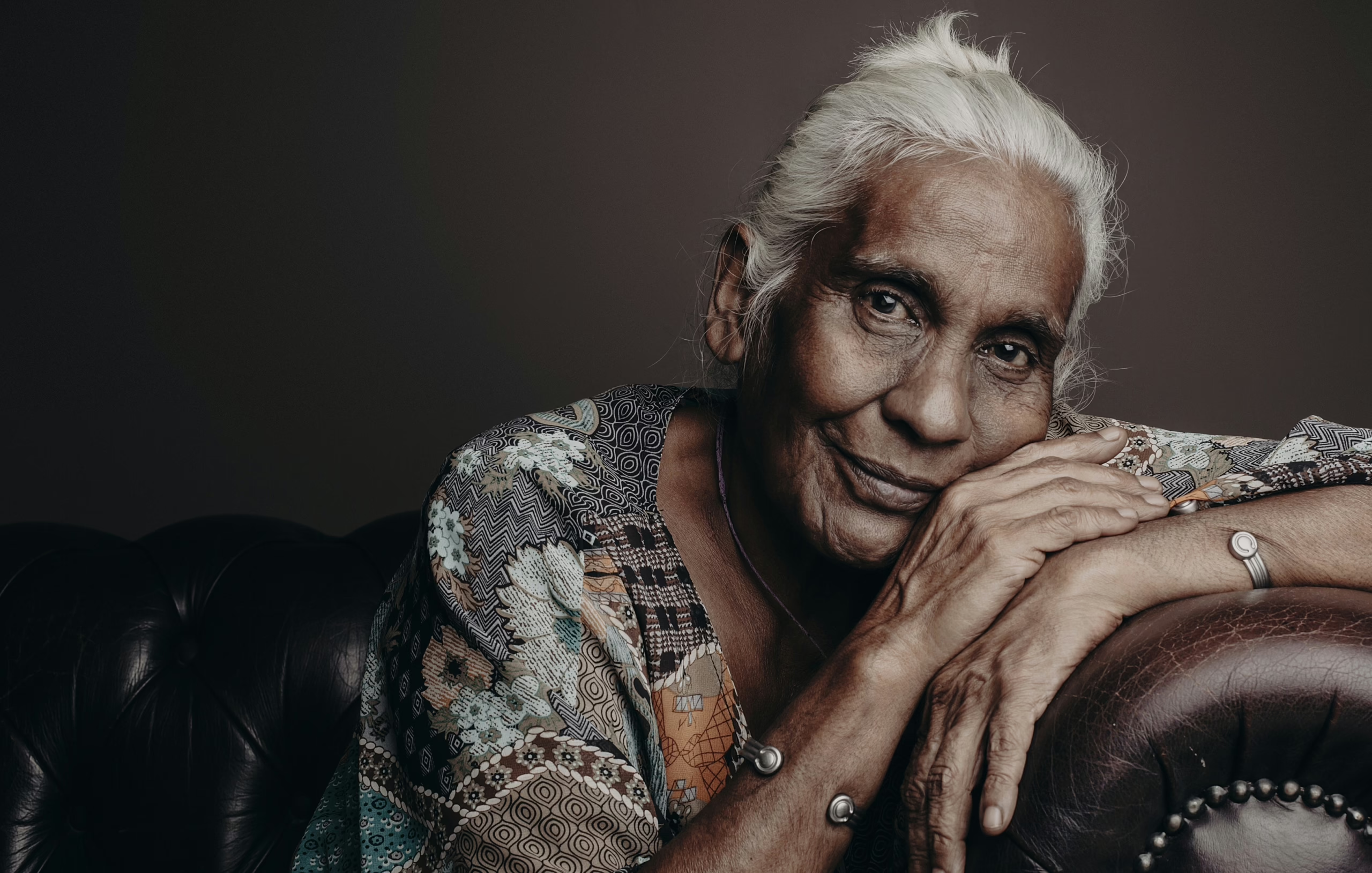
Historical child sexual abuse in Western Australia: In August 2024, our firm commenced civil proceedings in the District Court of Western Australia on behalf of our client Ms Cynthia Winawarl.
Cynthia was a survivor of child abuse during the 1950s and 1960s.
As an Aboriginal child, Cynthia was taken from her home by the State and placed into the care of Beagle Bay Mission, located on the Dampier Peninsula in Western Australia when she was only 18 months old.
At the Mission, Cynthia was forced to endure a ‘childhood’ that no person should have to.

Historical child sexual abuse in Western Australia: Beagle Bay Mission
She grew up receiving routine punishments which involved serious physical abuse such as being whipped with a stick, beaten with a machine strap, and being made to go without food. Then, when Cynthia turned six years of age, she experienced her first instance of sexual abuse at the hands of one of the priests at the Mission. In addition, she also faced sexual abuse at the hands of other older girls and an older boys at the Mission.
Cynthia bravely spoke out, telling the Sisters at the Mission what had happened to her and asking for help. No help was ever provided, and Cynthia was only punished further for her “lies”.
More than 60 years later, after having to live with the ramifications of this abuse at Beagle Bay Mission, Cynthia found the strength to speak out again. She came to our firm to seek redress for the wrongs she suffered.
Read our other successful Civil Law Case Studies for Sexual Abuse.
Historical sexual abuse in Western Australia
However, only months before the opportunity to settle her civil matter was scheduled, Cynthia sadly passed away due to unexpected circumstances.
Unlike in every other state and territory of Australia, in which a claim for historical sexual abuse damages can survive the death of the claimant with the estate able to continue pursuing the claim, in Western Australia, it cannot.
Specifically, it is section 6A(6) of the Limitation Act 2005 (WA) which prevents such an action from surviving the death of the claimant.
Such a law is inherently unfair and disadvantageous to claimants.
Further, it is hard to truly find any validation for the use of this law, when we look to the removal of the limitation period for civil claims of survivors of childhood sexual abuse. This removal which occurred across all jurisdictions, including Western Australia, was enacted for the very purpose of eliminating time constraints which were found to be a prominent obstacle to justice and compensation for those children who suffered “one of the most abhorrent crimes imaginable”, as acknowledged by the then Attorney General of Western Australia, Mr J.R Quigley, in the Second Reading Speech in 2017.
Historical Child Sexual Abuse in Western Australia survivors
The understanding and recognition of the requirement for more time to be given to historical child sexual abuse survivors, stemmed largely from a key finding of the Royal Commission into Institutional Responses to Child Sexual Abuse which noted that the average time for a victim to disclose child sexual abuse was 22 years.
Yet despite this recognition, the current laws in Western Australia seem to be actively re-creating the very obstacle that the Civil Liability Legislation Amendment (Child Sexual Abuse Actions) Act 2018 sought to remove.

The case of Lawrence v Province Leader of the Oceania Province of the Congregation of the Christian Brothers [2020] WADC 27 outlined this exact failure, with his Honour Justice Herron commenting on the restricting nature of these contrasting laws at:
“Therefore, although the limitation period has been removed for sexual abuse causes of action, the cause of action does not survive the death of the claimant.”
Principal solicitor, Mr Peter O’Brien, has commented about this law and the tragic impact it has not only on claimants, like Cynthia, but also on the family of these claimants, who are prevented from seeking the justice they so rightly deserve:
“Child sexual abuse has lingering and ongoing impacts beyond the survivor’s childhood, deep into their life and for long lasting periods. It can therefore have generational and intergenerational impacts.
The importance of an estate to a historical child sexual abuse claimant is an integral part of the pursuit of justice because of the profound and intergenerational impact of such abuse.”
Ms Nikita Dann, Cynthia’s granddaughter, also shared her thoughts:
“My grandmother’s decision to come forward took extraordinary courage. In choosing to speak out, she not only faced the emotional toll of reliving her trauma, but also the heavy burden of cultural shame and societal stigma.
Being by her side on her journey to find justice through the legal system, I saw the hope that it gave my grandmother.
Earlier this year, however, that hope was ripped away. Having to not only deal with the grief of my grandmother’s passing but, on top of that, being advised that the very legal system we were depending on for justice, was unable to deliver, was heartbreaking.
We implore the Western Australian government to commence an urgent review and repeal of the current legislation, to ensure that the pursuit of justice for survivors of institutional abuse does not terminate upon their death.”
Reaching out to Attorney General in Western Australia
Unable to continue pursuing Cynthia’s matter in the court, we reached out to the Attorney General of Western Australia, the Honourable Dr. Tony Buti, for relief. We outlined the tragic nature of Cynthia’s passing, particularly in circumstances where she was left without the opportunity to see redress for the wrongs she faced and sought an act of grace payment from the State of WA.
The payment being sought was for Cynthia’s funeral expenses, allowing her loved ones to properly mourn and honour Cynthia’s life.
Further, Cynthia’s greatest wish, which she passed on to her granddaughter Nikita, was that she hoped her efforts of telling her story would ultimately allow her to provide a safe home to her family, to ensure that they wouldn’t endure the childhood she had and to start the healing process for not only herself but her family who also carried the burden of the abuse.
In August this year, we received a response from the Attorney General, denying our request for an act of grace payment on the premise that they did not accept liability.
To be clear, an act of grace payment does not require an admission of liability. Rather, it comes as a voluntary payment out of grace and is ultimately a discretionary concession to be made where someone has been unfairly disadvantaged by government action.
It is more than apparent that Cynthia and, in turn, her family, have suffered unfairly.
A Lasting Impact
Cynthia was a proud Nyul Nyul and Yawuru woman who fought hard for the rights of First Nations people. Amongst her many efforts and achievements, Cynthia volunteered her time to assist with the National Inquiry into Removal of Children and Institutionalised Abuse, was a representative for Nyul Nyul people, was a member of Nyamba Buru Yawuru lending her guidance on Yawuru matters, and she also courageously shared her story in the landmark ‘Bringing Them Home’ report of 1997.
Cynthia was also adversely impacted by the Stolen Generation, with her grandmother Ana Maria being stolen as a child and taken to Beagle Bay Mission.
In the very last years of her life, Cynthia dedicated her time and energy to bravely starting her own healing process by seeking compensation and recognition for the abuse she faced as a child at Beagle Bay Mission.
With Western Australia law failing them, and now the Western Australian Government failing them, the family of Cynthia are determined to demonstrate the serious injustice facing survivors of child sexual abuse and their families if the claimant does not live to see their day in court.
In turn, we call on the Western Australian government for change and for the reform of this outrageous legislation, which prevents child sexual abuse survivors and their families, like Cynthia’s, from pursuing the justice which they are rightly entitled to.
Need Legal Help?
Contact us today for a confidential consultation and take the first step towards resolution.
 Call (02) 9261 4281
 Email
Email
 Or enquire online for a confidential consultation.
*We usually keep our client’s name private in our case studies, but as this case was in the media and of public interest, we had Cynthia’s permission to share name in this instance.