
If you were abused as a child in the care of a church, a private or religious school, a sporting club, a youth group, or a charity, you may be able to bring a civil claim against that organisation for compensation. This guide is for survivors and their families. It is written to help you understand your rights and your options, not to relive what happened to you.
Australian law in this area has changed a great deal in the survivor’s favour over the past decade. Time limits for child sexual abuse have been removed, and organisations now carry legal responsibilities they once tried to avoid. One recent High Court decision, Bird v DP in late 2024, did narrow one particular avenue. The short version: avenues to seek compensation remain, and the right legal advice matters more than ever. More on this below.
Suing for abuse is a difficult area of law and every situation is different. Nothing here is a substitute for confidential, personal advice about your own circumstances.
At a glance
- What it is: a civil claim for compensation against a non-government institution (church, school, club, charity) for abuse suffered by someone in its care.
- Time limit: there is no limitation period for child sexual abuse claims in NSW, you can bring a claim regardless of how long ago the abuse occurred.
- The main NSW avenue: an organisation’s statutory duty of care under the Civil Liability Act, where the organisation must prove it took reasonable steps to prevent the abuse.
- The one thing to do now: speak to a lawyer who acts for survivors before doing anything else. An early, confidential conversation costs you nothing and protects your position.
What Does “Vicarious Liability” Actually Mean?
Vicarious liability is a legal principle that can make an organisation responsible for wrongs committed by its people, even though the organisation did not commit the wrong itself. In plain terms, it is the idea that an employer can be held liable for what its employee did in the course of their work.
The classic example is a delivery driver who injures someone while doing their job. In this case, the company that employs them can be sued, not just the driver. Applied to abuse, vicarious liability was, for a time, a way to hold a church or institution responsible for abuse committed by a priest, teacher, or staff member, without having to prove the institution itself was careless.
It is important to separate vicarious liability from two related ideas you will also see in this area:
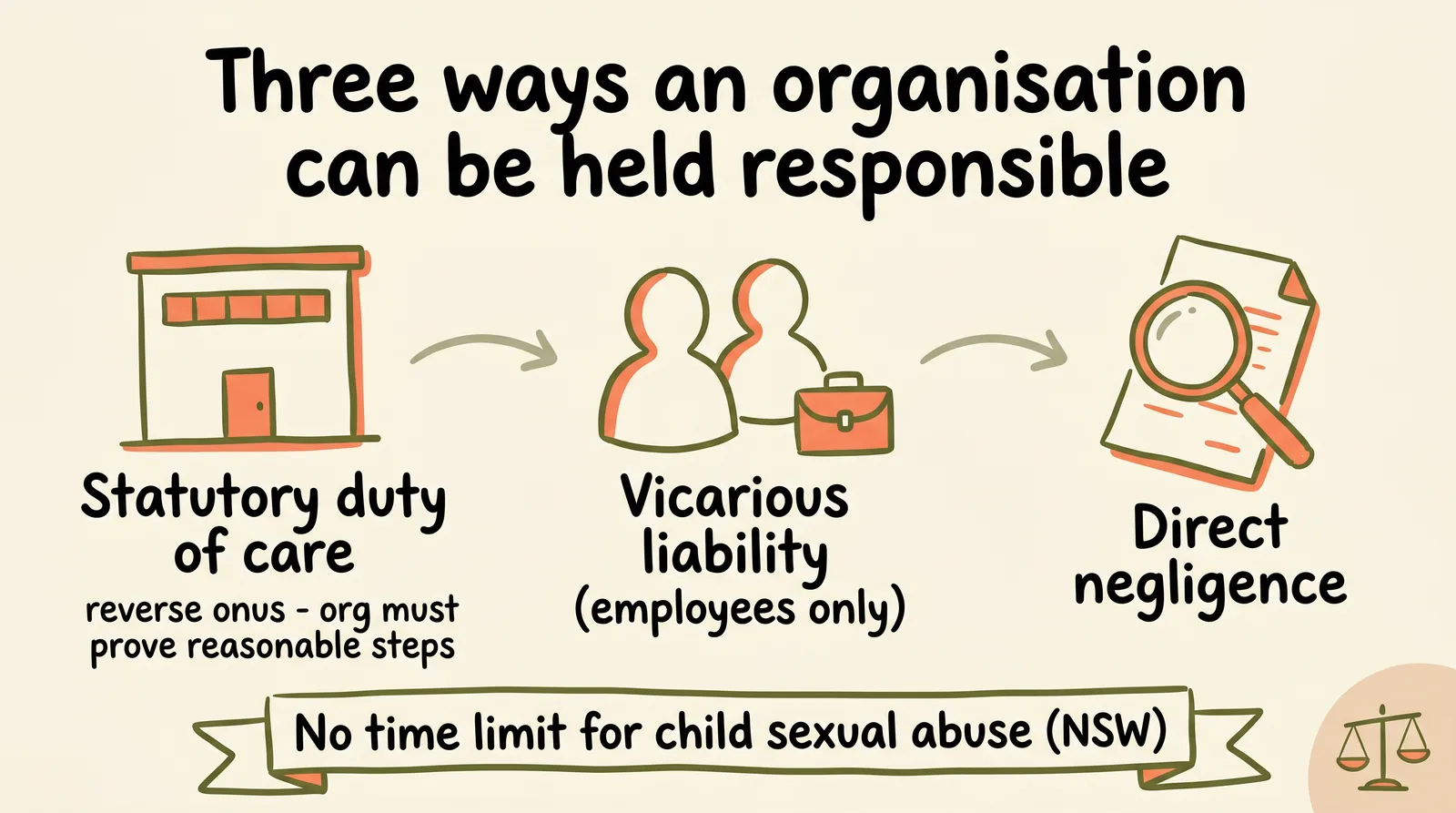
- Direct negligence: the organisation is sued for its own failure, such as ignoring warning signs, failing to supervise, or moving a known offender to a new role. This is about what the organisation itself did or failed to do.
- Non-delegable / organisational duty of care: a heightened duty an organisation owes to protect children in its care, which cannot simply be handed off to someone else.
Understanding the difference matters, because a recent High Court decision changed the reach of vicarious liability specifically, while leaving the other avenues intact.
Can You Sue A Church, School Or Organisation For Abuse?
Yes, in some cases you may be able to bring a civil claim for compensation against a non-government institution for abuse suffered in its care. Whether a claim succeeds, and on what legal basis, depends on the facts, the organisation involved, and the type of abuse.
Non-government institutions that survivors commonly bring claims against include:
- Churches and religious bodies: dioceses, religious orders, congregations.
- Private and religious schools:including boarding schools and church-run schools.
- Sporting clubs and associations: where abuse occurred through junior sport, coaching, or club activities.
- Youth organisations and charities: scouting-type groups, youth groups, residential care providers, and similar bodies.
These claims are usually brought as civil compensation claims, you (the plaintiff) sue the organisation for damages. This is a completely separate process from any criminal prosecution of the individual abuser.
A criminal case can result in the offender being punished; a civil case is about compensation for the harm done to you. You do not need there to have been a criminal conviction to bring a civil claim.
How Is Suing A Non-government Organisation Different From Suing The Government?
The legal principles are broadly similar, but the defendant, the evidence, and some of the practical hurdles differ, which is why the two are treated separately.
When the abuse occurred in a government institution (a state school, a youth detention centre, a government-run home, or the defence forces), the claim is generally against the State or the Commonwealth. We cover that scenario in our separate guide on suing the State for abuse by a government employee.
This guide deals with the non-government side, churches, private schools, clubs, and charities. Two practical differences matter for survivors:
- Identifying who to sue. A government defendant is usually clear (the State of NSW, or the Commonwealth). A church or unincorporated organisation can be harder to pin down, because it may not exist as a single legal entity with assets. NSW law has addressed this (see below), so the old tactic of an organisation saying “there is no one to sue” no longer works the way it once did.
- Employment status of the abuser. Government workers are typically employees, which keeps certain legal avenues open. In many church and community settings, the abuser was a priest, volunteer, or contractor rather than a formal employee, and that distinction is at the heart of the recent High Court decision.
What Did The High Court Decide In Bird v DP, And What Does It Mean For Survivors?
In Bird v DP (a pseudonym) [2024], the High Court held that vicarious liability in Australia does not extend beyond a genuine employer–employee relationship. This means an organisation generally cannot be held vicariously liable for abuse committed by someone who was not its employee, such as a priest, a volunteer, or an independent contractor.
The case concerned a survivor who sued the Catholic Diocese of Ballarat over abuse committed by an assistant priest. The lower courts had found the Diocese vicariously liable even though the priest was not, in law, an employee. In this case, the High Court unanimously overturned that finding, holding that a relationship of employment “has always been a necessary precursor” to vicarious liability in Australian law, and that it was not for the courts to expand the doctrine to relationships “akin to employment”.
The Court said any such change is a matter for parliaments, not judges. (You can read the High Court’s decision in Bird v DP for the official position.)
Why this matters: the decision closed off one avenue, common-law vicarious liability for non-employees, that some survivors had relied on, particularly against churches where the abuser was a priest or volunteer.
Why survivors should not lose hope: it did not close the door to compensation, and several important avenues remain, including:
- Direct negligence and the statutory duty of care: the strongest avenue in NSW for many claims (explained next). This does not depend on vicarious liability at all.
- Vicarious liability where the abuser was an employee: many teachers and staff were employees, so this avenue survives for them.
- Statutory reform: governments have responded to Bird. The Standing Council of Attorneys-General (the meeting of federal, state and territory attorneys-general) agreed to work towards reform, and some jurisdictions have moved to legislate a broader form of institutional liability. This is a fast-moving area, so current advice is essential.
The practical takeaway is that Bird changed the legal route, not the destination. A lawyer who acts for survivors will identify which avenue fits your circumstances.
What Is The Organisation’s Statutory Duty Of Care In NSW?
In NSW, an organisation that has care, supervision or authority over children owes them a statutory duty to prevent child abuse. If abuse does occur, the organisation is presumed to have breached that duty unless it can prove it took reasonable precautions. This is often the most direct avenue for survivors, and it does not depend on the vicarious-liability question decided in Bird.
This duty was introduced into Part 1B of the Civil Liability Act 2002 (NSW) following the Royal Commission into Institutional Responses to Child Sexual Abuse. The key features are:
- A duty to prevent abuse. An organisation that exercises care, supervision or authority over a child must take reasonable steps to prevent abuse of that child by a person associated with the organisation, including employees, office-holders, volunteers and contractors.
- A reverse onus of proof. Ordinarily, an injured person must prove the other side was careless. Here it is flipped: if abuse occurred, the organisation is taken to have breached its duty unless it proves it took all reasonable steps to prevent it. This is a significant advantage for survivors.
This reverse-onus duty is separate from, and survives, the Bird decision, because it is a negligence-based duty written into legislation, not the common-law doctrine of vicarious liability.
Who Do You Actually Sue When The Organisation Is A Church Or Unincorporated Body?
NSW law now requires an organisation to nominate a proper defendant with assets to meet a claim, and if it refuses, a court can appoint one. This closed a loophole, sometimes called the “Ellis defence”, where a church could argue there was no legal entity to sue.
Historically, some unincorporated organisations (particularly churches) held their assets in trusts and argued that there was no single body a survivor could sue. Part 1B of the Civil Liability Act now provides that:
- An unincorporated organisation can (and can be required to) nominate an entity with sufficient assets to be the defendant.
- If it does not, a court can appoint a proper defendant, including the trustees of an associated trust.
- These provisions apply retrospectively, so they can be used for historical claims.
In short, the fact that abuse happened long ago, or that the organisation is loosely structured, is far less of a barrier than it once was.
Is There A Time Limit To Make A Claim?
No, there is no limitation period for child sexual abuse claims in NSW. Since 17 March 2016, section 6A of the Limitation Act 1969 (NSW) has removed the time limit for claims arising from child sexual abuse (and serious physical abuse and connected abuse). You can bring a claim no matter how many years or decades have passed.
Two further points are important:
- Past settlements can sometimes be reopened. If you signed a settlement or deed before the time limit was removed, often for a small amount and without proper advice, a court may be able to set that agreement aside where it is just and reasonable to do so. This is a specialist area and turns on the specific facts.
- Practical delay still matters. While there is no legal deadline, evidence can be lost and witnesses can pass away over time. Getting advice sooner rather than later helps preserve your position.
If your abuse occurred when you were an adult, different rules and time limits may apply, so it is important to get specific advice about your situation.
What Compensation Can You Claim?
Compensation in an abuse claim is intended to recognise the harm you suffered and its ongoing effects on your life, not to put a price on what happened, but to acknowledge and help redress it. The exact amount depends entirely on your individual circumstances, and no lawyer can promise a figure in advance.
Damages in a civil abuse claim may cover:
| Type of loss | What it can include |
| Pain and suffering | The physical and psychological harm caused by the abuse, and its ongoing impact on your quality of life. |
| Past and future economic loss | Lost earnings and reduced earning capacity where the abuse affected your education, career, or ability to work. |
| Medical and treatment costs | Past and future counselling, psychological treatment, and related care. |
| Other out-of-pocket losses | Expenses reasonably connected to the harm you suffered. |
There is also the National Redress Scheme, a separate government scheme that can provide a payment, counselling, and a direct personal response from the institution. Redress and a civil claim are different pathways with different consequences, accepting redress can affect your ability to bring a civil claim.
Your Rights And What You Can Do Now
You have rights and options here, whatever happened and however long ago. Some practical steps can protect your position:
- You have the right to seek compensation through a civil claim, independently of whether the abuser was ever charged or convicted.
- You control the process. You decide whether, when, and how to proceed. A first conversation with a lawyer does not commit you to anything.
- Your privacy is protected. Survivors of sexual abuse are not identified publicly, and courts have processes to protect your identity. Your initial contact with a law firm is confidential.
- Write down what you can, when you feel able. Names, dates, places, roles, and any people who may have known, even rough details help. Do this only if and when it is safe for your wellbeing to do so.
- Keep any relevant documents. School or club records, letters, medical or counselling records, or any prior correspondence with the organisation can all assist a claim.
- Do not sign anything from the organisation without advice. If an institution offers a payment or asks you to sign a deed, speak to a lawyer first.
- Look after yourself. Free, confidential support is available through 1800RESPECT (1800 737 732) and Bravehearts for survivors of child sexual abuse.
How A Civil Lawyer Could Help Your Claim
A civil solicitor who acts for survivors can identify the right legal avenue and build a case. Depending on your circumstances, a lawyer may be able to:
- Assess the merits and the correct legal pathway: deciding whether your claim is best run on the statutory duty of care, direct negligence, vicarious liability (where the abuser was an employee), or a combination, especially given the Bird decision.
- Identify the right defendant: using the proper-defendant provisions so that a church or unincorporated body cannot avoid the claim by saying there is “no one to sue”.
- Gather and preserve evidence: obtaining records, locating witnesses, and dealing sensitively with the fact that the abuse may have occurred long ago.
- Use the reverse onus to your advantage: putting the organisation to prove that it took reasonable steps, rather than you having to prove it was careless.
- Advise on redress versus a civil claim: so you make an informed choice between the National Redress Scheme and civil proceedings.
- Consider setting aside an unfair past settlement, where you were previously pressured into a small settlement without proper advice.
- Negotiate or litigate, pursuing a fair resolution while shielding you, as far as possible, from the stress of the process.
The law here is genuinely complex and has shifted recently, so an experienced solicitor’s judgement about which avenue fits your case can make a real difference to the outcome.
Frequently Asked Questions
Can I still sue a church after the Bird v DP decision?
Yes. Bird v DP narrowed one route, common-law vicarious liability where the abuser was not an employee, but it did not remove your ability to claim. In NSW, the statutory duty of care with its reverse onus, direct negligence claims, and vicarious liability where the abuser was an employee all remain available. Governments are also considering reforms in response to the decision. A lawyer can identify which avenue fits your circumstances.
Do I need a criminal conviction against the abuser first?
No. A civil compensation claim is separate from any criminal case. You can bring a civil claim whether or not the abuser was ever charged, convicted, or is still alive. The standard of proof in a civil claim is lower than in a criminal prosecution.
What if the abuser has died?
You may still be able to claim against the organisation. Because civil claims target the institution’s responsibility, through the statutory duty of care, negligence, or vicarious liability where an employment relationship existed, the death of the individual abuser does not automatically end your claim.
Is there a deadline to make a claim?
No, for child sexual abuse. There is no limitation period for child sexual abuse claims in NSW. You can bring a claim regardless of how long ago the abuse occurred. Different rules may apply to abuse suffered as an adult, so get specific advice.
How much compensation could I receive?
There is no set figure, compensation depends entirely on your individual circumstances, including the harm suffered and its ongoing effect on your life. No lawyer can responsibly promise an amount in advance. A solicitor can give you a realistic assessment once they understand your situation.
Will my identity be made public?
No, not without protections in place. Survivors of sexual abuse are not publicly identified, and courts have measures to protect your identity throughout the process. Your first contact with a law firm is completely confidential.
I already accepted a settlement years ago, is it too late?
Not necessarily. If you settled before time limits were removed, often for a small sum and without proper legal advice, a court may be able to set that agreement aside where it is just and reasonable. This is a specialist question worth raising with a lawyer.
To learn more about how we act for survivors, see our pages on institutional abuse claims, historic child abuse claims, and sexual abuse compensation in NSW.
How O’Brien Criminal & Civil Solicitors can help
O’Brien Criminal & Civil Solicitors acts for survivors of institutional and historical abuse, guiding you through this process with care and without judgement. Our team understands how much the law in this area has changed, including the impact of Bird v DP, and can assess the right avenue for your claim, identify the correct defendant, and pursue fair compensation on your behalf.
You are in control of the process, your first conversation is confidential, and there is no obligation.
If you were abused in the care of a church, school, club, or other organisation, you can request initial advice (no-obligation) via the form on our institutional abuse page or call us on (02) 9261 4281.