
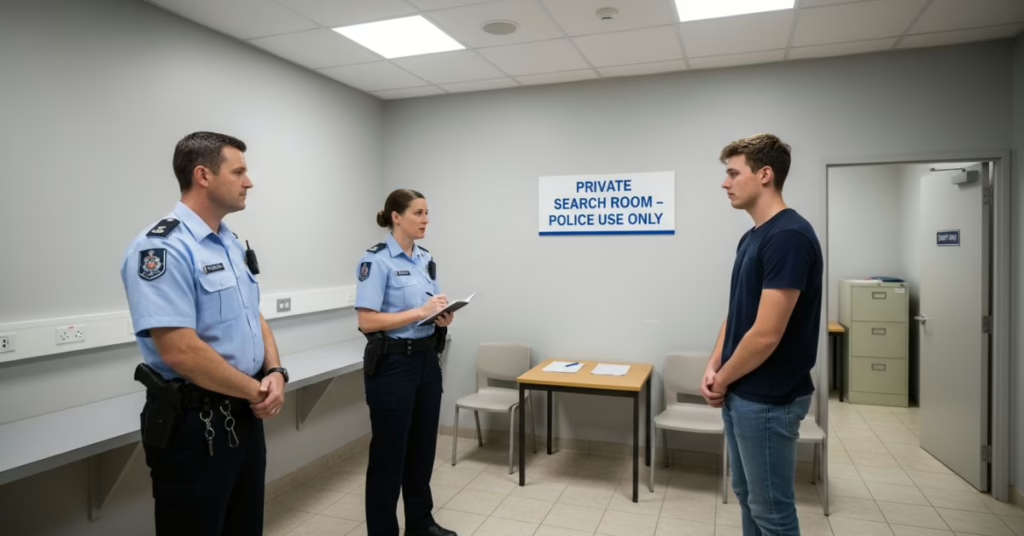
Strip searches represent one of the most intrusive police powers under Australian law. If you’ve been subjected to a strip search that you believe may have been unlawful, or are concerned about your rights, keep reading to understand your rights.
Here we’re going to explain NSW strip search laws, your rights, what police can and cannot do, and when to seek legal help.
Key Takeaways:
- Strip searches require reasonable suspicion plus seriousness and urgency
- Children under 18 must have a parent or independent adult present
- Over 60% of strip searches find nothing illegal
- Police routinely exceed their legal authority in conducting strip searches
O’Brien Criminal & Civil Solicitors are award-winning specialists with over 20 years of experience protecting clients.
Essential Facts About Strip Searches
Your Key Rights
For a lawful strip search:
- Police must have reasonable suspicion that you possess prohibited items
- Circumstances must be serious and urgent to justify a strip search
- You have the right to basic dignity during the search
- Children must have an adult present during strip searches
- Police must use the least invasive search method possible
If you are being strip searched:
- Ask the police to clearly explain their grounds for the search
- Request documentation of the search and reasons
- If you’re under 18, insist on a parent or independent adult being present
- Remember the details of what occurred for potential legal action
When to Seek Legal Help Immediately:
- If you believe the search was conducted unlawfully
- If proper procedures weren’t followed (especially for children)
- If you suffered trauma or humiliation from the search
- If no prohibited items were found despite the search
Understanding Your Rights: The Legal Framework
Strip searches in NSW are governed by the Law Enforcement (Powers and Responsibilities) Act 2002 (LEPRA). This legislation was designed to balance police investigative needs with individual privacy rights, but recent evidence suggests this balance has been severely compromised.
The law recognises that strip searches are highly intrusive procedures that would constitute assault in the absence of legal justification. They also represent a significant violation of personal dignity and privacy, which is why the law restricts their use to exceptional circumstances.
Your fundamental right is to bodily integrity and dignity, always. Therefore, strip searches should never be used as fishing expeditions, intimidation tactics, or routine procedures following drug detection dog operations.
Legal Requirements and Definitions of Strip Searches in NSW
Two-Stage Test for Strip Searches
Under sections 21 and 31 of LEPRA, police must meet a strict two-stage test:
Stage 1 Reasonable Suspicion: Police must have reasonable grounds to suspect you possess:
- Stolen or unlawfully obtained items
- Items used or intended for criminal offences
- Dangerous articles in public places
- Prohibited drugs or plants
Stage 2 Seriousness and Urgency: The circumstances must be both serious and urgent enough to justify the extreme intrusion of a strip search.
What Constitutes a Strip Search
A strip search under section 3 of LEPRA includes:
- Requiring you to remove all clothing
- Examination of your body (but not body cavities)
- Examination of removed clothing
Important: Police have no lawful authority to require you to squat and cough or perform other degrading acts that effectively enable visual body cavity searches.
Mandatory Procedural Requirements
Section 33 of LEPRA sets strict rules for conducting strip searches, including:
- Strip searches must be conducted in private
- The person conducting the search must be of the same gender
- A minimum number of people present necessary for safety
- For children under 18: parent or independent adult must be present
- Must use the least invasive method practicable
Real-World Scenarios: What Can Go Wrong
Music Festival Strip Searches
What Happened: At Splendour in the Grass music festival, 143 strip searches were conducted with only 12 (8.4%) finding any items. At Lost City Music Festival (an under-18 event), drugs were found in only one of 39 strip searches.
Police CANNOT:
- Conduct blanket strip searches following drug dog indications
- Strip search without individual reasonable suspicion
- Proceed directly to strip searches without trying less invasive methods first
- Ignore the requirement for adult supervision of children
Police CAN:
- Conduct a general search first (pat-down, remove jacket, shoes)
- Only escalate to strip search if specific circumstances justify it
- Use reasonable force if you resist a lawful search
Transport Hub Operations
Common Scenario: Drug detection dogs at railway stations followed by immediate strip searches.
The Reality: Less than 25% of personal searches following drug dog indications result in drugs being found. Drug dog indications alone do not automatically provide grounds for strip searches.
Your Rights:
- Police must still establish individual reasonable suspicion
- The presence at a train station or transport hub is not grounds for suspicion
- Looking nervous, avoiding eye contact, or refusing to cooperate does not establish reasonable suspicion
What Authorities Can and Cannot Do
Police Powers
Police CAN legally:
- Conduct a quick pat-down if they have reasonable suspicion
- Require removal of outer clothing (jacket, shoes, hat)
- Use metal detection devices
- Progress to strip search only if both stages of the test are met
Police CANNOT legally:
- Conduct strip searches based solely on drug dog indications
- Strip search without establishing seriousness and urgency
- Require you to perform degrading acts like squatting and coughing
- Search children without an appropriate adult present
- Use strip searches for general deterrence or intimidation
Current Enforcement Reality
Recent investigations by the NSW Law Enforcement Conduct Commission (LECC) found systematic unlawfulness in strip search practices. Key findings include:
- Routine breaches of LEPRA requirements
- Inadequate training of frontline officers on legal thresholds
- Absence of supervision during operations
- Failure to provide adequate independent adults for children
- Working rules that prioritise police convenience over legal requirements
Frequently Asked Questions
Can police strip search me just because a drug dog indicated?
No. Drug dog indications alone do not provide reasonable grounds for strip searches. Police must still establish individual reasonable suspicion and show the circumstances are serious and urgent.
What if I’m under 18?
A parent or independent adult must be present during any strip search of a person under 18. At Lost City Music Festival, adults were present for only 5 of 39 strip searches of children.
Can I refuse a strip search?
You cannot legally refuse a lawful strip search, but you can and should question whether the legal requirements are met. Ask police to explain their grounds clearly.
Can police search me in public?
Strip searches must be conducted in private with minimal people present. Public strip searches are unlawful.
What if police used the “squat and cough” method?
This is unlawful as it constitutes a visual body cavity search, which is prohibited under section 33(4) of LEPRA.
How long after a strip search can I take legal action?
Contact a lawyer immediately if you believe your rights were violated. Time limits apply to compensation claims and complaints.
Can I record or photograph the search?
No, but you should take detailed notes immediately afterwards about what occurred, who was present, and what was said.
What about psychological trauma from strip searches?
Strip searches can cause significant psychological harm, including PTSD, particularly for those who have experienced sexual violence. This trauma is recognised in law.
Can I complain about an unlawful strip search?
Yes, through multiple channels: NSW Police complaints system, Law Enforcement Conduct Commission, NSW Ombudsman, or civil legal action.
What evidence should I gather?
Record names/badge numbers of officers, exact location and time, witnesses present, reasons given by police, and your emotional state immediately after.
Practical Action Guide: What to Do and Say
During the Encounter
What to Do:
- Stay calm and don’t physically resist
- Ask clearly: “What specific grounds do you have for this search?”
- State clearly: “I do not consent to this search”
- If under 18: “I require a parent or independent adult to be present”
- Document mentally: Officer names, badge numbers, exact location, time
- Observe: Whether proper procedures are followed
What to Say:
- “Can you please explain the specific reasonable suspicion you have?”
- “What makes these circumstances serious and urgent?”
- “Are you conducting the least invasive search possible?”
- “I want this search properly documented with reasons recorded”
- If a child: “This search cannot proceed without an appropriate adult present”
After the Search
Immediate Steps:
- Write down everything that happened while fresh in memory
- Seek medical attention if you suffered physical harm
- Contact support services if traumatised
- Take photos of any injuries or torn clothing
- Gather witness details if others saw what occurred
- Contact a lawyer immediately to discuss your options
Documentation Checklist:
- Date, time, and exact location
- Names and badge numbers of all officers
- Reasons given for the search
- Whether procedures were followed correctly
- What was or wasn’t found
- Any witnesses present
- Your physical and emotional state
When Professional Legal Help is Essential
Immediate Legal Consultation Required:
- Strip search conducted without proper legal grounds
- Child searched without appropriate adult present
- Degrading or unlawful search methods used
- Physical or psychological harm suffered
- Evidence of discriminatory targeting
What to Expect from Your Lawyer:
- Immediate assessment of whether your rights were violated
- Evidence gathering and witness statements
- Formal complaints to appropriate authorities
- Compensation claims for unlawful searches
- Criminal defence if charges were laid following the search
Potential Legal Remedies:
- Civil compensation for unlawful search and detention
- Exclusion of evidence obtained through unlawful searches
- Formal complaints leading to police disciplinary action
- Systemic challenges to unlawful police practices
The systematic abuse of strip search powers in NSW has been extensively documented by the Law Enforcement Conduct Commission. Recent cases show police routinely conduct unlawful strip searches, particularly targeting young people and Indigenous Australians.
Don’t suffer in silence. If you believe your rights were violated during a strip search, professional legal advice is essential to protect your interests and hold police accountable.
Call Now: 02 9261 4281
Free Initial Consultation Available
Led by accredited specialist civil and criminal lawyers with a proven track record protecting clients across Australia. Our award-winning team has over 20 years of experience challenging unlawful police conduct and securing compensation for our clients.