

A stalking or intimidation charge can quickly affect where you live, who you contact and your freedom while the case is ongoing.
This guide explains what police must prove, the penalties, AVOs and what to do next.
This guide explains, in plain English, what the offence covers, the realistic penalties and how AVOs follow these charges. It also sets out where the law stands on tracking devices and what you can do now.
Stalking and intimidation at a glance (NSW)
- The offence: stalking or intimidating someone intending (or knowing it is likely) to cause them to fear physical or mental harm, under section 13 of the Crimes (Domestic and Personal Violence) Act 2007.
- Maximum penalty: 5 years’ imprisonment, a fine of 50 penalty units ($5,500), or both.
- Where it’s heard: almost always the Local Court (maximum 2 years’ imprisonment there), unless the prosecution elects to take it to the District Court.
- AVO: the court must make an interim AVO when you are charged, and a final AVO if you plead guilty or are found guilty, unless one is not needed.
- Do now: say nothing about the allegation to police beyond your identity details, do not contact the other person, and get legal advice before your first court date.
What is stalking and intimidation under NSW law?
It is a single offence: stalking or intimidating another person with the intention of causing them to fear physical or mental harm. It sits in section 13 of the Crimes (Domestic and Personal Violence) Act 2007 (NSW), and the prosecution must prove each part beyond reasonable doubt.
The prosecution has to prove that:
- You stalked or intimidated the other person
- You intended to cause them to fear physical or mental harm.
The intention part is important. Under section 13(3), you are taken to intend to cause fear if you knew your conduct was likely to cause fear in the other person. Fear of harm to someone they share a domestic relationship with, such as their child or partner, also counts.
Attempting the offence is treated the same as committing it.
The charge does not require any relationship between the people involved, although many arise from a current or former relationship or a family situation.
What counts as stalking, and what counts as intimidation?
The Act defines both terms broadly, and messages, calls, social media and tracking can all fall within them.
| What the Act includes | Where | |
|---|---|---|
| Intimidation | Conduct amounting to harassment or molestation, including cyberbullying | s 7(1)(a) |
| An approach by any means (phone, text, email or other technology) that causes the person to fear for their safety | s 7(1)(b) | |
| Conduct causing a reasonable apprehension of injury, violence, damage to property or harm to an animal | s 7(1)(c) | |
| Stalking | Following a person about | s 8(1)(a) |
| Watching or frequenting the vicinity of their home, work, or places they go for social or leisure activities | s 8(1)(b) | |
| Monitoring or tracking their activities, communications or movements, by technology or otherwise, whether or not they are contacted | s 8(1)(b1) | |
| Contacting or approaching them online or by other technology | s 8(1)(c) |
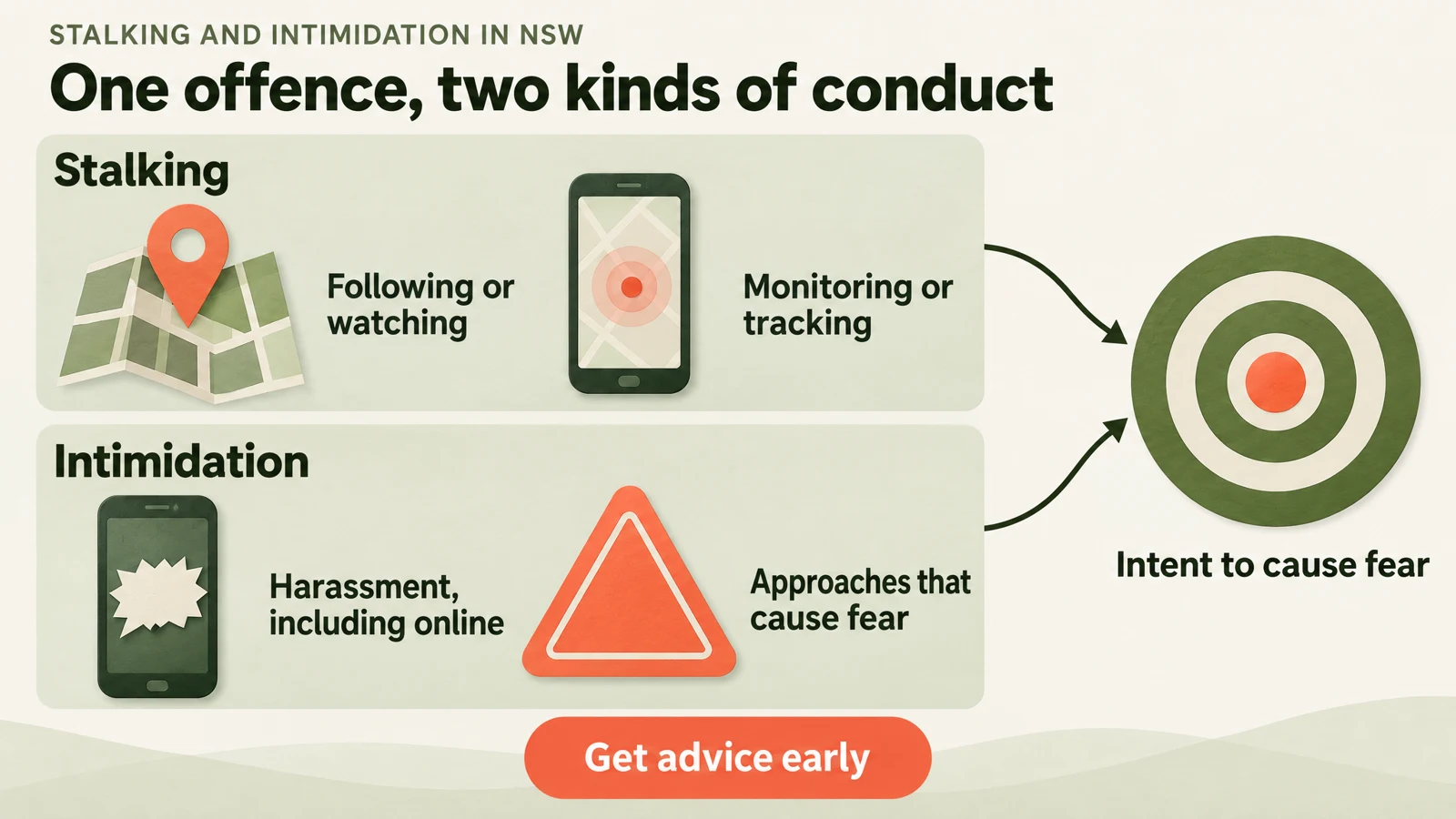
Two further points matter in practice:
- History can be taken into account. When deciding if the conduct is stalking or intimidation, the court may consider any pattern of violence in the person’s behaviour, especially domestic violence offences.
- One incident may be enough for intimidation. A single threatening message or confrontation may amount to intimidation, depending on the circumstances. Stalking generally involves a pattern of conduct.
Despite the name, the NSW Bureau of Crime Statistics and Research (BOCSAR) found that domestic violence-related stalking and intimidation incidents typically involve threats and verbal abuse. In fact, stalking behaviours, such as following someone or turning up at their home or work, were only in around 6% of the 2019 police reports it analysed.
Does the other person have to have actually been afraid?
No. Section 13(4) says the prosecution does not have to prove that the person actually feared physical or mental harm. The focus is on your intention or knowledge, not on how the other person reacted.
That cuts both ways. A complainant saying they were not frightened does not end the case, and a complainant saying they were terrified does not prove what you intended or knew. That second question is often where the real contest lies.
Where is a stalking or intimidation charge heard, and what are the penalties?
Most matters are finalised in the Local Court. Stalking and intimidation is a Table 2 offence under Schedule 1 of the Criminal Procedure Act 1986 (NSW). Therefore, it stays there unless the prosecution chooses to take it to the District Court. You cannot make that election yourself.
| Court | Maximum penalty | When it applies |
|---|---|---|
| Local Court | 2 years’ imprisonment and/or a fine of 50 penalty units ($5,500) | The default. BOCSAR found 93.5% of domestic violence-related stalking and intimidation matters were finalised here in 2021 |
| District Court | 5 years’ imprisonment and/or a fine of 50 penalty units ($5,500) | Only if the prosecution elects |
The Local Court’s 2-year ceiling comes from section 268 of the Criminal Procedure Act; a penalty unit is currently $110.
What usually happens in practice
The maximum is not the starting point. BOCSAR’s 2022 study of domestic violence-related stalking and intimidation, using 2021 court data, found:
- The most common penalty was a supervised community sentence (41.0% of proven matters), usually community correction orders.
- Just under one in eight people found guilty (12.9%) received a custodial sentence, with an average non-parole period of about 5.4 months.
- Around 18% of matters ended without a guilty or not guilty outcome, and about 60% of those were charges withdrawn by the police prosecution.
Those figures cover domestic violence-related matters only and reflect the whole court appearance, which often included other charges. Every case turns on its own facts.
If the offence is a domestic violence offence, section 4A of the Crimes (Sentencing Procedure) Act 1999 requires the court to impose full-time detention or a supervised order, unless it gives reasons why a different option is more appropriate. A section 10 dismissal or conditional release order without conviction remains possible in suitable cases, but it has to be argued for carefully.
Will an AVO be made against you?
Very likely, yes. A stalking or intimidation charge is a “serious offence” for AVO purposes. The court must make an interim AVO when you are charged, and a final AVO if you plead guilty or are found guilty.
The rules sit in sections 39 and 40 of the Crimes (Domestic and Personal Violence) Act. Police are also generally required to apply for an AVO when they suspect this offence has recently been committed (section 49). If an adult is sentenced to full-time imprisonment, an apprehended domestic violence order made on sentence generally lasts for the prison term plus 2 years.
Breaching an AVO is a separate offence once you have been served or were in court when it was made. Our fact sheet on apprehended violence orders in NSW explains how AVOs work and how to respond to one.
If the offence was a domestic violence offence, the court must also direct that it be recorded on your criminal record as a domestic violence offence.
What about tracking devices and “covert stalking”?
Tracking someone is already covered by NSW law, but the proposed covert stalking offence announced in 2026 is not yet law. As at 2 October 2026, it is still a Bill before Parliament.
What applies now:
- Since 1 December 2024, the definition of stalking has expressly included monitoring or tracking a person’s activities, communications or movements, by technology or otherwise, even without any contact. That conduct can found a section 13 charge if the intention to cause fear is proved.
- Separately, section 9 of the Surveillance Devices Act 2007 (NSW) makes it an offence to knowingly install, use or maintain a tracking device to find a person’s location without their consent. The maximum for an individual is 5 years’ imprisonment or 100 penalty units.
What has been proposed: the Crimes (Domestic and Personal Violence) and Other Legislation Amendment Bill 2026 would create a covert stalking offence: stalking a person who is unaware of it at the time, where a reasonable person would consider they would fear physical or mental harm if they knew. It would also extend “stalking” to directing another person to stalk, and create a separate offence of intentionally promoting the unlawful use of a surveillance device when advertising it for sale.
The Bill passed the Legislative Assembly on 24 June 2026 and, when we checked on 2 October 2026, was awaiting the Minister’s second reading speech in the Legislative Council. It has not passed both Houses and is not in force. Even if it passes, the stalking and surveillance changes would start only on a date set by proclamation, and conduct is generally judged against the law that applied when it happened.
Online messages and the Commonwealth offence
Where the conduct involves phone calls, texts or online messages, police may lay a Commonwealth charge as well as, or instead of, a NSW one. That offence is using a carriage service to menace, harass or cause offence, under section 474.17 of the Criminal Code (Cth), and it is separate from the NSW charge, so confirm which law you have been charged under.
Your rights and what you can do now
You have important rights from the first contact with police, and the steps you take in the first days can shape the whole case.
Your rights:
- The right to silence. Beyond your name and address, you do not have to answer questions about the allegation. Our guide to police questioning in NSW explains what you must and need not do.
- The right to a lawyer before deciding whether to take part in an interview.
- The presumption of innocence. The prosecution must prove every element, including your intention.
Practical steps:
- Do not contact the other person, directly or through friends, family or social media, even to apologise or “sort it out”. Contact can breach an AVO and may be treated as further intimidation.
- Follow your AVO and bail conditions exactly. If one is unworkable (for example, around shared children or a shared home), get advice about varying it rather than ignoring it.
- Keep, do not delete, your messages, call logs and social media history. Deleting them may destroy context that helps you.
- Write down what happened while it is fresh: dates, what was said, who was present, and anyone who saw it.
- Get advice before your first court date, so decisions about pleading are made with full information.
How a lawyer could help your stalking or intimidation case
A criminal lawyer tests whether the prosecution can prove every element and, where you accept responsibility, presents your circumstances so the penalty is as light as the law allows.
Challenging the elements. A lawyer may argue that:
- The intention or knowledge is not proved. Heated words in an argument, or contact intended to sort out a practical issue, may not show an intention to cause fear of harm, or knowledge that fear was likely.
- The conduct does not meet the definition. Not every unwanted message or meeting is stalking or intimidation; it depends on the full context.
- You are not the person responsible. Where messages came from an account or number others could access, identification may be in genuine dispute.
- The evidence is incomplete. Selected screenshots without the surrounding conversation can mislead.
Negotiating with the prosecution. Where the evidence allows, a lawyer may seek to have the charge withdrawn or replaced with a less serious one, or the facts amended to reflect what happened.
Dealing with the AVO. A lawyer can advise whether to consent without admissions, contest it, or seek to vary unworkable conditions, so the AVO and the criminal case support each other.
Presenting the strongest case on sentence. If you plead guilty, a lawyer can gather references and evidence of counselling or behaviour change programs. They can then argue for the most lenient available outcome, including a non-conviction order in appropriate cases.
No lawyer can promise a particular result, but early advice helps make sure the right issues are identified from the start.
Frequently asked questions
Can you be charged with stalking or intimidation for text messages or social media posts?
Yes. Intimidation includes a threatening approach by phone, text or other technology, and harassment including cyberbullying, while stalking includes contacting someone online. The Commonwealth carriage service offence may also be charged.
Is stalking and intimidation a domestic violence offence?
It can be. It is a domestic violence offence when the people involved have, or have had, a domestic relationship, such as partners, ex-partners, relatives or people who live together. If so, the court directs that it be recorded on your criminal record as a domestic violence offence.
Will I go to jail for a first stalking or intimidation offence?
Not necessarily. BOCSAR’s 2021 data shows just under one in eight people found guilty of domestic violence-related stalking or intimidation received a custodial sentence, and that figure covers everyone sentenced, not only people with no prior record. The outcome depends on the conduct, any history and your circumstances, so no result can be assured.
Can I get a section 10 for stalking or intimidation?
Possibly, in the right case. A court can dismiss the charge or impose a conditional release order without recording a conviction. For domestic violence offences, the court must give reasons if it imposes neither full-time detention nor a supervised order (a conditional release order with a supervision condition counts as supervised), so the case for a non-conviction outcome needs careful preparation.
Can the other person drop the charges?
Not on their own. Once police have charged you, the decision to continue rests with the prosecution. The complainant’s wishes may be considered, but the case can proceed without their support.
Do I have to agree to the AVO?
No. You can consent to an AVO without admitting the allegations, or you can contest it. But if you plead guilty or are found guilty of the stalking or intimidation charge, the court must generally make a final AVO anyway, so the two decisions are linked and worth getting advice on together.
Is putting a tracking device on someone’s car illegal in NSW?
Generally, yes, without consent. Using a tracking device to find a person’s location without their consent is an offence under the Surveillance Devices Act, and tracking can also be stalking under section 8. The proposed covert stalking offence was still before Parliament on 2 October 2026.
How O’Brien Criminal & Civil Solicitors can help
A stalking or intimidation charge rarely comes alone: it usually brings an AVO, bail conditions and often family or housing consequences that need managing at the same time. O’Brien Criminal & Civil Solicitors has more than 20 years in criminal defence. The firm is led by an Accredited Specialist in Criminal Law (fewer than 6% of NSW lawyers hold any Law Society specialist accreditation).
We act from your first contact with police, test whether the prosecution can prove the intention it alleges, and coordinate the charge and the AVO so one does not undermine the other. Our stalking and intimidation lawyers and domestic violence defence team will explain your options plainly so you can make good decisions under pressure.
Request initial advice (no-obligation) via the form below or call us on (02) 9261 4281.
This content is for general information purposes only and does not constitute legal advice. You should seek independent legal advice relevant to your specific circumstances.