
If you were assaulted, neglected, or injured because of unsafe conditions in custody, you have legal rights. Corrective Services NSW owes every person in its care a legal duty of care, and that does not go away just because you’re an inmate. And a breach of that duty which causes you harm can lead to a genuine civil claim for compensation.
We know that speaking up about what happened in custody can be difficult. Many people worry no one will believe them, that raising it will make things worse, or that being an inmate means the law is not on their side, but none of that is true.
You have legal protections while incarcerated, so you can bring a civil claim while still in custody or after release. The law prohibits retaliation against anyone who complains or takes legal action over their treatment.
This guide covers the types of prison abuse claims you can bring, the duty of care Corrective Services owes you, how to gather evidence from inside a correctional facility, the time limits that apply, what to expect if you take legal action, and the compensation you may be able to recover.
At a glance
- Who you can sue: Corrective Services NSW (the Crown), not the individual guard or inmate directly, in most cases.
- Legal basis: Negligence and breach of duty of care under the Crimes (Administration of Sentences) Act 1999 (NSW) and common law.
- Time limit: Generally 3 years from when the injury is legally “discoverable” (not necessarily the incident date), with a 12-year outer limit. See below.
- One thing to do now: Write down everything you remember while it’s fresh, and request your medical and incident records in writing.
What Counts as Prison Abuse? The Main Types of Claims
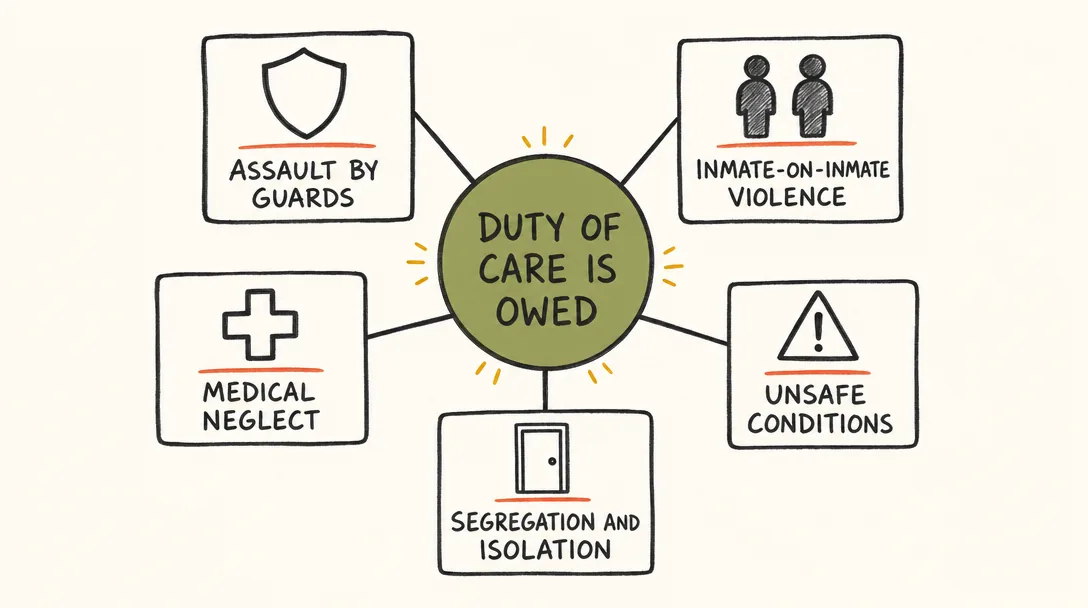
Prison abuse claims fall into different categories, measured against a different part of the duty of care Corrective Services owes you.
| Type of claim | What it covers | Duty of care standard |
|---|---|---|
| Assault by guards | Excessive, unnecessary, or disproportionate force by correctional officers | Officers may only use force that is reasonably necessary and proportionate to the situation |
| Inmate-on-inmate violence | Injury caused by another inmate where staff knew, or should have known, of the risk | A positive duty to take reasonable steps to protect inmates from foreseeable harm by others |
| Medical neglect | Denial, delay, or failure to provide appropriate medical treatment or medication | Reasonable access to medical care broadly equivalent to what is available in the community |
| Unsafe conditions | Injury or illness caused by hazardous, unsanitary, or poorly maintained facilities | Reasonable steps to maintain safe premises and adequate supervision |
| Segregation and isolation | Prolonged or unjustified solitary confinement causing psychological harm | Segregation only for a legitimate purpose, proportionate in duration, and subject to review |
What Duty of Care Does Corrective Services Actually Owe You?
Corrective Services NSW owes every inmate an active, ongoing duty of care, not a passive one. This duty exists under general negligence principles. It is reinforced by the statutory framework in the Crimes (Administration of Sentences) Act 1999 (NSW), which governs how correctional centres are run and how inmates must be treated.
In practice, this means Corrective Services must:
- Take reasonable care for your physical safety and wellbeing
- Protect you from foreseeable harm, whether from staff or other inmates
- Provide medical care for your needs
- Maintain premises and equipment that are reasonably safe
- Use no more force than is necessary
- Have a legitimate reason which is proportionate for any segregation or isolation
When is the duty breached?
A breach happens when Corrective Services falls short of what a reasonable correctional authority would do in the same circumstances. Common examples include using force well beyond what the situation called for, failing to separate you from an inmate with a known history of violence towards you, or ignoring or delaying a medical emergency. Withholding prescribed medication, or leaving an obvious hazard unaddressed, are also common grounds for a civil claim.
How do you prove a prison abuse claim? Gathering the evidence
Evidence is very important for a claim, but it is harder to gather from inside a correctional facility.
Useful evidence includes:
- Medical records and incident reports generated by the prison itself
- Photographs of injuries, taken as soon as it is safe to do so
- Written statements from witnesses: other inmates, visitors, or staff
- Any contemporaneous notes, letters, or complaints you made describing what happened
- CCTV footage (usually only obtainable once formal legal proceedings begin, through discovery)
- Correspondence with the Ombudsman or Inspector of Custodial Services
- Medical or expert evidence linking your injuries to the incident
The Practical Barriers, and What Actually Helps
Limited access to your own records. You are entitled to request your prison file, medical records, and incident reports. Ask the prison administration, or write to Corrective Services NSW. If your claim proceeds to litigation, the other side must produce relevant documents, including CCTV footage.
Fear of retaliation against witnesses. It is unlawful to retaliate against an inmate for making a complaint or pursuing legal action. If a witness is genuinely worried about safety, tell your solicitor. This is something a lawyer can raise directly with Corrective Services and the court.
Time and fading memory. If time has passed since the incident, write down everything you can remember, in as much detail as possible. Partial recollections are still useful. Medical evidence can show the physical consequences of what happened, even if you can’t remember how everything happened exactly.
How Long Do You Have to Bring a Claim?
You generally three years from the date your claim becomes legally “discoverable.” Importantly, this is not always the same as the date of the incident, with an outer limit of 12 years.
Personal injury claims in NSW are governed by the Limitation Act 1969 (NSW). Under section 50C, you generally have:
- 3 years from the date the cause of action is “discoverable”: this is basically the date you knew (or reasonably ought to have known) that you were injured, that Corrective Services’ fault caused it, and that the injury was serious enough to justify a claim
- 12 years from the date of the act or omission itself, as an outer limit, regardless of when the injury became apparent
This matters because if your injury, particularly a psychological injury from prolonged mistreatment, only became apparent well after the incident, the clock may not start running until that later discoverability date, within the 12-year cap.
What if you were unable to act because you were in custody?
Being incarcerated does not, on its own, automatically pause the limitation clock. The Act’s disability provisions (section 52) suspend time only where a person is a minor or an “incapacitated person,” meaning someone who lacks the capacity to manage their own affairs due to a disability, for a continuous period of 28 days or more. Custody alone doesn’t meet that test.
What does help is section 60G, which lets the court extend the limitation period where it is “just and reasonable” to do so. Genuine practical barriers to instructing a solicitor or gathering evidence while incarcerated are the kind of factor a court can weigh in that assessment. However, an extension is a discretionary court decision, not an automatic entitlement, and courts have refused extensions where a claim wasn’t pursued diligently once it could have been.
The safest course is always to act within the standard 3-year window if at all possible. Don’t assume your claim is out of time without getting advice first. Equally, don’t assume being in custody buys you unlimited time.
What Happens If You Take Legal Action? The Litigation Process
Here is how a prison abuse claim against Corrective Services NSW usually proceeds.
- Initial advice and assessment. You provide details of what happened. A lawyer assesses the strength of the claim and identifies the correct defendant (Crown/Corrective Services NSW). You don’t need to have all your evidence gathered at this stage.
- Investigation and evidence-gathering. Your lawyer helps obtain prison records, medical files, incident reports, and witness statements, using formal requests where needed.
- Ongoing representation. Your solicitor represents you whether you remain in custody or have since been released, liaising with correctional authorities on your behalf.
- Commencing proceedings. A statement of claim is filed in the District Court or Supreme Court (depending on the claim’s value), naming Corrective Services NSW / the State of NSW as defendant and setting out the facts and damages sought.
- Discovery. Both sides exchange documents. Corrective Services can be compelled to produce CCTV footage, medical records, and incident reports it might not otherwise disclose voluntarily.
- Negotiation. Many claims resolve before trial once the strength of the evidence is apparent to the other side, often faster, cheaper, and less stressful than a hearing.
- Hearing, if required. If no settlement is reached, the matter proceeds to a hearing where a judge determines whether negligence is established and what compensation should follow.
Your Rights & What You Can Do Now
You have real rights here, and there are concrete things you can do today, whether or not you’ve spoken to a lawyer yet:
- You have the right to make a complaint without fear of retaliation. Reprisals against inmates for complaining or pursuing a claim are unlawful.
- You have the right to request your own records. Ask Corrective Services in writing for your medical file and any incident reports relating to the event.
- You can lodge a complaint with an independent body. The NSW Ombudsman investigates complaints about custodial treatment, including use of force and medical care. The Inspector of Custodial Services independently inspects correctional centres and publishes findings.
- Write it down now, in detail. Dates, times, names, and what was said and done, while your memory is freshest. This document doesn’t need to be formal to be useful later.
- Photograph injuries as soon as it’s safe to do so, and ask a nurse, doctor, or support worker to note them in your medical file.
- Don’t wait to get advice because you think it’s “too late.” Whether you’re still within the standard window or wondering about an extension, a solicitor can tell you where you actually stand, for free and without obligation.
How a Lawyer Could Help Your Case
A civil claim against Corrective Services is not something most people can realistically run alone from inside a correctional facility. A solicitor’s role goes well beyond simply making the argument.
- Assessing whether the claim is viable. A lawyer can look at what happened, the injury caused, and the evidence available, and give you a realistic view of whether a claim is worth pursuing, before you commit time and emotional energy to it.
- Accessing evidence you can’t reach alone. Once proceedings are on foot, a solicitor can use discovery and subpoena powers to compel Corrective Services to produce CCTV footage, staff rosters, medical records, and incident reports that are not available to you simply by asking.
- Managing communication with Corrective Services and its insurer. This removes you from having to negotiate directly with the institution you’re making a claim against, which matters especially if you remain in custody.
- Negotiating a resolution. In many cases, a well-evidenced claim can be resolved through negotiation rather than a full hearing, which may be faster and less stressful, though outcomes always depend on the individual facts and evidence.
- Running the case if it goes further. If a resolution can’t be reached, a lawyer prepares and presents the case, including arranging medical and expert evidence to support what you experienced.
None of this guarantees a particular outcome. Every case turns on its own facts and evidence. But it reflects the practical difference between attempting a claim alone from custody and having someone act for you who can access the records, information, and legal processes you cannot reach on your own.
Frequently Asked Questions
Can I sue if another inmate assaulted me, not a guard?
Yes, in some circumstances. You don’t sue the other inmate. You sue Corrective Services for failing in its duty to protect you. This generally requires showing that staff knew, or reasonably should have known, of a risk to your safety and failed to take reasonable steps to prevent it.
What if I was denied medical treatment while inside?
If you were refused or delayed access to treatment you were reasonably entitled to, and that failure caused or worsened an injury, this may support a medical negligence claim. Keep a record of when you asked for treatment, who you asked, and what response (if any) you received.
How do I get evidence if I’m still in custody?
Start documenting immediately: photos of injuries, written notes of what happened and when, and the names of anyone who witnessed it. Request your prison and medical records in writing. A complaint to the NSW Ombudsman or Inspector of Custodial Services is separate from a legal claim but can generate a useful independent record. Once a solicitor is instructed, formal discovery can obtain further material Corrective Services would not otherwise release.
Is there really a time limit if I’m still in prison?
Generally yes. The standard 3-year discoverability period and 12-year long-stop under the Limitation Act 1969 (NSW) still apply while you’re incarcerated. Being in custody does not, by itself, pause the clock. A court can extend the period where it’s “just and reasonable.” Genuine barriers to getting legal advice while inside can also be relevant to that. Don’t assume you’re out of time, but similarly, don’t assume custody gives you unlimited time either. Get advice as early as you can.
Is compensation for pain and suffering capped for people in custody?
Yes. Under Part 2A of the Civil Liability Act 2002 (NSW), damages for non-economic loss (pain and suffering) are awarded to an offender in custody against a protected defendant. This includes Corrective Services NSW and its staff, capped at the maximum amount a worker with the same degree of permanent impairment would receive. Other heads of damage, such as medical expenses and future care costs, are assessed separately and are not subject to this particular cap.
How O’Brien Criminal & Civil Solicitors Can Help
Claims against Corrective Services NSW require solicitors who understand both the custodial system and civil negligence law, two areas that don’t often overlap in general legal practice. Our civil lawyers have acted for inmates and former inmates in matters involving assault by guards, medical neglect, and unsafe conditions, working within the specific evidentiary and procedural challenges that come with claiming against a government institution while incarcerated.
If your treatment involved police rather than correctional staff, our guide to NSW police misconduct complaints and compensation may be more relevant. Past results, including matters brought against Corrective Services for prison officer conduct and custodial neglect, do not guarantee future outcomes: every case is assessed on its individual merits.
If you’ve experienced abuse, neglect, or unsafe conditions in custody, an initial conversation costs nothing and carries no obligation.
Request initial advice (no-obligation) via the form below or call us on (02) 9261 4281.
This content is for general information purposes only and does not constitute legal advice. You should seek independent legal advice relevant to your specific circumstances.