
If a police officer or public official deliberately abused their power, or acted with reckless indifference to your rights, and you were seriously harmed as a result, you may have a claim for misfeasance in public office.
This is a public office, different from an ordinary negligence claim, that exists to hold public officials accountable when they knowingly step outside their legal authority. Police officers, government employees, and other public officials occupy a special position of trust, and the law responds more seriously when that trust is knowingly betrayed.
This fact sheet explains what misfeasance in public office is, the two forms it can take, what you need to prove, who can sue and be sued, what compensation may be available, and how it compares to related claims like false imprisonment and malicious prosecution.
At a glance
- What is misfeasance in public office: A civil claim against a public official (often a police officer) who knowingly exceeded their legal power and caused you harm, deliberately or recklessly.
- Where it’s heard: These cases are typically heard in the NSW District Court or Supreme Court, depending on the claim.
- Time limits: Civil claims are subject to strict time limitation periods, usually six years from when the cause of action accrued.
- What makes it different: Misfeasance is one of the few civil claims where exemplary (punitive) damages are available, on top of compensation for your actual loss.
- The one thing to do now: Preserve every document, record, and piece of correspondence connected to the incident.
What Is Misfeasance in Public Office?
Misfeasance in public office is a tort (a civil wrong) that lets you sue a public official personally for loss caused by their abuse of public power. Unlike a negligence claim, which asks whether the official failed to take reasonable care, misfeasance asks whether the official knowingly or recklessly exceeded their authority.
The modern Australian test comes from the High Court’s decision in Northern Territory v Mengel (1995) 185 CLR 307. In this case, Justice Brennan described the required state of mind as being satisfied:
“When the public officer engages in the impugned conduct with the intention of inflicting injury or with knowledge that there is no power to engage in that conduct and that that conduct is calculated to produce injury.”
Put simply, the tort captures behaviour that cannot be explained as honest.
In Sanders v Snell (1998) 196 CLR 329, the High Court confirmed it is a deliberate, intentional tort with five elements:
- an invalid or unauthorised act (or omission),
- done maliciously or knowingly,
- by a public officer,
- in the purported discharge of the duties of that office,
- which causes loss or harm.
Closer to home, the NSW Court of Appeal in Leerdam v Noori [2009] NSWCA 90 has clarified what counts as a “public office.” It confirmed that a person doesn’t need to hold a specific statutory position, and reaffirmed Mengel’s ruling that there’s no separate requirement to show the official owed you a personal duty of care.
What Are the Two Forms of Misfeasance?
Misfeasance can be proven in one of two ways. However, both require you to show the official knew (or was recklessly indifferent to the fact) that they had no legal power to act as they did.
Form 1: Targeted malice
The official knows they’re acting outside their lawful authority, and they intend to injure you (or were recklessly indifferent to whether they injure you).
Example: An officer arrests you without lawful grounds, specifically to stop you attending a court hearing in an unrelated matter.
Form 2: Untargeted malice (reckless indifference)
The official knows they’re exceeding their authority, and they know their conduct could cause injury to a class of people that includes you, or are recklessly indifferent to that risk. Importantly, they don’t need to have you personally in mind, but they must turn their mind to the fact they lack power and to the likely harm that will follow.
Example: A government official knows they have no legal basis to refuse a certain type of application, but rejects them all anyway, without reviewing the individual merits. They know this will cause people harm, and you are one of those affected.
The distinction matters:
Form 2 is not simply “the official was careless about members of the public in general.” Both forms require actual knowledge (or recklessness as to) the lack of power, and actual knowledge (or recklessness as to) the likelihood of harm. That’s a considerably higher bar than negligence, and it’s why misfeasance claims are assessed carefully before they’re run.
What Must You Prove?
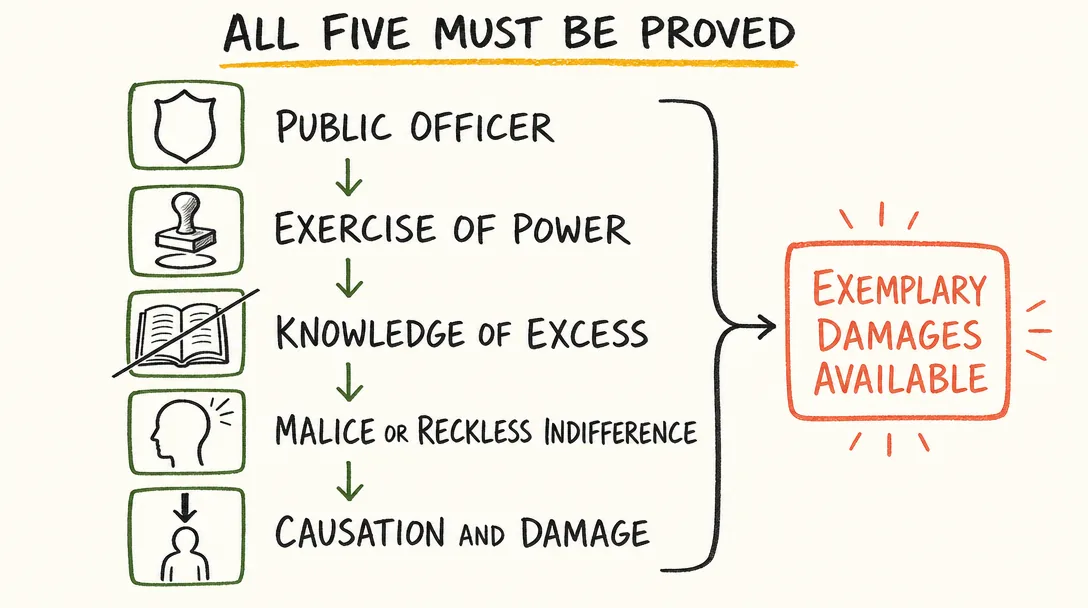
To succeed in a misfeasance claim, you need to prove five elements, and all five must be made out.
| Element | What it means | Evidence that typically helps |
| Public officer | The defendant held a public office: police officer, government employee, or other official exercising public power. | Employment/appointment records, police records, official correspondence. |
| Exercise of power | The official acted in the purported exercise of their public power (an arrest, a decision, a refusal). | Incident reports, arrest records, official notices and decisions. |
| Knowledge of excess | The official knew, or was recklessly indifferent to whether, they had no legal power to act as they did. | Legal advice available to the official, expert evidence on the scope of their powers, prior court rulings, internal policy documents. |
| Malice or reckless indifference to harm | Either intention to injure you, or knowledge/recklessness that the conduct would cause injury to a class that includes you. | Communications, a pattern of conduct, deliberate departure from proper procedure. |
| Causation and damage | The conduct actually caused you loss, whether financial, physical, psychological, or reputational. | Medical reports, financial records, expert evidence on causation and loss. |
Who Can Be Sued, and Who Can Sue?
Who can be sued: Anyone holding public office under statute or at common law who acted in the purported exercise of their public powers and either knowingly exceeded their authority with intent to injure, or did so with reckless indifference.
Police officers are the most common defendants in these claims and can be sued personally; the state may also be vicariously liable, which is why many misfeasance claims are run alongside a vicarious liability claim against the state. Government department employees, council officers, and other statutory office holders can also be sued.
Who can sue: Generally, anyone who suffers loss or damage as a result of the misfeasance. In Form 2 claims, you need to be a member of the class of people the official’s reckless conduct was directed at, which covers most people directly affected.
Additionally, you must show actual damage; distress alone is usually not enough, though psychological injury can be. The damage also has to be a reasonably foreseeable result of the misfeasance.
What Compensation Can You Claim?
A key feature of misfeasance claims is that exemplary (punitive) damages are genuinely available, on top of compensation for what you actually lost.
Compensatory damages
These aim to put you back in the position you’d have been in had the misfeasance not occurred:
- Economic loss: lost wages, lost business income, legal costs incurred defending yourself against unlawful charges.
- Non-economic loss: pain and suffering, psychological injury, damage to reputation.
- Future loss: ongoing treatment costs, reduced earning capacity, lost superannuation.
Exemplary damages
Exemplary damages don’t compensate you; they punish the official for particularly serious conduct and deter repeat behaviour. They may be awarded where the conduct was deliberate, wilful, or showed contempt for your rights.
For example, an officer who manufactured false evidence or knowingly disregarded the law altogether.
Courts have recognised that misfeasance cases, more than most civil claims, are suited to an award of exemplary damages, given the tort exists specifically to address abuse of a position of public trust. The amount depends heavily on the seriousness of the conduct and the circumstances, and every case is assessed on its own facts.
How Does Misfeasance Compare to Other Claims?
Misfeasance is often pleaded alongside other claims arising from the same incident, because each addresses a different aspect of what happened.
| Claim | Focus | How it differs from misfeasance |
| False imprisonment | Unlawful detention, regardless of the official’s state of mind. | Misfeasance additionally requires knowledge or recklessness about the lack of power. |
| Assault or battery | Unlawful physical contact or threat of force. | These require intentional physical conduct; misfeasance also captures reckless indifference more broadly. |
| Malicious prosecution | Prosecuting you without reasonable and probable cause, and with an improper purpose. | Focused specifically on the decision to prosecute; misfeasance covers a broader range of official conduct. |
| Unlawful arrest | An arrest made without legal power to arrest. | Misfeasance requires the added element of knowledge/recklessness as to that lack of power and the resulting harm. |
| Negligence | Failure to take reasonable care. | Negligence doesn’t require any element of knowledge or intent; misfeasance is a deliberate tort, which is also why exemplary damages are more readily available. |
Why claim misfeasance specifically?
It directly targets the deliberate or reckless abuse of public power and it opens the door to exemplary damages in a way negligence claims generally don’t. Additionally, a claim can succeed in circumstances where the elements of other torts aren’t fully made out.
Suing For Misfeasance in Public Office
If you believe you’ve been affected by an abuse of public power, there are practical steps you can take now, before you’ve even spoken to a lawyer, that will strengthen any future claim.
- Preserve everything connected to the incident. Keep any documents, notices, correspondence, photographs, or recordings you already have. Don’t delete texts, emails, or social media posts referring to what happened, even if they seem unhelpful, because a complete record is more persuasive than a curated one.
- Write down what happened while it’s fresh. Note the date, time, location, the officials involved (names, badge numbers, vehicle numbers if visible), and exactly what was said and done. Memory fades quickly and contemporaneous notes carry real weight later.
- Request relevant records. You (or your lawyer) can request incident reports, custody records, body-worn camera footage, and other official documents through formal channels. These records often exist even when you don’t yet have them.
- Note the outcome of any related criminal matter. If charges were laid against you and were later withdrawn, dismissed, or you were acquitted, that outcome can be relevant evidence that the original arrest, search, or prosecution lacked lawful basis. It doesn’t prove misfeasance on its own, but it’s a meaningful piece of the picture.
- Get medical or psychological attention if you need it, and keep records. If the incident caused physical injury or psychological harm, seeing a GP or other health professional both looks after you and creates a documented record of the impact.
- Don’t wait. Limitation periods apply to civil claims, and evidence such as CCTV and body-worn camera footage is often only retained for a limited time. The earlier you seek advice, the more evidence is likely to still be available.
How a Lawyer Could Help Your Case
A misfeasance claim relies heavily on facts, and whether it’s worth pursuing depends heavily on the detail of what happened.
Here’s what a lawyer can do:
- Assess your claim against the legal elements. A lawyer can review what happened. Looking into whether the official’s conduct was arguably outside their power, and whether there’s a realistic basis to say they knew or were reckless as to that fact, before you commit the time and cost to a claim.
- Gather evidence you may not be able to access yourself. This can include formally requesting police or agency records, incident reports, and body-worn camera footage through the appropriate legal channels. They can also obtain expert evidence on the scope of the official’s powers where needed.
- Identify every available claim, not just misfeasance. Given the overlap with false imprisonment, assault, and malicious prosecution, a lawyer can advise on which claims apply to your facts and plead the strongest combination.
- Pursue exemplary damages where the conduct genuinely warrants it. In cases involving egregious or deliberate misconduct, a lawyer can build the evidentiary case for an exemplary damages award, not just compensation for your loss.
- Negotiate with the state or its insurer. Many civil claims against police and public officials resolve through negotiation rather than a full trial. A lawyer experienced in these claims can negotiate from a position of strength, informed by how similar matters have previously been resolved.
- Run the case through to resolution if negotiation doesn’t succeed. Where a fair settlement isn’t reached, a lawyer can prepare and run the matter in the District or Supreme Court, including briefing barristers for complex or high-value claims.
No Win, No Fee arrangements are available for select practice areas, including some claims against police and public officials, and are subject to assessment. While you won’t have to pay our legal costs if your claim is unsuccessful, you may still be responsible for your opponent’s legal costs in some circumstances.
Frequently Asked Questions
What is the difference between misfeasance and negligence?
Negligence is about a failure to take reasonable care. Misfeasance is about a deliberate or reckless abuse of power.
A negligent officer might make an honest mistake. An officer who commits misfeasance knows, or is recklessly indifferent to the fact, that they’re exceeding their legal authority, and knows or is reckless as to whether that will cause harm. This is also why exemplary damages are realistically available for misfeasance but rarely for negligence.
Can I sue for misfeasance if my charges were dropped or I was acquitted?
Yes, potentially. The withdrawal of charges, or an acquittal, can be relevant evidence that an arrest, search, or prosecution lacked proper legal basis. It isn’t proof of misfeasance by itself, since misfeasance also requires you to show the official’s state of mind at the time, but it’s often a meaningful part of the picture and worth raising with a lawyer.
What damages can I actually claim?
You can claim compensatory damages for your economic and non-economic loss, things like lost income, medical costs, and psychological injury. In appropriate cases you may also be able to claim exemplary damages where the official’s conduct was particularly deliberate or contemptuous of your rights. Exemplary damages punish the conduct rather than compensate you directly.
Is misfeasance hard to prove?
It’s more demanding than a straightforward negligence claim, because you need to establish the official’s state of mind, not just that something went wrong. You’ll typically need evidence about what the official knew or should have known about the limits of their power, and evidence about their conduct that supports an inference of malice or recklessness. Flagrant departures from proper procedure, or ignoring legal advice, can be strong evidence of the required mental element. Many claims do succeed, particularly where the underlying conduct was serious.
What evidence will I need to gather?
Broadly: (1) records of what actually happened, incident reports, arrest records, correspondence; (2) evidence the official lacked the power to act as they did, which may require expert or legal evidence; (3) evidence of their state of mind, communications, procedural failures, a pattern of similar conduct; and (4) evidence of the harm you suffered, medical records, financial records, and expert reports where relevant.
How long do I have to bring a claim?
Time limits apply under the Limitation Act 1969 (NSW), and the applicable period can depend on the type of loss you’re claiming for. Because misfeasance claims often overlap with other tort claims that have different limitation periods, it’s worth getting advice on timing early rather than assuming you have more time than you do.
How O’Brien Criminal & Civil Solicitors Can Help
Misfeasance in public office is a genuinely difficult claim to run well, and O’Brien Criminal & Civil Solicitors has represented clients in exactly this kind of matter, including claims against NSW Police involving allegations of misfeasance and malicious prosecution.
Our team knows how to assess whether the elements are realistically made out, gather the records and evidence these claims depend on, and pursue both compensation and, where the conduct warrants it, exemplary damages.
If you’ve been seriously harmed by an abuse of public power, we can assess your situation and explain your options clearly, including whether related claims like false imprisonment or unlawful arrest should be pursued alongside misfeasance. Our team acting for people suing the police in Sydney has direct experience with claims like this.
Request initial advice (no-obligation) via the form below or call us on (02) 9261 4281.
This content is for general information purposes only and does not constitute legal advice. You should seek independent legal advice relevant to your specific circumstances.