
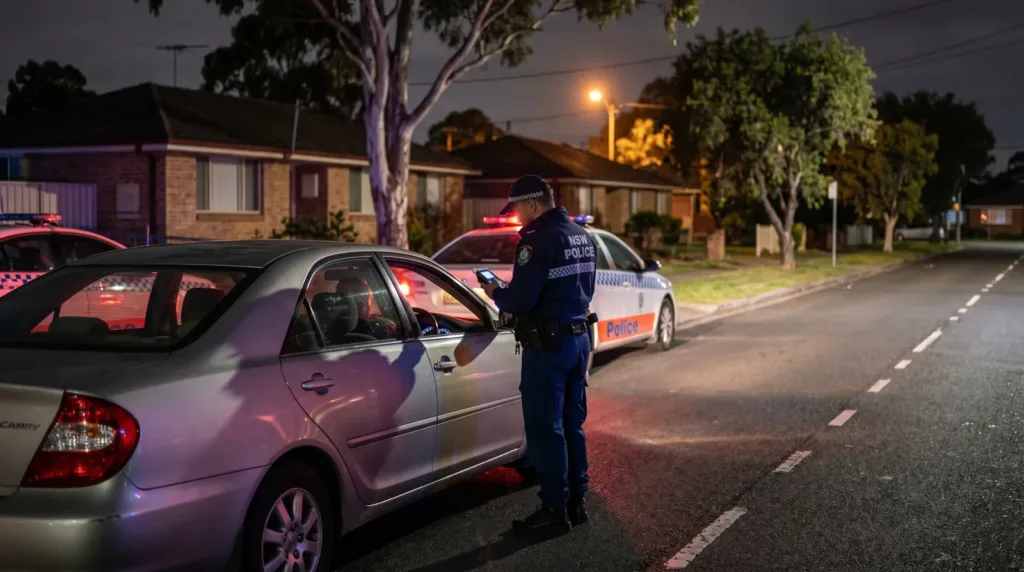
Being pulled over for a roadside drug test, or getting a letter weeks later saying your saliva sample tested positive, is unsettling, especially when you didn’t feel affected at the time. You’re probably worried about your licence, whether you’ll end up with a criminal record, and how a positive test even works when you weren’t drunk or obviously “high”.
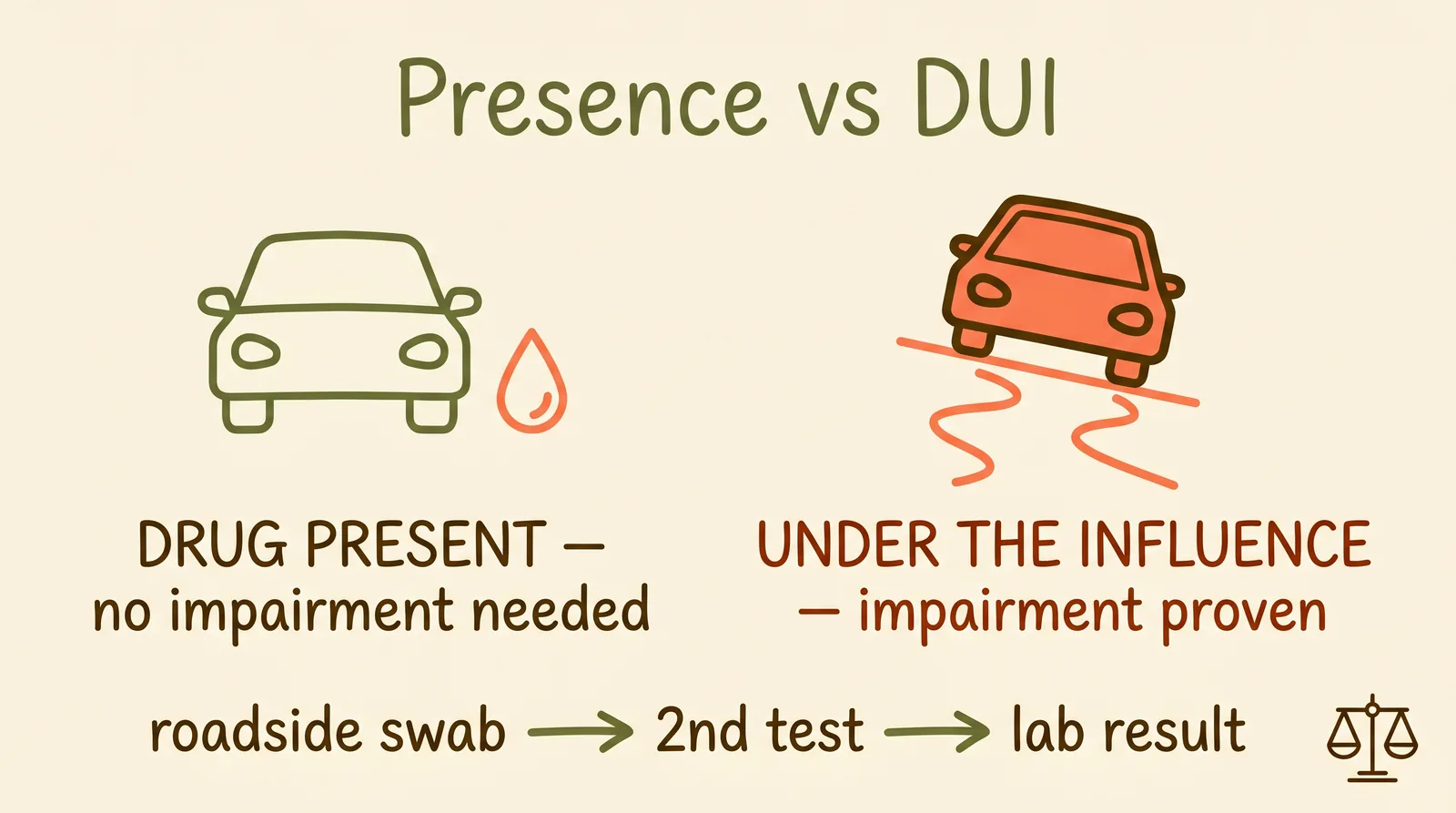
Here’s the part worth understanding straight away: drug driving in NSW is not one offence. There’s a big difference between simply having a drug present in your system and actually driving under the influence.
Importantly, that difference changes everything about how serious the charge is and what you’re facing.
This guide explains what the drug driving offences are, exactly how police prove them, the penalties for a first and subsequent offence, how these charges can be defended, and what a licence disqualification and appeal actually involve.
At a glance
- Two very different offences: having a drug present in your system (the common charge, no proof of impairment needed) versus driving under the influence (DUI) of a drug, which is far more serious.
- How it’s proven: a roadside saliva swab (Mobile Drug Testing), then a second swab, then laboratory analysis of the sample, and, for DUI, often blood and evidence of impaired driving.
- Where it’s heard: the Local Court, though a first presence offence can often be dealt with by an on-the-spot penalty notice instead.
- A criminal record is not automatic: a court may deal with a first offence by a Conditional Release Order without conviction (what people used to call a “section 10”).
- The one thing to do now: don’t rush to plead guilty or pay the penalty notice, that decision affects your record and your licence, and it’s worth getting advice first.
What Is Drug Driving In NSW, And What Are The Offences?
Drug driving in NSW covers two distinct offences, and it matters enormously which one you’re charged with. One is about a drug simply being in your system; the other is about a drug actually affecting your driving.
The offences sit in the Road Transport Act 2013 (NSW), and the current penalties are published on the NSW Government drink and drug driving penalties page. This is worth checking, as the figures are updated from time to time.
- Presence of an illicit drug (the “presence offence”): Section 111. This is the charge most people face. It’s an offence to drive with a prescribed illicit drug present in your oral fluid (saliva), blood or urine. Crucially, the prosecution does not have to prove you were affected or driving badly. The mere presence of the drug is enough. Therefore, you can be entirely sober-feeling and still commit this offence if a detectable trace remains.
- Driving under the influence of a drug (DUI): Section 112. This is a much more serious offence. Here the prosecution must prove you were actually under the influence of a drug while driving, that is, that your ability to drive was impaired. It doesn’t rely on the roadside saliva test; it’s usually built on evidence of your driving, your appearance and behaviour, and often a blood or urine analysis.
There’s also a combined drink and drug offence for drivers who have both alcohol and a drug in their system, which is treated more seriously again.
The single biggest question in a drug driving case is which offence you’re charged with, a presence charge and a DUI charge are worlds apart in seriousness.
Which Drugs Do Roadside Tests Detect?
The roadside test screens for four common illicit drugs. NSW Mobile Drug Testing (MDT) uses a saliva swab that detects the presence of:
- THC: the active component of cannabis;
- methylamphetamine: speed and ice;
- MDMA: ecstasy; and
- cocaine.
You can read how the roadside programme works on the Transport for NSW drugs and driving page. The presence offence doesn’t require impairment, a positive result can come from drug use hours, or, for cannabis in particular, sometimes longer, before you got behind the wheel. How long a drug stays detectable varies from person to person and depends on the drug, the amount, and how often it’s used.
Medicinal cannabis is a fast-moving area.
Under the law as it currently stands, having a valid prescription is not a general defence to the presence offence if THC is detected. However, the NSW Government just introduced the Road Transport Amendment (Medical Cannabis and Driving Offences) Bill 2026 to Parliament.
This bill proposes a registration scheme and a “no automatic penalty” approach for eligible, unimpaired prescribed patients. If this affects you, get current advice, the rules are changing, and impaired driving will remain an offence regardless.
How Do Police Prove A Drug Driving Charge?
For a presence offence, it comes down to the saliva sample and the laboratory result; for DUI, it’s about proving impairment. The two offences are proven in very different ways.
For a presence offence, the process usually runs like this:
- Roadside saliva swab. Police conduct an initial oral fluid test at the roadside or a random testing site.
- Second swab. If the first is positive, you’re asked to provide a second saliva sample in a drug testing vehicle (“drug bus”) or at a police station.
- 24-hour direction. If the second swab is also positive, police can direct you not to drive for 24 hours and send the sample away.
- Laboratory analysis. The sample is analysed at a laboratory. You are usually not charged at the roadside, the charge (or a court attendance notice) typically comes later, once the lab confirms the result, which is why many people are caught off guard weeks after the stop.
For a DUI charge, the roadside swab isn’t the centrepiece. The prosecution relies on evidence of impairment. So how you were driving, observations of your appearance and behaviour, admissions, and often a blood and urine analysis are considered. This is a higher bar for police to meet, but the penalties if proven are far greater.
A criminal defence lawyer looks closely at all of it: whether the sample was taken lawfully, whether it was analysed correctly, and whether the evidence actually proves the offence.
What Are The Penalties For Drug Driving In NSW?
For a first presence offence, the realistic outcome is usually a fine and a disqualification, not jail, and sometimes no conviction at all. DUI is where imprisonment becomes a genuine risk. The table below sets out the current maximums; remember these are ceilings, not starting points.
| Offence | First offence | Second / subsequent offence |
| Presence of illicit drug (s 111) | Penalty notice fine ~$704 + 3-month suspension, or court: max fine ~$2,200, disqualification 3–6 months (6 months automatic) | Court: max fine ~$3,300, disqualification from 6 months (12 months automatic), up to unlimited |
| Driving under the influence (s 112) | Court: max fine ~$3,300, up to 18 months’ imprisonment, disqualification from 12 months (3 years automatic) | Court: max fine ~$5,500, up to 2 years’ imprisonment, disqualification from 2 years (5 years automatic) |
In practice, a first presence offence is rarely dealt with at the top of that range.
A first offence often doesn’t need a court date. It can be finalised on the spot with a penalty notice, a fine plus a 3-month suspension, and no criminal conviction. If it does go to court, a magistrate can impose a fine and disqualification, and in some cases deal with it without recording a conviction at all (see below).
The NSW Bureau of Crime Statistics and Research publishes sentencing data if you want to understand typical outcomes, though it has noted that non-conviction outcomes for drug driving have become less common than they once were, which is a reason to prepare a case properly rather than assume leniency.
The maximum imprisonment terms attached to DUI are reserved for the most serious matters, but they are real, and DUI should never be treated as a minor traffic charge.
Will I Get A Criminal Record, And Can I Avoid One?
Not necessarily. A drug driving conviction is a criminal conviction, but a court has the discretion to deal with a first offence without recording one.
The main mechanism is a Conditional Release Order (CRO) without conviction. This replaced the old “section 10 bond” in 2018, so if you’ve heard people talk about “getting a section 10”, a CRO without conviction is what they now mean. The court finds the offence proven but dismisses it on conditions (such as being of good behaviour) for a set period. The result: no conviction, no automatic disqualification, and no criminal record.
A court is more likely to consider this for a genuine first offence that’s out of character, where there are strong personal circumstances and you’ve shown insight, for example, by completing a recognised traffic offender or drug-driving education programme. It is never guaranteed, and it’s entirely at the magistrate’s discretion, but how your case is prepared and presented makes a real difference to whether it’s realistically on the table.
Our guide to Conditional Release Orders in NSW explains how they work.
Your Rights & What You Can Do Now
The steps you take between the roadside stop (or receiving your notice) and going to court can genuinely improve your outcome. Here’s where to focus:
- Don’t rush to pay the penalty notice or plead guilty. This is the most common mistake. Paying an on-the-spot fine or pleading guilty without advice can mean giving up the chance to argue for a non-conviction order. Understand your options first.
- Check whether you can go to court on a penalty notice. You can elect to have a penalty-notice matter dealt with by a court if you want to ask a magistrate for a non-conviction order, but there are time limits.
- Check your suspension and any appeal window. If police suspended your licence, there may be a limited right to appeal, but the clock starts quickly.
- Note the timeline of your drug use. For a presence charge, when you last used relative to when you drove can be relevant, write down what you remember while it’s fresh, for your lawyer.
- Gather character references. Written references from an employer or someone who knows you well can help show the offence is out of character.
- Consider a drug-driving education or traffic offenders programme. Completing a recognised course before your court date can demonstrate genuine insight and is often viewed favourably.
The earlier you get advice, the more of these doors stay open.
How a Lawyer Could Help Your Case
A lawyer’s job isn’t just to plead guilty and hope for leniency. A good defence starts by asking whether the charge even stands up, and, if it does, how to get the best realistic result. Depending on the facts, a solicitor may be able to:
- Test whether the charge is made out. Was the testing procedure followed correctly? Was the sample handled and analysed properly (the “chain of custody”)? Was the initial stop and test lawful? Were you actually driving or in control of the vehicle at the relevant time? For a DUI charge in particular, does the evidence genuinely prove impairment, a much harder thing for the prosecution to establish than mere presence?
- Raise an available defence. Depending on the facts, a defense of honest and reasonable mistake may be an option. For example, where you had a genuine and reasonable belief that no drug was present in your system. Whether such a defence is realistically available depends heavily on the circumstances.
- Argue for no conviction. Even on a guilty plea, a solicitor can put the case for a Conditional Release Order without conviction, supported by character references, a completed education programme, and evidence of why the offence was out of character.
- Appeal an immediate suspension. Where police have suspended your licence, there may be a limited right to appeal that suspension to the Local Court within a tight time frame.
- Present the strongest sentencing case. If a penalty is unavoidable, a lawyer can argue for the minimum disqualification and the lightest appropriate penalty, drawing on your circumstances and licence need.
None of these outcomes can be promised, which arguments are realistically open to you depends heavily on the facts, and that’s exactly what a solicitor can assess. If your matter is heading toward a defended hearing, our drug driving lawyers in Sydney can advise on your options.
Will I Lose My Licence, And Can I Appeal?
Usually there’s a licence loss, but its length and whether it applies at all depend on the outcome. If you’re dealt with by penalty notice, a 3-month suspension typically applies to a first presence offence. If you’re convicted in court, an automatic disqualification applies (6 months for a first presence offence, longer for repeat offences and for DUI), which a magistrate can reduce to the statutory minimum. If the court grants a CRO without conviction, there is no automatic disqualification.
Two appeal pathways matter:
- Appealing a police suspension. Where police suspended your licence on the spot, you may be able to appeal that suspension to the Local Court within a limited period.
- Appealing the court’s decision. If you’re convicted or disqualified and believe the outcome was too harsh, you generally have a right to appeal to the District Court. Strict time limits apply.
Frequently Asked Questions
How is drug driving different from drink driving?
They’re separate offences with different tests. Drink driving is measured by your blood alcohol concentration against fixed limits. Drug driving (the presence offence) needs no measurement of a “level” and no proof of impairment. Simply having an illicit drug detected in your saliva, blood or urine is enough. If you’re specifically dealing with alcohol, see our guide to a first-time drink driving offence in NSW.
Do I have to be affected by the drug to be charged?
No, not for the presence offence. For a section 111 presence charge, the prosecution only has to prove the drug was in your system, not that it affected your driving. Impairment only has to be proven for the more serious driving under the influence charge under section 112.
How long do drugs stay detectable in a saliva test?
It varies, sometimes far longer than the “high” lasts. Detection depends on the drug, how much was taken, how often you use, and your own body. Cannabis in particular can remain detectable for an extended period, which is why people are sometimes caught long after they last used and no longer feel any effect.
Can I be charged if I have a medicinal cannabis prescription?
Under the current law, a prescription is not a general defence to the presence offence. However, NSW has introduced reform legislation (the Medical Cannabis and Driving Offences Bill 2026) proposing a registration scheme for eligible prescribed patients. The law is changing, so get current advice, and note that driving while impaired remains an offence regardless of any prescription.
Will I go to jail for drug driving?
Very unlikely for a first presence offence. Imprisonment is not a realistic outcome for a typical first presence charge, which is usually resolved by a fine and disqualification (or a non-conviction order). Imprisonment becomes a genuine possibility for driving under the influence and for repeat offending, which is why those charges should be taken seriously.
Can a drug driving charge be dropped or defended?
Sometimes, it depends on the facts. Charges can be defended where, for example, the testing or sample handling wasn’t done correctly, the stop wasn’t lawful, you weren’t driving or in control, or a defence such as honest and reasonable mistake is available. A lawyer can assess whether any of these realistically apply to your matter.
Should I just pay the fine to get it over with?
Not before getting advice. Paying the penalty notice finalises the matter, but it may also close off the chance to ask a court for a non-conviction order. Whether to pay, elect to go to court, or defend the charge is a genuine strategic decision worth taking advice on first.
How O’Brien Criminal & Civil Solicitors Can Help
A drug driving charge is often decided by preparation, whether the testing procedure holds up, whether you’re facing a presence charge or the far more serious DUI, and the case put to the magistrate on whether to record a conviction.
O’Brien Criminal & Civil Solicitors is a specialist criminal and traffic defence firm with more than 20 years’ experience in the NSW Local Court. We’ll explain your realistic options clearly, examine whether the charge stands up, and put the strongest possible case for keeping your licence and avoiding a conviction where that’s achievable.
Request initial advice (no-obligation) via the form below or call us on (02) 9261 4281.