

If you have been contacted by Services Australia, asked to attend an interview, or charged over Centrelink payments you weren’t entitled to, it’s natural to feel worried. These matters carry real criminal consequences, but a debt is not the same as a crime, and being contacted is not the same as being convicted.
Centrelink fraud is prosecuted under Commonwealth (federal) law, so the same offences apply across Australia. Our firm acts for people facing these charges in the New South Wales courts.
This guide explains, in plain English, what welfare fraud actually is, the offences you can be charged with, how investigations work and the penalties a court can impose. We also go through why repaying the money matters, the defences that may apply, and the practical steps you can take right now.
At a glance
- The two common charges: obtaining a financial advantage from the Commonwealth (Criminal Code s 135.2, max 12 months’ imprisonment) and obtaining a financial advantage by deception (s 134.2, max 10 years’ imprisonment).
- It’s federal: prosecuted by the Commonwealth Director of Public Prosecutions (CDPP), not NSW Police, but heard in NSW courts.
- A debt alone isn’t a crime: it only becomes fraud if the prosecution can prove you knew you weren’t entitled to the money.
- Repaying the debt matters: it doesn’t make the charge disappear, but it can genuinely affect the outcome of the sentence.
- The one thing to do now: don’t attend a “voluntary” interview or sign a statement before getting legal advice.
What Is Centrelink (Welfare) Fraud?
Centrelink fraud, more formally, social security fraud, is dishonestly obtaining a Centrelink payment you know you are not entitled to. The key word is dishonestly: the offence is about your state of mind, not just the fact that you were overpaid.
Common situations that can lead to a charge include:
- not declaring (or under-declaring) income from work,
- failing to report that you have started living with a partner,
- continuing to receive a payment after your circumstances changed,
- or using false information or another identity to claim a benefit.
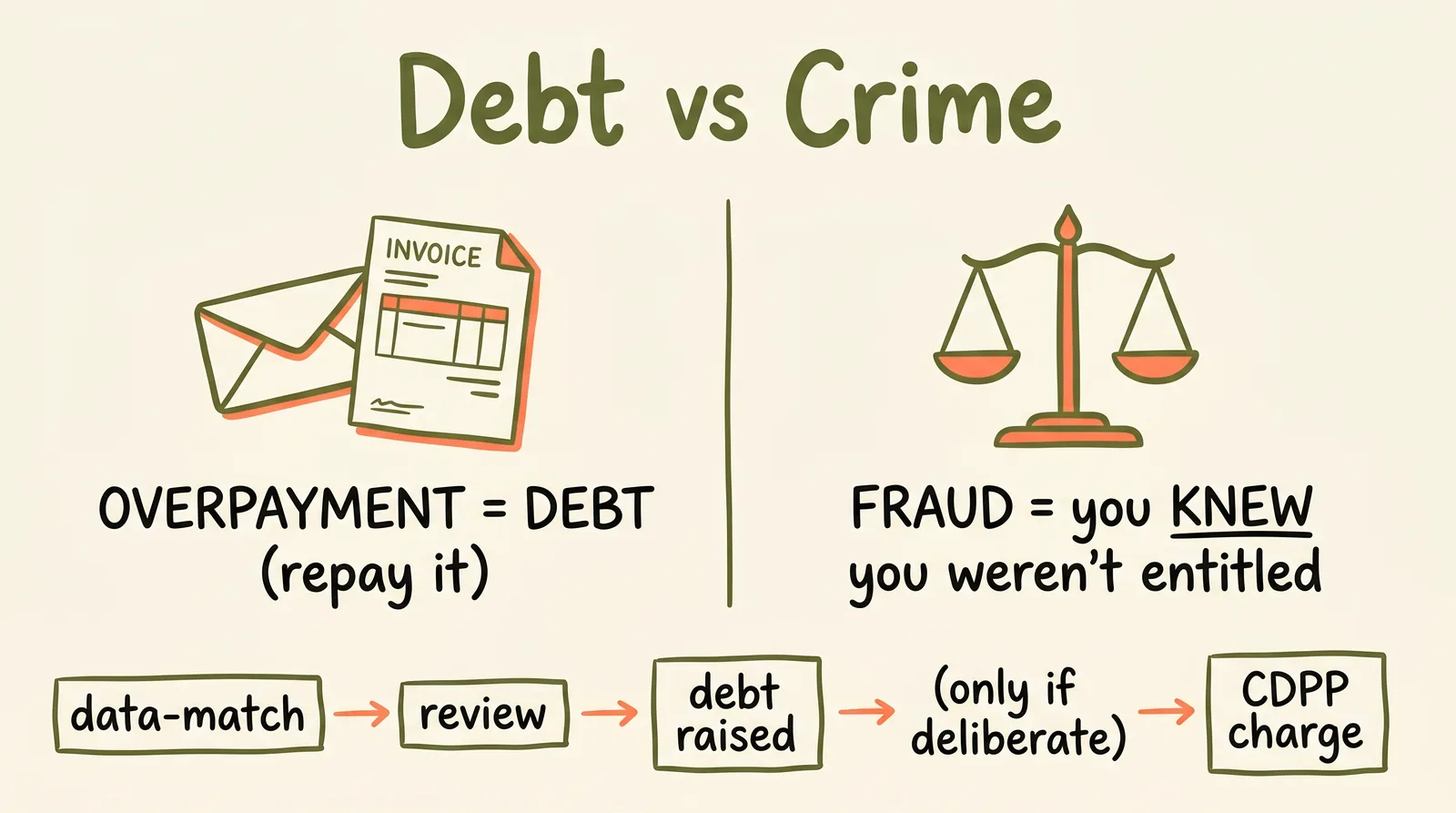
Importantly, receiving money you weren’t entitled to does not make you a criminal.
Overpayments happen for all sorts of innocent reasons, a reporting error, a misunderstanding of the rules, a change you genuinely didn’t realise you had to report. That kind of overpayment is a debt to be repaid, not a crime. It only crosses into criminal territory where the prosecution can prove you acted dishonestly and knew you weren’t entitled to what you received.
What offences can you be charged with?
Centrelink fraud is charged under the Criminal Code (the Schedule to the Criminal Code Act 1995 (Cth)). There are three offences you’re most likely to see, and the difference between them matters enormously, because the maximum penalties are worlds apart.
| Offence | What the prosecution must prove | Maximum penalty |
| Obtaining a financial advantage, s 135.2 | You obtained a financial advantage from a Commonwealth entity knowing you weren’t eligible. No deception required. | 12 months’ imprisonment |
| Obtaining a financial advantage by deception, s 134.2 | You obtained the advantage by a deception, a false statement or misleading conduct, done dishonestly. | 10 years’ imprisonment |
| General dishonesty, s 135.1 | You did something with the intention of dishonestly obtaining a gain from, or causing a loss to, the Commonwealth. | 10 years’ imprisonment |
The line between these charges usually comes down to deception. If you simply failed to declare something, that tends to fall under s 135.2 (the least serious, and by far the most common Centrelink charge). If you actively told a lie, filed false forms, used a fake name, created fictional circumstances, the prosecution may charge the far more serious s 134.2.
Which offence you are charged with can change your exposure from a maximum of one year to a maximum of ten, so it is one of the first things a lawyer will scrutinise.
How Much Do You Have To Owe To Be Charged?
There’s no fixed threshold. In principle, any amount dishonestly obtained can be prosecuted. In practice, two factors tend to drive whether a matter becomes a prosecution rather than just a debt: the size of the overpayment and how deliberate it looks.
A large sum obtained through repeated false declarations is treated very differently from a modest, one-off overpayment caused by confusion about the rules. The former is more likely to end in a charge, the latter in a debt notice.
How do Centrelink investigations work?
Most matters begin not with police, but with Services Australia, the agency that runs Centrelink. It uses data-matching to compare what you told Centrelink against information from other sources, the Australian Taxation Office, employers, banks, and other government agencies.
A mismatch (for example, declared income that doesn’t line up with your tax records) can trigger a review.
The process typically runs like this:
- Review and data-match. Services Australia identifies a discrepancy and reviews your record.
- Contact and request for information. You may be asked to provide documents or explain your circumstances. This can include a request to attend an interview.
- Debt raised. If you were overpaid, a debt is calculated and you’re asked to repay it. Many matters stop here, as a civil debt, not a criminal charge.
- Referral to the CDPP. Where Services Australia believes there is evidence you deliberately obtained payments you knew you weren’t entitled to, it can refer a brief of evidence to the Commonwealth Director of Public Prosecutions, who decides whether to lay charges.
A Services Australia interview is often the pivotal moment. It may be presented as informal or “just a chat”, but anything you say can end up in the brief handed to the CDPP. You are generally not obliged to attend a voluntary interview or answer questions that could incriminate you, and this is exactly the point at which advice is most valuable.
Note too that there is no strict limitation period on when these matters can be investigated: reviews can reach back over a number of years of payments.
What Penalties Could A Centrelink Fraud Conviction Carry?
The maximum penalties are set out above, but a maximum tells you very little about a real case. Courts have a range of sentencing options, and the outcome depends heavily on the amount, the period involved, whether the money has been repaid, and your personal circumstances.
A court can impose penalties ranging from a fine or a good behaviour bond (a recognizance release order under Commonwealth law), through to a community-based order, and up to full-time imprisonment for the most serious matters. For a federal offence, a court also has the option, even after a finding of guilt, of not recording a conviction under s 19B of the Crimes Act 1914 (Cth), in appropriate cases.
So what happens in practice? The courts treat social security fraud seriously, and general deterrence, sending a message to the wider community, carries significant weight. For fraud committed over a sustained period, the courts have made clear that even a person of prior good character will often face full-time imprisonment.
The published NSW Public Defenders sentencing table for s 134.2 shows real cases with penalties. These range from bonds and non-custodial orders (often where amounts were lower and the money was repaid, with strong mitigation), through to years of imprisonment for large, prolonged frauds.
The clearest pattern from the case law: the amount involved, the length of the offending, and whether the debt has been repaid are among the strongest drivers of where a sentence lands. Treat any range as a guide only, every case is decided on its own facts.
Does Repaying The Money Help?
Yes, though it doesn’t make the charge go away. Repaying a Centrelink debt is not a defence, and it won’t automatically stop a prosecution. However, it is one of the most important things you can do before you are sentenced.
Repayment, or a genuine, committed repayment arrangement, is treated by the courts as evidence of remorse and of taking responsibility. It can meaningfully improve your prospects at sentence, the difference between a custodial and a non-custodial outcome, or a conviction even being recorded. The earlier and more genuinely it’s addressed, the more weight it tends to carry.
Separately, the size of the debt is usually a fixed civil liability regardless of the criminal outcome. Therefore, paying it down rarely leaves you worse off, but how and when you do it is worth getting advice on.
What Defences Apply To A Centrelink Fraud Charge?
These are offences about knowledge and dishonesty, which is where many defences are built. Which defence applies depends entirely on the facts.
| Defence / issue | How it can apply |
| You didn’t act dishonestly / no knowledge | The prosecution must prove you knew you weren’t entitled. A genuine mistake, a misunderstanding of complex reporting rules, or confusion about your obligations can mean the required dishonesty simply isn’t there. |
| The debt calculation is wrong | Overpayment figures are sometimes inaccurate or overstated. Challenging how the debt was calculated can reduce the amount, and sometimes the seriousness of the charge, or undermine the case entirely. |
| The deception element is missing | For the serious s 134.2 charge, the prosecution must prove an actual deception. If there was no false statement, just a failure to update, the charge may be the wrong one, or unsustainable as framed. |
| Duress | You were compelled to act by a threat of serious harm to you or someone else. |
| Mental health / impaired judgment | Where a mental health condition affected your judgment or capacity at the relevant time, it can be central both to the defence and, at sentence, to reducing the weight the court places on general deterrence. |
Even where a full defence isn’t available, there is often significant room to reduce the charge, challenge the amount, or build a strong case in mitigation.
Your Rights & What You Can Do Now
What you do in the early stages, before an interview, before you sign anything, can shape the entire matter. Here are some practical steps to strengthen your position:
- You don’t have to attend a “voluntary” interview. If Services Australia invites you to an interview about possible fraud, you are generally not obliged to attend or to answer questions that might incriminate you. Get legal advice before you decide.
- Be careful what you sign or say. A statement given at an interview can become the centrepiece of the brief handed to the CDPP. Well-meaning explanations, given without advice, are one of the most common ways people harm their own case.
- Gather your records. Payslips, bank statements, tax records, correspondence with Centrelink, and anything showing what you reported and when, these can be vital in challenging the debt figure or showing you didn’t act dishonestly.
- Don’t ignore correspondence. Letters about a debt or a review don’t disappear if ignored. Engaging early, with advice, keeps your options open, including repayment arrangements that can help you later.
- Consider repayment, with advice. Addressing the debt genuinely and early can materially improve your position in sentences. How and when to do it is worth discussing with a lawyer first.
- Get advice before the charge, not after. The most useful moment for legal help is often before charges are laid, at the review or interview stage, when the direction of the whole matter is still open.
How A Criminal Centrelink Fraud Lawyer Could Help Your Case
As these charges turn on knowledge, dishonesty, and the amount involved, experienced representation can influence the outcome at every stage. A criminal defence lawyer may be able to:
- Challenge the charge itself. Test whether the prosecution can actually prove dishonesty and knowledge, and whether the more serious s 134.2 (deception) charge is even made out. They can argue that a lesser charge or no charge should stand.
- Attack the debt figure. Scrutinise how the overpayment was calculated; a reduced or corrected amount can change both the seriousness of the matter and the eventual sentence.
- Engage before charges are laid. Make representations to Services Australia or the CDPP at the review stage, which can, in some cases, affect whether, and how, a matter proceeds.
- Build the strongest sentence case. Where a plea is appropriate, assemble the repayment evidence, medical and psychological reports, character references, and background material that genuinely influence a Commonwealth sentence, including arguments for a non-custodial order or for no conviction being recorded under s 19B.
None of these outcomes can be promised, but in an area where the facts and the framing of the charge make an enormous difference, careful preparation is what gives you the best chance of the best available outcome.
Frequently Asked Questions
Can you go to jail for Centrelink fraud?
Yes, it’s possible, but not inevitable. The courts treat sustained social security fraud seriously, and full-time imprisonment is a real outcome for larger, prolonged matters, even for people with no prior record. For smaller amounts, where the debt is repaid and there is strong personal mitigation, non-custodial outcomes, bonds, community-based orders, and in some cases no conviction recorded, are achievable.
How much do you have to owe before Centrelink presses charges?
There’s no fixed minimum. Any amount dishonestly obtained can, in principle, be prosecuted. In practice, prosecuting authorities weigh the size of the overpayment, how long it went on, and how clearly deliberate it was. Larger sums and sustained under-reporting are much more likely to become a criminal charge rather than just a debt.
Is being overpaid by Centrelink automatically fraud?
No. Many overpayments are honest mistakes, a reporting error or a genuine misunderstanding of the rules. That’s a debt to be repaid, not a crime. It only becomes fraud if the prosecution can prove you knew you weren’t entitled to the money and acted dishonestly.
Will repaying the money stop the charge?
Not by itself. Repayment is not a defence and doesn’t automatically end a prosecution. But it’s treated as strong evidence of remorse and responsibility, and it can significantly improve your outcome at sentence, sometimes making the difference between a custodial and a non-custodial result.
Do I have to attend a Centrelink interview?
Generally, no, not a “voluntary” one. You are usually not obliged to attend a voluntary interview or to answer questions that could incriminate you. Because what you say can end up in the brief given to the CDPP, it’s wise to get legal advice before you attend or say anything.
How far back can Centrelink investigate?
There is no strict limitation period, reviews can reach back over several years of payments. Services Australia uses data-matching against tax, employer, and banking records to identify discrepancies across past periods.
Will I get a criminal record?
Not necessarily. For Commonwealth offences, a court can find the charge proven but decline to record a conviction under s 19B of the Crimes Act 1914 (Cth) in appropriate cases. Whether that’s available depends on the seriousness of the matter, your circumstances, and often on whether the money has been repaid.
How O’Brien Criminal & Civil Solicitors Can Help
A Centrelink fraud charge is a Commonwealth matter with serious consequences, but also one where the framing of the charge, the accuracy of the debt, and the strength of your mitigation can genuinely change the result. O’Brien Criminal & Civil Solicitors is a dedicated criminal defence firm with more than 20 years defending fraud and dishonesty matters. We act early, engaging at the review or interview stage where the direction of the whole matter is often decided.
The sooner we’re involved, the more we can do, ideally before you attend an interview or a charge is laid. It’s confidential, there’s no obligation, and it costs you nothing to find out where you stand.
For more on fraud offences generally, see our guides to fraud charges in NSW and our Sydney fraud lawyers service.
Request initial advice (no-obligation) via the form below or call us on (02) 9261 4281.