

Being charged over a text, voicemail or social media post can feel disproportionate to what happened. But it is a serious Commonwealth offence carrying up to 5 years’ imprisonment.
This guide explains what prosecutors must prove, when a message may cross the line, penalties and what to do next.
Using a carriage service to menace, harass or offend: at a glance
- The offence: using a phone, the internet or a similar service in a way reasonable people would regard as menacing, harassing or offensive, under s 474.17 of the Criminal Code (Cth).
- Maximum penalty: 5 years’ imprisonment. If dealt with in the Local Court, the limit is 12 months and/or 60 penalty units.
- Who prosecutes: ordinarily the Commonwealth Director of Public Prosecutions (CDPP), even when NSW Police laid the charge.
- Where it’s heard in NSW: often the Local Court, but only if both the prosecution and you consent.
- Do now: stop all contact with the other person, do not delete anything, and get legal advice before you speak to police.
What does “using a carriage service to menace, harass or offend” mean?
It means police allege you used a phone, the internet or a similar service in a way that reasonable people would regard as menacing, harassing or offensive. The offence is in section 474.17 of the Criminal Code (Cth), and because it is Commonwealth law it applies the same way across Australia.
The prosecution must prove, beyond reasonable doubt, that:
- You used a carriage service, such as a call, text, email, app message or post.
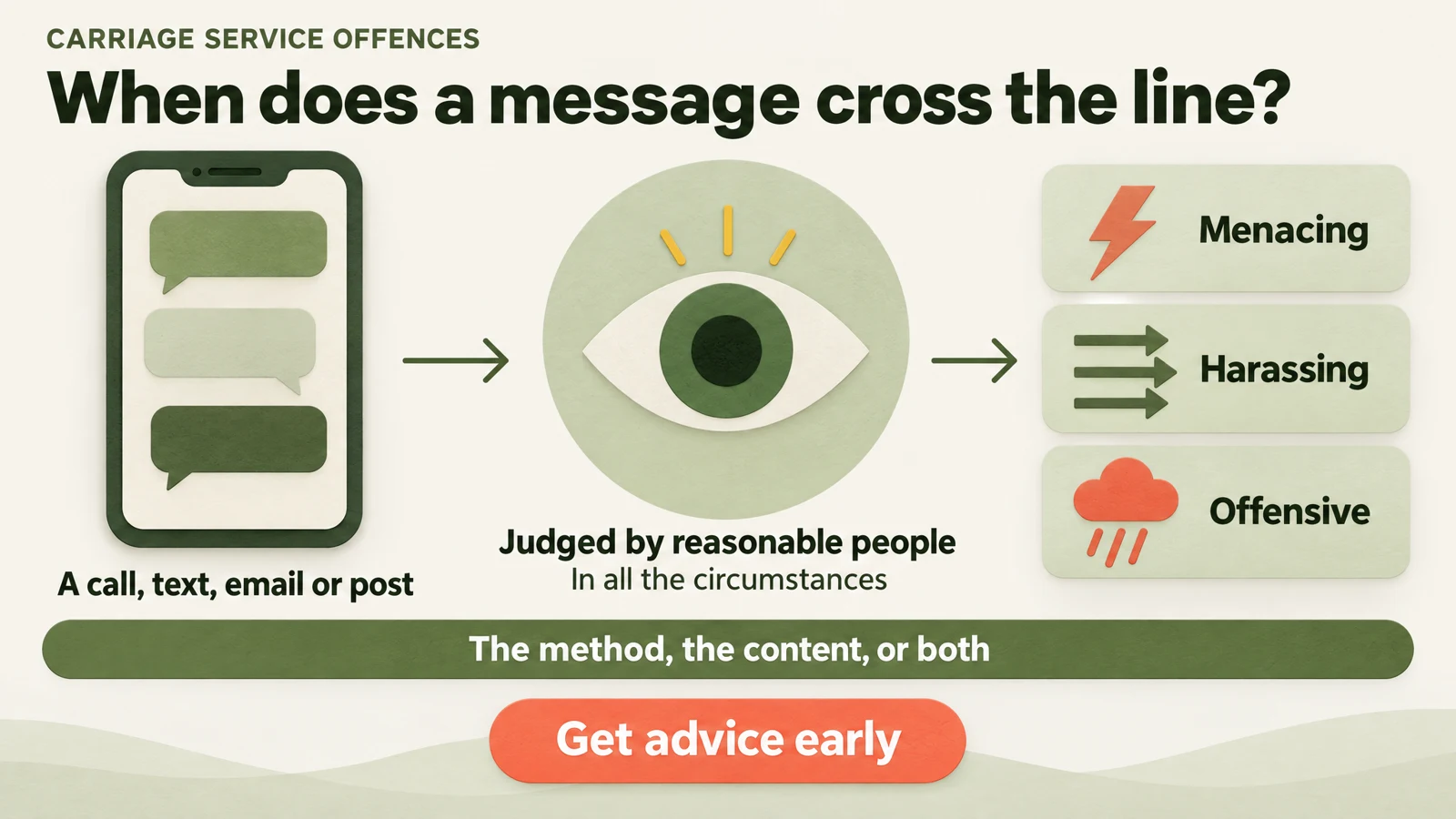
- You used it in a way that reasonable persons would regard as being, in all the circumstances, menacing, harassing or offensive. The problem can be the method (dozens of calls in an hour), the content, or both.
It must also prove the required state of mind. Under the Criminal Code’s default fault rules (s 5.6), that includes proving you meant to send the message or make the call.
The maximum penalty is 5 years’ imprisonment. It was raised from 3 years on 23 January 2022, so older guides online may still quote the lower figure.
What is a carriage service?
A carriage service is any service that carries communications by phone, internet or similar technology. In practice, this covers calls, texts, email, messaging apps, social media posts and online comments.
Once the prosecution proves you sent the message or made the post, the law presumes a carriage service was used unless you prove otherwise. So contested cases rarely turn on whether a phone or the internet was involved. They turn on who sent it and whether it crossed the line.
When does a message cross the line into a crime?
A message is criminal only if reasonable people, considering all the circumstances, would regard it as seriously menacing, harassing or offensive. The test is objective: it does not depend on how upset the recipient actually was.
The CDPP’s guidance on cyberbullying and threats describes the threshold this way:
- Offensive material must be seriously or significantly offensive, judged objectively.
- Menacing or harassing conduct requires a serious potential effect on the person receiving it, such as causing apprehension or fear for their safety.
On offensiveness, section 473.4 of the Criminal Code points to the standards of morality, decency and propriety generally accepted by reasonable adults. It also points to any literary, artistic or educational merit, and the general character of the material.
The leading High Court case, Monis v The Queen (2013), concerned the postal offence (s 471.12). Three of the Justices read it as aimed at seriously offensive material. The Court split three to three, so the appeals were dismissed and the offence stood.
Context matters. The same words can be a joke between friends or a frightening message to someone who has asked for no contact.
Common situations that lead to these charges include:
| Fact pattern | What tends to matter |
|---|---|
| Repeated calls or texts after being asked to stop | Frequency, timing, the request to stop, any existing order |
| Abusive messages during a relationship breakdown | Content, history between you, whether there were threats |
| Posts or comments about someone online | Whether it was aimed at them, how public, how serious |
| Messages to a workplace, council or call centre | Volume, threats, whether staff were targeted personally |
| Fake or anonymous accounts | Evidence linking the account to you |
What are the related carriage service offences?
Section 474.17 sits alongside several other offences, most with higher maximum penalties. Police sometimes charge more than one from the same messages.
| Offence | Criminal Code section | Maximum penalty |
|---|---|---|
| Menace, harass or cause offence | s 474.17 | 5 years |
| Threat to cause serious harm (must intend the person to fear it will be carried out) | s 474.15(2) | 7 years |
| Threat to kill (same intent requirement) | s 474.15(1) | 10 years |
| Hoax threat about an explosive or dangerous substance | s 474.16 | 10 years |
| Transmitting sexual material of an adult without consent, including deepfakes | s 474.17A | 6 years |
| Aggravated sexual material offence (created or altered it, or 3+ prior civil penalty orders) | s 474.17AA | 7 years |
| Publishing someone’s personal data in a menacing or harassing way (“doxxing”) | s 474.17C | 6 years |
| Doxxing members of a group because of race, religion, sex or another listed attribute | s 474.17D | 7 years |
For the threat offences, the prosecution does not have to prove the person actually felt afraid. The doxxing offences have only applied since 11 December 2024.
Sharing intimate images is also an offence under NSW law, covered in our fact sheet on revenge porn and image-based abuse in NSW. Where the messages are part of a wider pattern of contact, police may also or instead charge stalking or intimidation under NSW law. Our separate guide to stalking and intimidation charges in NSW explains that offence.
The eSafety Commissioner also runs a separate civil scheme under the Online Safety Act 2021 (Cth) that can require posts to be taken down.
Who prosecutes, and which court hears the charge?
Under Commonwealth prosecution policy, the Commonwealth Director of Public Prosecutions (CDPP) ordinarily prosecutes these charges, even when NSW Police laid them. In NSW they are often finalised in the Local Court.
Who charges you. The Australian Federal Police or NSW Police can lay the charge, and under the Prosecution Policy of the Commonwealth the CDPP ordinarily carries on or takes over state police prosecutions. Where you also face NSW charges from the same events, the matter may stay with NSW prosecutors.
NSW procedure applies. Section 68 of the Judiciary Act 1903 (Cth) means arrest, bail, court procedure and appeals follow the NSW rules.
Which court. Because the maximum is more than 12 months, s 474.17 is technically an indictable offence. It can be finalised in the Local Court only if both the prosecution and you consent.
The Judicial Commission’s Local Court Bench Book gives s 474.17 as an example of a charge often seen in the Local Court, where getting that consent is particularly important. Consent has to be given before the hearing of evidence begins.
| Where it’s heard | Maximum for s 474.17 |
|---|---|
| Local Court (with consent) | 12 months’ imprisonment and/or a fine of 60 penalty units |
| District Court (on indictment) | 5 years’ imprisonment |
A Commonwealth penalty unit is $364 for offences committed on or after 1 July 2026, so 60 penalty units is $21,840. A lower figure applies to earlier conduct.
What penalty could you realistically face?
Imprisonment is the last resort for a federal offence, and the court has a full range of options short of custody, including outcomes with no conviction. The result depends heavily on the content, the number of messages, any threats or existing orders, and your circumstances.
Federal sentencing follows Part IB of the Crimes Act 1914 (Cth). Under s 16A the court weighs the nature of the offence and its effect on the person who received the messages. It also weighs whether and how early you pleaded guilty, your contrition, character, health and prospects of rehabilitation, and the effect on your family.
A court must not impose imprisonment unless it is satisfied that no other sentence is appropriate (s 17A). The options, from least to most serious, include:
| Outcome | Crimes Act section | Conviction recorded? |
|---|---|---|
| Charge dismissed after being found proved | s 19B(1)(c) | No |
| Discharge on a good behaviour bond (up to 3 years) | s 19B(1)(d) | No |
| Conviction and release on a good behaviour bond (up to 5 years) | s 20(1)(a) | Yes |
| Fine | ss 4B, 4J | Yes |
| Community correction order or intensive correction order | s 20AB | Yes |
| Imprisonment | s 17A applies | Yes |
Section 19B is the federal counterpart of a NSW section 10 dismissal. It works in a similar way, but the grounds are narrower: your character, antecedents, age, health or mental condition, how trivial the offence was, or extenuating circumstances.
Your rights and what you can do now
You have the right to stay silent and to get legal advice before deciding whether to be interviewed. The most useful thing you can do right now is avoid adding to the evidence.
Your rights:
- The right to silence. Beyond your name and address, you do not have to answer police questions about the messages.
- The right to a lawyer. You can ask to speak to a lawyer before any interview.
- The presumption of innocence. The prosecution has to prove every element. You do not have to prove anything.
- Limits on phone searches. Police powers to search or seize a phone have limits, which our guide to police search powers and mobile phones in NSW explains.
Practical steps:
- Stop all contact with the person, directly, through friends or through other accounts. Further messages can become further charges.
- Do not delete messages, accounts or posts. Save the whole conversation, including their messages to you, because the full thread may contain context that helps you.
- Follow any bail conditions or apprehended violence order to the letter. Police can apply for an apprehended violence order to protect the person who received the messages, and a breach is a separate offence.
- Get advice before your first court date. Consent to the Local Court dealing with the charge has to be given before any evidence is heard, and how to plead is decided early.
How a lawyer could help your carriage service case
A lawyer’s job is to test whether the prosecution can prove every element. If you accept responsibility, it is to present your circumstances so the outcome is as light as the law allows.
Challenging whether the messages crossed the line. A lawyer may argue that, read in context, the messages were rude or hurtful but not seriously offensive, menacing or harassing.
Challenging identification. Shared phones, shared logins, fake accounts and bare screenshots can make it hard to prove who sent a message.
Testing the threat offences. For s 474.15, the prosecution must prove you intended the person to fear the threat would be carried out. Words said in anger, or plainly not meant literally, may not meet that test, and a lawyer may negotiate the charge down to s 474.17.
Making representations to the prosecution. The CDPP should only continue where there is a reasonable prospect of conviction and it is in the public interest. A lawyer may seek withdrawal or a less serious charge.
Arguing for a non-conviction outcome. Where the charge is proved, a lawyer can gather references, evidence of counselling or treatment and other material to support a s 19B order. Where a mental illness or intellectual disability is involved, the Local Court may be able to dismiss the charge under s 20BQ, including on treatment conditions.
No lawyer can promise a particular result, but early advice means the right arguments are found before key decisions are made.
Frequently asked questions
Is using a carriage service to menace a federal offence?
Yes. It is a Commonwealth offence under s 474.17 of the Criminal Code (Cth), so federal sentencing rules apply. In NSW, though, the charge is heard in the state courts under NSW procedure.
Can I go to jail for a first offence?
It is possible, but far from automatic. Federal law requires a court to consider every other option first, and outcomes without a conviction are available. Threats, a large volume of messages, or breaching an existing order all increase the risk.
Can I be charged over a single message?
Yes. One message can be enough if reasonable people would regard it as seriously menacing, harassing or offensive in the circumstances. In practice, many charges involve a pattern of messages or calls.
Can the person I messaged drop the charges?
No. Once you are charged, the decision belongs to the prosecution, not the person who complained. Under the CDPP’s prosecution policy, their views may be taken into account where appropriate.
What is the difference between this offence and stalking or intimidation?
They are different laws that often cover the same facts. Section 474.17 is a federal offence about how a carriage service is used. Stalking or intimidation is a NSW offence: stalking or intimidating someone intending (or knowing it is likely) to make them fear physical or mental harm, in person or online.
Will a section 19B order stay on my record?
It may still count for some purposes. Under s 19B no conviction is recorded, but the Commonwealth spent convictions scheme treats a finding of guilt with a discharge as a conviction until a waiting period passes.
The waiting period is 10 years, or 5 years if you were dealt with as a minor. How that affects a particular check depends on the check, so get advice.
How O’Brien Criminal & Civil Solicitors can help
Carriage service charges often begin with a phone seizure or a call from police. O’Brien Criminal & Civil Solicitors is a criminal defence firm led by an Accredited Specialist in Criminal Law (fewer than 6% of NSW lawyers hold any Law Society specialist accreditation). We have defended clients charged with carriage service, stalking and intimidation offences.
We can advise you before any police interview, test whether the messages meet the legal threshold, and deal with the prosecution about the charges. Where the facts allow, we will put the strongest case for an outcome without a conviction, and you can learn more about how our domestic violence lawyers defend these matters.
Request initial advice (no-obligation) via the form below or call us on (02) 9261 4281.
This content is for general information purposes only and does not constitute legal advice. You should seek independent legal advice relevant to your specific circumstances.