

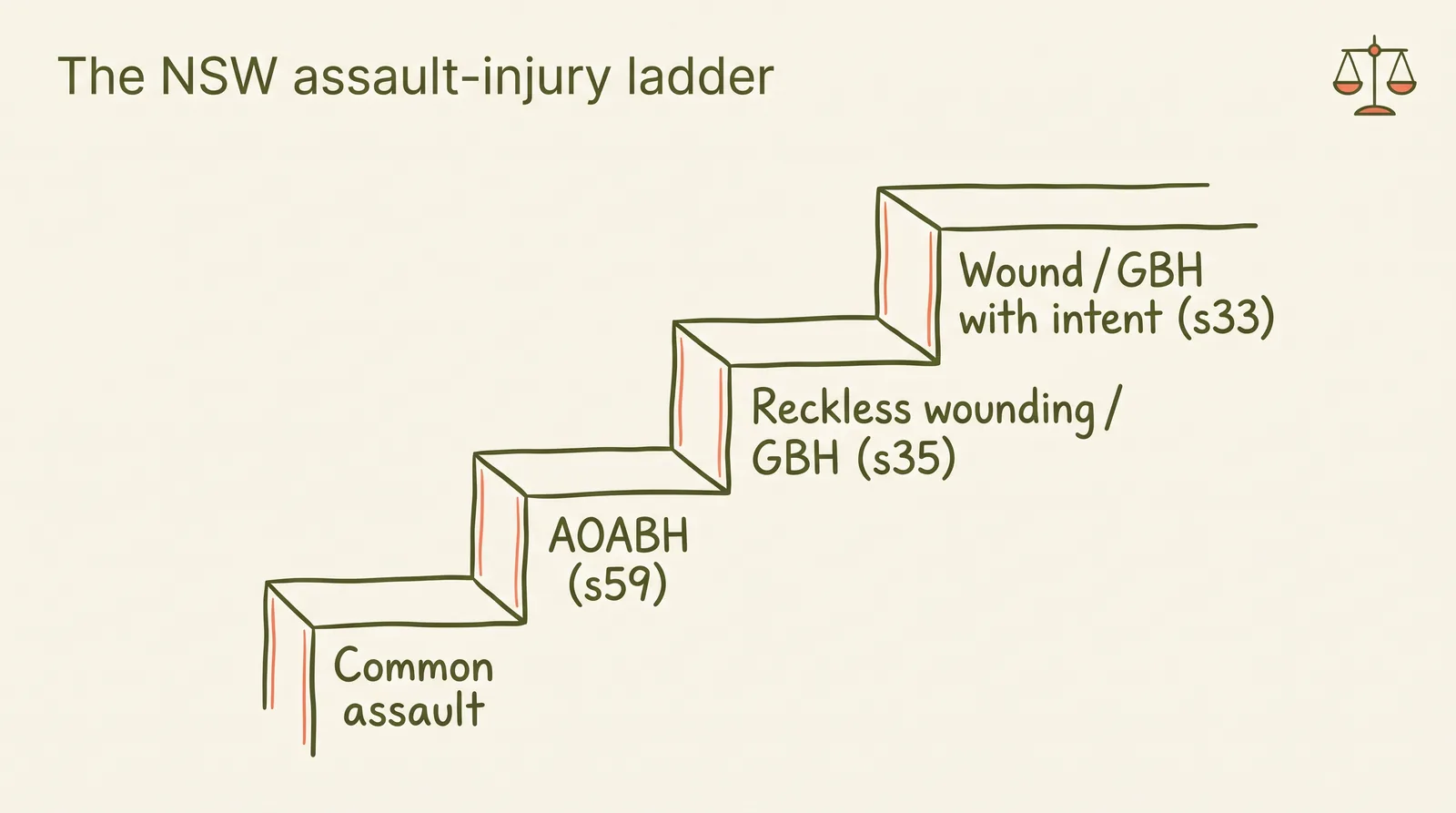
If you have been charged with an assault that caused an injury, the first thing to understand is that “assault” is not one charge. NSW law sorts these matters into a hierarchy, and where your charge sits on that ladder changes almost everything, including the maximum penalty, which court hears it, and how a court is likely to approach sentencing.
It’s easy to assume the worst. However, the label on the charge sheet is only the starting point. What actually happened, how serious the injury was, and whether the prosecution can prove intent all shape where a case lands. There is usually more room to move than people expect.
This guide explains, in plain English, the assault-injury offences above common assault: assault occasioning actual bodily harm (AOABH), reckless wounding and reckless grievous bodily harm, and wounding or GBH with intent.
At a glance
- The hierarchy (least to most serious): common assault → assault occasioning actual bodily harm (s 59) → reckless wounding / reckless GBH (s 35) → wounding or GBH with intent (s 33).
- What decides the charge: how serious the injury is, and the accused’s state of mind (was there intent, or only recklessness?).
- Maximum penalties range widely: from 5 years (AOABH) up to 25 years (wounding/GBH with intent).
- The one thing to do now: say nothing to police beyond your identifying details, and speak to a criminal lawyer before any interview.
This page focuses on the injury offences. If your matter is a common assault (an assault with no lasting injury) or involves an AVO, see our fact sheet on common assault and AVO charges in NSW.
How is “assault causing injury” different from common assault?
The dividing line is injury. Common assault covers threats and contact that leaves no real harm; the injury offences begin the moment an assault causes actual damage to the body.
A common assault under section 61 of the Crimes Act 1900 (NSW) is an assault that causes no injury, or no injury beyond something trivial. It includes things like a shove, a slap that leaves nothing, or even a threat that makes someone fear immediate violence. Its maximum penalty is 2 years’ imprisonment.
Once an assault causes a genuine injury, the charge steps up. From there, two questions decide which offence applies:
- How serious is the injury? Actual bodily harm is the lowest rung; wounding and grievous bodily harm are more serious.
- What was the accused’s state of mind? An injury caused recklessly is treated far less severely than one caused with intent to cause it.
Those two dials, severity of injury and state of mind, run right through everything below.
What do “Actual Bodily Harm”, “Wounding” and “Grievous Bodily Harm” mean?
These three terms are the building blocks of the whole hierarchy, and they are more precise than they sound.
Actual bodily harm (ABH) is any hurt or injury that interferes with a person’s health or comfort. However, it must be “more than merely transient or trifling” (the test drawn from McIntyre v R (2009) 198 A Crim R 549). Bruising, scratches, or minor lacerations can qualify. ABH can also include recognised psychological injury that is more than mere emotional upset, not just physical harm.
Wounding has a specific legal meaning: the breaking of both layers of the skin. Them being the outer layer (the epidermis) and the layer beneath it (the dermis). A cut that goes right through the skin is a wound; a graze or bruise is not. A wound does not have to be deep or permanent to count.
Grievous bodily harm (GBH) is “really serious” bodily injury (from DPP v Smith [1961] AC 290). Examples include Broken bones, serious internal injuries, and lasting disfigurement.
Section 4 of the Crimes Act also spells out that GBH includes the destruction of a foetus (other than in the course of a medical procedure or a lawful termination), any permanent or serious disfiguring, and the deliberate transmission of a grievous bodily disease.
The key contrast: wounding is about the skin being broken; GBH is about how serious the injury is. A single deep cut can be a wound; a shattered eye socket, even with no broken skin, can be GBH.
The assault-injury offences and their maximum penalties
The table below sets out the injury offences above common assault, in order of seriousness. The standard non-parole period (SNPP) is a reference point that guides the minimum time a court has in mind for a mid-range example of the offence. It is a guidepost, not a mandatory minimum, and the actual sentence turns on the facts.
| Offence | Section | Maximum penalty | Standard non-parole period | Assault occasioning actual bodily harm (AOABH) | s 59(1) | 5 years | — | AOABH in company | s 59(2) | 7 years | — | Reckless wounding | s 35(4) | 7 years | 3 years | Reckless wounding in company | s 35(3) | 10 years | 4 years | Reckless grievous bodily harm | s 35(2) | 10 years | 4 years | Reckless GBH in company | s 35(1) | 14 years | 5 years | Wounding or GBH with intent | s 33 | 25 years | 7 years |
Source: NSW Judicial Commission Sentencing Bench Book and the ODPP. Maximum penalties are imprisonment terms and represent the worst-case ceiling, not the usual outcome.
A maximum is exactly that, the top of the range, reserved for the most serious version of the offence. Most real cases sit well below it, as the sections below explain.
Assault occasioning Actual Bodily Harm (AOABH): Section 59
AOABH is an assault that causes actual bodily harm. It carries a maximum of 5 years’ imprisonment, or 7 years if committed in company under s 59.
To prove AOABH, the prosecution must establish that there was an assault (intentional or reckless contact, or the threat of it) and that the assault caused actual bodily harm.
Notably, the prosecution does not have to prove the accused intended the injury, only that they intended the assault. The injury itself can be an unintended consequence.
AOABH is a Table 2 indictable offence so is usually dealt with in the Local Court before a magistrate. Here the maximum penalty is capped at 2 years’ imprisonment. In more serious cases, the prosecution can ask to have it heard in the District Court, where the full 5-year (or 7-year) maximum is available.
As the injury threshold is relatively low, AOABH is one of the most commonly laid injury offences. It’s also one where the range of outcomes is unusually wide, from a section 10 non-conviction order at the lower end through to full-time custody at the higher end.
Reckless Wounding and Reckless Grievous Bodily Harm: Section 35
Section 35 covers wounds and grievous bodily harm caused recklessly rather than deliberately. It sits between AOABH and the most serious “with intent” offence.
“Reckless” here has a precise meaning: the prosecution must prove the accused foresaw the possibility that some physical harm might result from their actions and went ahead anyway. It is not enough that harm was foreseeable to a reasonable person, the accused must have known the risk.
Section 35 creates four offences, escalating by the seriousness of the injury and whether it was committed in company:
| s 35 offence | Injury | In company? | Maximum | s 35(4) | Wounding | No | 7 years | s 35(3) | Wounding | Yes | 10 years | s 35(2) | Grievous bodily harm | No | 10 years | s 35(1) | Grievous bodily harm | Yes | 14 years |
These are Table 1 indictable offences. They can be dealt with in the Local Court (where the 2-year cap applies). Either the prosecution or the accused can elect to have the matter heard in the District Court, a decision with real strategic consequences that should only be made with criminal legal advice.
For a real-world sense of how these matters can resolve, note that s 35 charges are frequently defended on the basis that recklessness cannot be proven, or that self-defence applies.
Wounding or Grievous Bodily Harm With Intent: Section 33
Section 33, the most serious of the assault-injury offences, is when someone causes a wound or grievous bodily harm with the intention to do so. It carries a maximum of 25 years’ imprisonment and a standard non-parole period of 7 years under s 33.
The big difference from section 35 is the mental element. For s 33, the prosecution must prove the accused intended to cause the wound or grievous bodily harm, not just that they were reckless about it. That intention is what separates a case with a 10-year ceiling from one with a 25-year ceiling. If there was intent or not is so often the central battleground in these cases.
Section 33 is a strictly indictable offence. It cannot be dealt with in the Local Court and must proceed in the District Court (or Supreme Court), before a judge and jury.
Where the evidence of intent is weak, a common outcome is that a s33 charge is reduced to a s 35 (reckless) charge, lowering the maximum penalty a person faces.
What Does “In Company” Mean, and why does it increase the penalty?
“In company” means the offence was committed with one or more other people present, sharing a common purpose. It is an aggravating feature that raises the maximum penalty.
The law treats group violence more seriously because being outnumbered is frightening and dangerous for the victim, and because the presence of others can embolden an attacker. You do not personally have to strike the blow to be “in company”, being part of a group acting together can be enough.
Other factors that tend to aggravate an assault-injury charge at sentencing include the use of a weapon, an attack on a vulnerable victim, a gratuitous or prolonged assault, and offending while on bail or with a relevant record.
What penalties do these offences carry in practice?
The maximum penalties for these offences are alarming. However, they are not common, with sentences varying depending on facts. A court weighs the seriousness of the offence against everything known about the person before it.
For the lower-tier offences, particularly AOABH, a full range of outcomes is available.
Depending on the circumstances, a court may impose anything from a section 10 non-conviction order or a conditional release order, through to a fine, a community correction order, an intensive correction order (a prison sentence served in the community), or full-time imprisonment.
Non-custodial outcomes are genuinely achievable for AOABH where the offending is at the lower end and the personal circumstances are strong.
As the injury and the offender’s culpability climb the ladder, to reckless GBH and, above all, to wounding or GBH with intent, the likelihood of full-time imprisonment rises steeply. At that end of the scale, the standard non-parole periods in the table above come into play as guideposts.
Sentencing statistics kept by the NSW Judicial Commission show a broad spread of outcomes across all of these offences, which is why the material a court is given about the offence and the offender matters so much.
At sentencing, the court balances factors on both sides:
| Tends to increase the sentence | Tends to reduce the sentence | A weapon was used | The offending was spontaneous, not planned | The victim was vulnerable | Genuine remorse and good rehabilitation prospects | Committed in company | An early guilty plea (a discount of up to 25%) | A relevant prior record | A strong subjective case, no record, mental health, background | A gratuitous or prolonged attack | Provocation or a genuine but flawed belief in self-defence |
What defences apply to an assault-injury charge?
Several defences can lead to a full acquittal or less serious penalty, including:
- Self-defence. Under Part 11 of the Crimes Act (ss 418–423), you are not criminally responsible if you believed your conduct was necessary to defend yourself or another person, and your response was reasonable in the circumstances as you saw them. Self-defence is a complete defence, if the prosecution cannot disprove it beyond reasonable doubt, you must be acquitted. (For how self-defence works in the context of a common assault, see our common assault and AVO fact sheet.)
- No intent (for a s 33 charge). If the prosecution cannot prove you intended to cause the wound or GBH, a s 33 charge should not succeed. Then, the matter may instead be reduced to a reckless offence under s 35, with a far lower maximum.
- No recklessness (for a s 35 charge). If it cannot be shown that you actually foresaw the possibility of harm, recklessness is not made out.
- Causation. The prosecution must prove your act actually caused the injury. Where an injury resulted from something else, a pre-existing condition, an intervening event, or another person’s actions, causation can be challenged.
- Duress or necessity. Being compelled to act by a serious threat can be a defence.
- Identification. Where the case turns on who did what, mistaken or unreliable identification can be a powerful line of defence.
Your rights & what you can do now
What you do in the hours and days after being charged with an assault causing injury can shape the entire case. These practical steps genuinely strengthen your position:
- Use your right to silence. Beyond giving police your name and address, you are not obliged to answer questions or give an account of what happened. Explanations offered without legal advice are one of the most common ways people unintentionally damage their own case. Politely say you wish to speak to a lawyer first.
- Ask for a lawyer before any interview. You are entitled to legal advice before a police interview. A short call before you speak can change everything that follows.
- Preserve the evidence. Keep phones, messages, clothing, and anything else exactly as they are. If there is CCTV nearby, note where footage can be overwritten within days.
- Write down your account while it’s fresh, for your lawyer only. A private, dated note of what happened, and of any injuries you sustained, helps preserve detail. Photograph your own injuries if you were defending yourself.
- Identify witnesses. Names and contact details of anyone who saw the incident can matter months later.
- Stay off social media. Do not post about the incident or discuss it with anyone other than your lawyer. Messages and posts are routinely used as evidence.
The single most valuable step is getting experienced representation involved early, before the interview, before bail, and before decisions are made that are hard to undo.
How a Criminal Lawyer can help your case
In an assault-injury matter, the right preparation can change the outcome at several stages. Depending on the facts, a criminal defence lawyer may be able to:
- Argue the charge is wrong or too high. Where intent cannot be proven, push to have a s 33 charge reduced to a reckless s 35 charge, or a s 35 charge reduced to AOABH, cutting the maximum penalty a person faces.
- Run a complete defence. Where the evidence supports it, argue self-defence, challenge causation, or contest identification to seek an acquittal.
- Negotiate with the prosecution. Representations to police or the DPP can, in some cases, lead to a charge being withdrawn, downgraded, or the facts being amended to something less serious.
- Elect the right court. Advise on whether to keep a Table 1 or Table 2 matter in the Local Court (with its 2-year cap) or take it to the District Court, a decision with significant consequences.
- Build the strongest sentence case. Where a plea is appropriate, assemble the references, reports, and evidence of rehabilitation that can move an outcome from custody towards a community-based order or a non-conviction order.
None of these outcomes can be promised, every case turns on its own facts, but the difference the right preparation makes is real.
Frequently Asked Questions
What is the difference between actual bodily harm and grievous bodily harm?
Severity. Actual bodily harm (ABH) is an injury that is more than bruising, scratches, or minor cuts. Grievous bodily harm (GBH) is a really serious injury, such as a broken bone, a serious internal injury, or permanent disfigurement. The more serious the injury, the higher up the offence hierarchy the charge sits, and the greater the maximum penalty.
What is the difference between reckless and intentional wounding or GBH?
State of mind. For a section 35 (reckless) offence, the prosecution only has to prove you foresaw that some harm might result and went ahead anyway. For a section 33 (with intent) offence, it must prove you actually intended to cause the wound or serious injury. Intent is the difference between a maximum of 10 years and a maximum of 25 years, which is why it is so often the key issue in these cases.
Is assault occasioning actual bodily harm a serious charge?
Yes, but its outcomes vary widely. AOABH is an indictable offence carrying up to 5 years’ imprisonment (7 if committed in company). However, it is usually dealt with in the Local Court, where the maximum is capped at 2 years, and a full range of outcomes is genuinely available, including non-conviction and community-based orders where the circumstances support them.
Will I go to jail for AOABH or reckless wounding?
Not necessarily. Imprisonment is one possible outcome, but for the lower-tier offences, particularly AOABH, courts regularly impose non-custodial penalties such as conditional release orders, community correction orders, or non-conviction orders, especially for a first offence with strong personal circumstances. As the seriousness of the injury and the culpability increase, the likelihood of full-time custody rises. Every case is decided on its own facts.
What does “in company” mean in an assault charge?
It means the offence was committed with one or more other people present, sharing a common purpose. It is an aggravating feature that increases the maximum penalty. For example, AOABH rises from a 5-year to a 7-year maximum when committed in company. You do not have to personally strike the blow; participating as part of a group can be enough.
Can I claim self-defence to an assault-injury charge?
Yes, where the evidence supports it. Under the Crimes Act, if you believed your actions were necessary to defend yourself or someone else, and your response was reasonable in the circumstances as you perceived them, self-defence is a complete defence. Once it is raised, the prosecution must disprove it beyond reasonable doubt, if it cannot, you are entitled to be acquitted.
Can an assault-injury charge be reduced to a lesser charge?
Often, yes. Where intent cannot be proven, a section 33 charge may be reduced to a reckless section 35 charge; a section 35 charge may in turn be reduced to AOABH; and negotiations with the prosecution can sometimes result in a charge being withdrawn or the agreed facts being amended. These are strategic decisions that should be made with legal advice.
How O’Brien Criminal & Civil Solicitors Can Help
Assault-injury charges depend on distinctions, the seriousness of the injury, and whether the prosecution can prove intent rather than recklessness. Getting those distinctions argued correctly can be the difference between a downgraded charge and the full weight of a s 33 conviction.
O’Brien Criminal & Civil Solicitors is a dedicated criminal defence firm with more than 20 years defending assault and violent-offence matters.
The earlier we’re involved, the more we can do, from the first police contact, through charge negotiation, to sentencing. Speak with us before your next police interview: it’s confidential, there’s no obligation, and it costs you nothing to find out where you stand.
Request initial advice (no-obligation) via the form below or call us on (02) 9261 4281.