
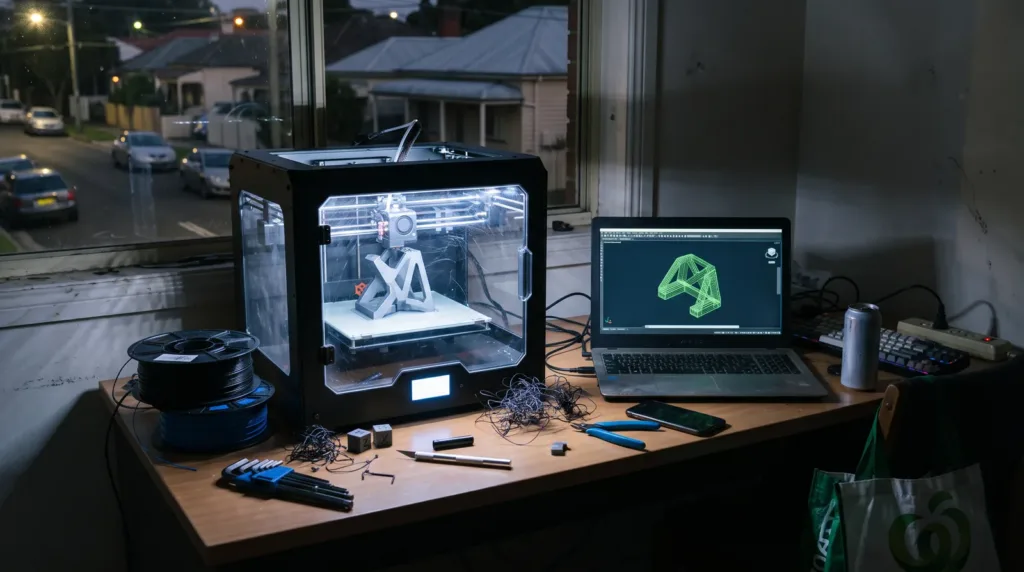
Charges related to 3D printers or printed firearm components are serious criminal matters.
Despite the technology being new, NSW law treats 3D-printed firearms, also known as ‘ghost guns’ or privately manufactured firearms, the same as any other illegal, lethal firearm. Furthermore, the law also criminalises the digital files before a firearm is ever printed.
This guide explains what the law actually says: what counts as manufacturing, when possessing a digital blueprint is a crime, the real penalties, how these cases typically come to police attention, and what a solicitor can do for you at each stage.
You have rights at every stage of the criminal process, from the moment police first make contact with you, right through to sentencing.
This is a growing area of focus for law enforcement across NSW and the wider nation, as government agencies respond to how accessible the technology has become.
At a glance
- Manufacturing a firearm without a licence: up to 10 years’ imprisonment (up to 20 years if the firearm is a pistol or a prohibited firearm), under Firearms Act 1996 (NSW) s 50A.
- Possessing a digital blueprint to 3D print a firearm: up to 14 years, under Firearms Act 1996 (NSW) s 51F.
- Possessing the finished prohibited firearm: up to 14 years (4-year standard non-parole period), rising to 20 years if aggravating factors apply, such as the firearm being loaded (s 7(1) and s 7A).
- These matters are prosecuted in the NSW District Court (indictable offences of this seriousness are rarely dealt with summarily in the Local Court).
- The to do now: do not say anything to the police, beyond your name and address. Get a solicitor involved before any interview, forensic download, or further contact.
Is It Illegal to 3D Print a Gun in NSW?
Yes. Manufacturing any firearm, including a 3D printed one, without a licence and the relevant manufacturing authorisation is a criminal offence under the Firearms Act 1996 (NSW), which applies across New South Wales, from Sydney to regional communities such as the Blue Mountains region.
In particular, section 50A says it is an offence to manufacture a firearm without authority. “Manufacture” is defined broadly, including:
- Assembling or constructing a complete firearm
- Producing firearm parts or components (a barrel, receiver, or frame) capable of being fitted to a firearm
- Modifying an object so that it functions as a firearm
- Altering an existing firearm
A 3D printer or electronic milling machine falls within this definition just as a lathe or a workshop does. The method is different, but the law isn’t. It also doesn’t matter whether the print job succeeded or produced only partial, non-functional components. Courts treat partially printed parts as evidence of an intention to manufacture, which is enough to build a charge.
Separately, once any firearm meets the definition of a prohibited firearm or a pistol under the Act, no civilian can lawfully hold it. Therefore, this means most 3D printed firearms attract two layers of criminal exposure: the manufacturing offence itself, and a separate possession offence for whatever was produced.
What Are the Penalties for 3D Printed Firearm Offences?
Penalties depend on exactly what you’re alleged to have done: manufactured a firearm, possessed the finished item, or possessed the digital file used to make it.
The table below sets out the maximum penalties under the Firearms Act 1996 (NSW). Actual sentences are usually well below the maximum penalties, as the case examples further down show.
| Offence | Section | Maximum penalty |
|---|---|---|
| Manufacturing a firearm without authority (general) | s 50A(1) | 10 years |
| Manufacturing a pistol or prohibited firearm without authority | s 50A(2) | 20 years |
| Unauthorised possession of a pistol or prohibited firearm | s 7(1) | 14 years |
| Aggravated unauthorised possession (e.g. loaded, with ammunition, multiple firearms, in company) | s 7A | 20 years |
| Possessing a digital blueprint to manufacture a firearm on a 3D printer or electronic milling machine | s 51F | 14 years |
How these interact:
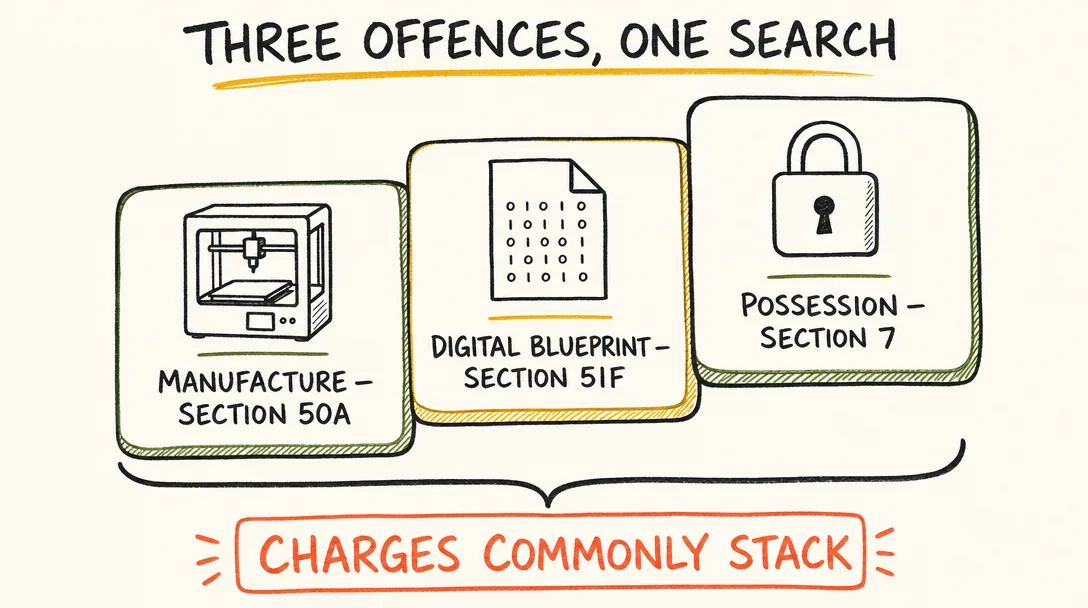
- Charges commonly stack. Someone found with a 3D printer, printed components, and the design files on their laptop can face manufacturing, possession, and blueprint charges. Sentencing then turns heavily on totality, meaning how the court accounts for overlapping conduct. That’s squarely a matter for legal argument, not something to leave unaddressed.
- The maximum is not the likely outcome. Courts look at the whole picture: whether the firearm was functional, whether there was any evidence of an intention to sell or use it unlawfully, prior record, and personal circumstances. The real Australian cases below illustrate how differently these facts can play out.
- “Prohibited firearm” is a defined, technical category, not just any firearm someone dislikes the look of. Whether a specific printed item actually meets that definition, as opposed to being an inert model or a non-functional prop, is a question a solicitor can properly test. It can make or break a possession charge.
What Counts as a “Digital Blueprint”, and Is Just Having One a Crime?
Yes, possessing a digital blueprint for 3D printing a firearm is its own standalone offence. This offence is separate from actually printing or possessing a physical firearm.
Section 51F of the Firearms Act 1996 (NSW) states that possessing a digital blueprint for the manufacture of a firearm on a 3D printer or an electronic milling machine, carries a maximum penalty of 14 years’ imprisonment.
A “digital blueprint” is any electronic file or detailed technical drawing in digital form, capable of being used to manufacture a firearm.
“Possession” is defined broadly. It includes files on a computer, phone, USB drive, or cloud storage, and even control over a file held on someone else’s computer.
However, there is no standalone offence for ‘supplying a digital blueprint’ in the same way there is for possession. Yet, supplying or distributing a blueprint can still attract criminal liability under other firearms and weapons laws, and under Commonwealth law if the file crosses borders.
If you’re unsure where sharing, forwarding, or hosting a file leaves you, that’s a question worth putting to a solicitor directly rather than guessing.
Defences to blueprint possession
Defences require the defendant to prove (on the balance of probabilities) one of the following:
- Innocent production, dissemination or possession: you didn’t know, and couldn’t reasonably be expected to know, that you possessed the digital blueprint.
- Unsolicited receipt: the file came into your possession unsolicited and, as soon as you became aware of its nature, you took reasonable steps to get rid of it.
- Public benefit: your conduct was necessary for, or assisted in, enforcing or administering the law.
- Approved research: your conduct was necessary for scientific, medical, educational, military, or law enforcement research approved in writing by the Attorney General, and stayed within the conditions of that approval.
Casual curiosity or “I was just looking” is not one of these defences, and courts have consistently rejected it. However, whether one of the genuine defences applies to your case, particularly innocent possession or unsolicited receipt, which turn heavily on digital forensic detail, is exactly the kind of factual argument a solicitor needs to build early. Evidence such as browser history, download timestamps, and device metadata is also still available to be properly examined.
How Do Police Detect 3D Printed Firearms and Blueprint Possession?
Most 3D printed firearm investigations start from one of a few common sources, including:
- Online monitoring. The AFP and NSW Police Firearms Registry monitor forums, file-sharing platforms, and social media for discussion of 3D printed firearms, blueprint files, or images of printed components. Accounts and IP addresses can be traced back to individuals through standard digital forensics.
- Purchase patterns. Purchases of high-capability 3D printers (particularly resin or metal printers), unusual combinations of components, or ammunition bought by someone without a firearms licence can prompt retailer reports or trigger further inquiry.
- Search warrants. Once police have reasonable grounds, a warrant lets them seize printers, printed components, computers, and storage devices. Digital forensic examiners then work to recover deleted files, establish download dates, and reconstruct a timeline of what was done and when.
- Tip-offs. A significant number of these matters begin with information from a family member, ex-partner, housemate, or acquaintance, rather than proactive policing.
If you’re aware police may already be looking into your conduct, whether a search has occurred, devices have been seized, or you’ve been asked to attend for a voluntary interview, that is the point to get a solicitor involved, not after charges are laid.
Recent Australian Cases
Real sentencing outcomes give a clearer picture than the maximum penalties alone. These matters show how much weight courts give to intent, functionality, and personal circumstances.
Gold Coast, Queensland (2021): A man was sentenced to 4 years’ imprisonment, suspended after 12 months, for manufacturing 3D printed firearm components. Police seized a 3D printer, partially printed parts, and digital blueprints. The court found that even incomplete components demonstrated an intention to manufacture a functional firearm.
Sydney, NSW (2023): A man received 6 years’ imprisonment with a 3-year non-parole period for manufacturing multiple 3D printed pistols and possessing ammunition. The sentencing reflected both the manufacturing offence and an aggravated possession charge, with the court emphasising the risk 3D printed firearms pose to the state’s firearms control regime.
Melbourne, Victoria (2022): A man convicted of possessing digital blueprints and manufacturing firearm components was sentenced to 2 years’ imprisonment, wholly suspended. He argued he had been “experimenting” with the technology and had no intention of using any firearm unlawfully. The court accepted this went to mitigation but was clear that manufacturing remains a serious offence regardless of intended use.
Past results do not guarantee future outcomes. Every case is assessed on its individual merits.
Your Rights & What You Can Do Now
If you’re facing, or believe you may soon face, a 3D printed firearm or blueprint charge, there are concrete steps that protect your position:
- You have the right to silence. Beyond confirming your name and address, you are not obliged to answer police questions, explain what was found on your devices, or account for a 3D printer’s use. Anything said in an informal conversation with police can still be used against you later.
- You don’t have to consent to an interview. If police ask you to attend “for a chat” or a formal record of interview, you can decline until you’ve obtained legal advice. This is not obstruction: it’s a right.
- Ask to see the warrant. If police execute a search warrant at your home, you’re entitled to see it and to note what it authorises them to search for and seize.
- Don’t delete anything. If you’re aware devices may be examined, deleting files after the fact can itself become evidence of consciousness of guilt, or attract separate charges for destroying evidence. Leave devices as they are and get advice first.
- Keep a record. Note dates, what was said, what was seized, and by whom. This detail is genuinely useful to a solicitor building your case later.
- Get advice before bail conditions are set. If you’re arrested, the conditions attached to bail, such as surrender of passport, reporting conditions, or non-association, are negotiable at the point they’re first proposed. It’s far easier to argue for reasonable conditions upfront than to vary them later. For the most serious matters, bail can be refused entirely rather than granted subject to conditions, so getting a solicitor involved before any bail application is critical.
How a Lawyer Could Help Your Case
3D-printed firearm and blueprint matters are technically and legally complex, and the right legal strategy depends heavily on the specific facts: what was actually found, whether it worked, and what the digital evidence shows about intent. A solicitor experienced in this area may be able to help in a number of ways, depending on your circumstances:
- Testing whether a file is genuinely a “blueprint.” Not every technical drawing or 3D model file is capable of manufacturing a functioning firearm. Whether a specific file meets the legal definition is a real, arguable question, not a formality, and it can be the difference between a s 51F charge succeeding or failing.
- Raising a statutory defence under s 51G. Innocent possession and unsolicited receipt both depend on digital forensic detail: when a file was downloaded, whether it was opened, how it arrived. A solicitor can have this evidence properly analysed rather than accepted at face value.
- Contesting manufacturing intent for incomplete components. Courts have found that partial or non-functional printed parts can still support a manufacturing charge, but the strength of that inference depends on the specific facts: how complete the parts were, what else was found, and what, if anything, was said about purpose.
- Arguing for reduced culpability at sentencing. Factors that may support a more lenient outcome include no prior criminal history, no evidence of intention to sell or use the firearm unlawfully, genuine remorse, cooperation with police, and early guilty pleas, which attract a sentencing discount. The Melbourne 2022 case above shows how significantly absence of unlawful intent can affect the outcome, even where the offending is not disputed.
- Negotiating charges and running committal arguments. Where multiple charges arise from overlapping conduct, such as manufacturing, possession, and blueprint charges from one search, there may be scope to negotiate the charges that proceed. This can materially affect both the sentencing exposure and which court hears the matter.
These are all genuine, fact-dependent avenues, not guarantees. What a lawyer can actually achieve depends entirely on the evidence in your specific matter, and no solicitor can promise a particular result. What early, properly informed legal advice can do is make sure every one of these avenues is actually tested, rather than assumed away.
As 3D printing technology spreads around the world, governments in Australia and elsewhere have moved to close the legislative gap it created, restricting access to both the physical firearm and the digital file used to make it, with some jurisdictions moving to ban certain printer types outright. NSW’s approach reflects that broader effort to close the net on privately manufactured and 3D printed weapons before they ever reach the street.
Frequently Asked Questions
Is it illegal to 3D print a gun in NSW?
Yes. Manufacturing any firearm without the relevant authority is illegal under s 50A of the Firearms Act 1996 (NSW), carrying up to 10 years’ imprisonment (up to 20 years if the firearm is a pistol or prohibited firearm). Because most 3D printed firearms also meet the definition of a prohibited firearm, simply possessing the finished item is usually a separate offence again.
Can I be charged just for downloading gun blueprints, even if I never printed anything?
Yes. Possessing a digital blueprint capable of manufacturing a firearm on a 3D printer is a standalone offence under s 51F of the Firearms Act 1996 (NSW), carrying up to 14 years’ imprisonment. It does not matter whether you ever attempted to print the firearm: possession of the file itself is the offence, subject to the statutory defences in s 51G.
What’s the actual penalty for manufacturing a 3D printed firearm? Is it really 20 years?
Twenty years is the maximum penalty, and it applies specifically where the firearm manufactured is a pistol or a prohibited firearm (s 50A(2)). Manufacturing a firearm that doesn’t fall into those categories carries a lower 10-year maximum (s 50A(1)). In practice, recent sentences in comparable Australian cases have ranged from a wholly suspended 2-year sentence to 6 years’ imprisonment with a 3-year non-parole period. Courts weigh functionality, intent, and personal circumstances heavily.
How do police find out about 3D printed firearms or blueprint possession?
Common triggers include online monitoring of forums and file-sharing sites, unusual purchase patterns (high-end 3D printers, ammunition bought by unlicensed individuals), search warrants executed on other information, digital forensic recovery of deleted files, and tip-offs from people who know the person involved. Many cases begin with information from someone in the person’s own life rather than proactive policing.
I was just experimenting and never intended to use the firearm. Does that matter?
Lack of intention to use a firearm unlawfully is not a defence to manufacturing or possession charges. Courts have consistently rejected “hobbyist” or “curiosity” arguments as a basis for acquittal. It can, however, be a significant factor at sentencing. The Melbourne 2022 case above resulted in a wholly suspended sentence partly because the court accepted there was no intention to use the firearms criminally, but the underlying offence was still made out.
Can I be charged for sharing a blueprint file with someone else?
There is no standalone NSW offence specifically for distributing or sharing a blueprint file, but that doesn’t mean sharing one is risk-free. If the person you send it to goes on to possess or use it unlawfully, you can potentially face liability as a party to their offending, and sending files across state, territory or international borders can separately engage Commonwealth firearms and customs offences. If you’re concerned about something you’ve already sent or received, get specific advice rather than assuming the absence of a named offence means there’s no exposure.
How O’Brien Criminal and Civil Solicitors Can Help
3D printed firearm and blueprint charges sit at the intersection of firearms law and digital forensic evidence, an area where the technical detail genuinely changes the outcome, not just the argument. O’Brien Criminal and Civil Solicitors is led by an Accredited Specialist in Criminal Law, an accreditation held by fewer than 6% of NSW solicitors, with over 20 years’ experience in serious firearms matters, including illegal firearm possession and firearms trafficking charges across NSW and nationally.
Acting early gives us the best opportunity to properly test the digital evidence, identify available defences, and put the right mitigating case before the court where a charge proceeds. For matters heading to trial in the District Court, our solicitor-and-barrister team approach means you have experienced advocacy at every stage.
Request initial advice (no-obligation) via the form below or call us on (02) 9261 4281.